London – The Thames through time
Introduction
This is a journey through time, looking at the prehistoric London (The Thames) through time, Landscape based on the book ‘The Post-Glacial Flooding Hypothesis’ – that contains conclusive and extended evidence of Robert John Langdon’s hypothesis, that rivers of the past were higher than today, which changes the history of not only Britain, but the world. In this extract, we look at the Case Study within the book about the Thames. (The Thames through time ).
Case Study – The Thames
The Lower Thames sequence has been thoroughly studied not only because it is one of the largest river systems in the country but also because of its fortuitous exposure in many of the quarries and recent development programmes in and around London. The Thames was diverted into its current valley during the Anglian period, where it proceeded to lay down extensive gravel deposits before reaching the sea. Archaeological interest in the Thames alluvial deposits and the raised beaches of the south-east coast is also due to the presence of significant Lower and Middle Palaeolithic artefacts and hominin remains within these deposits.
The depositional chronology of the Thames gravel terraces has not yet been universally accepted, and the two significant sequences have been proposed by Gibbard (1985) and Bridgland (1994). This is because the terraces are dated by the artefacts found within them, which are archaeologically dated and not carbon-dated. The problem with this method is that if the area flooded after the original deposits were laid down, the artefacts could have been washed down from upstream and embedded at random.
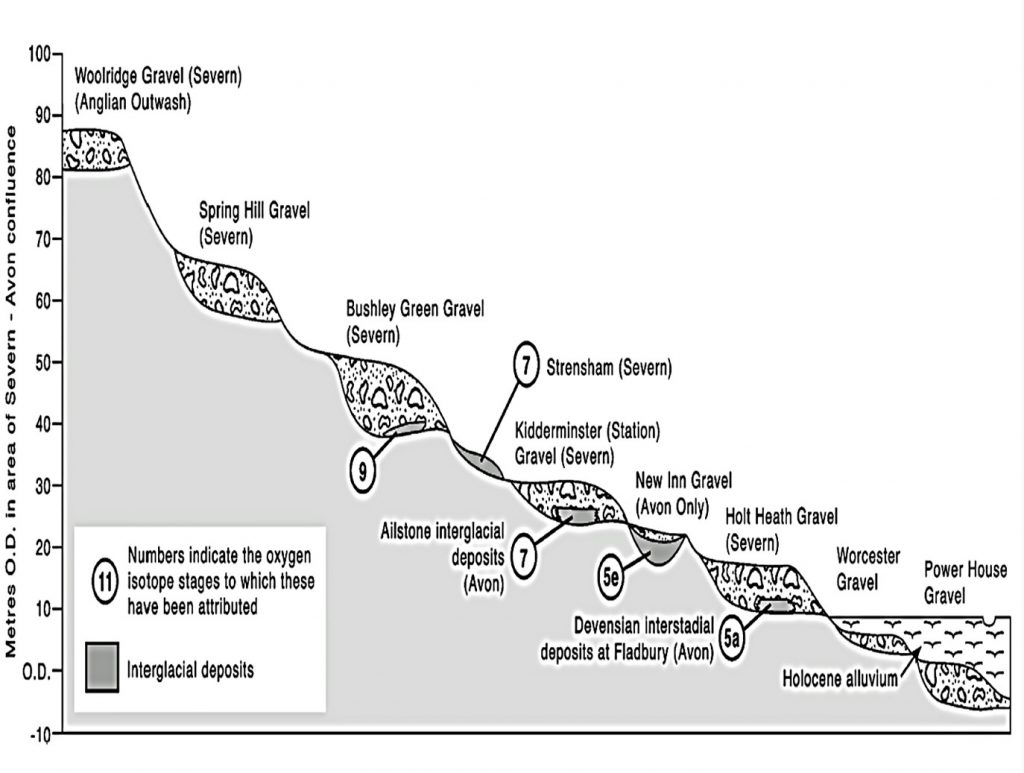
| Traditional View of the Thames River terraces |
The modern floodplain of the Lower Thames, downstream of central London, is bounded either by older Pleistocene sands or gravels at the higher levels or by bedrock. The depositional chronology of the Thames gravel terraces has not yet been universally accepted, and the two significant sequences were proposed by Gibbard (1985).
The SBAB model of floodplain evolution proposes that during the early Holocene, multi-channel braided systems stabilised as some channels narrowed and deepened, and others were progressively abandoned over the course of the Holocene (Brown et al. 1994).
The Lower Thames saw a rise of about 15m in relative sea level between c. 10,000 and c. 6000 BP (Rackham and Sidell, 2000; Sidell, 2003b). This would have had a significant effect on the settlement of the outer and mid estuary floodplain. It has been suggested, for example, that settlement areas along the river margin progressively moved to higher ground as the land below was overtaken by the rising water levels (Rackham and Sidell 2000).
During the early Holocene, the Lower Thames floodplain was a complex environment of peat-forming areas, migrating channels and raised eyots (Sidell 2003a). Often, these eyots were the focus of prehistoric occupation, for example, at Runnymede (Needham 1991; 1992), Westminster, Southwark (Bowsher 1991; Dillion et al. 1991; Merriman 1992), and Bermondsey (Sidell et al. 2002). These areas tended to lie at the junction between the higher ground on the edge of an island and the adjacent peat and alluvium, which preserved evidence of human activity that occurred when river levels were lower (Merriman 1992; Sidell et al. 2002).
The investigations carried out for the Jubilee Line extension have suggested that the sand eyots of Westminster and north Southwark did not complete their formation by the early Holocene as initially believed. Still, instead, they formed in the mid-Neolithic (c. 3500 cal B.C.). This could help explain why there is a lack of Early Neolithic occupation in the floodplain (Sidell 2003b).
An extensive number of boreholes (> 1100) have enabled the British Geological Society to map the extent of flooding in the early Holocene, as it left extensive alluvium up to 10m deep in places, showing the long duration of the raised water levels.
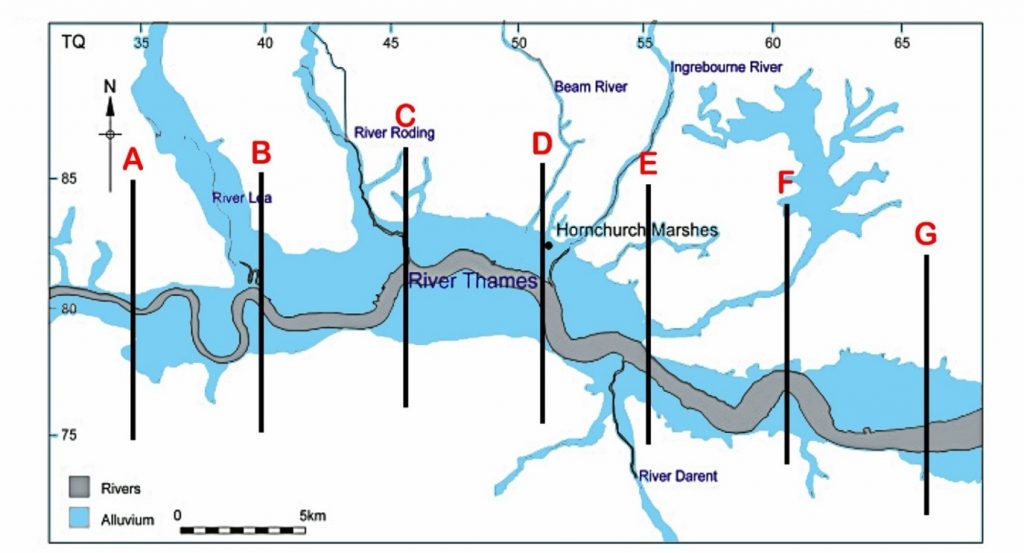
| BGS Map of London showing in blue the Alluvium deposited at the end of the LGM. We have sectioned off A- G areas to look at their cross-sections. |
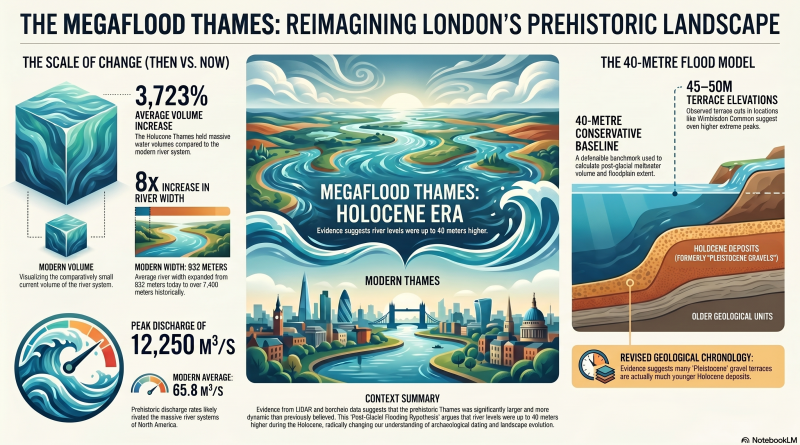
If we section off (A to G) the Thames and look at the volume and width of the Holocene Thames in comparison to today, we can get an estimation of the discharge of water at its peak during this period.
Increased discharge levels during the Holocene
| Cross- Section | Current Width | Holocene Width | Width Increase % | Volume Increase – (Holo. – Present =) Cu.m3 | Increase in Volume |
| A | 400m | 4,425m | 1,100 | 71,724 – 800 = 70,924 | 8,866% |
| B | 650m | 7,725m | 1,188 | 71,950 – 1950 = 70,000 | 3,590% |
| C | 731m | 8,450m | 1,156 | 128,430 – 2924 = 125,506 | 4,292% |
| D | 965m | 7,644m | 792 | 60,348 – 4825 = 55,523 | 1,151% |
| E | 1,207m | 11,265m | 933 | 90,122 – 7274 = 82,880 | 7,367% |
| F | 1,125m | 5,230m | 465 | 38,622 – 7875 = 30,747 | 390% |
| G | 1,448m | 7,242m | 500 | 58,902 – 11584 = 47318 | 408% |
| Average | 932m | 7426m | 797% | 3723% |
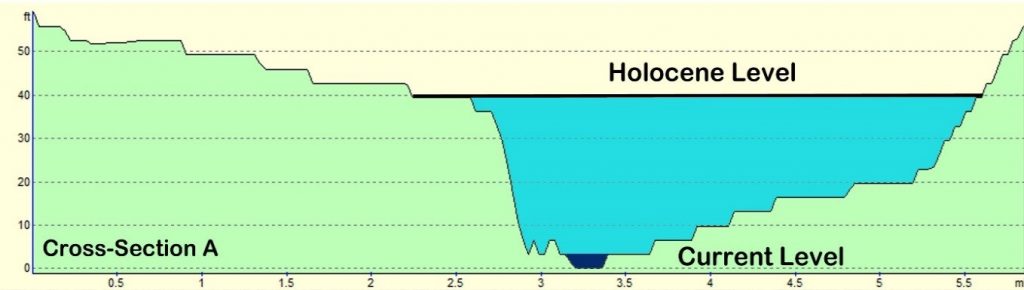
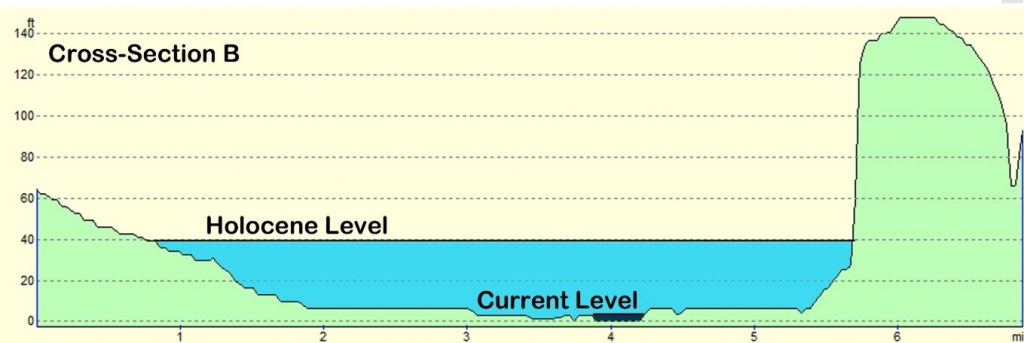
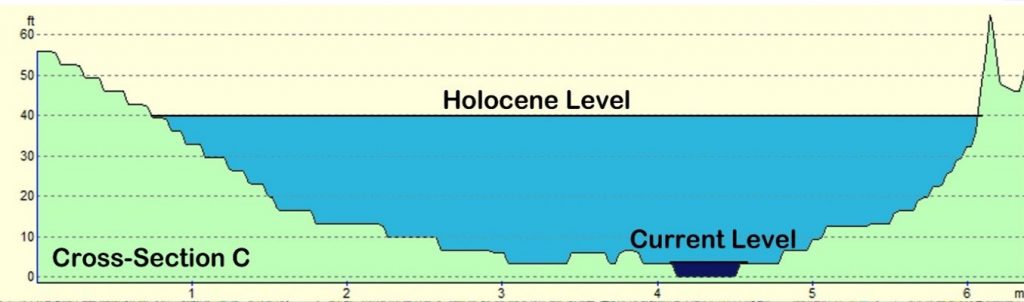
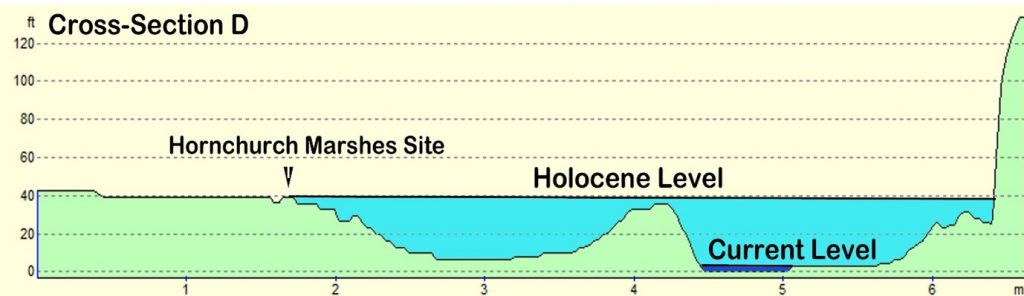
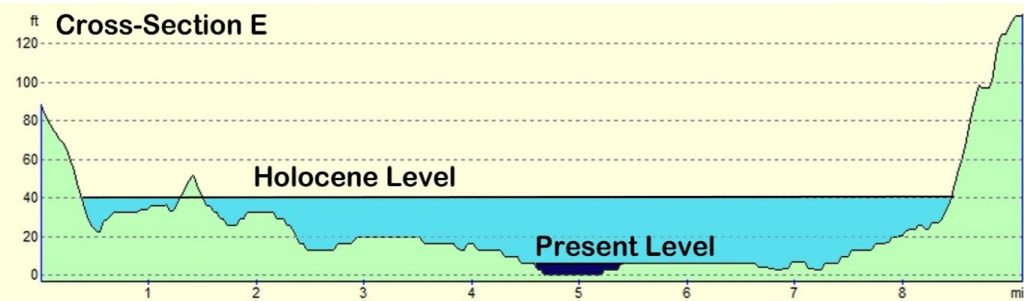
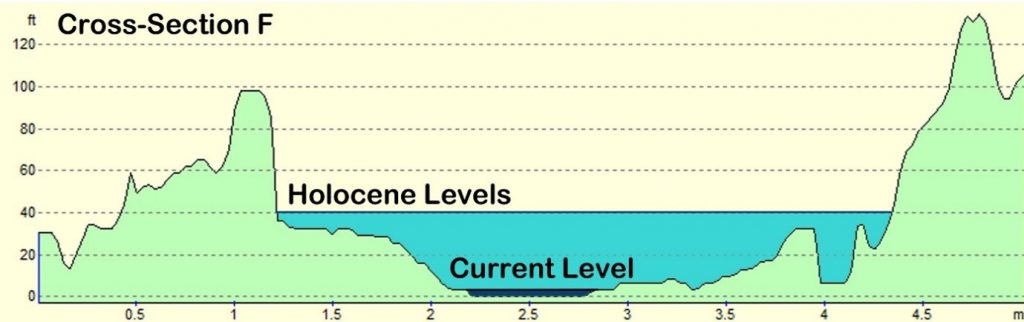
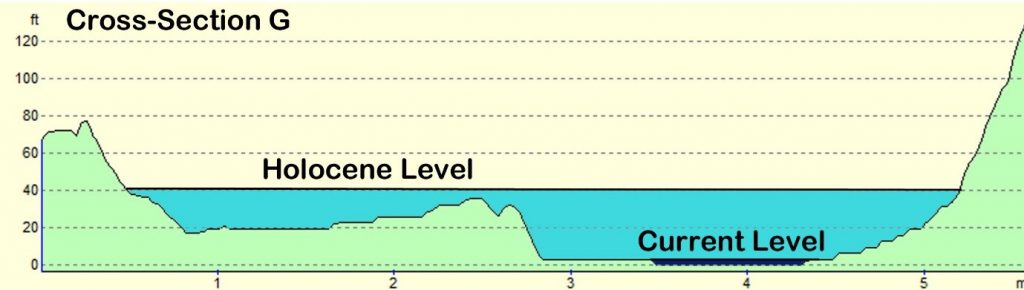
| Thames River Cross-Sections A – G |
The current average discharge is 65.8 m³/s; therefore, with a 3723% increase in the watershed area, we can estimate that, at its peak, the Thames River discharged 2450 m³/s (0.0025 Gt/s or 1314 Gt per annum).
About the same rate of one of the smaller rivers ‘Susquehanna/Chesapeake River’ (Table 5) in North America – which is minor, in comparison to the eight North American river discharge ratios, which begs the question as the Thames is the largest river in the country, would it not be affected mostly by the meltwater at the end of the last ice age – so, have the scientists got the extent of the alluvium flooding correct?
To investigate further, we need to examine a detailed excavation at the edge of the BGS superficial Alluvium flood map to obtain real evidence of dates and clues about which sediments are present, compared with the ages suggested in past publications.
‘Holocene environmental changes in the Lower Thames Valley’ (Branch et al.,2012) excavated parts of Hornchurch marsh at the edge of the BSG alluvium deposit (Cross-Section D).
The paper suggests that “Palaeoenvironmental data (publicly or in the form of commercial archaeological reports) on these near-surface sediments indicate that following the end of the last glaciation, the lower reaches of the Thames Valley and its tributaries were inundated by the sea, and marine and estuarine sediments accumulated. Since that time, the evidence suggests that sea level continued to rise at a much slower rate as a response to either glacio-eustatic or sedimentary processes”. But the idea of any recent “inundation by the sea” can now be easily rebuked.
The reason for this incorrect interpretation of sediments was that past Geologists believed that the LGM was much smaller than previous ice ages – this has now been disproved by new research at sea level data from the Mediterranean (Rohling et al., 2017) as they could only measure by observation the extent of the ice sheets on the surface of the landmass and took for granted the greater the area, the larger the ice mass by estimation.
The conclusion of this study is to show that the last Ice Age was far more significant than previously thought (PCM) as illustrated below in Table 6 and Fig. 30)
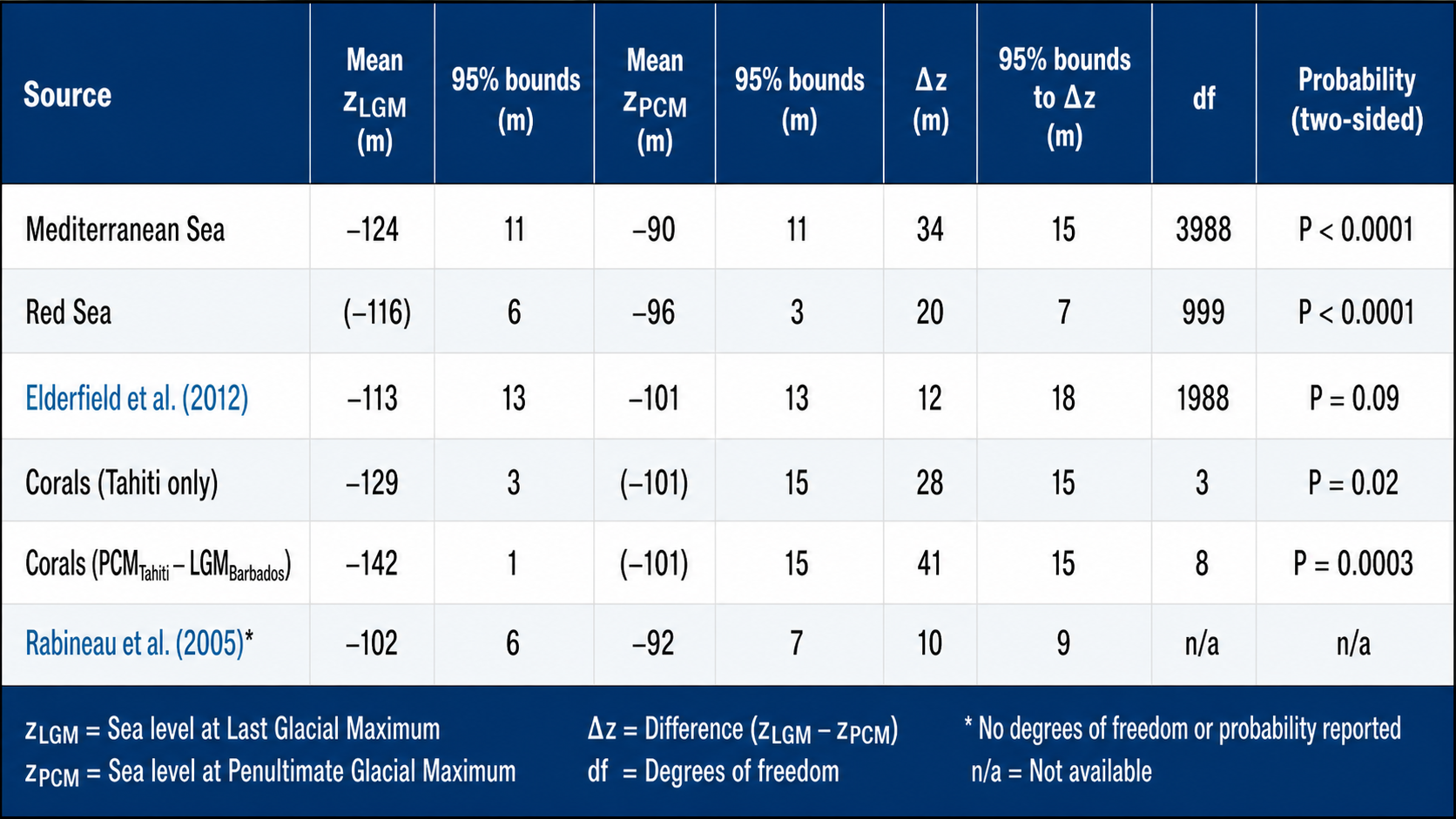
Table 6 – (Rohling et al., 20170 Comparison of LGM v PGM by sea-level difference
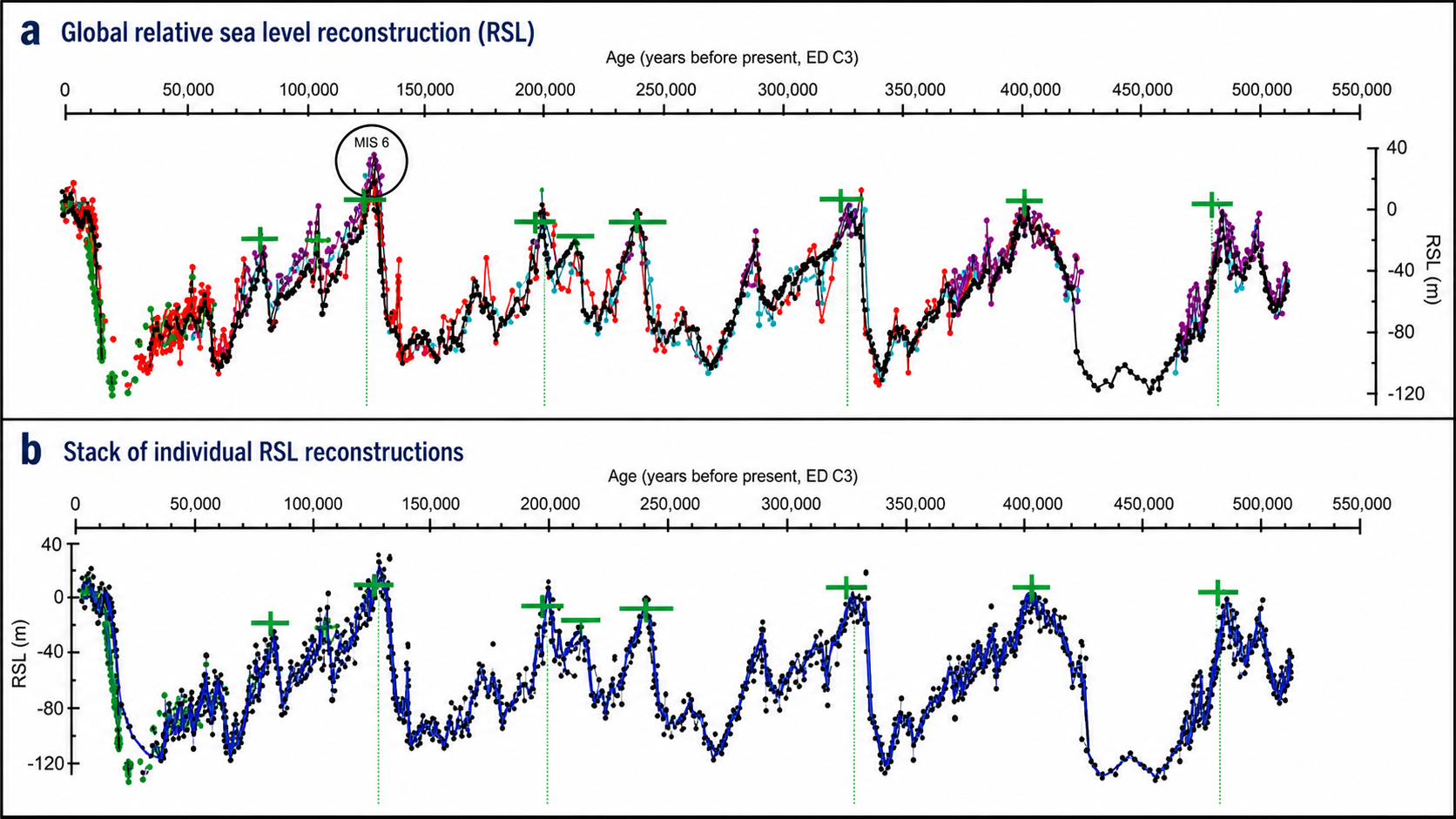
| (Rohling et al.,2009) sea levels over the last 500k years – notice that they are either equivalent or smaller than the LGM |
🔍 Validating the 40 Metre Flood Model: A Conservative Benchmark with Room for Expansion
Recent analysis of Thames River terrace data, combined with marine isotope stages (MIS) and global sea-level reconstructions, has confirmed that the highest river terrace associated with the Anglian glaciation (MIS 12) reaches elevations of up to 45–50 metres above the present-day floodplain. These terraces are preserved in locations such as Wimbledon Common, Islington, Dartford Heath, and around the Goring Gap and represent the earliest and most substantial fluvial deposits in the Thames Valley. Their considerable height corresponds with what is now understood to be the largest ice volume of the last 500,000 years, when sea levels were more than 130 metres below modern levels.
In contrast, our working model for reconstructing prehistoric Thames hydrology assumes a maximum flood level of 40 metres above modern—a figure chosen deliberately to provide a conservative and defensible baseline. This height has been used to calculate post-glacial meltwater volume, floodplain extent, and terrace formation through time. Although lower than the peak terrace cuts, 40 metres accurately reflects the likely active flood height during the most extreme meltwater episodes, accounting for factors such as sediment infill, compaction, and subsequent erosion that would have reshaped the original floodplain surface.

That said, the confirmation of higher terrace cuts opens the door for revising the volume model upwards. If we were to use the 45–50 metre elevation as our baseline for MIS 12, the resulting model would show a 12.5% to 25% increase in total flood volume compared to the current 40 metre assumption. This adjustment could significantly strengthen the case for post-glacial aquifer discharge and explain the massive sediment loads and geomorphic features observed downstream. However, such a shift would require recalibration of all terrace heights and their correlation with glacial episodes, which, while feasible, may introduce new assumptions and reduce the clarity of the proportional model.
In conclusion, the existing 40 metre model remains sound—anchored in observable data and consistent with LiDAR-documented terrace formations. Nevertheless, this model should be viewed as a minimum estimate of post-glacial river height and volume. Future work could explore enhanced modelling scenarios using 45–50-metre benchmarks to test the upper limits of Thames flooding during MIS 12. Such refinements would not undermine the current hypothesis but rather strengthen the argument that prehistoric Britain experienced hydrological conditions far more dynamic and extreme than currently acknowledged in traditional archaeological and geological narratives.
📊 Table: Sea-Level Minima and Estimated River Terrace Heights by Glacial Cycle
| Glacial Period | Marine Isotope Stage (MIS) | Approx. Date (ka) | Sea-Level Minimum (m below present) | % of Maximum Ice Volume | Estimated Thames Terrace Height (if MIS 12 = 45 m) |
|---|---|---|---|---|---|
| Fifth Glacial (Anglian) | MIS 12 | ~480 – 430 | –130 m | 100% | 45 m |
| Penultimate Glacial | MIS 6 | ~190 – 135 | –125 m | 96.2% | 43.3 m |
| Last Glacial Maximum | MIS 2 | ~26 – 19 | –120 m | 92.3% | 41.5 m |
| Third Glacial | MIS 8 | ~300 – 245 | –105 m | 80.8% | 36.4 m |
| Fourth Glacial | MIS 10 | ~360 – 335 | –120 m | 92.3% | 41.5 m |
📚 References
- Grant, K.M. et al. (2014). Sea-level variability over five glacial cycles. Nature Communications, 5, 5076. DOI: 10.1038/ncomms6076
- Rohling, E.J. et al. (2009). Relative sea-level and climate change over the past 500,000 years. Quaternary Science Reviews, 28(17–18), 1537–1552. DOI: 10.1016/j.quascirev.2009.02.026
- British Geological Survey. (n.d.). Quaternary deposits and river terraces of the Thames Valley. Earthwise: The BGS Open Geoscience knowledge base. earthwise.bgs.ac.uk
Dated Geology
This new information has created a problem for Geologists, as their sequences were based on the assumption of more significant ice caps, and consequently, meltwater deposits prior to the last ice age formed the foundations of our geological river terracing.
According to previous publications, only ‘Alluvium’ OIS 1 was laid down on the landscape (as at our Case Study site in the Thames Valley) directly after the last Ice Age, 10k years ago. But there is no evidence that that is true or that the larger rivers would not have washed the previous deposits further down the stream, making these sequences incorrect; consequently, the ‘River Terrace’ Deposits of:
Kempton Park – Taplow – Hackney – Lynch Hill – Boyn Hill and Black Park are Holocene in origin (or a mixture) and not solely Late Pleistocene as suggested in Geology books. In practical terms, when we examine boreholes, we should look for the ‘floodplain Terrance’ to indicate the extent of Holocene flooding and ignore the guestimations of gravel deposits.
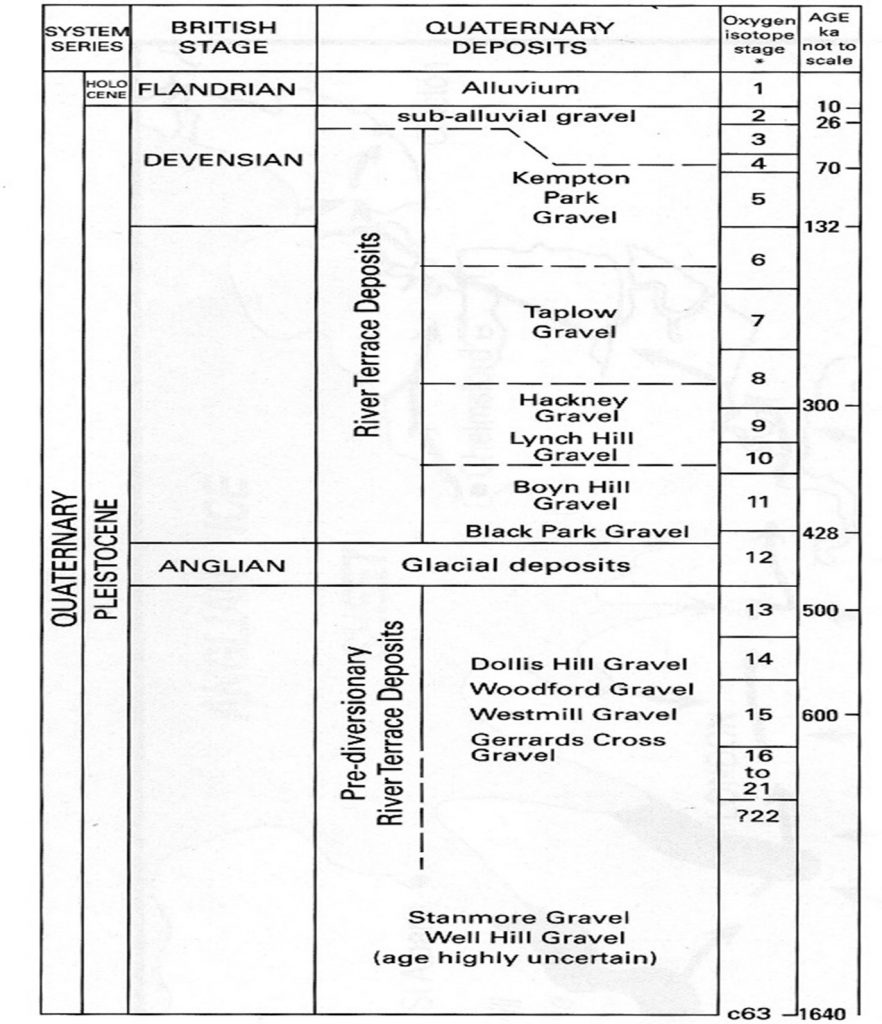
| Figure 31. Traditionally expressed river terrace deposits by ‘guesstimated’ age |
This ambiguity is, in fact, pointed out in BGS’s –‘The stratigraphical framework for the Palaeogene successions of the London Basin, the U.K. where it states that “In some areas, notably the north-eastern part of the London Basin, it has proved difficult to subdivide the strata between the Chalk and the London Clay with confidence” and this view is commonplace through the history of British Geology and hence the constant reclassification as shown in their obsolete terms table.
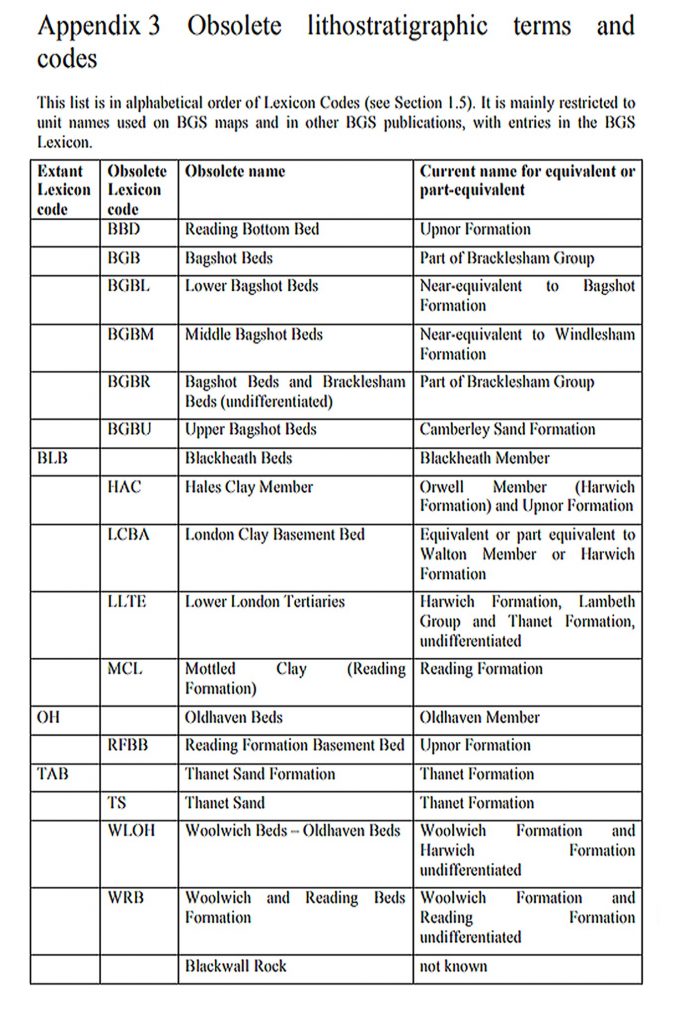
| Figure 32. Obsolete terms are a common occurrence in Geology as modern new methods are incorporated. BGS Superficial Deposits Handbook. |
This assumption is also highlighted by Lewin et al. (2005), who state –
“Furthermore, their assumption that floodplain gravels were Pleistocene in age was not supported by dating, and work both on the Thames (Robinson, 1992, Fig. 19.2) and more widely elsewhere (Brown et al., 1994) tends to suggest that late dates for overbank sedimentation may generally be constrained by the fact that the gravels beneath are themselves often of considerably later date than was earlier assumed.”
And concluded with “Overall, the skewed distributions suggest rapid autogenic recycling of older materials, with earlier deposits only being preserved beyond the reach of river activity (e.g. in terraces or floodplains which have not been impinged on by later river migration). The exceptions to this are floodplain environments where localised long-term aggradation has permitted the greater preservation of older Holocene units. To obtain evidence from parts of the Holocene that remain less well known, such sites still require discovery and study, whilst commonplace deposits (notably floodplain gravels) would benefit from the application of dating techniques that are less dependent on the fortuity’s preservation of datable organic materials”.
When we look at Palaeolithic sites on a regional scale, such as in the Thames basin, several general problems become apparent. The first is correlation and chronology. By their very nature, terrace fragments may not be unequivocally traceable down a river system. Ideally, a combination of surveying, stratigraphic description and lithological analysis is required to correlate fragments with key sites where more than one formation is present. None of these methods alone can be relied upon; for example, the same lithological content does not necessarily imply time equivalence, especially where rivers are reworking previous gravel terraces. (Brown et al., 1997)
Until the 1950s, archaeology dated the geology, but it is now increasingly the other way around. From the nineteenth century onwards, the traditional chronology of Northern European Pleistocene terraces was based on a combination of hand-axe typology, stratigraphy and counting climatic episodes back in time or from the top of the sequence down. This methodology was based on the belief that axe typology followed a clear progression from what we perceive as crude or simple to elegant or sophisticated, and that this progression occurred at roughly the same rate across different places. This was allied to the belief that a typology represented a ‘culture’.
Chronology
This chronology and methodology have been questioned for a variety of reasons (Green and McGregor, 1980). First, the traditional chronology was at odds with revised Pleistocene chronologies from ocean cores and from new terrestrial sites in North-West Europe, which showed an extremely complex picture of glacial, interglacial, stadial and interstadial stages. The ocean cores, for example, show at least 30 warm/cold cycles, and the terrestrial record has improved through the discovery of more sites and new chronometric dating techniques (Lowe and Walker, 1984; Jones and Keen, 1993).
However, the terrestrial record in Britain still shows major discontinuities in comparison with the ocean record and the much more detailed chronologies from the Netherlands and Germany. A chronology, and it must be noted that there is considerable debate and uncertainty about not only the position of major British stratigraphic units but also the number of pre-Pastonian and post-Hoxnian-pre-Ipswichian climatic cycles present in the British record (Jones and Keen, 1993).
Moreover, given that the river gravel sequences are ‘problematical’, we can now revisit the Holocene ‘Alluvium’ map to see whether the boundaries of the Holocene Thames were even more significant than those shown in the original BGS map.
If we look at the Cross-Section H profile, we see that the area of the Holocene effect increases by at least one mile and is terminated by Boreholes TQ47NE344 and TQ58NW141.
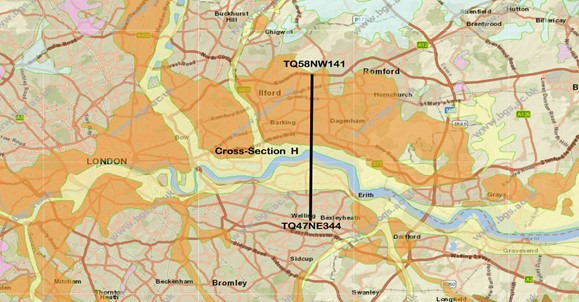
| Figure 34. Cross-Section H |
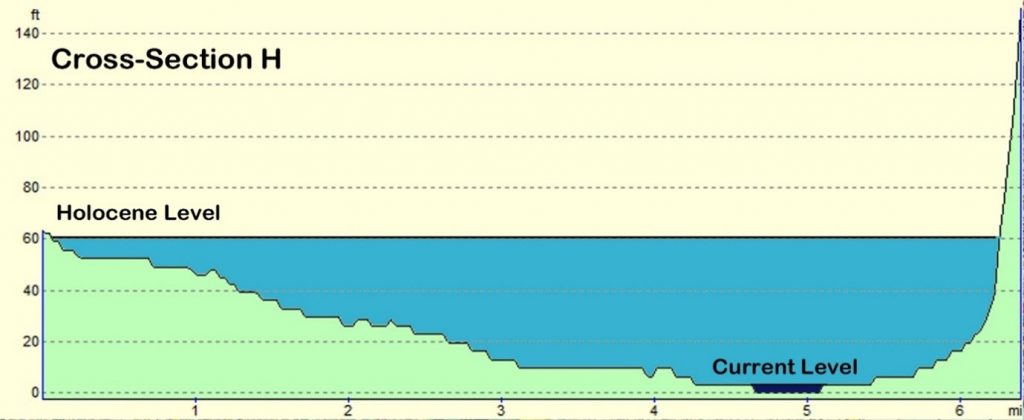
| BGS map of ‘superficial’ deposits left by the last LGM with cross-section H and the two boreholes (borehole details in Appendix A) |
Borehole TQ47NE344 – shows 5.95m of “Brown Silty Sand” before hitting Chalk and TQ58NW141 4.42m of “Loamy Sand and Stones” with a base of “sand and Gravel”.
This increases the Thames Flood Model from a discharge of 2,450 m3/s to 12,250 m3/s, which more accurately reflects the North American Discharge Model.
If we take this new model into account, the Thames valley will look very different to today, with all of the ‘superficial sediments’ being covered by water at the start of the Holocene period, 10 – 6 Ka.
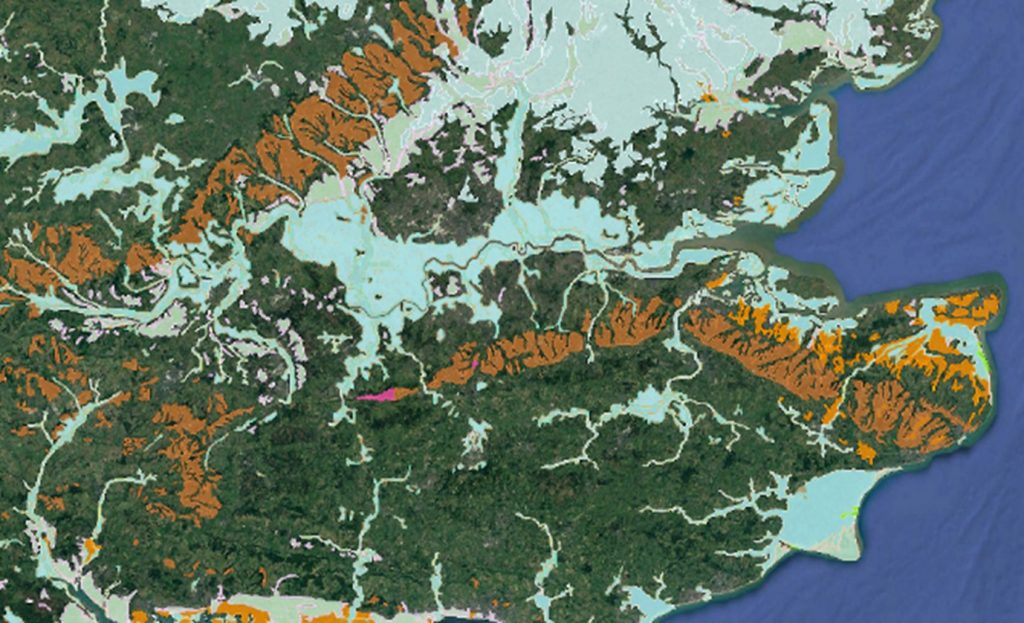
| How London probably looked just after the LGM, about 10,000 BCE, with as much water as land and most of it swampy. |
We can review the Hornchurch Marshes Paper (Branch et al., 2012) and examine the results to identify outcomes and possible related dates for our new Thames Valley flooding model.
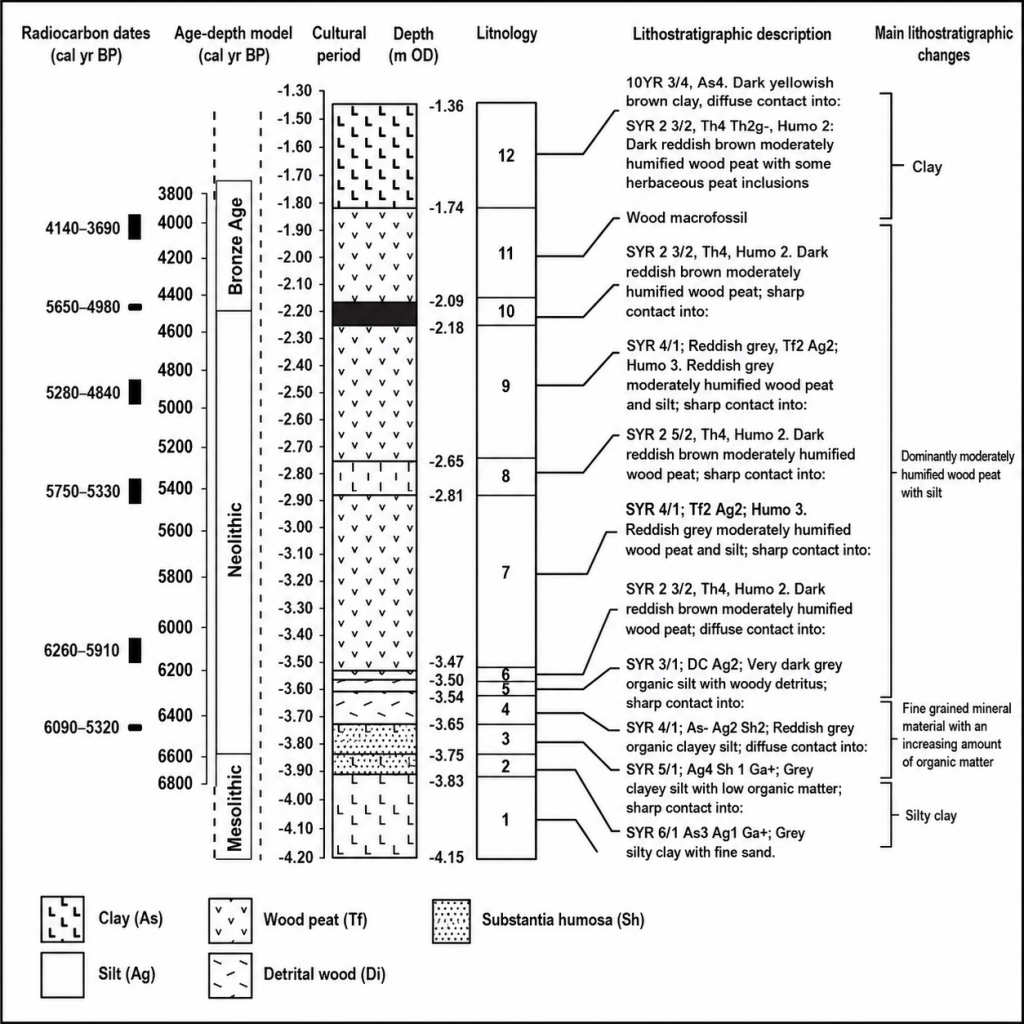
| (Branch et al.,2012) Hornchurch marshes investigation |
The radiocarbon dates show that the site was inhabited during the early Holocene period “Between −4.15 and −3.83 m O.D., a clay-rich sedimentary unit was deposited probably on the margins of a river channel (floodplain)” This would give us an idea of how much sediment was deposited by the river during the early Holocene, directly after the last ice age. If we look at boreholes around this site and within a few hundred metres of it, those bored lower, we can develop a working hypothesis.
Borehole TQ58SW:1 – the closest to the site (Appendix A) shows the sand and pebbles go down another 12.8m until it reaches “Coloured Sands and Stones”, whilst Borehole TQ58SW762 shows the names of many more segments, including ‘terrace gravel’ that goes down to 12.2m below the surface – which confirms our Holocene water level set at 40′ or 12.2m.
Between −3.54 m O.D. and −1.74 m O.D., the formation of wood peat represents the creation of more terrestrial conditions at the site. The results of the radiocarbon dating indicate that peat formation commenced at c. 6300 cal. Yr B.P. and ceased at c. 3900 cal. Yr B.P. with the onset of estuarine sedimentation.
Closer inspection of the Lithostratigraphic descriptions and Lithology reveals that the site suffered possible flooding about 6800 yr B.P. as silt deposits are found in unit number 2&3 (Figure 36.) after over 3000 years of flooding since the end of the last ice age and a build-up of ‘Grey Silty Clay and fine sand’ as would be expected.
There is then a sequence of peat (an accumulation of partially decayed vegetation or organic matter. It is unique to natural areas called peatlands, bogs, mires, moors, or muskegs) growth as this become a marsh area because of the Holocene flooding as is a majority of Britain (as we have seen in Fig. 25). This marshland lasted for 1200 – 1600 years (Unit number 4 -7, figure 36.).
Then there seems to be a flood period of about 200 years during which the area was inundated with a deposit of Sand and clay, replacing the marshland peat, dated 5750 – 5330 cal yr B.P. We then see another 1500 years as a marshland, with new peat samples, before another river flood at 3800 BP. The carbon dating of this site provides the evidence we require to finally prove that rivers were not only higher in the Holocene/Mesolithic period, but also remained high to such an extent that they periodically flooded into recent history, as we will now further illustrate.
NB. Extract from the Book ‘Post-Glacial Flooding Hypothesis’
PODCAST

Author’s Biography
Robert John Langdon, a polymathic luminary, emerges as a writer, historian, and eminent specialist in LiDAR Landscape Archaeology.
His intellectual voyage has been interwoven with stints as an astute scrutineer in government and grand corporate bastions, a tapestry spanning British Telecommunications, Cable and Wireless, British Gas, and the esteemed University of London.
A decade hence, Robert’s transition into retirement unfurled a chapter of insatiable curiosity. This phase saw him immerse himself in Politics, Archaeology, Philosophy, and the enigmatic realm of Quantum Mechanics. His academic odyssey traversed the venerable corridors of knowledge hubs such as the Museum of London, University College London, Birkbeck College, The City Literature Institute, and Chichester University.
In the symphony of his life, Robert is a custodian of three progeny and a pair of cherished grandchildren. His sanctuary lies ensconced in the embrace of West Wales, where he inhabits an isolated cottage, its windows framing a vista of the boundless sea – a retreat from the scrutinising gaze of Her Majesty’s Revenue and Customs, an amiable clandestinity in the lap of nature.
Exploring Prehistoric Britain: A Journey Through Time
My blog delves into the fascinating mysteries of prehistoric Britain, challenging conventional narratives and offering fresh perspectives grounded in cutting-edge research, particularly LiDAR technology. I invite you to explore some key areas of my research. For example, the Wansdyke, often cited as a defensive structure, is re-examined in light of new evidence. I’ve presented my findings in my blog post Wansdyke: A British Frontier Wall – ‘Debunked’, and a Wansdyke LiDAR Flyover video further visualises my conclusions.
My work also often challenges established archaeological dogma. I argue that many sites, such as Hambledon Hill, commonly identified as Iron Age hillforts, are not what they seem. My posts Lidar Investigation Hambledon Hill – NOT an ‘Iron Age Fort’ and Unmasking the “Iron Age Hillfort” Myth explore these ideas in detail and offer an alternative view. Similarly, sites like Cissbury Ring and White Sheet Camp receive re-evaluations based on LiDAR analysis in my posts “Lidar Investigation Cissbury Ring through time” and “Lidar Investigation White Sheet Camp,“ revealing fascinating insights into their true purpose. I have also examined South Cadbury Castle, often linked to the mythical Camelot56.
My research also extends to ancient water management, including the role of canals and other linear earthworks. I have discussed the true origins of Car Dyke in multiple posts, including Car Dyke – ABC News Podcast and Lidar Investigation Car Dyke – North Section, which suggest a Mesolithic origin 2357. I also explore the misidentification of Roman aqueducts, as seen in my posts on the Great Chesters (Roman) Aqueduct. My research has also been greatly informed by my post-glacial flooding hypothesis, which has helped explain landscape transformations over time. I have discussed this hypothesis in several posts, including AI now supports my Post-Glacial Flooding Hypothesis and Exploring Britain’s Flooded Past: A Personal Journey
Finally, my blog also investigates prehistoric burial practices, as seen in Prehistoric Burial Practices of Britain and explores the mystery of Pillow Mounds, often mistaken for medieval rabbit warrens, but with a potential link to Bronze Age cremation in my posts: Pillow Mounds: A Bronze Age Legacy of Cremation? and The Mystery of Pillow Mounds: Are They Really Medieval Rabbit Warrens?. My research also includes astronomical insights into ancient sites, for example, in Rediscovering the Winter Solstice: The Original Winter Festival. I also review new information about the construction of Stonehenge in The Stonehenge Enigma.
Further Reading
For those interested in British Prehistory, visit www.prehistoric-britain.co.uk, a comprehensive resource featuring an extensive collection of archaeology articles, modern LiDAR investigations, and groundbreaking research. The site also includes insights and excerpts from the acclaimed Robert John Langdon Trilogy, a series of books that explore Britain during the Prehistoric period. Titles in the trilogy include The Stonehenge Enigma, Dawn of the Lost Civilisation, and The Post-Glacial Flooding Hypothesis, which offer compelling evidence of ancient landscapes shaped by post-glacial flooding.
To further explore these topics, Robert John Langdon has developed a dedicated YouTube channel featuring over 100 video documentaries and investigations that complement the trilogy. Notable discoveries and studies showcased on the channel include 13 Things that Don’t Make Sense in History and the revelation of Silbury Avenue – The Lost Stone Avenue, a rediscovered prehistoric feature at Avebury, Wiltshire.
In addition to his main works, Langdon has released a series of shorter, accessible publications, ideal for readers delving into specific topics. These include:
- The Ancient Mariners
- Stonehenge Built 8300 BCE
- Old Sarum
- Prehistoric Rivers
- Dykes, Ditches, and Earthworks
- Echoes of Atlantis
- Homo Superior
- 13 Things that Don’t Make Sense in History
- Silbury Avenue – The Lost Stone Avenue
- Offa’s Dyke
- The Stonehenge Enigma
- The Post-Glacial Flooding Hypothesis
- The Stonehenge Hoax
- Dawn of the Lost Civilisation
- Darwin’s Children
- Great Chester’s Roman Aqueduct
- Wansdyke
For active discussions and updates on the trilogy’s findings and recent LiDAR investigations, join our vibrant community on Facebook. Engage with like-minded enthusiasts by leaving a message or contributing to debates in our Facebook Group.
Whether through the books, the website, or interactive videos, we aim to provide a deeper understanding of Britain’s fascinating prehistoric past. We encourage you to explore these resources and uncover the mysteries of ancient landscapes through the lens of modern archaeology.
For more information, including chapter extracts and related publications, visit the Robert John Langdon Author Page. Dive into works such as The Stonehenge Enigma or Dawn of the Lost Civilisation, and explore cutting-edge theories that challenge traditional historical narratives.
Other Blogs
1
a
- Ackling Dyke – Facts and the Archaeological Fiction
- Ackling Dyke – Part II – Puddletown Forest: When a Roman Road Becomes an Assumption
- Ackling Dyke – Part III – The Roman Road Mystery Finally Makes Sense
- AI now Supports – Homo Superior
- AI now supports my Post-Glacial Flooding Hypothesis
- Alexander the Great sailed into India – where no rivers exist today
- Ancient Secrets of Althorp – debunked
- Antler Picks built Ancient Monuments – yet there is no real evidence
- Antonine Wall – Prehistoric Canals (Dykes)
- Archaeological ‘pulp fiction’ – has archaeology turned from science?
- Archaeological Pseudoscience
- Archaeology in the Post-Truth Era
- Archaeology: A Bad Science?
- Archaeology: A Harbour for Fantasists?
- Archaeology: Fact or Fiction?
- Archaeology: The Flaws of Peer Review
- Archaeology’s Bayesian Mistake: Stop Averaging the Past
- Are Raised Beaches Archaeological Pseudoscience?
- Atlantis Found: The Mathematical Proof That Plato’s Lost City Was Doggerland
- ATLANTIS: Discovery with Dan Snow Debunked
- Avebury Ditch – Avebury Phase 2
- Avebury through time
- Avebury’s great mystery revealed
- Avebury’s Lost Stone Avenue – Flipbook
b
- Battlesbury Hill – Wiltshire
- Beyond Stone and Bone: Rethinking the Megalithic Architects of Northern Europe
- BGS Prehistoric River Map
- Blackhenge: Debunking the Media misinterpretation of the Stonehenge Builders
- Brain capacity (Cro-Magnon Man)
- Britain’s First Road – Stonehenge Avenue
- Britain’s Giant Prehistoric Waterways
- British Roman Ports miles away from the coast
c
- Caerfai Promontory Fort – Archaeological Nonsense
- Car Dyke – ABC News PodCast
- Car Dyke – North Section
- Cardigan Bay: The Holocene Evidence the Old Geological Story Has Missed
- CASE STUDY – An Inconvenient TRUTH (Craig Rhos Y Felin)
- Case Study – River Avon
- Case Study – Woodhenge Reconstruction
- Chapter 2 – Craig Rhos-Y-Felin Debunked
- Chapter 2 – Stonehenge Phase I
- Chapter 2 – Variation of the Species
- Chapter 3 – Post Glacial Sea Levels
- Chapter 3 – Stonehenge Phase II
- Chapter 7 – Britain’s Post-Glacial Flooding
- Cissbury Ring through time
- Clement Reid, Doggerland, and the Archaeological Establishment
- Cro-Magnon Brain Capacity
- Cro-Magnon Megalithic Builders: Measurement, Biology, and the DNA
- Cro-Magnons – An Explainer
d
- Darwin’s Children – Flipbook
- Darwin’s Children – The Cro-Magnons
- Dawn of The Lost Civilisation – 1/10
- Dawn of the Lost Civilisation – Flipbook
- Dawn of the Lost Civilisation – Introduction
- Digging for Britain – Cerne Abbas
- Digging for Britain Debunked – Cerne Abbas 2
- Digging Up Britain’s Past – Debunked
- DLC Chapter 1 – The Ascent of Man
- Durrington Walls – Woodhenge through time
- Durrington Walls Revisited: Platforms, Fish Traps, and a Managed Mesolithic Landscape
- Dyke Construction – Hydrology 101
- Dykes Ditches and Earthworks
- DYKES of Britain
e
f
g
h
- Hadrian’s Wall – Military Way Hoax
- Hadrian’s Wall – the Stanegate Hoax
- Hadrian’s Wall Vallum – Prehistoric Canals – FREE Online Book
- Hadrian’s Wall LiDAR investigation
- Hambledon Hill – NOT an ‘Iron Age Fort’
- Hayling Island Lidar Maps
- Hidden Sources of Ancient Dykes: Tracing Underground Groundwater Fractals
- Historic River Avon
- Hollingsbury Camp Brighton – A Hillfort… or a Forgotten Harbour?
- Hollows, Sunken Lanes and Palaeochannels
- Homo Superior – Flipbook
- Homo Superior – History’s Giants
- How Lidar will change Archaeology
- Hydrology 101 Simplified: Why Britain’s Dykes Worked Without Rivers
i
l
m
- Maiden Castle through time
- Mathematics Meets Archaeology: Discovering the Mesolithic Origins of Car Dyke
- Mesolithic River Avon
- Mesolithic Stonehenge
- Minerals found in Prehistoric and Roman Quarries
- Mining in the Prehistoric to Roman Period
- Mount Caburn through time
- Mysteries of the Oldest Boatyard Uncovered
- Mythological Dragons – a non-existent animal that is shared by the World.
o
- Offa’s Dyke Flipbook
- Old Sarum Lidar Map
- Old Sarum Through Time…………….
- On Sunken Lands of the North Sea – Lived the World’s Greatest Civilisation.
- OSL Chronicles: Questioning Time in the Geological Tale of the Avon Valley
- Oswestry LiDAR Survey
- Oswestry through time
- Oysters in Archaeology: Nature’s Ancient Water Filters?
p
- Pillow Mounds: A Bronze Age Legacy of Cremation?
- Pinkery Canal
- Plato Was Right: The Archaeological Evidence the Academics Never Expected
- Post Glacial Flooding – Flipbook
- Prehistoric Burial Practices of Britain
- Prehistoric Canals – Wansdyke
- Prehistoric Canals – Wansdyke
- Prehistoric Canals (Dykes) – Great Chesters Aqueduct (The Vallum Pt. 4)
- Prehistoric Canals (Dykes) – Offa’s Dyke (Chepstow)
- Prehistoric Canals (Dykes) – Offa’s Dyke (LiDAR Survey)
- Prehistoric Canals (Dykes) – Offa’s Dyke Survey (End of Section A)
- Prehistoric Canals (Dykes) – Wansdyke (4)
- Prehistoric Canals Wansdyke 2
- Professor Bonkers and the mad, mad World of Archaeology
r
- Real-World Confirmation of Post-Glacial Flooding
- Rebirth in Stone: Decrypting the Winter Solstice Legacy of Stonehenge
- Rediscovering the Winter Solstice: The Original Winter Festival
- Rethinking Ancient Boundaries: The Vallum and Offa’s Dyke”
- Rethinking Ogham: Could Ireland’s Oldest Script Have Begun as a Tally System?
- Rethinking The Past: Mathematical Proof of Langdon’s Post-Glacial Flooding Hypothesis
- Revolutionising History: Car Dyke Unveiled as Prehistoric & the Launch of FusionBook 360
- Rising Evidence, Falling Rivers: The Real Story of Europe’s First Farmers
- Rivers of the Past Were Higher: A Fresh Perspective on Prehistoric Hydrology
s
- Sea Level Changes
- Section A – NY26SW
- Section B – NY25NE & NY26SE
- Section C – NY35NW
- Section D – NY35NE
- Section E – NY46SW & NY45NW
- Section F – NY46SE & NY45NE
- Section G – NY56SW
- Section H – NY56NE & NY56SE
- Section I – NY66NW
- Section J – NY66NE
- Section K – NY76NW
- Section L – NY76NE
- Section M – NY87SW & NY86NW
- Section N – NY87SE
- Section O – NY97SW & NY96NW
- Section P – NY96NE
- Section Q – NZ06NW
- Section R – NZ06NE
- Section S – NZ16NW
- Section T – NZ16NE
- Section U – NZ26NW & NZ26SW
- Section V – NZ26NE & NZ26SE
- Silbury Avenue – Avebury’s First Stone Avenue
- Silbury Hill
- Silbury Hill / Sanctuary – Avebury Phase 3
- Sky Maps of Prehistoric Britain
- Somerset Plain – Signs of Post-Glacial Flooding
- South Cadbury Castle – Camelot
- Statonbury Camp near Bath – an example of West Wansdyke
- Stone me – the druids are looking the wrong way on Solstice day
- Stone Transportation and Dumb Censorship
- Stonehenge – Monument to the Dead
- Stonehenge Hoax – Dating the Monument
- Stonehenge Hoax – Round Monument?
- Stonehenge Hoax – Summer Solstice
- Stonehenge LiDAR tour
- Stonehenge Phase 1 — Britain’s First Monument
- Stonehenge Phase I (The Stonehenge Landscape)
- Stonehenge Solved – Pythagorean maths put to use 4,000 years before he was born
- Stonehenge Through Time
- Stonehenge, Doggerland and Atlantis connection
- Stonehenge: Borehole Evidence of Post-Glacial Flooding
- Stonehenge: Discovery with Dan Snow Debunked
- Stonehenge: The World’s First Computer – FREE Book
- Stonehenge: The Worlds First Computer
- Stonehenge’s The Lost Circle Revealed – DEBUNKED
- Stonehenge’s Chronological Mirage
t
- Ten Reasons Why Car Dyke Blows Britain’s Earthwork Myths Out of the Water
- Ten Things You Didn’t Know About Britain’s Prehistoric Flooded Past
- Ten thousand year old boats found on Northern Europe’s Hillsides
- Ten thousand-year-old boats found on Northern Europe’s Hillsides
- Testing Plato’s Atlantis Against Reality
- The “Hunter-Gatherer” Myth: Why It’s Time to Bury This Outdated Term
- The Ancient Mariners – Flipbook
- The Ancient Mariners – Prehistoric seafarers of the Mesolithic
- The Ascent of Man — From Survival to Systems
- The Beringian Migration Myth: Why the Peopling of the Americas by Foot is Mathematically and Logistically Impossible
- The Bluestone Enigma
- The Bulford Hoax: The “Simpler, Older Stonehenge” That Wasn’t
- The Cheddar Man Hoax
- The Cro-Magnon Cover-Up: How DNA and PR Labels Erased Our Real Ancestry
- The Dolmen and Long Barrow Connection
- The Durrington Mega-Monument Hoax: What Lies Beneath? – Debunked
- The Durrington Walls Hoax – it’s not a henge?
- The Dyke Myth Collapses: Excavation and Dating Prove Britain’s Great Dykes Are Prehistoric Canals
- The First European Smelted Bronzes
- The Fury of the Past: Natural Disasters in Historical and Prehistoric Britain
- The Giant’s Graves of Cumbria
- The Giants of Prehistory: Cro-Magnon and the Ancient Monuments
- The Great Ancient DNA Illusion: How Statistical Models Became Archaeological “Facts”
- The Great Antler Pick Hoax
- The Great Bell Beaker Migration Myth
- The Great Chichester Hoax – A Bridge too far?
- The Great Dorchester Aqueduct Hoax
- The Great Farming Hoax – (Einkorn Wheat)
- The Great Farming Migration Hoax
- The Great Hadrian’s Wall Hoax
- The Great Iron Age Hill Fort Hoax
- The Great Offa’s Dyke Hoax
- The Great Prehistoric Migration Hoax
- The Great Stone Transportation Hoax
- The Great Stonehenge Hoax
- The Great Wansdyke Hoax
- THE GREAT WEST WOODS HOAX — WHEN ONE STONE BECOMES FIFTY
- The Henge and River Relationship
- The Logistical Impossibility of Defending Maiden Castle
- The Long Barrow and Dolmen Enigma
- The Long Barrow Mystery
- The Long Barrow Mystery: Unravelling Ancient Connections
- The Lost Island of Avalon – revealed
- The Maiden Way Hoax – A Closer Look at an Ancient Road’s Hidden History
- The Maths – LGM total ice volume
- The Mystery of Pillow Mounds: Are They Really Medieval Rabbit Warrens?
- THE ODYSSEY PROBLEM: WHY DID A WEEK-LONG VOYAGE BECOME A TEN-YEAR EPIC?
- The Old Sarum Hoax
- The Oldest Boat Yard in the World found in Wales
- The Perils of Paradigm Shifts: Why Unconventional Hypotheses Get Branded as Pseudoscience
- The Post-Glacial Flooding Hypothesis – 1/11
- The Post-Glacial Flooding Hypothesis – Flipbook
- The Post-Glacial Flooding Theory
- The Problem with Hadrian’s Vallum
- The Rise of the Cro-Magnon (Homo Superior)
- The Roman Military Way Hoax
- The Silbury Hill Lighthouse?
- The Stone Money – Credit System
- The Stonehenge Avenue
- The Stonehenge Avenue
- The Stonehenge Code: Unveiling its 10,000-Year-Old Secret
- The Stonehenge Crescent: A Monument to a Lost World
- The Stonehenge Enigma – Flipbook
- The Stonehenge Enigma: Part 1/6
- The Stonehenge Hoax – Bluestone Quarry Site
- The Stonehenge Hoax – Flipbook
- The Stonehenge Hoax – Moving the Bluestones
- The Stonehenge Hoax – Periglacial Stripes
- The Stonehenge Hoax – Station Stones
- The Stonehenge Hoax – Stonehenge’s Location
- The Stonehenge Hoax – The Ditch
- The Stonehenge Hoax – The Slaughter Stone
- The Stonehenge Hoax – The Stonehenge Layer
- The Stonehenge Hoax – Totem Poles
- The Stonehenge Hoax – Woodhenge
- The Stonehenge Hospital
- The Stonehenge Transportation Mystery
- The Subtropical Britain Hoax
- The Troy, Hyperborea and Atlantis Connection
- The Vallum @ Hadrian’s Wall – it’s Prehistoric!
- The Vallum at Hadrian’s Wall (Summary)
- The Woodhenge Hoax
- Thirty Years of CAU Archaeology Going Nowhere?
- Three Dykes – Kidland Forest
- Thurnam’s 137 Skulls: The Forgotten People Behind Britain’s Megaliths.
- Top Ten Misidentified Fire Beacons in British History
- Troy Debunked – Troy did not exist in Asia Minor, but in fact, the North Sea island of Doggerland
- TSE – DVD Barrows
- TSE DVD – An Inconvenient Truth
- TSE DVD – Antler Picks
- TSE DVD – Avebury
- TSE DVD – Durrington Walls & Woodhenge
- TSE DVD – Dykes
- TSE DVD – Epilogue
- TSE DVD – Stonehenge Phase I
- TSE DVD – Stonehenge Phase II
- TSE DVD – The Post-Glacial Hypothesis
- TSE DVD Introduction
- TSE DVD Old Sarum
- Twigs, Charcoal, and the Death of the Saxon Dyke Myth
w
- Wansdyke – Short Film
- Wansdyke East – Prehistoric Canals
- Wansdyke Flipbook
- Wansdyke LiDAR Flyover
- Wansdyke: A British Frontier Wall – ‘Debunked’
- Was Columbus the first European to reach America?
- What Archaeology Missed Beneath Stonehenge
- White Sheet Camp
- Why a Simple Fence Beats a Massive Dyke (and What That Means for History)
- Windmill Hill – Avebury Phase 1
- Winter Solstice – Science, Propaganda and Indoctrination
- Woodhenge – the World’s First Lighthouse?