
The Stonehenge Enigma – Flipbook
The Stonehenge Enigma V4.0 – Robert John Langdon
This Is Not Archaeology as You Know It
This is not another theory.
This is not speculation.
And it is not a reinterpretation of the same old narrative.
👉 This is the point where the old narrative breaks.
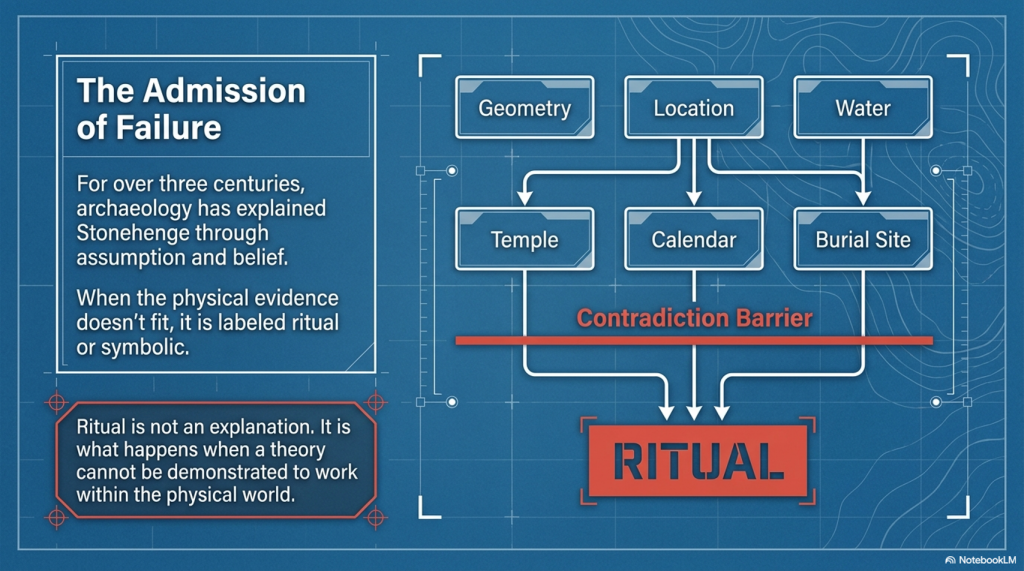
For over three centuries, archaeology has explained Stonehenge—and prehistory as a whole—through assumption, analogy, and belief. When the evidence didn’t fit, it was labelled “ritual,” “symbolic,” or simply ignored.
That approach ends here.
The First Scientific Reconstruction of Prehistory
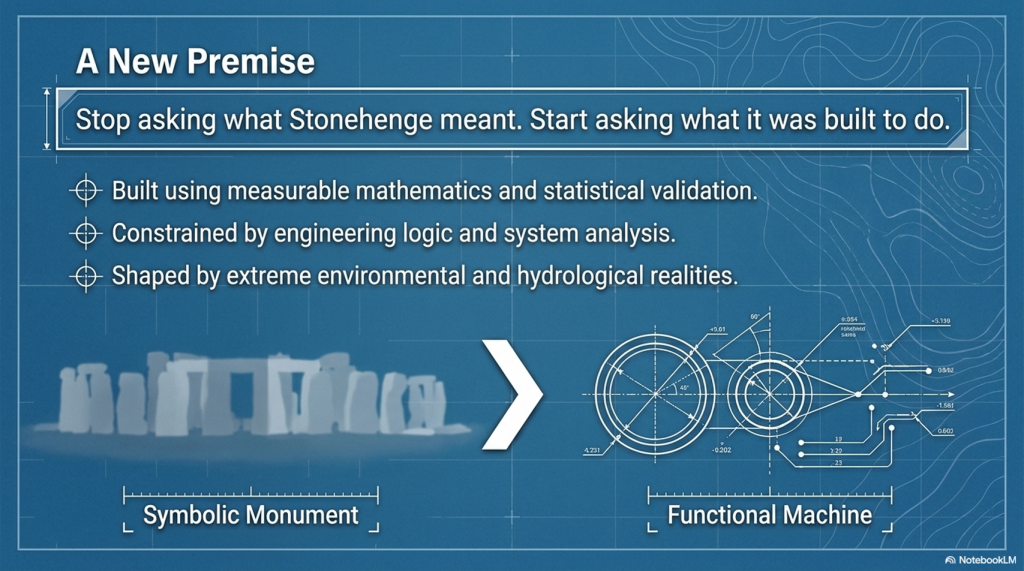
The Prehistoric Britain trilogy is the first body of work to rebuild prehistoric Britain using:
- Measurable scientific evidence
- Mathematics and statistical validation
- Engineering logic and system analysis
- Environmental and hydrological constraints
Not interpretation.
Not tradition.
👉 Proof.
At its core is a simple principle:
If a theory cannot be demonstrated to work within the physical world, it is not science.
Why the Old Narrative Is Dead
The traditional model of Stonehenge—and of prehistoric Britain—fails one basic test:
👉 It does not function.
It cannot explain:
- Why the geometry exists
- Why the site is positioned where it is
- Why water is fundamental to its construction
- Or how the system operates as a whole
Instead, it relies on disconnected explanations that never resolve into a working model.
This trilogy replaces that failure with something archaeology has never delivered:
👉 A complete, testable system that works.
The Consequence
Once the system is understood, the implications are unavoidable:
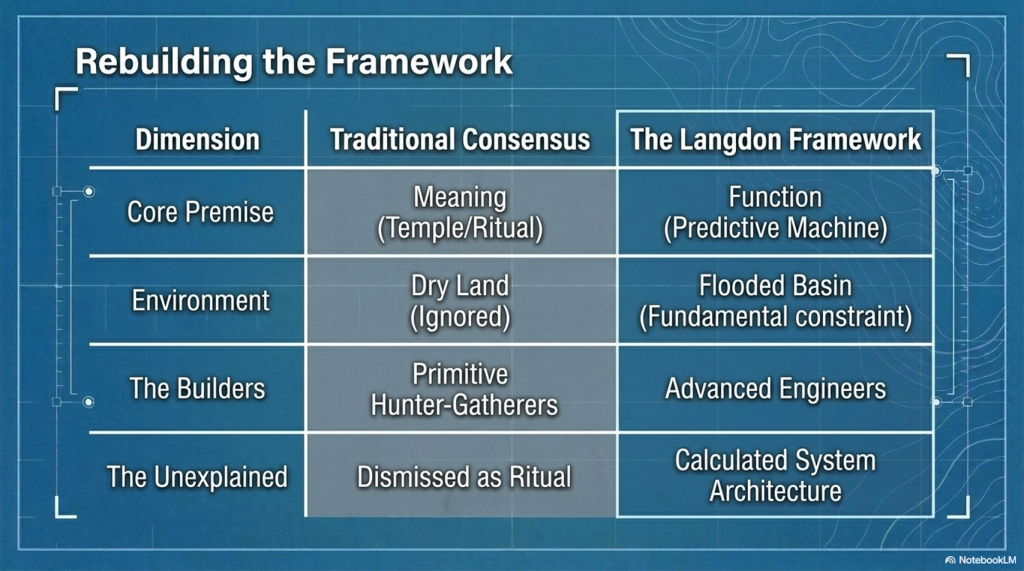
- Stonehenge is not symbolic—it is functional
- Its builders were not primitive—they were engineers
- And prehistoric Britain was not dry land—it was a water-dominated environment shaping everything that followed
This is not a minor correction.
👉 It is the collapse of the existing framework.
What You Are About to Read
This book does not ask you to accept a new belief.
It does something far more direct:
👉 It shows you how the system works.
And once you see that…
👉 The old explanations don’t just look weak.
👉 They become impossible to defend.
A Scientific Rebuild of Prehistoric Britain
What if Stonehenge isn’t a monument… but a machine?
For over 300 years, Stonehenge has been described as a temple, a calendar, a burial site, or a ritual site.
There’s just one problem:
👉 None of those explanations actually work.
They explain fragments.
They ignore contradictions.
And when the evidence doesn’t fit—they fall back on one word:
👉 “Ritual.”
That’s not an explanation.
That’s an admission of failure.
A Different Approach
The Stonehenge Enigma v4.0 starts from a simple premise:
👉 Stop asking what Stonehenge meant
👉 Start asking what it was built to do
This isn’t theory layered on top of assumption.
It’s a rebuild from the ground up using:
- Geometry
- Hydrology
- Construction logic
- Environmental constraints
No speculation.
No inherited narratives.
👉 Only what can be demonstrated.
The Key Breakthrough
The mistake has always been the same:
👉 Treating Stonehenge as one monument
It isn’t.
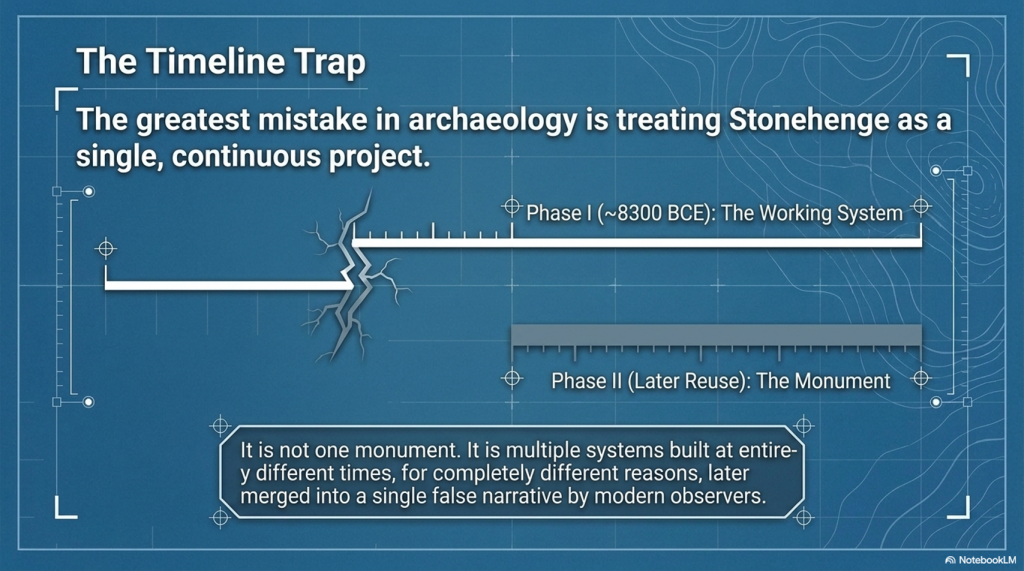
It’s multiple systems built at different times, then merged into a single story.
This book separates them properly:
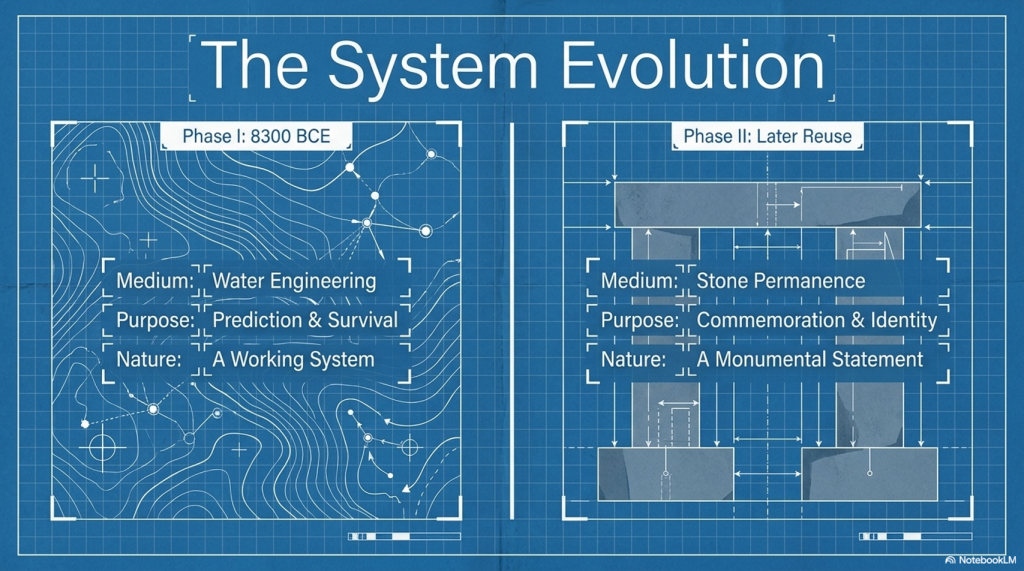
Phase I (~8300 BCE)
A functional, water-based system built within a flooded landscape
Phase II (Later Reuse)
A completely different structure—misinterpreted as the original purpose
Once separated, everything changes.
What Stonehenge Actually Was
When analysed as a system—not a symbol—the evidence leads to one unavoidable conclusion:
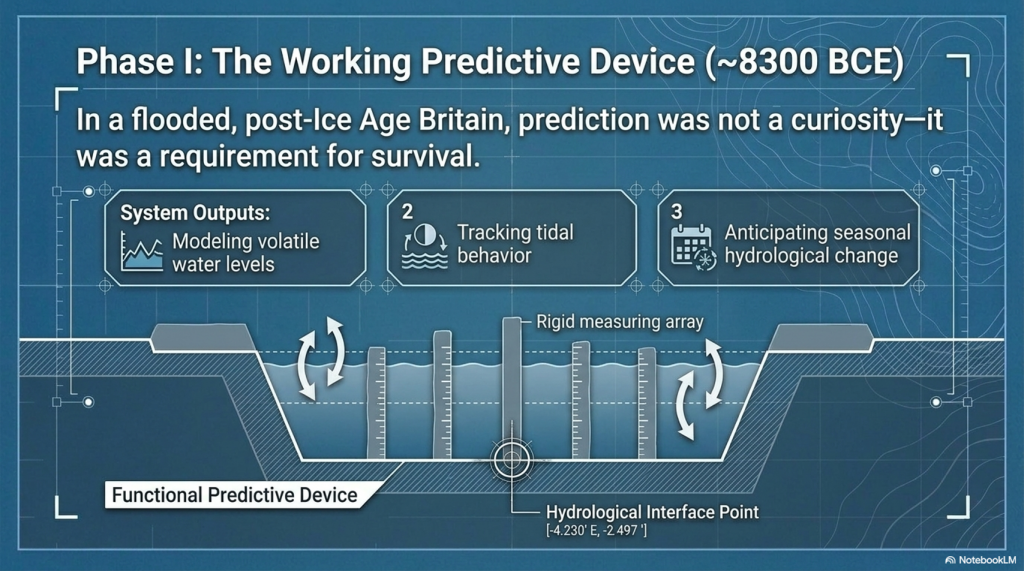
👉 Stonehenge was a working predictive device
Not abstract astronomy.
Not ceremonial alignment.
👉 A practical system used to model natural cycles:
- Water levels
- Tidal behaviour
- Seasonal change
Because in a flooded, post-Ice Age Britain…
👉 Prediction wasn’t curiosity—it was survival.
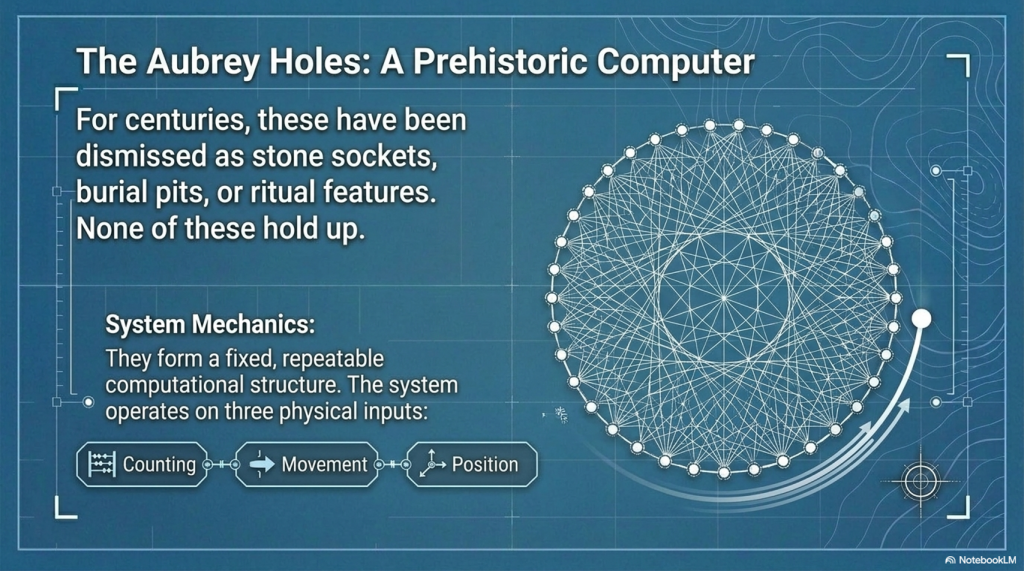
The Aubrey Holes – Finally Explained
For centuries, the Aubrey Holes have been treated as:
- Stone sockets
- Burial pits
- Ritual features
None of these explanations holds up.
Instead, they form:
👉 A fixed, repeatable computational structure
A system based on:
- Counting
- Movement
- Position
In simple terms:
👉 A prehistoric “computer”
The Missing Piece: Water
Archaeology has consistently ignored the most obvious constraint:
👉 The environment
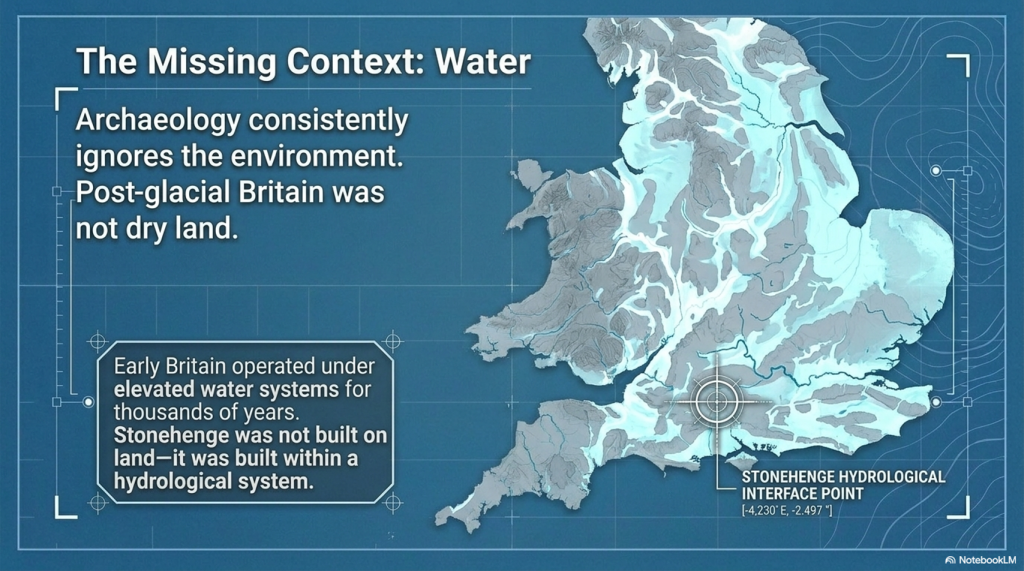
Post-glacial Britain wasn’t dry land.
It was:
- Flooded valleys
- Raised groundwater
- Expanding rivers
- Wetland basins
As shown in the wider Post-Glacial Flooding Hypothesis, early Britain operated under elevated water systems for thousands of years
That changes everything.
Stonehenge wasn’t built on land.
👉 It was built within a hydrological system
Phase II – A Monument to the Dead of Doggerland
Once Phase I is understood as a functional, water-based system, Phase II stops being a continuation—and starts to look like something very different.
It becomes a response.
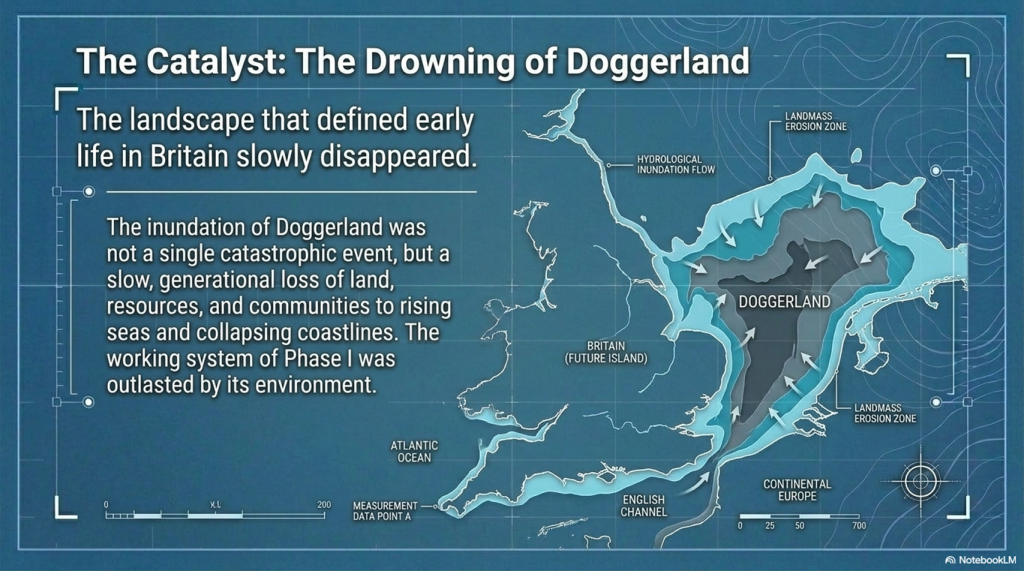
By the time Phase II was constructed, the landscape that defined earlier life in Britain had changed dramatically. The great lowland plains of Doggerland—once a vast, habitable region connecting Britain to mainland Europe—had been progressively inundated as seas rose and coastlines collapsed.
This was not a single event.
It was a slow, generational loss of land, resources, and communities.
Within this context, Phase II takes on a new and coherent meaning:
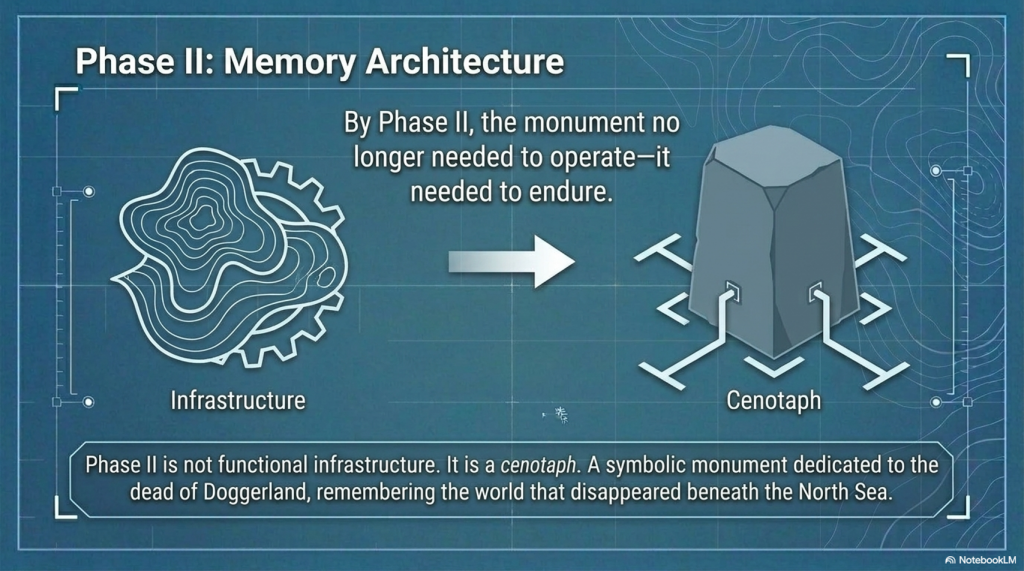
👉 It is not functional infrastructure.
👉 It is memory architecture.
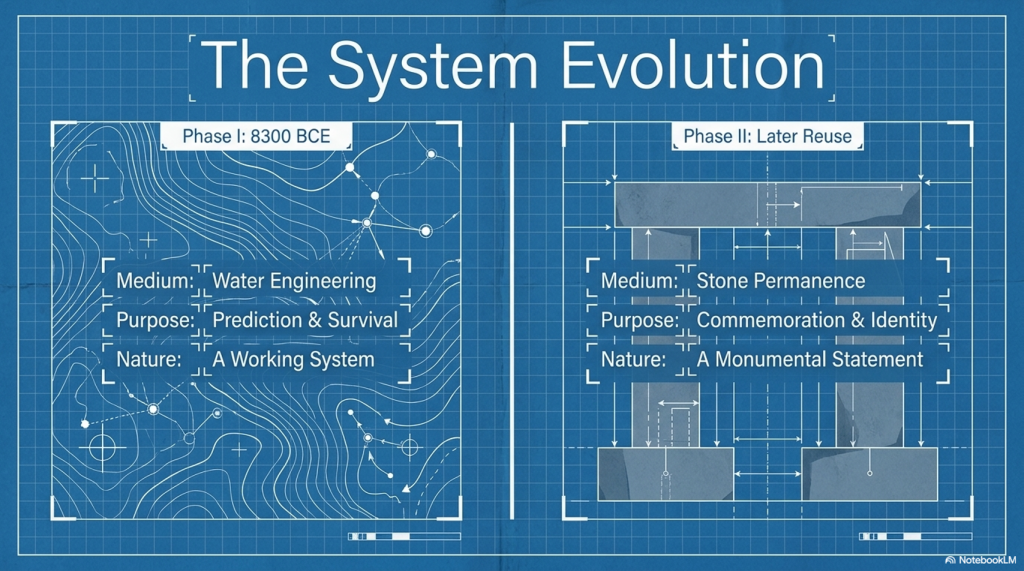
The shift is clear:
- From water engineering → to stone permanence
- From prediction and survival → to commemoration and identity
- From a working system → to a monumental statement
The geometry, scale, and orientation of Phase II reflect this transition. The monument no longer needs to operate—it needs to endure.
In this interpretation:
👉 Stonehenge Phase II becomes a cenotaph
👉 A symbolic structure representing a lost homeland
👉 A monument to the people and world that disappeared beneath the North Sea
This is why the site changes so fundamentally.
It is no longer solving a problem.
👉 It is remembering one.
Why Every Traditional Explanation Fails
Because they all start with meaning—not function.
- Temple → ignores engineering
- Observatory → ignores water
- Burial site → ignores process
- Ritual → explains nothing
👉 They don’t fail individually.
👉 They fail because they are asking the wrong question.
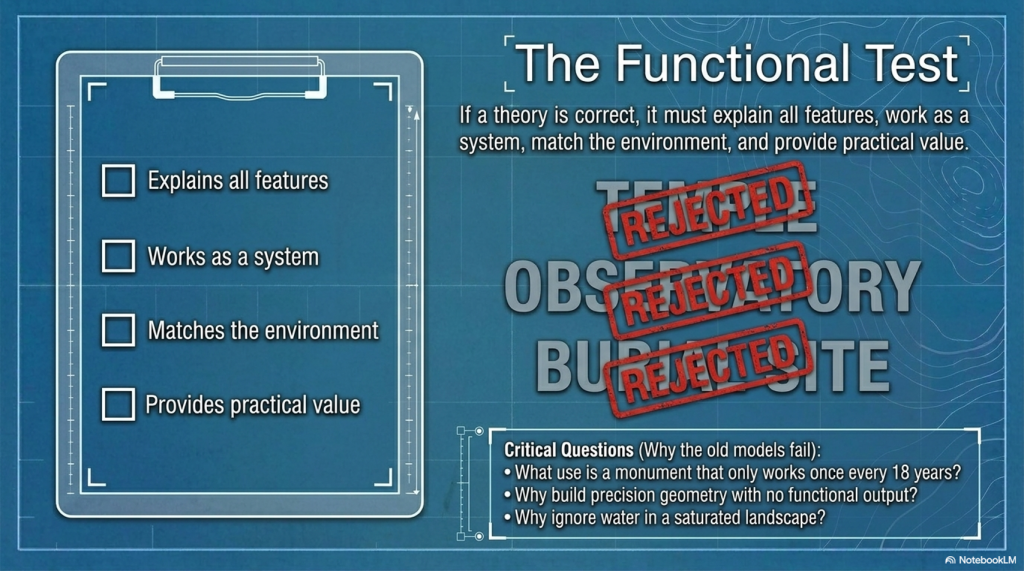
A Simple Test
If a theory is correct, it must:
✔ Explain all features
✔ Work as a system
✔ Match the environment
✔ Provide practical value
So ask yourself:
👉 What use is a monument that only “works” once every 18 years?
👉 Why build precision geometry with no functional output?
👉 Why ignore water in a saturated landscape?
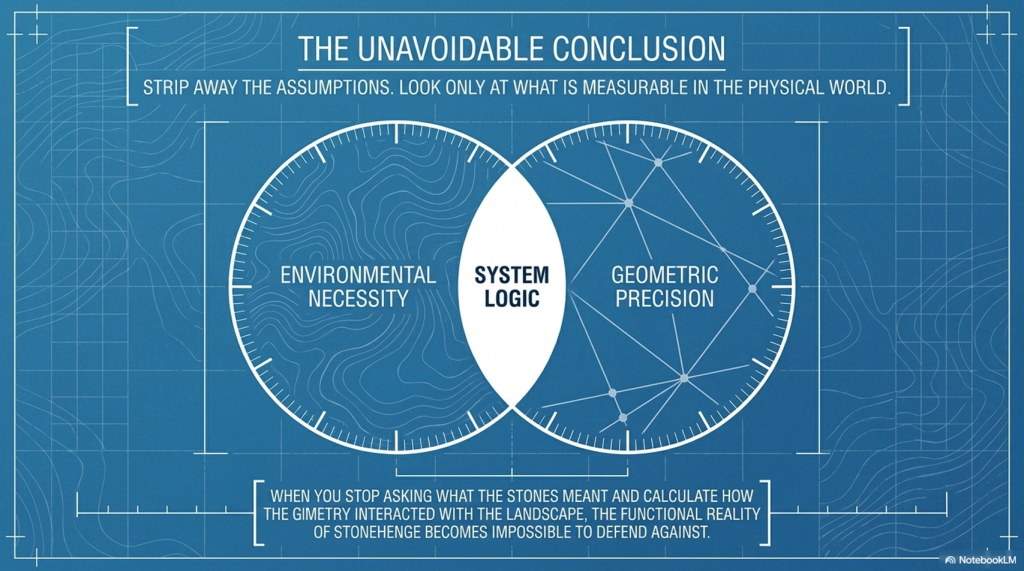
The Conclusion
Strip away the assumptions.
Look only at what’s measurable.
And the answer becomes obvious:
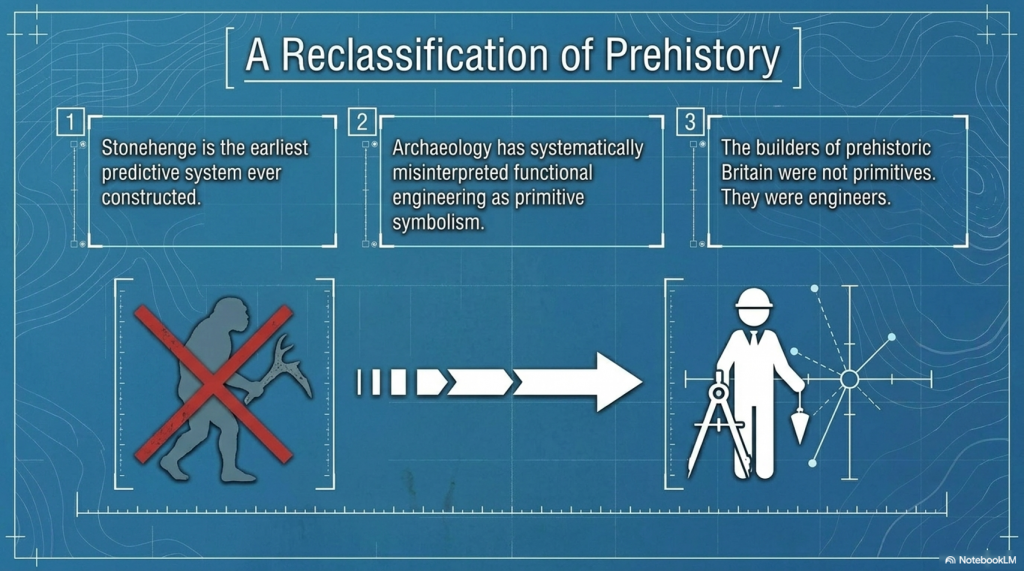
Why This Matters
If this model is correct, then:
- Stonehenge is the earliest predictive system ever built
- Prehistoric societies were engineers—not primitives
- And archaeology has been interpreting function as symbolism
The Final Point
Stonehenge has never lacked explanations.
👉 It has lacked one that works.
Now Available
The Stonehenge Enigma v4.0
A Scientific Rebuild of Prehistoric Britain

PODCAST

The Videos
More Book information
Technical White Paper: The Post-Glacial Flooding Hypothesis (PGFH) and British Hydrological Evolution
1. Theoretical Framework: The Post-Glacial Flooding Hypothesis
The Post-Glacial Flooding Hypothesis (PGFH) establishes a necessary paradigm shift in paleohydrological modelling, moving away from the simplistic “episodic flood event” narrative toward a rigorous model of sustained hydrological disequilibrium. This framework asserts that the early Holocene landscape was shaped not by modern-style meteorological cycles but by delayed continental drainage. This disequilibrium was the inevitable consequence of ice-sheet-induced crustal compression and the massive overcharging of continental aquifers.
The core premise of the PGFH is that prehistoric river levels followed hydraulic boundary conditions rather than modern precipitation patterns, which are largely irrelevant to early Holocene reconstructions. We must recognise the lithosphere’s failure to rebound instantaneously; this “isostatic lag” created physical obstructions that prevented efficient drainage. Consequently, Britain operated under a hydraulic regime where river stages were maintained at elevations significantly higher than today. This theoretical shift requires a rigorous re-examination of global sea-level data to resolve volumetric discrepancies that surface meltwater alone cannot explain.
2. Proof 1: Sea-Level Mass Balance and Volumetric Discrepancy
Between 19,000 and 7,000 years BP, the global deglacial sequence resulted in a 120m rise in mean sea level, representing an influx of approximately 4.5 × 10⁸ km³ of water into the ocean basins. However, a mass balance analysis reveals a profound “volumetric discrepancy.” Traditional models struggle to account for the continued rise in sea level during the Holocene, particularly as the British-Irish Ice Sheet (BIIS) had largely vanished.
While thermal expansion and residual ice loss from the Laurentide and Antarctic sheets contributed, they cannot explain the total observed ocean loading. The PGFH identifies pressurised continental aquifers as the primary engine for this continued discharge. This “asynchronous decay”—where continental aquifers acted as secondary, delayed reservoirs—sustained sea-level rise long after the primary meltwater pulses (MWP-1A and 1B).
The Deglacial Sequence identified in the PGFH:
- Stable Minimum (26–19 ka BP): Sea levels remained constant near -130m; global ice volume was at its maximum.
- Deglacial Rise (19–7 ka BP): Global mean sea level increased by 120m at an average rate of 1.2 cm/year.
- Holocene Highstand (After 7 ka BP): Relative stability within ±3m, characterised by regional divergence driven by glacio-isostatic adjustment (GIA).
If the global oceans were receiving this sustained continental discharge, the regional geomorphic response must be visible in the elevation and architecture of river terraces.
3. Proof 2: Ice-Volume Scaling and the Terrace Elevation Rule
Fluvial terrace formation directly depends on base-level thresholds and hydraulic energy. The PGFH utilises Langdon Mathematics to establish the “90% Terrace Rule” and the “Terrace Elevation Scaling Principle.” The 90% benchmark matters because the Last Glacial Maximum (LGM) reached about 90% of the maximum possible Pleistocene ice extent, creating a specific “hydrological energy” baseline. This mathematical benchmark allows for the precise prediction of early Holocene river heights based on ice-volume percentages.
| Feature | Traditional Model Limitations | PGFH Model (Langdon Mathematics) |
| Categorization | Qualitative climatic labels (e.g., “Interglacial”). | Numerical ice-volume benchmarks. |
| Predictive Power | Assumes modern drainage baselines were reached rapidly. | Predicts elevated river stages based on 90% ice-volume scaling. |
| Mechanism | Focused on surface runoff and precipitation. | Driven by hydraulic head and multi-millennial aquifer discharge. |
By applying Langdon Mathematics, we treat river terraces as time-calibrated gauges. When ice volume approached 90% of its maximum, the resulting groundwater pressure and river energy placed floodplains at elevations that modern hydrology cannot replicate.
4. Proof 3: Statistical Validation via Subsurface Matrix Analysis
The borehole data from Stonehenge Bottom provides the localised empirical rejection of traditional models. The “random chalk deposition model,” which dismisses subsurface variability as geological noise, is statistically untenable. By normalising data by elevation (Ordnance Datum) rather than depth, we identify a rigorous clustering of water-related deposits at discrete heights.
The analysis identifies a 92.6 m OD envelope where water-related deposits cluster with a 170:1 probability against chance. This statistical rejection is the “nail in the coffin” for traditional theories; it confirms that the water table was sustained at this elevation for millennia.
The Four Phases of Subsurface Matrix Analysis:
- Height-Frequency Analysis: Identifying the vertical distribution of sedimentary units.
- Matrix Concurrence: Comparing deposit types across independent boreholes at identical elevations.
- Discrete Elevation Zones: Defining the specific “water-envelopes” where saturation occurred.
- Statistical Rejection: Disproving random deposition in favour of sustained hydrological control.
5. Case Study: Volumetric Scaling in the Thames Valley Basin
As a principal Quaternary gauge, the Thames Valley demonstrates a massive mismatch between modern hydrology and Holocene geomorphology. The modern mean discharge of 65.8 m³/s cannot create the 3,723% average volumetric expansion observed in the mapped Holocene alluvium.
Cross-Sectional Analysis (Sections A–G):
| Cross-Section | Current Width (m) | Holocene Width (m) | Volume Increase % |
| A | 400 | 4,425 | 8,866% |
| B | 650 | 7,725 | 3,590% |
| C | 731 | 8,450 | 4,292% |
| D | 965 | 7,644 | 1,151% |
| E | 1,207 | 11,265 | 7,367% |
| F | 1,125 | 5,230 | 390% |
| G | 1,448 | 7,242 | 408% |
| AVERAGE | 932 | 7,426 | 3,723% |
The derived discharge for this system is approximately 2,450 m³/s. Critically, the sediment competence argument supports this: modern Thames flow cannot move the coarse gravel sheets found in the basin’s stratigraphic record. Only the high-energy discharge predicted by the PGFH explains the presence and transport of these massive gravel units.
6. Hydraulic Mechanisms: Aquifer Pressure and the “Age of Water”
Using Darcy’s Law, we can model the elevated hydraulic head in British chalk systems. During the glacial period, aquifers experienced immense subglacial recharge and lithospheric pressure. This “ancient pressure” sustained high river baseflow for thousands of years after the ice retreated.
Unlike “rain-fed” modern rivers, these spring-fed, high-stage rivers were consistent systems seeking hydraulic equilibrium. The PGFH clarifies that these were not short-lived runoff events but a multi-millennial release of stored glacial water.
Isotopic analysis identifies a 12,000-year gap between surface ice melt and the eventual rainwater replenishment of the aquifers. This gap provides definitive proof that early Holocene rivers were powered by “ancient” meltwater under pressure, not recent precipitation.
7. Chronological Constraints: Peat as a National Hydrological Clock
Peat serves as the ultimate geomorphological “clock” for the PGFH. The “Delayed Peat Peak Paradox”—the fact that British peat expansion reached its maximum well into the early Holocene (c. 9–8.5 ka BP)—is only resolvable if we accept the PGFH. Peat forms only in anaerobic, saturated conditions; its expansion shows the landscape remained saturated long after traditional models suggest it should have been “dry land.”
Buried peat beds in the Somerset Levels, Fenland, and the Thames Valley (c. 9–8.5 ka BP) are physical records of “delayed drainage.” They mark the period of maximum groundwater overcharge and provide the chronological proof of a landscape in slow, hydraulic transition.
8. Synthesis: The Deglacial Hydraulic Law and Engineering Implications
The convergence of Sea-Level Mass Balance, Ice-Volume Scaling, and Subsurface Matrix Analysis defines the Deglacial Hydraulic Law. This law dictates that the early Holocene landscape followed a predictable relationship among ice-mass loss, crustal rebound, and aquifer discharge duration.
Strategic Framework for Geomorphologists:
- Redefine Hydrological Baselines: Acknowledge that early Holocene baseflow was an order of magnitude higher than modern levels.
- Apply Volumetric Scaling: Use the 3,723% benchmark from the Thames as a baseline for other British catchment reconstructions.
- Reject Random Deposition Models: Replace Bayesian “noise” models with elevation-normalised matrix analysis.
- Model Sediment Competence: Account for the high-energy flow (e.g., 2,450 m³/s) required to transport Holocene gravel sheets.
- Utilise Peat Chronology: Interpret peat initiation as a record of peak groundwater saturation rather than simple climate shifts.
Ancient Britain was never a static, dry island; it was a dynamic system of “living water” undergoing a measurable, mathematically predictable, and multi-millennial transformation.
Author’s BiographyAuthor’s Biography
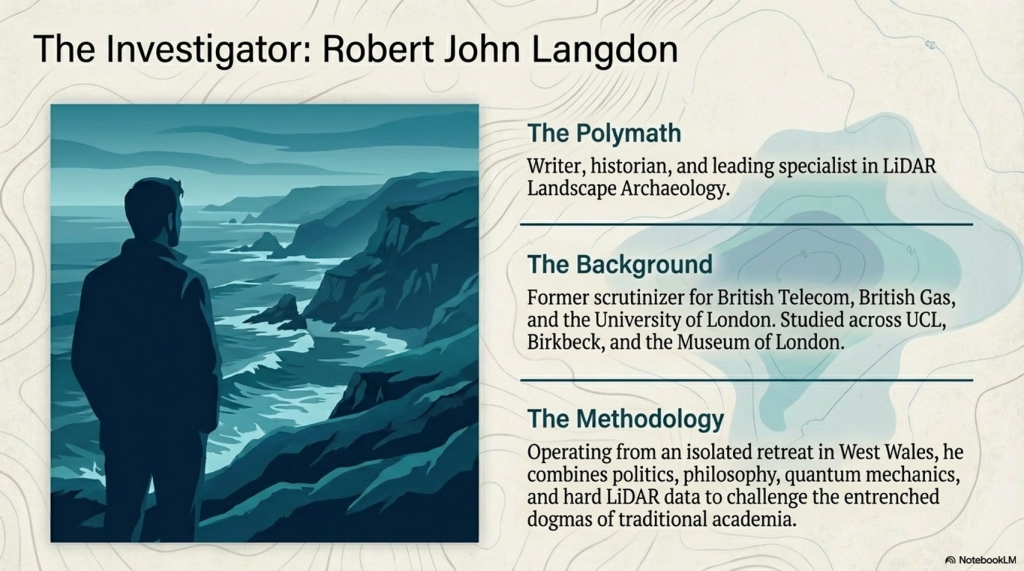
Robert John Langdon, a polymathic luminary, emerges as a writer, historian, and eminent specialist in LiDAR Landscape Archaeology.
His intellectual journey has included stints as an astute scrutineer in government and major corporate bastions, spanning British Telecommunications, Cable and Wireless, British Gas, and the esteemed University of London.
A decade hence, Robert’s transition into retirement unfurled a chapter of insatiable curiosity. He immersed himself in Politics, Archaeology, Philosophy, and the enigmatic realm of Quantum Mechanics. His academic odyssey took him through the venerable corridors of knowledge hubs such as the Museum of London, University College London, Birkbeck College, The City Literature Institute, and Chichester University.
In the symphony of his life, Robert is a custodian of three progeny and a pair of cherished grandchildren. His sanctuary lies ensconced in the embrace of West Wales, where he inhabits an isolated cottage, its windows framing a vista of the boundless sea – a retreat from the scrutinising gaze of Her Majesty’s Revenue and Customs, an amiable clandestinity in the lap of nature.
Exploring Prehistoric Britain: A Journey Through Time
My blog delves into the fascinating mysteries of prehistoric Britain, challenging conventional narratives and offering fresh perspectives grounded in cutting-edge research, particularly LiDAR technology. I invite you to explore some key areas of my research. For example, I re-examine the Wansdyke, often cited as a defensive structure, in light of new evidence. I’ve presented my findings in my blog post Wansdyke: A British Frontier Wall – ‘Debunked’, and a Wansdyke LiDAR Flyover video further visualises my conclusions.
My work also often challenges established archaeological dogma. I argue that many sites, such as Hambledon Hill, commonly identified as Iron Age hillforts, are not what they seem. My posts Lidar Investigation Hambledon Hill – NOT an ‘Iron Age Fort’ and Unmasking the “Iron Age Hillfort” Myth explore these ideas in detail and offer an alternative view. Similarly, sites like Cissbury Ring and White Sheet Camp have been re-evaluated through LiDAR analysis in my posts “Lidar Investigation Cissbury Ring through time” and “Lidar Investigation White Sheet Camp,“ revealing fascinating insights into their true purpose. I have also examined South Cadbury Castle, often linked to the mythical Camelot56.
My research also extends to ancient water management, including the role of canals and other linear earthworks. I have discussed the true origins of Car Dyke in multiple posts, including Car Dyke – ABC News Podcast and Lidar Investigation Car Dyke – North Section, which suggest a Mesolithic origin 2357. I also explore the misidentification of Roman aqueducts, as seen in my posts on the Great Chesters (Roman) Aqueduct. My research has also been greatly informed by my post-glacial flooding hypothesis, which has helped explain landscape transformations over time. I have discussed this hypothesis in several posts, including AI now supports my Post-Glacial Flooding Hypothesis and Exploring Britain’s Flooded Past: A Personal Journey
Finally, my blog also investigates prehistoric burial practices, as seen in Prehistoric Burial Practices of Britain and explores the mystery of Pillow Mounds, often mistaken for medieval rabbit warrens, but with a potential link to Bronze Age cremation in my posts: Pillow Mounds: A Bronze Age Legacy of Cremation? and The Mystery of Pillow Mounds: Are They Really Medieval Rabbit Warrens?. My research also includes astronomical insights into ancient sites, for example, in Rediscovering the Winter Solstice: The Original Winter Festival. I also review new information about the construction of Stonehenge in The Stonehenge Enigma.
Further Reading
For those interested in British Prehistory, visit www.prehistoric-britain.co.uk, a comprehensive resource featuring an extensive collection of archaeology articles, modern LiDAR investigations, and groundbreaking research. The site also includes insights and excerpts from the acclaimed Robert John Langdon Trilogy, a series of books that explore Britain during the Prehistoric period. Titles in the trilogy include The Stonehenge Enigma, Dawn of the Lost Civilisation, and The Post-Glacial Flooding Hypothesis, which offer compelling evidence of ancient landscapes shaped by post-glacial flooding.
To explore these topics further, Robert John Langdon has developed a dedicated YouTube channel featuring over 100 video documentaries and investigations that complement the trilogy. Notable discoveries and studies showcased on the channel include 13 Things that Don’t Make Sense in History and the revelation of Silbury Avenue – The Lost Stone Avenue, a rediscovered prehistoric feature at Avebury, Wiltshire.
In addition to his main works, Langdon has released a series of shorter, accessible publications, ideal for readers delving into specific topics. These include:
- 13 Things that Don’t Make Sense in History
- Silbury Avenue – The Lost Stone Avenue
- Offa’s Dyke
- The Stonehenge Enigma
- The Post-Glacial Flooding Hypothesis
- The Stonehenge Hoax
- Dawn of the Lost Civilisation
- Darwin’s Children
- Great Chester’s Roman Aqueduct
- Wansdyke
For active discussions and updates on the trilogy’s findings and recent LiDAR investigations, join our vibrant community on Facebook. Engage with like-minded enthusiasts by leaving a message or contributing to debates in our Facebook Group.
Through the books, the website, and interactive videos, we aim to deepen understanding of Britain’s fascinating prehistoric past. We encourage you to explore these resources and uncover the mysteries of ancient landscapes through the lens of modern archaeology.
For more information, including chapter extracts and related publications, visit the Robert John Langdon Author Page. Dive into works such as The Stonehenge Enigma or Dawn of the Lost Civilisation, and explore cutting-edge theories that challenge traditional historical narratives.
Other Blogs
1
a
- Ackling Dyke – Facts and the Archaeological Fiction
- Ackling Dyke – Part II – Puddletown Forest: When a Roman Road Becomes an Assumption
- Ackling Dyke – Part III – The Roman Road Mystery Finally Makes Sense
- AI now Supports – Homo Superior
- AI now supports my Post-Glacial Flooding Hypothesis
- Alexander the Great sailed into India – where no rivers exist today
- Ancient Secrets of Althorp – debunked
- Antler Picks built Ancient Monuments – yet there is no real evidence
- Antonine Wall – Prehistoric Canals (Dykes)
- Archaeological ‘pulp fiction’ – has archaeology turned from science?
- Archaeological Pseudoscience
- Archaeology in the Post-Truth Era
- Archaeology: A Bad Science?
- Archaeology: A Harbour for Fantasists?
- Archaeology: Fact or Fiction?
- Archaeology: The Flaws of Peer Review
- Archaeology’s Bayesian Mistake: Stop Averaging the Past
- Are Raised Beaches Archaeological Pseudoscience?
- Atlantis Found: The Mathematical Proof That Plato’s Lost City Was Doggerland
- ATLANTIS: Discovery with Dan Snow Debunked
- Avebury Ditch – Avebury Phase 2
- Avebury through time
- Avebury’s great mystery revealed
- Avebury’s Lost Stone Avenue – Flipbook
b
- Battlesbury Hill – Wiltshire
- Beyond Stone and Bone: Rethinking the Megalithic Architects of Northern Europe
- BGS Prehistoric River Map
- Blackhenge: Debunking the Media misinterpretation of the Stonehenge Builders
- Brain capacity (Cro-Magnon Man)
- Britain’s First Road – Stonehenge Avenue
- Britain’s Giant Prehistoric Waterways
- British Roman Ports miles away from the coast
c
- Caerfai Promontory Fort – Archaeological Nonsense
- Car Dyke – ABC News PodCast
- Car Dyke – North Section
- Cardigan Bay: The Holocene Evidence the Old Geological Story Has Missed
- CASE STUDY – An Inconvenient TRUTH (Craig Rhos Y Felin)
- Case Study – River Avon
- Case Study – Woodhenge Reconstruction
- Chapter 2 – Craig Rhos-Y-Felin Debunked
- Chapter 2 – Stonehenge Phase I
- Chapter 2 – Variation of the Species
- Chapter 3 – Post Glacial Sea Levels
- Chapter 3 – Stonehenge Phase II
- Chapter 7 – Britain’s Post-Glacial Flooding
- Cissbury Ring through time
- Clement Reid, Doggerland, and the Archaeological Establishment
- Cro-Magnon Brain Capacity
- Cro-Magnon Megalithic Builders: Measurement, Biology, and the DNA
- Cro-Magnons – An Explainer
d
- Darwin’s Children – Flipbook
- Darwin’s Children – The Cro-Magnons
- Dawn of The Lost Civilisation – 1/10
- Dawn of the Lost Civilisation – Flipbook
- Dawn of the Lost Civilisation – Introduction
- Digging for Britain – Cerne Abbas
- Digging for Britain Debunked – Cerne Abbas 2
- Digging Up Britain’s Past – Debunked
- DLC Chapter 1 – The Ascent of Man
- Durrington Walls – Woodhenge through time
- Durrington Walls Revisited: Platforms, Fish Traps, and a Managed Mesolithic Landscape
- Dyke Construction – Hydrology 101
- Dykes Ditches and Earthworks
- DYKES of Britain
e
f
g
h
- Hadrian’s Wall – Military Way Hoax
- Hadrian’s Wall – the Stanegate Hoax
- Hadrian’s Wall Vallum – Prehistoric Canals – FREE Online Book
- Hadrian’s Wall LiDAR investigation
- Hambledon Hill – NOT an ‘Iron Age Fort’
- Hayling Island Lidar Maps
- Hidden Sources of Ancient Dykes: Tracing Underground Groundwater Fractals
- Historic River Avon
- Hollingsbury Camp Brighton – A Hillfort… or a Forgotten Harbour?
- Hollows, Sunken Lanes and Palaeochannels
- Homo Superior – Flipbook
- Homo Superior – History’s Giants
- How Lidar will change Archaeology
- Hydrology 101 Simplified: Why Britain’s Dykes Worked Without Rivers
i
l
m
- Maiden Castle through time
- Mathematics Meets Archaeology: Discovering the Mesolithic Origins of Car Dyke
- Mesolithic River Avon
- Mesolithic Stonehenge
- Minerals found in Prehistoric and Roman Quarries
- Mining in the Prehistoric to Roman Period
- Mount Caburn through time
- Mysteries of the Oldest Boatyard Uncovered
- Mythological Dragons – a non-existent animal that is shared by the World.
o
- Offa’s Dyke Flipbook
- Old Sarum Lidar Map
- Old Sarum Through Time…………….
- On Sunken Lands of the North Sea – Lived the World’s Greatest Civilisation.
- OSL Chronicles: Questioning Time in the Geological Tale of the Avon Valley
- Oswestry LiDAR Survey
- Oswestry through time
- Oysters in Archaeology: Nature’s Ancient Water Filters?
p
- Pillow Mounds: A Bronze Age Legacy of Cremation?
- Pinkery Canal
- Plato Was Right: The Archaeological Evidence the Academics Never Expected
- Post Glacial Flooding – Flipbook
- Prehistoric Burial Practices of Britain
- Prehistoric Canals – Wansdyke
- Prehistoric Canals – Wansdyke
- Prehistoric Canals (Dykes) – Great Chesters Aqueduct (The Vallum Pt. 4)
- Prehistoric Canals (Dykes) – Offa’s Dyke (Chepstow)
- Prehistoric Canals (Dykes) – Offa’s Dyke (LiDAR Survey)
- Prehistoric Canals (Dykes) – Offa’s Dyke Survey (End of Section A)
- Prehistoric Canals (Dykes) – Wansdyke (4)
- Prehistoric Canals Wansdyke 2
- Professor Bonkers and the mad, mad World of Archaeology
r
- Real-World Confirmation of Post-Glacial Flooding
- Rebirth in Stone: Decrypting the Winter Solstice Legacy of Stonehenge
- Rediscovering the Winter Solstice: The Original Winter Festival
- Rethinking Ancient Boundaries: The Vallum and Offa’s Dyke”
- Rethinking Ogham: Could Ireland’s Oldest Script Have Begun as a Tally System?
- Rethinking The Past: Mathematical Proof of Langdon’s Post-Glacial Flooding Hypothesis
- Revolutionising History: Car Dyke Unveiled as Prehistoric & the Launch of FusionBook 360
- Rising Evidence, Falling Rivers: The Real Story of Europe’s First Farmers
- Rivers of the Past Were Higher: A Fresh Perspective on Prehistoric Hydrology
s
- Sea Level Changes
- Section A – NY26SW
- Section B – NY25NE & NY26SE
- Section C – NY35NW
- Section D – NY35NE
- Section E – NY46SW & NY45NW
- Section F – NY46SE & NY45NE
- Section G – NY56SW
- Section H – NY56NE & NY56SE
- Section I – NY66NW
- Section J – NY66NE
- Section K – NY76NW
- Section L – NY76NE
- Section M – NY87SW & NY86NW
- Section N – NY87SE
- Section O – NY97SW & NY96NW
- Section P – NY96NE
- Section Q – NZ06NW
- Section R – NZ06NE
- Section S – NZ16NW
- Section T – NZ16NE
- Section U – NZ26NW & NZ26SW
- Section V – NZ26NE & NZ26SE
- Silbury Avenue – Avebury’s First Stone Avenue
- Silbury Hill
- Silbury Hill / Sanctuary – Avebury Phase 3
- Sky Maps of Prehistoric Britain
- Somerset Plain – Signs of Post-Glacial Flooding
- South Cadbury Castle – Camelot
- Statonbury Camp near Bath – an example of West Wansdyke
- Stone me – the druids are looking the wrong way on Solstice day
- Stone Transportation and Dumb Censorship
- Stonehenge – Monument to the Dead
- Stonehenge Hoax – Dating the Monument
- Stonehenge Hoax – Round Monument?
- Stonehenge Hoax – Summer Solstice
- Stonehenge LiDAR tour
- Stonehenge Phase 1 — Britain’s First Monument
- Stonehenge Phase I (The Stonehenge Landscape)
- Stonehenge Solved – Pythagorean maths put to use 4,000 years before he was born
- Stonehenge Through Time
- Stonehenge, Doggerland and Atlantis connection
- Stonehenge: Borehole Evidence of Post-Glacial Flooding
- Stonehenge: Discovery with Dan Snow Debunked
- Stonehenge: The World’s First Computer – FREE Book
- Stonehenge: The Worlds First Computer
- Stonehenge’s The Lost Circle Revealed – DEBUNKED
- Stonehenge’s Chronological Mirage
t
- Ten Reasons Why Car Dyke Blows Britain’s Earthwork Myths Out of the Water
- Ten Things You Didn’t Know About Britain’s Prehistoric Flooded Past
- Ten thousand year old boats found on Northern Europe’s Hillsides
- Ten thousand-year-old boats found on Northern Europe’s Hillsides
- Testing Plato’s Atlantis Against Reality
- The “Hunter-Gatherer” Myth: Why It’s Time to Bury This Outdated Term
- The Ancient Mariners – Flipbook
- The Ancient Mariners – Prehistoric seafarers of the Mesolithic
- The Ascent of Man — From Survival to Systems
- The Beringian Migration Myth: Why the Peopling of the Americas by Foot is Mathematically and Logistically Impossible
- The Bluestone Enigma
- The Bulford Hoax: The “Simpler, Older Stonehenge” That Wasn’t
- The Cheddar Man Hoax
- The Cro-Magnon Cover-Up: How DNA and PR Labels Erased Our Real Ancestry
- The Dolmen and Long Barrow Connection
- The Durrington Mega-Monument Hoax: What Lies Beneath? – Debunked
- The Durrington Walls Hoax – it’s not a henge?
- The Dyke Myth Collapses: Excavation and Dating Prove Britain’s Great Dykes Are Prehistoric Canals
- The First European Smelted Bronzes
- The Fury of the Past: Natural Disasters in Historical and Prehistoric Britain
- The Giant’s Graves of Cumbria
- The Giants of Prehistory: Cro-Magnon and the Ancient Monuments
- The Great Ancient DNA Illusion: How Statistical Models Became Archaeological “Facts”
- The Great Antler Pick Hoax
- The Great Bell Beaker Migration Myth
- The Great Chichester Hoax – A Bridge too far?
- The Great Dorchester Aqueduct Hoax
- The Great Farming Hoax – (Einkorn Wheat)
- The Great Farming Migration Hoax
- The Great Hadrian’s Wall Hoax
- The Great Iron Age Hill Fort Hoax
- The Great Offa’s Dyke Hoax
- The Great Prehistoric Migration Hoax
- The Great Stone Transportation Hoax
- The Great Stonehenge Hoax
- The Great Wansdyke Hoax
- THE GREAT WEST WOODS HOAX — WHEN ONE STONE BECOMES FIFTY
- The Henge and River Relationship
- The Logistical Impossibility of Defending Maiden Castle
- The Long Barrow and Dolmen Enigma
- The Long Barrow Mystery
- The Long Barrow Mystery: Unravelling Ancient Connections
- The Lost Island of Avalon – revealed
- The Maiden Way Hoax – A Closer Look at an Ancient Road’s Hidden History
- The Maths – LGM total ice volume
- The Mystery of Pillow Mounds: Are They Really Medieval Rabbit Warrens?
- THE ODYSSEY PROBLEM: WHY DID A WEEK-LONG VOYAGE BECOME A TEN-YEAR EPIC?
- The Old Sarum Hoax
- The Oldest Boat Yard in the World found in Wales
- The Perils of Paradigm Shifts: Why Unconventional Hypotheses Get Branded as Pseudoscience
- The Post-Glacial Flooding Hypothesis – 1/11
- The Post-Glacial Flooding Hypothesis – Flipbook
- The Post-Glacial Flooding Theory
- The Problem with Hadrian’s Vallum
- The Rise of the Cro-Magnon (Homo Superior)
- The Roman Military Way Hoax
- The Silbury Hill Lighthouse?
- The Stone Money – Credit System
- The Stonehenge Avenue
- The Stonehenge Avenue
- The Stonehenge Code: Unveiling its 10,000-Year-Old Secret
- The Stonehenge Crescent: A Monument to a Lost World
- The Stonehenge Enigma – Flipbook
- The Stonehenge Enigma: Part 1/6
- The Stonehenge Hoax – Bluestone Quarry Site
- The Stonehenge Hoax – Flipbook
- The Stonehenge Hoax – Moving the Bluestones
- The Stonehenge Hoax – Periglacial Stripes
- The Stonehenge Hoax – Station Stones
- The Stonehenge Hoax – Stonehenge’s Location
- The Stonehenge Hoax – The Ditch
- The Stonehenge Hoax – The Slaughter Stone
- The Stonehenge Hoax – The Stonehenge Layer
- The Stonehenge Hoax – Totem Poles
- The Stonehenge Hoax – Woodhenge
- The Stonehenge Hospital
- The Stonehenge Transportation Mystery
- The Subtropical Britain Hoax
- The Troy, Hyperborea and Atlantis Connection
- The Vallum @ Hadrian’s Wall – it’s Prehistoric!
- The Vallum at Hadrian’s Wall (Summary)
- The Woodhenge Hoax
- Thirty Years of CAU Archaeology Going Nowhere?
- Three Dykes – Kidland Forest
- Thurnam’s 137 Skulls: The Forgotten People Behind Britain’s Megaliths.
- Top Ten Misidentified Fire Beacons in British History
- Troy Debunked – Troy did not exist in Asia Minor, but in fact, the North Sea island of Doggerland
- TSE – DVD Barrows
- TSE DVD – An Inconvenient Truth
- TSE DVD – Antler Picks
- TSE DVD – Avebury
- TSE DVD – Durrington Walls & Woodhenge
- TSE DVD – Dykes
- TSE DVD – Epilogue
- TSE DVD – Stonehenge Phase I
- TSE DVD – Stonehenge Phase II
- TSE DVD – The Post-Glacial Hypothesis
- TSE DVD Introduction
- TSE DVD Old Sarum
- Twigs, Charcoal, and the Death of the Saxon Dyke Myth
w
- Wansdyke – Short Film
- Wansdyke East – Prehistoric Canals
- Wansdyke Flipbook
- Wansdyke LiDAR Flyover
- Wansdyke: A British Frontier Wall – ‘Debunked’
- Was Columbus the first European to reach America?
- What Archaeology Missed Beneath Stonehenge
- White Sheet Camp
- Why a Simple Fence Beats a Massive Dyke (and What That Means for History)
- Windmill Hill – Avebury Phase 1
- Winter Solstice – Science, Propaganda and Indoctrination
- Woodhenge – the World’s First Lighthouse?