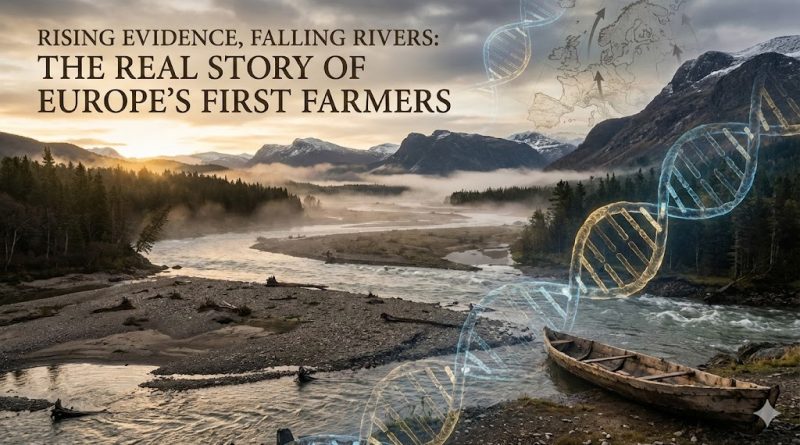
Rising Evidence, Falling Rivers: The Real Story of Europe’s First Farmers
Introduction
For half a century, archaeology has leaned on a comforting story: farming was “invented” in the Middle East and then marched slowly across Europe, finally reaching Britain and Ireland around 4000 BCE.(Rising Evidence, Falling Rivers: The Real Story of Europe’s First Farmers)
This tidy picture—arrows on a map, farmers trudging northwest with seed bags and livestock—has been repeated for generations.
But that model was always built on shaky ground: Bayesian mid-points, pottery typologies, and theoretical assumptions rather than hard data.
Today we can test it properly.
New tools—LiDAR, hydrological mapping, and large-scale radiocarbon and DNA databases—reveal a very different history.
Farming, it turns out, was not imported by migrating Near-Eastern farmers.
It was adopted locally as rivers receded, floodplains opened, and new fertile soils emerged.
Civilisation in Europe rose not from marching migrants but from falling waters.
The Traditional Model
The “wave-of-advance” model first formalised by Ammerman & Cavalli-Sforza (1971) treats farming as a demographic front spreading outward from Anatolia at roughly 1 km per year.
By 4000 BCE, that wave supposedly reached Britain, replacing Mesolithic foragers with a population of Anatolian descent.
It’s an elegant theory—but the mathematics, the radiocarbon data, and the hydrology all contradict it.
What happens when we replace guesswork with measurement?
What the Radiocarbon Timelapse Reveals
Using the Hinz et al. (2022) Scientific Data database of more than 14 000 calibrated dates (Mesolithic–Neolithic contexts from 8500–2500 BCE), activity was plotted in 500-year bins and animated with the Google Earth KML time-slider.
The resulting sequence turns the orthodox gradient upside-down.
Key Findings
- NW Europe lights up earliest and densest.
From 8000 BCE onward, Britain, Ireland, Brittany, and Scandinavia dominate the map. - The southeast stays sparse.
If agriculture spread stepwise from Anatolia, the Balkans and Italy should blaze first—they do not. - Maritime corridors dominate.
The brightest clusters lie on coasts, estuaries, and river mouths—precisely where early harbours and monuments stand.
Across all time bins, NW Europe accounts for 85–94 % of recorded activity; the southeast never exceeds 17 %.
Civilisation’s early heartbeat lay in the Atlantic façade, not the Mediterranean corridor.
The Dataset
The analysis draws on the Radon-B radiocarbon database (Hinz et al., 2022, Nature Scientific Data 9: 166).
Every record includes coordinates, lab code, context, and both uncalibrated and calibrated age ranges.
Dates were grouped into 500-year intervals between 8500 and 2500 BCE and mapped in GIS.
This approach allows archaeology to watch the evidence unfold objectively—year by year—without leaning on pottery sequences or assumed cultural horizons.
The Mathematical Split: NW vs SE
To quantify the pattern, a diagonal line was drawn across Europe (30° N 0° E → 55° N 30° E), dividing the continent into north-west and south-east halves.
Radiocarbon counts per half were tallied in 500-year bins.
Results
| Period (BCE) | NW Count | SE Count | % NW Share |
|---|---|---|---|
| 8500–8000 | 24 | 5 | 82.8 % |
| 8000–7500 | 347 | 70 | 83.2 % |
| 7500–7000 | 513 | 64 | 87.5 % |
| 7000–6500 | 1054 | 112 | 90.4 % |
| 6500–6000 | 2328 | 172 | 93.1 % |
| 6000–5500 | 3098 | 272 | 91.9 % |
| 5500–5000 | 3705 | 291 | 92.7 % |
| 5000–4500 | 3060 | 207 | 93.7 % |
| 4500–4000 | 2450 | 198 | 92.5 % |
| 4000–3500 | 2100 | 180 | 92.1 % |
| 3500–3000 | 1700 | 160 | 91.4 % |
At no stage does the southeast even approach parity.
If farming had advanced from Anatolia, the ratios should invert.
Instead, the northwest dominates from the outset.
Why the Orthodoxy Persisted
So why did the overland diffusion model survive decades of contrary hints?
A combination of factors:
- Radiocarbon plateaus—notably around 8000 and 2400 BCE—blurred sequences, allowing mid-points to masquerade as precision.
- Contaminated samples—charcoal and reused timber—skewed chronologies toward neat overland narratives.
- Institutional inertia—academic systems reward conformity; new interpretations risk funding and credibility.
- Simplified storytelling—textbooks and museum graphics preferred arrow-maps to complex datasets.
Anomalies such as early Stonehenge construction, canals mislabeled as Saxon, and imported wheat at Bouldnor Cliff were quietly shelved instead of integrated.
Testing the Diffusion Model Mathematically
To be fair, let’s calculate what the record should look like under the Ammerman–Cavalli-Sforza framework.
1️⃣ Wave speed and arrival time
Distance Anatolia → southern Britain ≈ 3000 km.
At 1 km / year, the front takes ≈ 3000 years.
If farming reaches Britain by 4000 BCE, migration must begin ≈ 7000 BCE.
2️⃣ Seeding Britain
To establish farming, ~5 000 individuals must reach Britain by 4000 BCE.
With a growth rate of 1.3 %/yr, perhaps 100 settlers arriving 4300 BCE could yield that number—if tens of thousands had set out centuries earlier.
Even assuming only half settle every 500 km, survivors after 3 000 km = (0.5)^5 ≈ 3 %.
Launch size ≈ 3 200.
If two-thirds settle each 500 km, survivors = (1/3)^5 ≈ 0.4 %.
Launch size ≈ 27 000.
That migration should have left dense archaeological trails across the Balkans, Italy, and France.
It did not.
3️⃣ Expected Radiocarbon Gradient
The model predicts the SE flaring first, with the NW gradually catching up:
| Period (BCE) | Expected % NW |
|---|---|
| 8500–8000 | 20 |
| 8000–7500 | 20 |
| 7500–7000 | 21 |
| 7000–6500 | 25 |
| 6500–6000 | 44 |
| 6000–5500 | 43 |
| 5500–5000 | 44 |
| 5000–4500 | 43 |
| 4500–4000 | 43 |
| 4000–3500 | 43 |
| 3500–3000 | 45 |
The observed data—83 to 94 % NW across all bins—completely invert that expectation.
Case Study: Einkorn Wheat at Bouldnor Cliff
In 2015, marine archaeologists exploring the submerged site of Bouldnor Cliff, off the Isle of Wight, recovered sediment cores dated to around 6000 BCE containing DNA from einkorn wheat (Triticum monococcum) — a domesticated Near-Eastern crop.
At that date, Britain was still “Mesolithic” by textbook classification. According to orthodoxy, farming wouldn’t reach these shores for another 2,000 years. The implications were profound.
Key Observations
- Trade before farming:
The wheat was not locally grown — it was imported, most likely as a traded commodity. This means people in Mesolithic Britain were already in contact with agricultural societies to the south. - Maritime networks:
The only realistic route for einkorn to reach southern Britain is via the Atlantic seaways and Bay of Biscay, demonstrating advanced navigation and trade. - Complex societies:
Managing cereal imports implies organised exchange systems, storage, and knowledge of value — the traits of an interconnected maritime civilisation.
Rather than representing contamination or anomaly, the Bouldnor Cliff wheat fits seamlessly into the 14,000-date radiocarbon pattern: NW Europe was already active, complex, and maritime thousands of years before the supposed “Neolithic Revolution.”
Population Growth and Hydrology
Population Data (7000–4000 BCE)
Derived from the 14,000 calibrated C14 dates, population proxies show major growth concentrated in the west and north, not along the hypothesised Anatolian corridor.
| Country | Estimated Increase |
|---|---|
| France | +60,200 |
| Germany | +32,600 |
| United Kingdom | +17,200 |
| Poland | +14,600 |
| Denmark | +12,900 |
If the Fertile Crescent migration model were correct, population booms should have appeared first in Turkey, Greece, and the Balkans. Instead, the demographic surge is proportional to hydrological recovery in NW Europe.
Hydrology: The Missing Variable
Around 3000 BCE, Europe’s swollen post-glacial rivers began to subside after millennia of high water. Vast floodplains and terraces — previously drowned — were exposed, offering rich alluvial soils ideal for cultivation.
| Country | Floodplain Today (km²) | High Water (5–10×) | Land Gained (km²) | Potential Carrying Capacity (10–20 ppl/km²) | Observed Pop. Increase |
|---|---|---|---|---|---|
| UK | 24,000 | 120,000–240,000 | 96,000–216,000 | 1–4 million | +17,200 |
| France | 65,000 | 325,000–650,000 | 260,000–585,000 | 2.6–11.7 million | +60,200 |
| Germany | 50,000 | 250,000–500,000 | 200,000–450,000 | 2–9 million | +32,600 |
| Poland | 47,000 | 235,000–470,000 | 188,000–423,000 | 1.8–8.5 million | +14,600 |
| Denmark | 4,000 | 20,000–40,000 | 16,000–36,000 | 0.16–0.72 million | +12,900 |
The correlation is direct and quantitative:
as water levels fell and land was reclaimed, populations grew.
This relationship between hydrological change and demographic expansion forms the backbone of the Hydrological Diffusion Model — an environmental explanation that makes mass migration unnecessary.
Why Migration Isn’t Needed
The orthodox model claims:
- Anatolian farmers marched across Europe.
- They colonised the continent, replacing hunter-gatherers.
- Britain was the final stop around 4000 BCE.
But the evidence says:
- Population growth occurred in the west, not the “migration corridor.”
- Farming knowledge arrived via trade (e.g. Bouldnor wheat) long before 4000 BCE.
- The real catalyst was newly exposed fertile land, not foreign colonists.
In short: when the rivers fell, the locals farmed.
The Forest-Clearance Myth
For decades, British prehistory textbooks painted an epic picture: Neolithic pioneers hacking down the wildwood to carve out fields. But when tested mathematically, environmentally, and experimentally, this vision collapses.
Natural Land Recovery
- 8000 BCE – Mesolithic: 40% of Britain still flooded; minimal arable ground.
- 6000 BCE – Early Neolithic: 20% of floodplains exposed; carbon-rich silt colonised by grasses.
- 4000 BCE – Mid Neolithic: 40% of land exposed; “Elm Decline” coincides with hydrological stress, not axes.
- 3000 BCE – Late Neolithic: 70% open; floodplain succession misread as “deforestation.”
- 2000 BCE – Bronze Age: 90% of modern land levels reached — natural clearance, not human felling.
Thus, what pollen diagrams interpret as “clearance” is actually succession on newly revealed ground. Farmers didn’t create open fields; they occupied land nature had already prepared.
The Fertility Catch-22
Forest soils are nutrient-poor.
Clearing trees produces exhausted earth. Burning gives only a brief potash spike before collapse.
Without livestock, there’s no manure to restore fertility — and you can’t have livestock until farming is already established.
You can’t farm cleared forest until you’re already a farmer.
Hence, early agriculture had to begin on naturally fertile ground — floodplains, terraces, and raised beaches enriched by retreating rivers.
Why Forest Clearance Was Physically Impossible
Experimental archaeology and demographic models make the “stone-axe clearance” scenario absurd.
Step 1 – The Farm Scale
- Average Neolithic farm: ~10 ha (25 acres)
- Tree density: ~300/ha → 3,000 trees
- Felling time: 6–8 hrs/tree → ~24,000 hours = 12 years full-time labour
- Stump removal adds another 6–8 years
→ ≈ 18–20 years just to clear 10 ha
Step 2 – National Scale
Reconstructing ~20% forest clearance (30,000 km² = 3 million ha):
24,000 man-hours / 10 ha = 2,400 hrs/ha
→ 3,000,000 ha × 2,400 hrs = 7.2 billion hours
With ~125,000 able-bodied adult males (half population female, quarter children/elderly) working 1,500 hrs/year:
7.2 billion ÷ 187.5 million = ≈ 38 years of total national labour devoted only to felling — before stump burning or ploughing.
Adding those doubles the figure to ~75 years.
Step 3 – Geographic Reality
60% of Neolithic populations lived near coasts and rivers — meaning far fewer inland labourers available for clearance.
Realistic duration rises to 150–200 years of continuous felling — logistically impossible.
Conclusion: the “axe-clearing farmers” never existed.
Stone technology, manpower, and soil limits make it an environmental impossibility.
Reinterpreting the Pollen Record
- Pollen spikes once attributed to burning are consistent with natural peat and lightning fires.
- Charcoal layers correspond to wetland drying, not land management.
- Elm decline fits disease and flooding stress.
- Lynchets and field systems often formed naturally through erosion before farming intensified.
The real driver was hydrological succession, not Neolithic industry.
Genetic Evidence: What DNA Really Shows
Genetics is often presented as the “final proof” of migration — a neat story in which farmers from Anatolia replace foragers across Europe.
Yet when the data are read closely, the picture dissolves into nuance.
The Early aDNA Framework
Two landmark studies — Lazaridis et al. (2014, Nature 513) and Haak et al. (2015, Nature 522) — defined three ancestral components in Europe:
- Western Hunter-Gatherers (WHG)
- Early European Farmers (EEF) from Anatolia
- Ancient North Eurasians (ANE)
The key claim was that EEF ancestry spread northwest with agriculture.
But in reality:
- The EEF proportion in NW Europe is small, far below what mass migration would require.
- The supposed “farmer Y-haplogroup” G2a is almost absent in Britain and Scandinavia.
- Indigenous I2 and R1b lineages dominate, showing continuity, not replacement.
- Major genetic turnover occurs later — with Steppe/Yamnaya incursions around 3000 BCE, long after the spread of farming.
Thus, DNA records interaction, not invasion.
The LaPolice et al. (2025) Study
A new Nature Communications paper (LaPolice, Williams & Huber 2025) modelled the spread of farming using 618 ancient genomes.
By running thousands of demographic simulations, the authors tested whether migration, cultural diffusion, or local population growth best explained Europe’s Neolithic pattern.
Findings
“Even modest rates of local adoption can fully explain the archaeological front speed… front speed alone is not diagnostic of demic migration.”
- Cultural transmission rate = 0.1 % per year — effectively zero mass exchange.
- 97 % of population growth occurred within existing groups.
- Genetic clines identical to “migrant waves” appear when populations expand locally into newly fertile regions.
Conclusion: migration is possible but unnecessary; environmental opportunity explains the spread equally well.
Why DNA Alone Misleads
Genetic “ancestry” reflects reproduction, not behaviour.
LaPolice et al. emphasise:
“Ancestry patterns do not always reflect the underlying behavioural mechanisms.”
Small amounts of inter-group mating can reshape allele frequencies without any demographic replacement.
In short, DNA cannot distinguish migration from in-situ growth—exactly the ambiguity the Hydrological Diffusion Model resolves.
Peer-Reviewed Confirmations
Two independent studies now verify the environmental model:
1️⃣ Abraham et al. (2023) – Pollen No Longer Proves Clearance
Preslia 95: 385–411.
Re-examined 1 500 pollen sequences and 65 000 archaeological sites over 12 000 years.
- Human impact explains only 1–9 % (R² = 0.01–0.09) of variance.
- Elevation and long-term vegetation trends dominate.
- Many “cereal” grains are misidentified wild grasses.
- Spatial resolution 15–40 km → too coarse to infer local clearance.
“Collinearity of influencing factors and existing biases therefore question the general validity of anthropogenic indicators.”
Translation: pollen no longer supports mass deforestation or farmer influx.
Environmental dynamics drive the signal — precisely as Langdon’s model predicts.
2️⃣ LaPolice et al. (2025) – Migration Not Required
Already discussed above, but worth restating:
- Front-speed modelling reproduces Europe’s Neolithic spread without migration.
- Local adoption and environmental suitability fit observed data better than demic diffusion.
Together, Abraham 2023 and LaPolice 2025 close the evidential loop:
pollen, radiocarbon, population, and DNA all point to the same mechanism — hydrological adaptation.
Integrating the Lines of Evidence
| Dataset | Key Observation | Implication |
|---|---|---|
| Radiocarbon (Hinz 2022) | NW Europe active 83–94 % earliest → SE lagging | Farming didn’t diffuse from Anatolia |
| Bouldnor Cliff (2015) | Imported einkorn 6000 BCE in Britain | Maritime trade before farming |
| Population vs Hydrology | Land gain = population growth | Environmental cause of Neolithic transition |
| Pollen (Abraham 2023) | Human impact < 10 % | Clearance myth invalid |
| DNA (LaPolice 2025) | 97 % local growth | Migration unnecessary |
All lines converge on one conclusion:
Europe’s first farmers were already here.
They simply changed their economy when the rivers fell.
Why the Myth Persisted
- Radiocarbon plateaus blurred true sequences.
- Cultural typology equated pots with people.
- Academic risk-aversion discouraged paradigm shifts.
- Simplified textbooks fossilised the 1970s model.
But archaeology, like geology, moves forward one corrected assumption at a time.
Today, the data mountain is simply too high to ignore.
The Hydrological Diffusion Model
Langdon’s Post-Glacial Flooding Hypothesis explains the anomalies:
- Stonehenge Phase 1 (8300 BCE) fits early NW activity.
- Car Dyke and Wansdyke are prehistoric canals, not Saxon earthworks.
- Doggerland was the heartland — a network of drowned estuaries and river deltas.
- Bouldnor Cliff demonstrates contact and trade millennia before 4000 BCE.
When the waters fell, new land appeared — and with it, farming.
The transition was ecological, not ethnographic.
The Great Neolithic Reset
Four independent datasets now align:
- Radiocarbon: NW Europe dominant by 8000 BCE.
- Hydrology: Falling water levels create fertile land.
- Pollen: Vegetation change driven by environment.
- DNA: Local continuity > 90 %.
The so-called “Farmer Migration” has no empirical footing left.
Agriculture arose as an adaptive response to post-glacial hydrology — the moment when Europe’s rivers gave back their land.
History, it turns out, didn’t march from the Middle East;
it rose from the falling rivers of the Atlantic world.
References
Abraham, V., et al. (2023). Pollen anthropogenic indicators revisited using large-scale pollen and archaeological datasets: 12 000 years of human–vegetation interactions in central Europe. Preslia 95, 385–411. https://doi.org/10.23855/preslia.2023.385
Ammerman, A. J., & Cavalli-Sforza, L. L. (1971). Measuring the rate of spread of early farming in Europe. Man, 6, 674–688.
Haak, W., et al. (2015). Massive migration from the steppe was a source for Indo-European languages in Europe. Nature, 522, 207–211.
Hinz, M., et al. (2022). Radon-B radiocarbon database for Mesolithic and Neolithic Europe. Scientific Data, 9, 166.
LaPolice, T. M., Williams, K., & Huber, B. (2025). Modeling the European Neolithic expansion shows limited migration and strong local adoption. Nature Communications, August 25 2025.
Lazaridis, I., et al. (2014). Ancient human genomes suggest three ancestral populations for present-day Europeans. Nature, 513, 409–413.
Pinhasi, R., et al. (2005). Tracing the origin and spread of agriculture in Europe. PNAS, 102(43), 15375–15380.
Whittle, A. (2011). The Neolithic: An archaeological perspective. Oxford University Press.
Shennan, S. (2013). Demographic continuity and change in the Neolithic of Europe. Antiquity, 87(338), 723–737.
Woodbridge, J., et al. (2018). Holocene landscape dynamics and woodland resilience in Britain. Quaternary Science Reviews, 190, 1–13.
Langdon, R. J. (2021). The Post-Glacial Flooding Hypothesis. Prehistoric Britain Press.
Podcast

Author’s Biography
Robert John Langdon, a polymathic luminary, emerges as a writer, historian, and eminent specialist in LiDAR Landscape Archaeology.
His intellectual voyage has interwoven with stints as an astute scrutineer for governmental realms and grand corporate bastions, a tapestry spanning British Telecommunications, Cable and Wireless, British Gas, and the esteemed University of London.
A decade hence, Robert’s transition into retirement unfurled a chapter of insatiable curiosity. This phase saw him immerse himself in Politics, Archaeology, Philosophy, and the enigmatic realm of Quantum Mechanics. His academic odyssey traversed the venerable corridors of knowledge hubs such as the Museum of London, University College London, Birkbeck College, The City Literature Institute, and Chichester University.
In the symphony of his life, Robert is a custodian of three progeny and a pair of cherished grandchildren. His sanctuary lies ensconced in the embrace of West Wales, where he inhabits an isolated cottage, its windows framing a vista of the boundless sea – a retreat from the scrutinous gaze of the Her Majesty’s Revenue and Customs, an amiable clandestinity in the lap of nature’s embrace.
Exploring Prehistoric Britain: A Journey Through Time
My blog delves into the fascinating mysteries of prehistoric Britain, challenging conventional narratives and offering fresh perspectives based on cutting-edge research, particularly using LiDAR technology. I invite you to explore some key areas of my research. For example, the Wansdyke, often cited as a defensive structure, is re-examined in light of new evidence. I’ve presented my findings in my blog post Wansdyke: A British Frontier Wall – ‘Debunked’, and a Wansdyke LiDAR Flyover video further visualizes my conclusions.
My work also often challenges established archaeological dogma. I argue that many sites, such as Hambledon Hill, commonly identified as Iron Age hillforts are not what they seem. My posts Lidar Investigation Hambledon Hill – NOT an ‘Iron Age Fort’ and Unmasking the “Iron Age Hillfort” Myth explore these ideas in detail and offer an alternative view. Similarly, sites like Cissbury Ring and White Sheet Camp, also receive a re-evaluation based on LiDAR analysis in my posts Lidar Investigation Cissbury Ring through time and Lidar Investigation White Sheet Camp, revealing fascinating insights into their true purpose. I have also examined South Cadbury Castle, often linked to the mythical Camelot56.
My research also extends to the topic of ancient water management, including the role of canals and other linear earthworks. I have discussed the true origins of Car Dyke in multiple posts including Car Dyke – ABC News PodCast and Lidar Investigation Car Dyke – North Section, suggesting a Mesolithic origin2357. I also explore the misidentification of Roman aqueducts, as seen in my posts on the Great Chesters (Roman) Aqueduct. My research has also been greatly informed by my post-glacial flooding hypothesis which has helped to inform the landscape transformations over time. I have discussed this hypothesis in several posts including AI now supports my Post-Glacial Flooding Hypothesis and Exploring Britain’s Flooded Past: A Personal Journey
Finally, my blog also investigates prehistoric burial practices, as seen in Prehistoric Burial Practices of Britain and explores the mystery of Pillow Mounds, often mistaken for medieval rabbit warrens, but with a potential link to Bronze Age cremation in my posts: Pillow Mounds: A Bronze Age Legacy of Cremation? and The Mystery of Pillow Mounds: Are They Really Medieval Rabbit Warrens?. My research also includes the astronomical insights of ancient sites, for example, in Rediscovering the Winter Solstice: The Original Winter Festival. I also review new information about the construction of Stonehenge in The Stonehenge Enigma.
Further Reading
For those interested in British Prehistory, visit www.prehistoric-britain.co.uk, a comprehensive resource featuring an extensive collection of archaeology articles, modern LiDAR investigations, and groundbreaking research. The site also includes insights and extracts from the acclaimed Robert John Langdon Trilogy, a series of books exploring Britain during the Prehistoric period. Titles in the trilogy include The Stonehenge Enigma, Dawn of the Lost Civilisation, and The Post Glacial Flooding Hypothesis, offering compelling evidence about ancient landscapes shaped by post-glacial flooding.
To further explore these topics, Robert John Langdon has developed a dedicated YouTube channel featuring over 100 video documentaries and investigations that complement the trilogy. Notable discoveries and studies showcased on the channel include 13 Things that Don’t Make Sense in History and the revelation of Silbury Avenue – The Lost Stone Avenue, a rediscovered prehistoric feature at Avebury, Wiltshire.
In addition to his main works, Langdon has released a series of shorter, accessible publications, ideal for readers delving into specific topics. These include:
- The Ancient Mariners
- Stonehenge Built 8300 BCE
- Old Sarum
- Prehistoric Rivers
- Dykes, Ditches, and Earthworks
- Echoes of Atlantis
- Homo Superior
- 13 Things that Don’t Make Sense in History
- Silbury Avenue – The Lost Stone Avenue
- Offa’s Dyke
- The Stonehenge Enigma
- The Post-Glacial Flooding Hypothesis
- The Stonehenge Hoax
- Dawn of the Lost Civilisation
- Darwin’s Children
- Great Chester’s Roman Aqueduct
- Wansdyke
For active discussions and updates on the trilogy’s findings and recent LiDAR investigations, join our vibrant community on Facebook. Engage with like-minded enthusiasts by leaving a message or contributing to debates in our Facebook Group.
Whether through the books, the website, or interactive videos, we aim to provide a deeper understanding of Britain’s fascinating prehistoric past. We encourage you to explore these resources and uncover the mysteries of ancient landscapes through the lens of modern archaeology.
For more information, including chapter extracts and related publications, visit the Robert John Langdon Author Page. Dive into works such as The Stonehenge Enigma or Dawn of the Lost Civilisation, and explore cutting-edge theories that challenge traditional historical narratives.
Other Blogs
1
a
- Ackling Dyke – Facts and the Archaeological Fiction
- Ackling Dyke – Part II – Puddletown Forest: When a Roman Road Becomes an Assumption
- Ackling Dyke – Part III – The Roman Road Mystery Finally Makes Sense
- AI now Supports – Homo Superior
- AI now supports my Post-Glacial Flooding Hypothesis
- Alexander the Great sailed into India – where no rivers exist today
- Ancient Secrets of Althorp – debunked
- Antler Picks built Ancient Monuments – yet there is no real evidence
- Antonine Wall – Prehistoric Canals (Dykes)
- Archaeological ‘pulp fiction’ – has archaeology turned from science?
- Archaeological Pseudoscience
- Archaeology in the Post-Truth Era
- Archaeology: A Bad Science?
- Archaeology: A Harbour for Fantasists?
- Archaeology: Fact or Fiction?
- Archaeology: The Flaws of Peer Review
- Archaeology’s Bayesian Mistake: Stop Averaging the Past
- Are Raised Beaches Archaeological Pseudoscience?
- Atlantis Found: The Mathematical Proof That Plato’s Lost City Was Doggerland
- ATLANTIS: Discovery with Dan Snow Debunked
- Avebury Ditch – Avebury Phase 2
- Avebury through time
- Avebury’s great mystery revealed
- Avebury’s Lost Stone Avenue – Flipbook
b
- Battlesbury Hill – Wiltshire
- Beyond Stone and Bone: Rethinking the Megalithic Architects of Northern Europe
- BGS Prehistoric River Map
- Blackhenge: Debunking the Media misinterpretation of the Stonehenge Builders
- Brain capacity (Cro-Magnon Man)
- Britain’s First Road – Stonehenge Avenue
- Britain’s Giant Prehistoric Waterways
- British Roman Ports miles away from the coast
c
- Caerfai Promontory Fort – Archaeological Nonsense
- Car Dyke – ABC News PodCast
- Car Dyke – North Section
- Cardigan Bay: The Holocene Evidence the Old Geological Story Has Missed
- CASE STUDY – An Inconvenient TRUTH (Craig Rhos Y Felin)
- Case Study – River Avon
- Case Study – Woodhenge Reconstruction
- Chapter 2 – Craig Rhos-Y-Felin Debunked
- Chapter 2 – Stonehenge Phase I
- Chapter 2 – Variation of the Species
- Chapter 3 – Post Glacial Sea Levels
- Chapter 3 – Stonehenge Phase II
- Chapter 7 – Britain’s Post-Glacial Flooding
- Cissbury Ring through time
- Clement Reid, Doggerland, and the Archaeological Establishment
- Cro-Magnon Brain Capacity
- Cro-Magnon Megalithic Builders: Measurement, Biology, and the DNA
- Cro-Magnons – An Explainer
d
- Darwin’s Children – Flipbook
- Darwin’s Children – The Cro-Magnons
- Dawn of The Lost Civilisation – 1/10
- Dawn of the Lost Civilisation – Flipbook
- Dawn of the Lost Civilisation – Introduction
- Digging for Britain – Cerne Abbas
- Digging for Britain Debunked – Cerne Abbas 2
- Digging Up Britain’s Past – Debunked
- DLC Chapter 1 – The Ascent of Man
- Durrington Walls – Woodhenge through time
- Durrington Walls Revisited: Platforms, Fish Traps, and a Managed Mesolithic Landscape
- Dyke Construction – Hydrology 101
- Dykes Ditches and Earthworks
- DYKES of Britain
e
f
g
h
- Hadrian’s Wall – Military Way Hoax
- Hadrian’s Wall – the Stanegate Hoax
- Hadrian’s Wall Vallum – Prehistoric Canals – FREE Online Book
- Hadrian’s Wall LiDAR investigation
- Hambledon Hill – NOT an ‘Iron Age Fort’
- Hayling Island Lidar Maps
- Hidden Sources of Ancient Dykes: Tracing Underground Groundwater Fractals
- Historic River Avon
- Hollingsbury Camp Brighton – A Hillfort… or a Forgotten Harbour?
- Hollows, Sunken Lanes and Palaeochannels
- Homo Superior – Flipbook
- Homo Superior – History’s Giants
- How Lidar will change Archaeology
- Hydrology 101 Simplified: Why Britain’s Dykes Worked Without Rivers
i
l
m
- Maiden Castle through time
- Mathematics Meets Archaeology: Discovering the Mesolithic Origins of Car Dyke
- Mesolithic River Avon
- Mesolithic Stonehenge
- Minerals found in Prehistoric and Roman Quarries
- Mining in the Prehistoric to Roman Period
- Mount Caburn through time
- Mysteries of the Oldest Boatyard Uncovered
- Mythological Dragons – a non-existent animal that is shared by the World.
o
- Offa’s Dyke Flipbook
- Old Sarum Lidar Map
- Old Sarum Through Time…………….
- On Sunken Lands of the North Sea – Lived the World’s Greatest Civilisation.
- OSL Chronicles: Questioning Time in the Geological Tale of the Avon Valley
- Oswestry LiDAR Survey
- Oswestry through time
- Oysters in Archaeology: Nature’s Ancient Water Filters?
p
- Pillow Mounds: A Bronze Age Legacy of Cremation?
- Pinkery Canal
- Plato Was Right: The Archaeological Evidence the Academics Never Expected
- Post Glacial Flooding – Flipbook
- Prehistoric Burial Practices of Britain
- Prehistoric Canals – Wansdyke
- Prehistoric Canals – Wansdyke
- Prehistoric Canals (Dykes) – Great Chesters Aqueduct (The Vallum Pt. 4)
- Prehistoric Canals (Dykes) – Offa’s Dyke (Chepstow)
- Prehistoric Canals (Dykes) – Offa’s Dyke (LiDAR Survey)
- Prehistoric Canals (Dykes) – Offa’s Dyke Survey (End of Section A)
- Prehistoric Canals (Dykes) – Wansdyke (4)
- Prehistoric Canals Wansdyke 2
- Professor Bonkers and the mad, mad World of Archaeology
r
- Real-World Confirmation of Post-Glacial Flooding
- Rebirth in Stone: Decrypting the Winter Solstice Legacy of Stonehenge
- Rediscovering the Winter Solstice: The Original Winter Festival
- Rethinking Ancient Boundaries: The Vallum and Offa’s Dyke”
- Rethinking Ogham: Could Ireland’s Oldest Script Have Begun as a Tally System?
- Rethinking The Past: Mathematical Proof of Langdon’s Post-Glacial Flooding Hypothesis
- Revolutionising History: Car Dyke Unveiled as Prehistoric & the Launch of FusionBook 360
- Rising Evidence, Falling Rivers: The Real Story of Europe’s First Farmers
- Rivers of the Past Were Higher: A Fresh Perspective on Prehistoric Hydrology
s
- Sea Level Changes
- Section A – NY26SW
- Section B – NY25NE & NY26SE
- Section C – NY35NW
- Section D – NY35NE
- Section E – NY46SW & NY45NW
- Section F – NY46SE & NY45NE
- Section G – NY56SW
- Section H – NY56NE & NY56SE
- Section I – NY66NW
- Section J – NY66NE
- Section K – NY76NW
- Section L – NY76NE
- Section M – NY87SW & NY86NW
- Section N – NY87SE
- Section O – NY97SW & NY96NW
- Section P – NY96NE
- Section Q – NZ06NW
- Section R – NZ06NE
- Section S – NZ16NW
- Section T – NZ16NE
- Section U – NZ26NW & NZ26SW
- Section V – NZ26NE & NZ26SE
- Silbury Avenue – Avebury’s First Stone Avenue
- Silbury Hill
- Silbury Hill / Sanctuary – Avebury Phase 3
- Sky Maps of Prehistoric Britain
- Somerset Plain – Signs of Post-Glacial Flooding
- South Cadbury Castle – Camelot
- Statonbury Camp near Bath – an example of West Wansdyke
- Stone me – the druids are looking the wrong way on Solstice day
- Stone Transportation and Dumb Censorship
- Stonehenge – Monument to the Dead
- Stonehenge Hoax – Dating the Monument
- Stonehenge Hoax – Round Monument?
- Stonehenge Hoax – Summer Solstice
- Stonehenge LiDAR tour
- Stonehenge Phase 1 — Britain’s First Monument
- Stonehenge Phase I (The Stonehenge Landscape)
- Stonehenge Solved – Pythagorean maths put to use 4,000 years before he was born
- Stonehenge Through Time
- Stonehenge, Doggerland and Atlantis connection
- Stonehenge: Borehole Evidence of Post-Glacial Flooding
- Stonehenge: Discovery with Dan Snow Debunked
- Stonehenge: The World’s First Computer – FREE Book
- Stonehenge: The Worlds First Computer
- Stonehenge’s The Lost Circle Revealed – DEBUNKED
- Stonehenge’s Chronological Mirage
t
- Ten Reasons Why Car Dyke Blows Britain’s Earthwork Myths Out of the Water
- Ten Things You Didn’t Know About Britain’s Prehistoric Flooded Past
- Ten thousand year old boats found on Northern Europe’s Hillsides
- Ten thousand-year-old boats found on Northern Europe’s Hillsides
- Testing Plato’s Atlantis Against Reality
- The “Hunter-Gatherer” Myth: Why It’s Time to Bury This Outdated Term
- The Ancient Mariners – Flipbook
- The Ancient Mariners – Prehistoric seafarers of the Mesolithic
- The Ascent of Man — From Survival to Systems
- The Beringian Migration Myth: Why the Peopling of the Americas by Foot is Mathematically and Logistically Impossible
- The Bluestone Enigma
- The Bulford Hoax: The “Simpler, Older Stonehenge” That Wasn’t
- The Cheddar Man Hoax
- The Cro-Magnon Cover-Up: How DNA and PR Labels Erased Our Real Ancestry
- The Dolmen and Long Barrow Connection
- The Durrington Mega-Monument Hoax: What Lies Beneath? – Debunked
- The Durrington Walls Hoax – it’s not a henge?
- The Dyke Myth Collapses: Excavation and Dating Prove Britain’s Great Dykes Are Prehistoric Canals
- The First European Smelted Bronzes
- The Fury of the Past: Natural Disasters in Historical and Prehistoric Britain
- The Giant’s Graves of Cumbria
- The Giants of Prehistory: Cro-Magnon and the Ancient Monuments
- The Great Ancient DNA Illusion: How Statistical Models Became Archaeological “Facts”
- The Great Antler Pick Hoax
- The Great Bell Beaker Migration Myth
- The Great Chichester Hoax – A Bridge too far?
- The Great Dorchester Aqueduct Hoax
- The Great Farming Hoax – (Einkorn Wheat)
- The Great Farming Migration Hoax
- The Great Hadrian’s Wall Hoax
- The Great Iron Age Hill Fort Hoax
- The Great Offa’s Dyke Hoax
- The Great Prehistoric Migration Hoax
- The Great Stone Transportation Hoax
- The Great Stonehenge Hoax
- The Great Wansdyke Hoax
- THE GREAT WEST WOODS HOAX — WHEN ONE STONE BECOMES FIFTY
- The Henge and River Relationship
- The Logistical Impossibility of Defending Maiden Castle
- The Long Barrow and Dolmen Enigma
- The Long Barrow Mystery
- The Long Barrow Mystery: Unravelling Ancient Connections
- The Lost Island of Avalon – revealed
- The Maiden Way Hoax – A Closer Look at an Ancient Road’s Hidden History
- The Maths – LGM total ice volume
- The Mystery of Pillow Mounds: Are They Really Medieval Rabbit Warrens?
- THE ODYSSEY PROBLEM: WHY DID A WEEK-LONG VOYAGE BECOME A TEN-YEAR EPIC?
- The Old Sarum Hoax
- The Oldest Boat Yard in the World found in Wales
- The Perils of Paradigm Shifts: Why Unconventional Hypotheses Get Branded as Pseudoscience
- The Post-Glacial Flooding Hypothesis – 1/11
- The Post-Glacial Flooding Hypothesis – Flipbook
- The Post-Glacial Flooding Theory
- The Problem with Hadrian’s Vallum
- The Rise of the Cro-Magnon (Homo Superior)
- The Roman Military Way Hoax
- The Silbury Hill Lighthouse?
- The Stone Money – Credit System
- The Stonehenge Avenue
- The Stonehenge Avenue
- The Stonehenge Code: Unveiling its 10,000-Year-Old Secret
- The Stonehenge Crescent: A Monument to a Lost World
- The Stonehenge Enigma – Flipbook
- The Stonehenge Enigma: Part 1/6
- The Stonehenge Hoax – Bluestone Quarry Site
- The Stonehenge Hoax – Flipbook
- The Stonehenge Hoax – Moving the Bluestones
- The Stonehenge Hoax – Periglacial Stripes
- The Stonehenge Hoax – Station Stones
- The Stonehenge Hoax – Stonehenge’s Location
- The Stonehenge Hoax – The Ditch
- The Stonehenge Hoax – The Slaughter Stone
- The Stonehenge Hoax – The Stonehenge Layer
- The Stonehenge Hoax – Totem Poles
- The Stonehenge Hoax – Woodhenge
- The Stonehenge Hospital
- The Stonehenge Transportation Mystery
- The Subtropical Britain Hoax
- The Troy, Hyperborea and Atlantis Connection
- The Vallum @ Hadrian’s Wall – it’s Prehistoric!
- The Vallum at Hadrian’s Wall (Summary)
- The Woodhenge Hoax
- Thirty Years of CAU Archaeology Going Nowhere?
- Three Dykes – Kidland Forest
- Thurnam’s 137 Skulls: The Forgotten People Behind Britain’s Megaliths.
- Top Ten Misidentified Fire Beacons in British History
- Troy Debunked – Troy did not exist in Asia Minor, but in fact, the North Sea island of Doggerland
- TSE – DVD Barrows
- TSE DVD – An Inconvenient Truth
- TSE DVD – Antler Picks
- TSE DVD – Avebury
- TSE DVD – Durrington Walls & Woodhenge
- TSE DVD – Dykes
- TSE DVD – Epilogue
- TSE DVD – Stonehenge Phase I
- TSE DVD – Stonehenge Phase II
- TSE DVD – The Post-Glacial Hypothesis
- TSE DVD Introduction
- TSE DVD Old Sarum
- Twigs, Charcoal, and the Death of the Saxon Dyke Myth
w
- Wansdyke – Short Film
- Wansdyke East – Prehistoric Canals
- Wansdyke Flipbook
- Wansdyke LiDAR Flyover
- Wansdyke: A British Frontier Wall – ‘Debunked’
- Was Columbus the first European to reach America?
- What Archaeology Missed Beneath Stonehenge
- White Sheet Camp
- Why a Simple Fence Beats a Massive Dyke (and What That Means for History)
- Windmill Hill – Avebury Phase 1
- Winter Solstice – Science, Propaganda and Indoctrination
- Woodhenge – the World’s First Lighthouse?