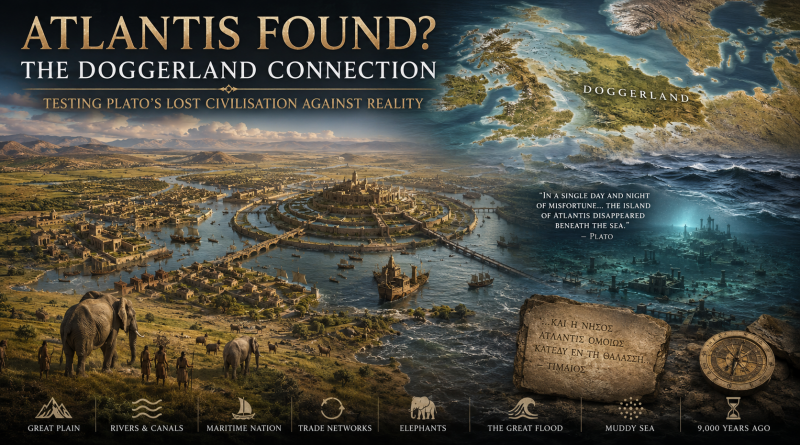
Testing Plato’s Atlantis Against Reality
Introduction
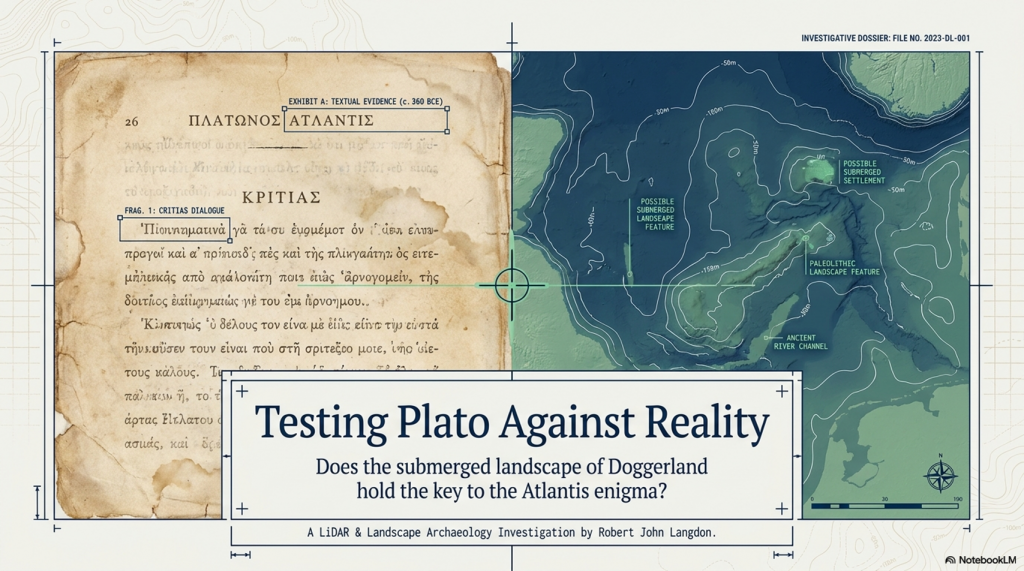
Atlantis is one of the most investigated mysteries in history.
For more than two thousand years, researchers have searched for the civilisation described by Plato. Hundreds of locations have been proposed, from the Mediterranean and Spain to Antarctica and the Caribbean. Yet despite thousands of books, documentaries, websites, and personal theories, no consensus has ever emerged. (Testing Plato’s Atlantis Against Reality)
The reason is simple.
Most Atlantis investigations begin with a location and then search for evidence to support it.
This study reverses the process.
Rather than asking where Atlantis was, it begins by asking what Plato actually described.
Using the original texts of Timaeus and Critias, every geographical, environmental, engineering, economic, and hydrological description is treated as an independent test. The objective is not to prove a theory but to examine whether any known prehistoric landscape satisfies the greatest number of Plato’s descriptions simultaneously.
Modern archaeological discoveries, seabed mapping, geological surveys, and AI-assisted analysis now allow Plato’s account to be examined in ways that were impossible even a decade ago.
The question is no longer whether Atlantis existed.
The question is whether Plato’s description corresponds to a real prehistoric landscape.
To answer that question, we must begin with the evidence itself.
1. The Atlantis Problem
Few subjects have generated more speculation than Atlantis.
Since Plato first recorded the story over two thousand years ago, hundreds of locations have been proposed as the site of the lost civilisation. Atlantis has been placed in the Mediterranean, Spain, the Azores, Antarctica, the Caribbean, the Sahara, and even beyond the Atlantic Ocean. Entire industries have developed around the search for Atlantis, yet no location has achieved universal acceptance.
The reason is not a lack of theories.
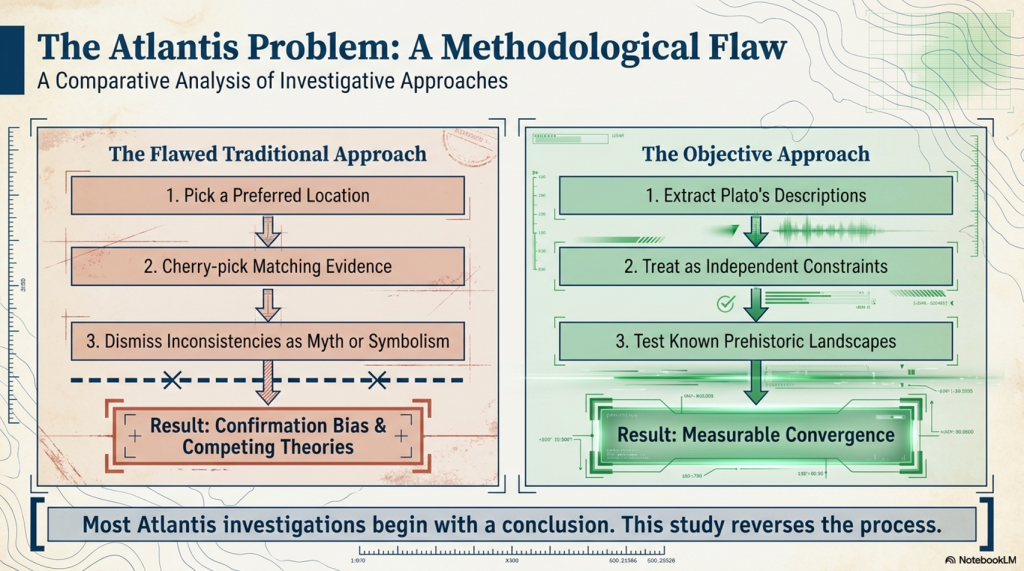
The problem is that most investigations begin with a conclusion.
A researcher selects a preferred location and then searches for evidence that supports it. Features that appear to match Plato’s description are highlighted, while features that do not are often ignored, reinterpreted, or dismissed as symbolism. As a result, Atlantis research has become dominated by confirmation bias, with each new theory selecting only the evidence that supports its own conclusion.
This approach creates an impossible situation.
A location may possess mountains but lack the great plain described by Plato.
Another may contain evidence of flooding but have no connection to the sea routes he describes.
A third may fit the chronology but fail the geographical requirements.
Each theory can explain some aspects of Plato’s account, but none can explain all of it.
The consequence is that Atlantis has become less an archaeological investigation and more a competition among competing interpretations.
Yet Plato’s account provides a solution to this problem.
Rather than treating Atlantis as a mystery to be solved through speculation, it can be approached as a series of measurable constraints. Plato describes the size of the landscape, its relationship to the sea, the existence of mountains, rivers, lakes, marshes, canals, harbours, shipping, trade, natural resources, wildlife, and ultimately its destruction by flooding. These are not opinions. They are observations recorded within the text.
The question, therefore, changes completely.
Instead of asking whether a particular location could be Atlantis, we can ask a far more objective question:
How many of Plato’s descriptions does that location actually satisfy?
This simple change transforms Atlantis from a debate about belief into a testable investigation.
The objective of this study is therefore not to prove Atlantis existed, nor to defend a preconceived theory.
It is to examine Plato’s descriptions one by one and determine whether any known prehistoric landscape satisfies the greatest number of independent constraints simultaneously.
Only then can we begin to assess whether Plato was describing fiction, memory, or a real place lost beneath the sea.
2. What Did Plato Actually Say?
Before Atlantis can be investigated, a more fundamental question must be answered.
What exactly did Plato describe?
This may appear to be a simple question, yet it lies at the heart of the Atlantis mystery. For more than two thousand years, researchers have debated the location of Atlantis, often overlooking the only source that truly matters. Every claim about Atlantis ultimately depends upon the writings of a single individual: Plato.
The surviving account appears in two dialogues, Timaeus and Critias, written during the fourth century BCE. Everything that is known about Atlantis originates from these texts. There are no surviving Atlantean records, no inscriptions, no maps, and no independent historical accounts describing the civilisation. Whether Atlantis was real, fictional, exaggerated, or based upon cultural memory, the investigation must begin with Plato because Plato is the only witness we possess.
This immediately creates an important distinction between evidence and interpretation.
Over the centuries, Atlantis has accumulated layer upon layer of speculation. It has been transformed into a lost continent, an advanced technological civilisation, a spiritual kingdom, an alien colony, and even a prehistoric superpower possessing knowledge beyond modern science. Yet none of these claims originates with Plato. They are later additions imposed upon the story.
When the original text is examined, a very different picture emerges.
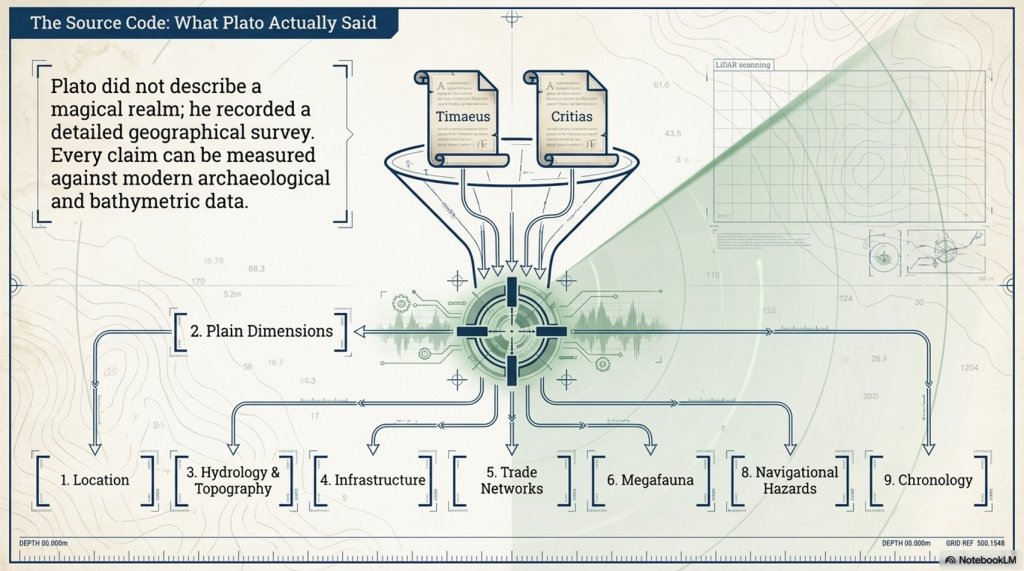
Plato’s Atlantis is not described through myths or miracles. Instead, it is described in geographic terms. He provides measurements for the plain. He describes mountains, rivers, lakes, marshes, fertile land, canals, harbours, shipping routes, wildlife, natural resources, agriculture, engineering works, and political organisation. The account reads less like a legend and more like a geographical survey.
This is an important observation because geography can be tested.
A statement such as “Atlantis lay beyond the Pillars of Heracles” can be examined against real locations.
A statement describing a plain measuring approximately two thousand by three thousand stadia can be compared against modern maps.
Descriptions of waterways, marshes, canals, and harbours can be compared against geological and archaeological evidence.
Even Plato’s observations regarding flooding and the eventual destruction of the landscape can be examined using modern sea-level reconstructions.
This transforms the investigation completely.
Most Atlantis theories focus on individual details that appear to support a preferred location. One researcher may focus on flooding. Another may focus on volcanic activity. A third may focus on the shape of a harbour. The result is a collection of theories that often explain one aspect of Plato’s account while ignoring the rest.
A more rigorous approach is to treat every description as part of a larger system.
Plato did not describe a mountain.
He described a landscape.
He did not describe a flood.
He described a civilisation connected to rivers, waterways, shipping, trade, resources, agriculture, and ultimately destruction by water.
The significance lies not in any single observation but in the cumulative pattern created when all of the observations are considered together.
For this reason, the purpose of this study is not to prove that Plato was correct in every detail. Nor is it to assume that Atlantis existed before the evidence is examined.
Instead, Plato’s account will be treated as a series of independent constraints.
Each description becomes a test.
If a proposed location satisfies the description, it passes.
If it does not, it fails.
The objective is not to find evidence that supports a theory. The objective is to determine whether any known prehistoric landscape satisfies the greatest number of Plato’s descriptions simultaneously.
Before examining maps, archaeology, geology, hydrology, trade networks, and environmental reconstruction, we must therefore establish the criteria against which every Atlantis theory will be measured.
Those criteria come directly from the only surviving source that matters.
Plato’s own words.
3. The Rules of the Investigation
Most Atlantis investigations begin with a map.
A researcher selects a promising location and then searches for similarities between that landscape and Plato’s account. If a mountain matches, it is highlighted. If evidence of flooding is found, it is presented as confirmation. If an inconsistency appears, it is often explained away as symbolism, mistranslation, exaggeration, or myth.
This approach has produced hundreds of competing theories about Atlantis and very little agreement.
The reason is simple.
Almost every investigation begins with a conclusion.
The objective of this study is different.
Rather than starting with a location, it starts with a set of measurable constraints derived directly from Plato’s text. Every geographical, environmental, engineering, economic, and hydrological description is treated as an independent test that any proposed Atlantis location must satisfy.
This transforms Atlantis from a mystery into a problem that can be examined systematically.
For example, Plato states that Atlantis lay “beyond the Pillars of Heracles”. Any location within the Mediterranean immediately fails that test.
Plato describes “a vast plain approximately two thousand by three thousand stadia in size“. Any proposed landscape lacking a comparable plain fails that test.
Plato describes mountains, rivers, lakes, marshes, navigable waterways, engineered canals, harbours, shipping, abundant natural resources, wildlife, and eventual destruction by flooding. Each description becomes another independent constraint against which candidate locations can be measured.
The importance of this approach lies in the cumulative effect.
A single match proves very little.
Many locations contain mountains.
Many locations contain rivers.
Many locations have experienced flooding.
The question is not whether a location satisfies one description.
The question is whether it satisfies many descriptions simultaneously.
This distinction is crucial because Atlantis is not described through a single characteristic. Plato presents an integrated landscape in which geography, hydrology, engineering, trade, agriculture, and society are interconnected.
The mountains matter because they feed the rivers.
The rivers matter because they support the plains.
The plains matter because they support agriculture.
The waterways matter because they support transport and trade.
The flooding matters because it explains the destruction of the entire system.
Each component is linked to the others.
The investigation, therefore, focuses not on individual observations but on patterns.
Modern archaeological and geological research now provides an unprecedented opportunity to perform this analysis. Seabed mapping has revealed the submerged landscapes beneath the North Sea. LiDAR surveys have transformed our understanding of prehistoric earthworks. Geological investigations have reconstructed ancient river systems, coastlines, and sea-level changes. Archaeological discoveries continue to provide evidence for long-distance trade, large-scale engineering, and sophisticated social organisation.
At the same time, modern analytical techniques allow large quantities of information to be compared systematically. Rather than relying upon isolated observations, entire datasets can be examined together to determine how closely a proposed location aligns with Plato’s description.
This is where the investigation differs from traditional Atlantis research.
The objective is not to prove Doggerland was Atlantis.
The objective is to test Doggerland against the same criteria that apply to every other proposed location.
If Doggerland fails the tests, it should be rejected.
If it passes the tests, that result must also be acknowledged.
The process is therefore simple.
Extract Plato’s descriptions.
Compare them with the evidence.
Record the result.
Repeat the process for every major characteristic of Atlantis.
Only then can a meaningful conclusion be reached.
With the methodology established, the investigation can now begin with the first and most fundamental question:
Where did Plato place Atlantis?
4. Beyond the Pillars of Heracles
The first test is also the simplest.
Where did Plato place Atlantis?
This question matters because it immediately eliminates many popular theories about Atlantis. Before examining plains, canals, elephants, trade networks, or flooding, we must first establish the geographical location described in the original text.
Plato is remarkably clear on this point.
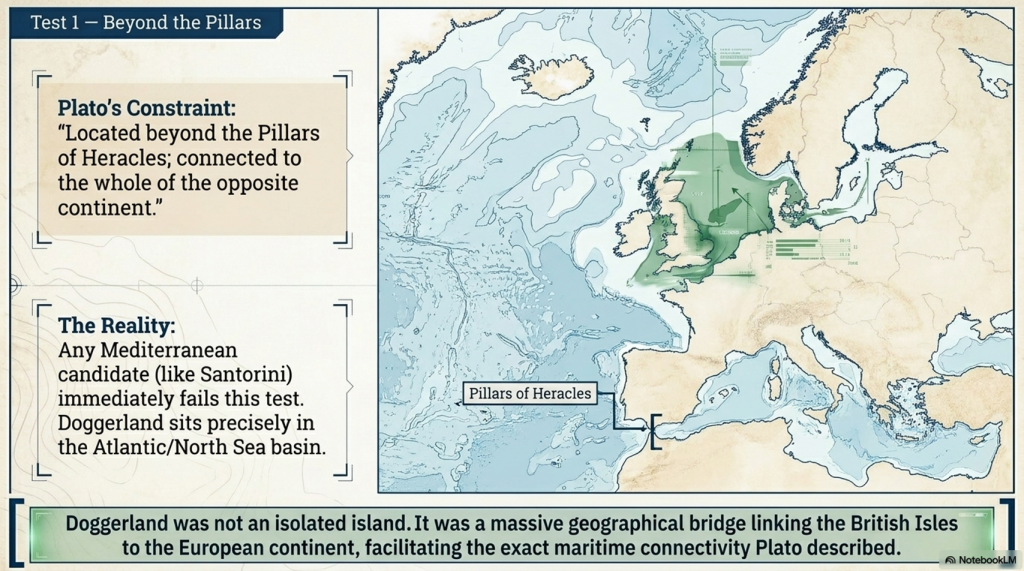
“This power came forth out of the Atlantic Ocean, for in those days the Atlantic was navigable; and there was an island situated in front of the straits which are by you called the Pillars of Heracles.”
This statement establishes the first and most important geographical constraint.
Atlantis was located beyond the Pillars of Heracles.
Traditionally, the Pillars of Heracles are identified with the Strait of Gibraltar. If this interpretation is correct, Atlantis must lie outside the Mediterranean rather than within it.
This creates a significant problem for many popular Atlantis theories.
Santorini, one of the most frequently proposed candidates, lies firmly within the Mediterranean basin. The same problem applies to numerous locations in Greece, Turkey, Italy, and other parts of the eastern Mediterranean. Regardless of their archaeological significance, they fail Plato’s first geographical test.
The importance of this passage is reinforced by what follows.
Plato continues:
“From it travellers could pass to the other islands, and from the islands to the whole of the opposite continent which surrounded the true ocean.”
This second statement introduces additional constraints.
Atlantis was not described as an isolated island.
Instead, it formed part of a wider geographical system connecting other islands and a larger landmass beyond.
For centuries, this passage has caused considerable debate. Some researchers have interpreted it as evidence of trans-Atlantic voyages. Others have suggested that Plato was describing a chain of islands leading westward into the Atlantic Ocean.
Regardless of interpretation, the description requires a location that can serve as a geographical bridge rather than a remote destination.
This is where Doggerland becomes particularly interesting.
Prior to its inundation, Doggerland occupied the centre of a vast landscape linking Britain, continental Europe, and Scandinavia. Rather than existing as an isolated island, it formed part of a connected North European peninsula extending across much of the present-day North Sea basin. Movement through this landscape naturally linked multiple regions through both land and water routes.
The significance of this arrangement is often overlooked.
Most theories about Atlantis focus on finding an island.
Plato, however, spends considerable time describing connections between islands, neighbouring lands, and larger continental regions. The emphasis is not isolation but connectivity.
This observation becomes increasingly important when examined alongside the archaeological evidence discussed later in this study. Trade routes, transport networks, and material movement all suggest that prehistoric Europe was far more interconnected than traditionally believed.
Doggerland occupied the centre of that network.
It linked Britain to mainland Europe.
It linked the Atlantic to the North Sea.
It linked multiple river systems into a single hydrological landscape.
In short, it occupied precisely the sort of strategic position one might expect from the civilisation Plato describes.
This does not prove that Doggerland was Atlantis.
It does, however, satisfy the first major geographical requirement.
Unlike many proposed locations, Doggerland lies beyond the Mediterranean world, forms part of a wider interconnected landscape, and occupies a position that can link islands, coastlines, and continental regions into a single system.
The first test, therefore, produces an intriguing result.
Plato’s description places Atlantis beyond the Pillars of Heracles and connects it to a broader geographical network.
Doggerland satisfies both requirements.
The investigation can therefore proceed to the next question.
Did Plato’s description of Atlantis match the physical shape and dimensions of the lost landscape beneath the North Sea?
NB. A Curious Linguistic Clue
One detail is often overlooked.
When Plato describes Atlantis, he simultaneously refers to the surrounding body of water as the Atlantic Ocean.
“For in those days the Atlantic was navigable…”
This raises an obvious question.
Which came first?
Did the island receive its name from the ocean, or did the ocean receive its name from the island?
Whatever the answer, the association is significant because more than two thousand years later, we still refer to the same body of water as the Atlantic Ocean. The spelling has evolved through successive Greek, Latin, and European translations, but the root name remains essentially unchanged.
This observation does not prove the existence of Atlantis, but it does reinforce an important point. Plato was not describing an isolated island detached from its surroundings. He was describing a location embedded within a much larger Atlantic system, comprising oceans, islands, coastlines, and continental landmasses.
The investigation must therefore consider not only the island itself, but the wider landscape to which Plato repeatedly refers.
5. Measuring Atlantis
The description of Atlantis becomes considerably more interesting once Plato begins discussing the central plain.
Unlike many ancient writers, Plato does not simply describe a fertile landscape. He provides dimensions.
This is important because measurements can be tested.
They are not matters of opinion.
They either correspond to a real landscape or they do not.
In Critias, Plato describes the central plain of Atlantis:
“The plain around the city was level and smooth, and of an oblong shape, extending in one direction three thousand stadia, and in the centre inland across it two thousand stadia.”
This is one of the most precise geographical descriptions in the entire account of Atlantis.
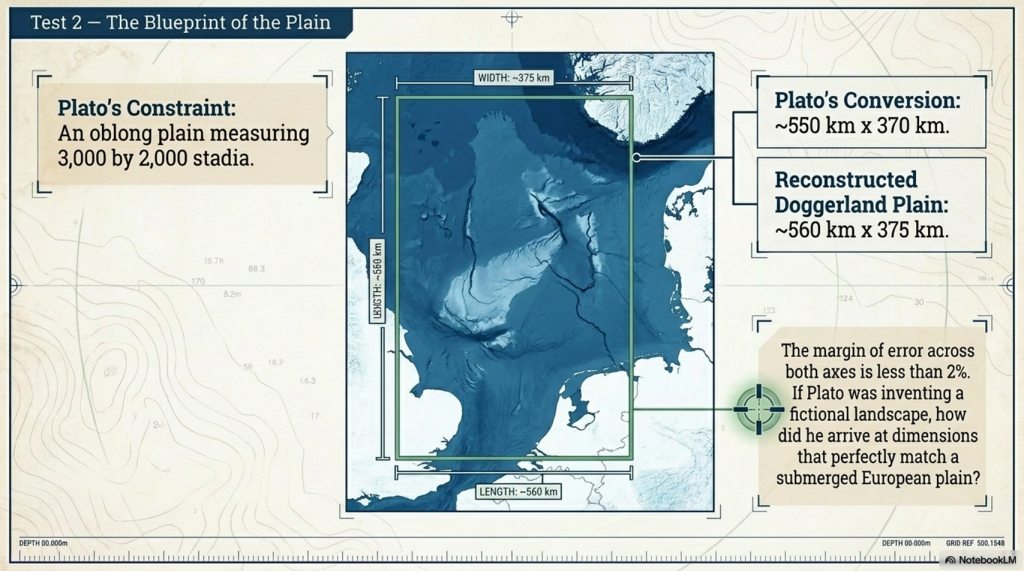
Using the standard Greek stadion, these dimensions equate to approximately 550 kilometres by 370 kilometres.
For centuries, researchers have attempted to identify a landscape matching these proportions.
Many proposed locations for Atlantis immediately encounter difficulties.
Some are too small.
Others lack a significant plain entirely.
Many require extensive reinterpretation of Plato’s measurements in order to fit the available geography.
The advantage of a numerical description is that it can be compared directly against modern mapping.
When bathymetric surveys of the North Sea are examined, a striking pattern emerges.
Prior to inundation, Doggerland occupied a vast low-lying region stretching between Britain and continental Europe. At its centre lay an enormous plain surrounded by higher ground associated with Britain, Scandinavia, and mainland Europe.
Reconstructions of this central landscape produce dimensions remarkably similar to those described by Plato.
Modern estimates place the principal Doggerland plain at approximately 375 kilometres by 560 kilometres.
The correspondence is extraordinary.
Across both axes, the difference between Plato’s measurements and the reconstructed dimensions of Doggerland is less than two per cent.
This does not prove that Doggerland was Atlantis.
However, it raises an obvious question.
If Plato was inventing a fictional landscape, how did he arrive at dimensions that correspond so closely to one of the largest submerged plains in Europe?
The significance of this match extends beyond simple size.
Plato does not describe a circular landscape, a mountain range, or an irregular island chain.
He describes an oblong plain.
That distinction matters because shape is an independent constraint.
A landscape may match the dimensions but fail the shape.
Equally, it may match the shape but fail the dimensions.
Doggerland appears to satisfy both simultaneously.
Plato continues by describing the plain as exceptionally fertile and traversed by waterways descending from the surrounding uplands.
This observation becomes increasingly important when examined alongside modern environmental reconstructions.
Far from being a barren landscape, Doggerland is now understood to have contained extensive river systems, wetlands, lakes, estuaries, and productive alluvial environments capable of supporting abundant wildlife and human populations.
The plain, therefore, does not stand alone.
It forms part of a larger geographical system.
The mountains feed the rivers.
The rivers cross the plain.
The plain supports agriculture and settlement.
The waterways provide transport and communication.
This interconnected landscape is precisely the type of environment Plato describes.
Critics often focus on individual details while overlooking the cumulative significance of the evidence.
The importance of the plain is not simply that it exists.
The importance is that its dimensions, shape, position, and environmental setting all align with Plato’s description simultaneously.
This is exactly the type of test outlined in the previous chapter.
A single correspondence proves little.
Multiple independent correspondences are more difficult to dismiss.
The central plain, therefore, represents the first major quantitative comparison between Plato’s account and a real prehistoric landscape.
The result is striking.
Plato describes an oblong plain measuring approximately 550 by 370 kilometres.
The reconstructed plain of Doggerland measures approximately 560 by 375 kilometres.
The difference is so small that it falls within the uncertainties associated with both ancient measurements and modern reconstruction.
For the first time in this investigation, Plato’s description is not merely similar to the evidence.
It is measurable against it.
And the match is remarkably close.
6. Mountains, Rivers and Wetlands
Having established that Doggerland satisfies Plato’s description of a vast central plain, the next question is whether the surrounding landscape also matches his account.
This is where many Atlantis theories begin to encounter difficulties.
A location may contain a plain, but Plato does not describe Atlantis as a plain in isolation. He describes a complete environmental system in which mountains, rivers, lakes, marshes, and fertile lowlands are interconnected. Each component supports the others, creating a landscape that functions as a single geographical unit.
Plato writes:
“The surrounding mountains descended towards the sea.”
He further describes streams flowing down from these uplands into the plain below.
“Receiving the streams which came down from the mountains.”
These statements immediately create another set of measurable constraints.
Atlantis must possess:
- A large central plain.
- Higher ground surrounds parts of that plain.
- Rivers descending from those uplands.
- Extensive water systems distributed across the landscape.
For many years, critics of the Doggerland hypothesis have focused on the mountain requirement. They argue that the North Sea contains no mountains and therefore cannot be Atlantis.
The objection appears convincing only when the entire landscape is considered, rather than the modern seabed alone.
Doggerland did not exist in isolation.
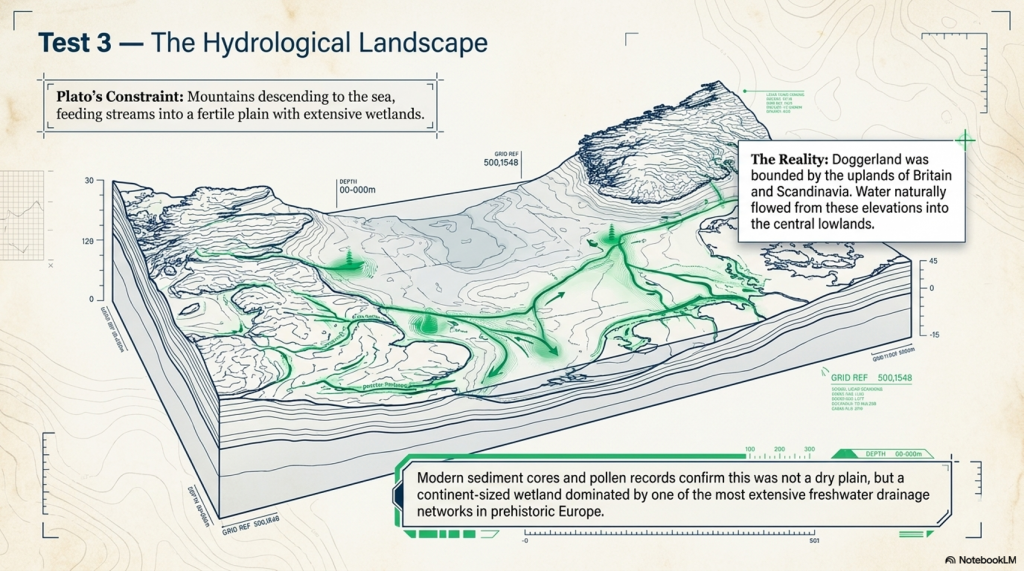
Before inundation, it formed part of a much larger North European landscape bounded by the uplands of Britain, Scotland, Norway, and Scandinavia. These elevated regions surrounded the lower-lying basin that now forms the North Sea. Water naturally flowed from these uplands into the central lowlands, creating one of the most extensive river systems in prehistoric Europe.
Modern seabed surveys have revealed that the North Sea floor preserves the remains of this lost hydrological network.
Buried beneath the sea are the traces of rivers, tributaries, lakes, estuaries, and wetlands that once crossed Doggerland. Some river systems were comparable in scale to major modern European rivers. Others combined to form vast drainage networks flowing through the centre of the landscape before eventually reaching the Atlantic.
This is not speculation.
It is visible on modern bathymetric maps.
The significance of these discoveries cannot be overstated.
For centuries, Atlantis was often imagined as a small island surrounded by open ocean. The emerging picture of Doggerland is entirely different. It was not a solitary island but a continent-sized wetland environment dominated by freshwater systems.
This distinction is important because Plato repeatedly emphasises water.
He describes rivers.
He describes canals.
He describes harbours.
He describes fertile plains sustained by water.
He describes a civilisation organised around waterways rather than isolated from them.
The environmental reconstruction of Doggerland aligns remarkably well with this picture.
Evidence from sediment cores, pollen records, peat deposits, and submerged landscapes indicates that Doggerland supported extensive woodland, grassland, marshes, lakes, and river valleys. These environments would have provided abundant resources for both humans and animals.
Plato’s description of a fertile landscape, therefore, finds support within the geological evidence.
The same is true of the wetlands.
Throughout his account, Plato describes a landscape rich in water and natural productivity. Modern reconstructions consistently portray Doggerland as exactly such an environment. Rather than a dry plain, it appears to have been characterised by interconnected waterways, elevated groundwater, seasonal flooding, and extensive marsh systems.
This observation becomes increasingly significant when combined with the evidence presented in earlier chapters.
The dimensions of the plain match.
The geographical position matches.
The surrounding uplands match.
The river systems match.
The wetland environment matches.
Individually, each correspondence might be dismissed as a coincidence.
Together, they form a coherent pattern.
Most theories about Atlantis focus on a single feature.
Doggerland continues to satisfy multiple independent constraints simultaneously.
More importantly, the evidence reveals not merely a location but a functioning landscape.
The mountains feed the rivers.
The rivers cross the plain.
The wetlands support wildlife.
The waterways provide transport.
The entire system operates exactly as Plato describes.
The result is that Atlantis begins to look less like a mythical kingdom and more like a recognisable prehistoric environment.
Having established that the geography and environmental reconstruction closely correspond to Plato’s account, we can now turn to one of the most overlooked aspects of the story of Atlantis.
The waterways themselves.
Because Plato was not simply describing rivers.
He was describing a civilisation built around them.
7. The Waterway Civilisation
The traditional image of prehistoric Europe is one of scattered communities separated by forests, mountains, and vast distances. According to this model, movement was slow, local, and difficult. Rivers are generally viewed as obstacles to be crossed rather than infrastructure to be used.
Plato describes something very different.
Throughout Critias, waterways recur as central features of the Atlantean landscape. They are not incidental features but fundamental elements of how the civilisation functioned.
Plato writes:
“They cut canals…”
He further states:
“They brought a canal from the sea…”
And then adds:
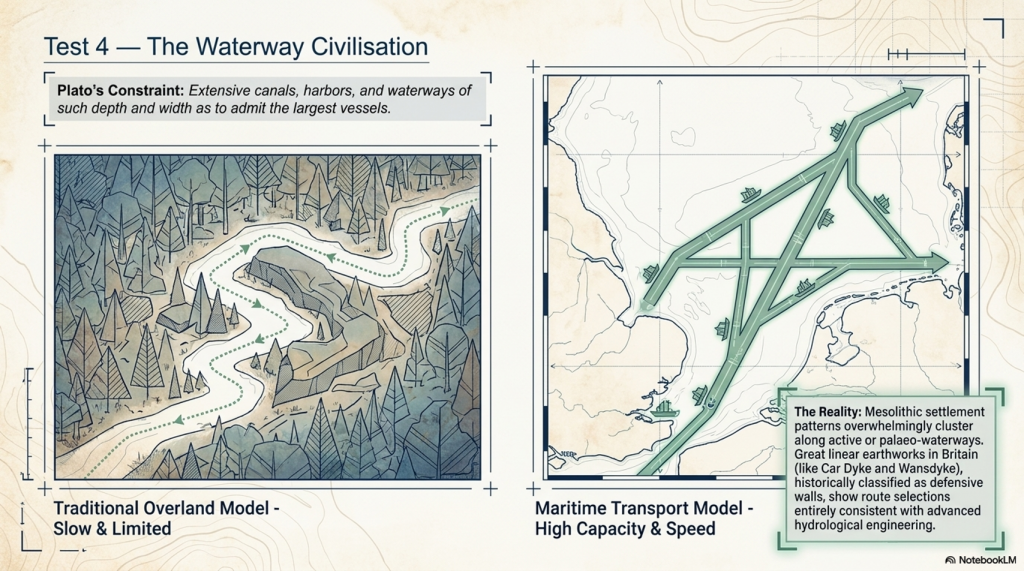
“The canal was of such a depth and width as to admit the largest vessels.”
These statements are extraordinary.
Most discussions of Atlantis focus on the destruction of the civilisation while paying little attention to the infrastructure Plato describes. Yet canals, harbours, and navigable waterways imply something far more significant than a simple settlement. They imply a society organised around the movement of people, materials, and resources by water.
This distinction is critical.
Roads require continuous maintenance and are limited by terrain.
Waterways perform the same function naturally.
A boat can move far greater loads than can be transported overland, particularly in heavily forested landscapes. In a world dominated by rivers, estuaries, lakes, and shallow seas, water is the most efficient means of transport.
This is precisely the environment reconstructed for Doggerland.
Modern seabed surveys reveal an extensive network of rivers and channels linking the North Sea basin to Europe’s major river systems. The Rhine, Thames, Elbe, Meuse, and numerous smaller waterways formed an interconnected transport network stretching across north-west Europe.
Rather than acting as barriers, these waterways would have functioned as highways.
This interpretation is reinforced by settlement patterns.
When Mesolithic sites are plotted geographically, a striking pattern emerges. The overwhelming majority occur on active waterways or on palaeo-water systems that were once navigable. Settlements repeatedly cluster along rivers, estuaries, coastal margins, and wetland environments.
This distribution is unlikely to be accidental.
It reflects the underlying infrastructure of the civilisation itself.
The implications extend far beyond simple travel.
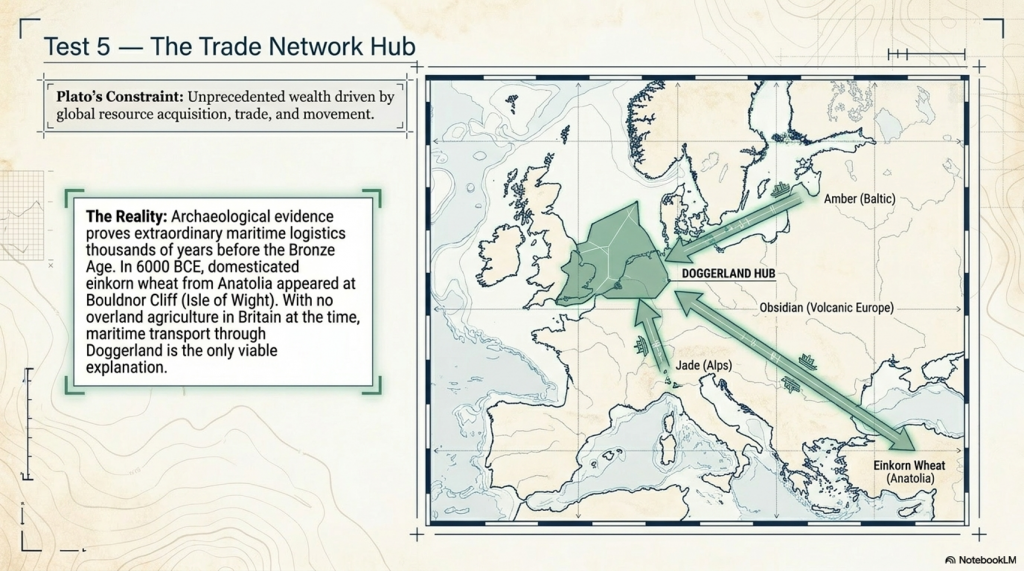
A water-based transport system explains the movement of materials across enormous distances. Amber travelled from the Baltic. Obsidian moved from volcanic regions into central Europe. Alpine jade appeared thousands of kilometres from its source. Wheat reached Britain from Anatolia. Large stones were transported across landscapes that conventional archaeology often struggles to explain.
Viewed through a maritime framework, these movements cease to be mysterious.
The waterways provide the answer.
The significance of this observation becomes even greater when considered alongside Britain’s great linear earthworks.
Features such as Car Dyke, Wansdyke, Offa’s Dyke, and the Vallum have traditionally been interpreted as defensive structures. Yet many possess characteristics that are equally consistent with hydrological engineering. Their scale, route selection, gradients, and relationship to water raise the possibility that at least some formed part of a much larger water-management system.
Whether every dyke served such a purpose remains open to debate.
What matters is that Plato repeatedly describes a civilisation that engineered waterways for transport and communication.
The concept, therefore, exists within the original account of Atlantis itself.
This is one of the strongest correspondences between Plato’s description and the emerging picture of prehistoric north-west Europe.
Both depict landscapes organised around water.
Both depict movement occurring primarily through waterways.
Both depict engineering directed toward the control and use of water.
Most importantly, both describe societies whose success depended upon mastering the hydrological environment in which they lived.
The traditional image of Atlantis is often that of a lost city.
Plato’s account suggests something much larger.
It suggests a waterway civilisation.
A civilisation whose rivers, canals, harbours, and maritime routes formed the foundation of its economy, communication, and survival.
If this interpretation is correct, then Atlantis was not defined by its buildings.
It was defined by its network.
And that network extended across an entire landscape.
The next question is therefore obvious.
If waterways connected the civilisation, what exactly was moving through them?
8. The Trade Network
If Atlantis was organised around waterways, then an obvious question follows.
What was moving through them?
Plato repeatedly describes Atlantis as a wealthy civilisation possessing access to resources on a scale unmatched by its contemporaries. He writes:
“They had such an amount of wealth as was never before possessed by kings and potentates.”
This statement is often treated as an exaggeration. Yet wealth does not emerge in isolation. It is the product of production, movement, and exchange. If Atlantis possessed extraordinary wealth, then it must also have possessed extraordinary infrastructure capable of acquiring, transporting, and distributing resources.
Plato reinforces this observation when describing the natural abundance available to the Atlanteans.
“They dug out of the earth whatever was to be found there, solid as well as fusile.”
He also describes abundant timber, agricultural production, and animal resources.
These descriptions are significant because they imply a civilisation that actively exploits and manages a wide range of materials rather than simply consuming local resources.
When the archaeological evidence from Mesolithic and Neolithic Europe is examined, a remarkably similar picture emerges.
Materials repeatedly appear far beyond their natural sources.
Baltic amber is found throughout Britain, central Europe, and the Mediterranean.
Alpine jade axes occur thousands of kilometres from the quarries where the stone originated.
Obsidian can be traced geochemically to specific volcanic regions yet appears across large areas of Europe.
Copper, gold, and tin all exhibit long-distance movement patterns that require organised transport systems.
Viewed individually, each example appears unusual.
Viewed collectively, they reveal something far more significant.
They reveal a network.
The scale of this network is often underestimated.
The transport of jade from the Italian Alps to Britain required passage across rivers, along coastlines, and through multiple regions. Baltic amber travelled from northern Europe into southern markets. Obsidian was carried hundreds, and sometimes thousands, of kilometres. These journeys were not isolated events. They occurred repeatedly across long periods of time.
This suggests that movement was systematic rather than occasional.
One of the most compelling examples comes from Bouldnor Cliff off the Isle of Wight.
Archaeologists recovered evidence of domesticated einkorn wheat dating to approximately 6000 BCE. Genetic analysis linked this wheat to farming populations in Anatolia.
At that time, Britain showed no evidence of domestic agriculture.
The wheat, therefore, had to arrive from elsewhere.
There is no plausible overland route.
The implication is clear.
Maritime connections between Britain and continental Europe existed long before conventional models would predict.
This discovery is important because it demonstrates that materials, knowledge, and potentially people were moving through extensive transport networks thousands of years before the Bronze Age.
The same principle applies to the movement of stone.
Large megaliths appear at locations far removed from their geological source. The Altar Stone at Stonehenge is a notable example. Moving such materials through dense woodland by purely overland methods presents enormous logistical challenges.
Transport by water offers a far simpler solution.
Rivers, estuaries, and coastal routes enable the efficient transport of heavy loads over considerable distances.
The significance of these observations becomes increasingly apparent when compared with Plato’s account.
Atlantis is not described as an isolated settlement.
It is described as a civilisation connected to other islands and distant lands.
“From it they passed to the other islands, and from the islands to the whole of the opposite continent.”
This statement implies movement.
It implies communication.
Most importantly, it implies connectivity.
The archaeological evidence points toward exactly the same conclusion.
Europe was not a collection of isolated communities.
It was linked through a network of rivers, coastlines, estuaries, and maritime routes that facilitated the movement of materials over extraordinary distances.
Doggerland occupied the centre of that network.
Situated between Britain and continental Europe, connected to major river systems, and positioned within the North Sea basin, it formed a natural hub through which people, resources, and ideas could circulate.
The importance of this observation extends beyond trade itself.
Trade requires boats.
Boats require engineering.
Engineering requires organisation.
Organisation requires knowledge.
The movement of materials, therefore, provides indirect evidence for a much larger system operating behind the scenes.
This is precisely the type of organised, interconnected society described by Plato.
The materials themselves are not the story.
They are the evidence.
What they reveal is a civilisation capable of linking distant regions into a single functioning network.
A civilisation whose wealth was not created by isolation, but by connectivity.
The next question is whether Plato’s description extends beyond trade and infrastructure into the natural world itself.
Among his most surprising observations is one that many critics have dismissed entirely.
The presence of elephants.
9. The Elephant Problem
Few passages in Plato’s account have been attacked more frequently than his reference to elephants.
For generations, critics have treated a single sentence as sufficient reason to dismiss any northern European location for Atlantis.
Plato writes:
“Moreover, there were a great number of elephants in the island.”
The conclusion appears obvious.
Britain has no elephants.
Therefore, Atlantis cannot have been Britain, Doggerland, or anywhere within the North Sea basin.
At first glance, the argument appears convincing.
The problem is that it depends upon assumptions that become increasingly difficult to defend when examined against the archaeological evidence.
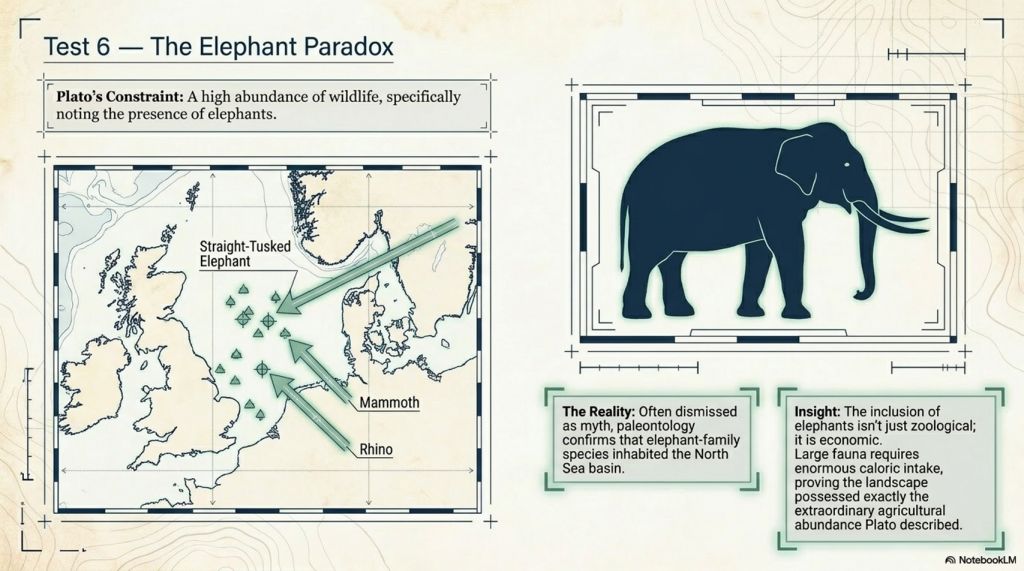
The first issue is that elephant-family species are already accepted within the British fossil record. Straight-tusked elephants, mammoths, hippopotamus, rhinoceros, lions, hyenas, and numerous other large mammals have all been recovered from Britain and the landscapes surrounding the North Sea. Their existence is not disputed. Museums throughout Britain contain the evidence.
The debate, therefore, is not about whether these animals existed.
They did.
The debate concerns how they got there.
According to the conventional model, many of these animals occupied Britain during warm interglacial periods, particularly the Eemian. During this period, Britain is frequently portrayed as a warm environment capable of supporting species normally associated with much more southerly regions.
Yet this explanation immediately creates a contradiction.
The same model often requires sea levels to be substantially higher than present levels. As sea levels rise, the land connections linking Britain to continental Europe become progressively restricted. The very animals used as evidence of a warm climate require migration routes that are increasingly difficult to explain.
The result is an uncomfortable paradox.
The archaeological evidence demonstrates that the animals existed.
The environmental model struggles to explain how such large populations repeatedly arrived.
This problem becomes even greater when the wider geographical distribution of these animals is considered. Elephant remains are not confined to Britain. Similar evidence exists throughout north-west Europe bordering the North Sea basin. The pattern suggests a much larger landscape supporting extensive animal populations rather than isolated pockets of wildlife trapped on an island.
This is precisely what Doggerland represents.
A vast interconnected landmass linking Britain to continental Europe.
A landscape through which both animals and humans could move freely.
The significance of this observation becomes even more apparent when viewed alongside Plato’s wider description of Atlantis.
Critics often isolate the elephant passage as though it exists independently of the rest of the account.
It does not.
By this stage of the investigation, Plato has already described a civilisation connected by waterways, supported by maritime transport, and operating across an extensive geographical network. The archaeological evidence points towards the movement of obsidian across Europe, Baltic amber into distant regions, Alpine jade over thousands of kilometres, Anatolian wheat into Britain, and the transport of massive stones across substantial distances.
Materials moved.
Resources moved.
People moved.
Ideas moved.
Entire trade networks operated across rivers, coastlines, and shallow seas.
Against this backdrop, the suggestion that large animals could also be moved becomes far less remarkable than critics often imply.
Indeed, elephants were not confined to Africa. Throughout antiquity, elephant populations occupied regions much closer to Europe, including parts of the eastern Mediterranean. The modern tendency to associate elephants exclusively with Africa is, therefore, misleading when discussing prehistoric and ancient landscapes.
More importantly, Plato’s reference is not primarily zoological.
It is economic.
Large animals consume enormous quantities of food and water. A landscape capable of supporting significant elephant populations is, by definition, a landscape of abundance.
This is exactly the point Plato is making.
The elephant passage forms part of a wider description of exceptional productivity. Throughout Critias, Atlantis is portrayed as a land rich in water, wildlife, natural resources, agriculture, and wealth. The elephants are not presented as curiosities. They are presented as evidence of the extraordinary prosperity of the landscape itself.
When viewed in this context, the criticism begins to collapse.
The fossil evidence demonstrates that elephant-family species existed within Britain and the wider North Sea region.
The conventional explanation for their presence contains unresolved contradictions.
The geographical reconstruction of Doggerland provides a more coherent mechanism for both animal and human movement.
And Plato’s description of elephants forms part of a broader picture of abundance that aligns closely with the productive environments reconstructed for the drowned landscapes of north-west Europe.
Far from disproving the existence of a northern Atlantis, the elephant passage may preserve one of the clearest memories of a world that has long since disappeared.
A world of vast plains, interconnected waterways, abundant wildlife, and rich ecosystems stretching across what is now the floor of the North Sea.
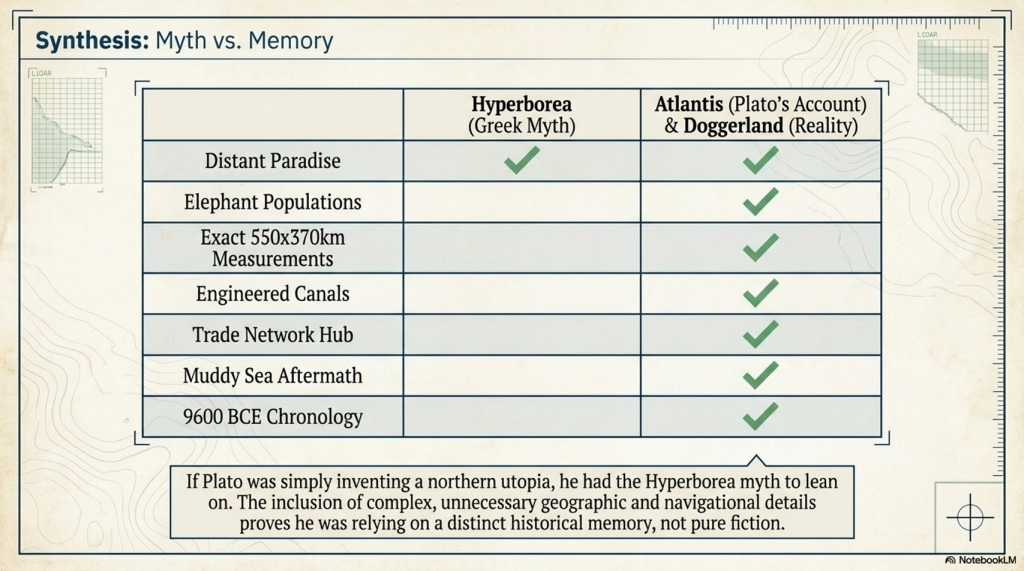
NB. The Hyperborea Problem
One possible explanation for Atlantis is that Plato simply invented a mythical land beyond the known world. However, this explanation encounters an unexpected difficulty.
Greek literature already contained examples of distant northern paradises, the most famous of which was Hyperborea. Like Atlantis, Hyperborea was described as a prosperous land located beyond the ordinary limits of the Greek world. It was associated with abundance, favourable conditions, and a people living in harmony with the gods.
Yet Hyperborea contains no elephants.
This is significant because it demonstrates that Greek writers did not normally populate northern legendary lands with elephant herds. If Plato simply wanted to create another distant paradise, elephants were not a necessary part of the story.
Indeed, Hyperborea shares several broad themes with Atlantis while lacking many of Atlantis’s most distinctive features. There are no great engineering works, no vast canal systems, no maritime empire, no imperial ambitions, and no large elephant populations.
The question, therefore, becomes difficult to avoid.
Why did Plato include elephants?
If they were merely a literary invention, they represent a surprisingly specific addition to a narrative that did not require them. If they originated within an earlier tradition known to Plato, then the problem changes completely. The question is no longer why Plato added elephants, but why the source tradition contained them in the first place.
Hyperborea demonstrates that Greeks could imagine northern utopias without elephants.
The elephant passage, therefore, remains one of the most unusual and difficult-to-explain details within the Atlantis account.
And if Plato’s description of the environment continues to align with the evidence, attention must now turn to the most dramatic claim of all.
According to Plato, this entire landscape was ultimately destroyed by water.
10. The Great Flood
No aspect of Plato’s account has received more attention than the destruction of Atlantis.
For many researchers, it is the defining event of the story. Entire theories have been built around earthquakes, volcanic eruptions, tsunamis, and sudden catastrophes. Yet before attempting to explain the destruction, it is essential to establish exactly what Plato wrote.
In Timaeus, the Egyptian priest tells Solon:
“There occurred violent earthquakes and floods; and in a single day and night of misfortune all your warlike men in a body sank into the earth, and the island of Atlantis in like manner disappeared beneath the sea.”
This passage is frequently misunderstood.
The phrase “your warlike men” does not refer to the Atlanteans. The priest is speaking directly to Solon and is referring to the prehistoric Athenians who supposedly opposed Atlantis. Plato is therefore describing two separate losses.
First, the destruction of the ancient Athenian force:
“all your warlike men in a body sank into the earth.”
Second, the destruction of Atlantis:
“the island of Atlantis in like manner disappeared beneath the sea.”
The distinction is important because the two events are described differently. The Athenians are said to sink into the earth, while Atlantis disappears beneath the sea. Although Plato links the events together, he does not explicitly state that they occurred through the same mechanism.
This observation immediately complicates the traditional interpretation of Atlantis being destroyed in a single catastrophic moment.
The text may instead preserve memories of different processes combined within a single narrative.
This becomes particularly significant when compared with the geological evidence.
Unlike most proposed locations for Atlantis, Doggerland is known to have suffered the exact fate Plato describes.
It disappeared beneath the sea.
For thousands of years following the end of the last Ice Age, Doggerland formed a vast low-lying landscape connecting Britain to continental Europe. Rivers crossed its plains. Forests covered large areas. Lakes, marshes, and wetlands supported abundant wildlife and human populations. Archaeological discoveries from the North Sea continue to demonstrate that this landscape was inhabited for millennia.
Today, it lies beneath the sea.
This is not a theory.
It is a geological fact.
The significance of this cannot be overstated.
Many theories about Atlantis attempt to explain how a civilisation might have been destroyed.
Doggerland requires no such explanation.
Its destruction is already accepted.
The debate concerns how that destruction occurred.
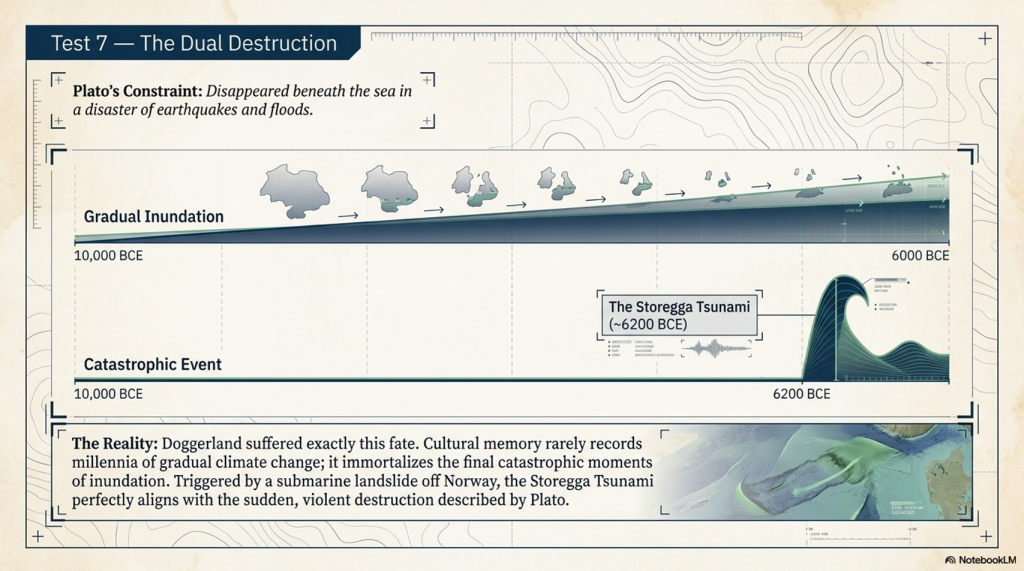
The conventional model describes a gradual process. As the Ice Age ended, melting glaciers caused global sea levels to rise. Over thousands of years, coastlines retreated, and low-lying regions became increasingly vulnerable to flooding. Rivers expanded into estuaries. Wetlands spread across the landscape. Eventually, large portions of Doggerland were submerged.
At first glance, this appears inconsistent with Plato’s dramatic description.
However, this comparison may be misleading.
Human societies rarely preserve memories of gradual environmental change.
They remember disasters.
A coastline may retreat slowly over centuries, but a major flood, storm surge, or sudden inundation can become fixed within cultural memory for generations. What survives in oral tradition is often not the process itself but the final catastrophe.
This distinction is crucial.
Doggerland was not lost through a single mechanism.
It was lost through a combination of processes acting over long periods.
Sea levels rose.
Coastlines retreated.
Settlements were abandoned.
Communities migrated.
Then, on top of these gradual changes, catastrophic events occurred.
The most famous of these was the Storegga tsunami around 6200 BCE. Triggered by a massive submarine landslide off the coast of Norway, the resulting tsunami impacted large areas of the North Atlantic and North Sea basin. Evidence of its effects has been identified around the coasts of Britain and neighbouring regions.
Whether Storegga alone destroyed Doggerland remains debated.
What matters is that it demonstrates something often overlooked.
The North Sea basin experienced both gradual inundation and sudden catastrophic flooding.
The landscape was therefore subject to precisely the combination of processes capable of generating the type of memory preserved in Plato’s account.
A long decline.
Followed by dramatic losses.
The more closely Doggerland is examined, the more unusual the comparison becomes. The geographical location corresponds. The dimensions of the plain correspond. The rivers, wetlands, maritime networks, trade routes, and environmental evidence all show remarkable similarities to Plato’s description.
Now the destruction itself reveals another correspondence.
Unlike Atlantis, Doggerland is not a legend.
Its existence is accepted.
Its flooding is accepted.
Its disappearance beneath the sea is accepted.
The only remaining question is whether Plato’s account preserves a distant memory of that lost landscape.
And it is here that Plato provides one final clue—one so unusual that many Atlantis researchers simply ignore it.
According to Plato, the destruction of Atlantis left behind something very specific.
Not an open sea.
But a sea of mud.
11. The Muddy Sea Mystery
If the flooding of Atlantis is the most famous part of Plato’s account, the muddy sea is undoubtedly the most neglected.
Yet it may also be one of the most important.
Following his description of Atlantis’s destruction, Plato records a curious consequence:
“For in consequence of the subsidence of the island, the sea in those parts became impassable and impenetrable, because there is a shoal of mud in the way; and this was caused by the subsidence of the island.”
This statement is remarkable.
Unlike the great plain, the canals, the elephants, or the flooding itself, the muddy sea serves no obvious literary purpose. It contributes nothing to Plato’s moral lesson concerning the rise and fall of civilisations. It does not glorify Atlantis. It does not explain its destruction.
Instead, it appears to be an observational detail.
A practical problem.
A navigational hazard.
This immediately raises an important question.
Why include it at all?
Most Atlantis theories struggle to answer.
If Atlantis were destroyed by a volcanic eruption, the expected consequence would be volcanic debris rather than a vast muddy shoal. If Atlantis existed in the deep Atlantic Ocean, the disappearance of an island would not normally leave behind an impassable sea of mud. If Atlantis were merely a philosophical invention, the muddy sea would become an oddly specific detail with little narrative value.
Yet when examined against Doggerland, the description becomes surprisingly familiar.
Doggerland was not a rocky island rising from deep water.
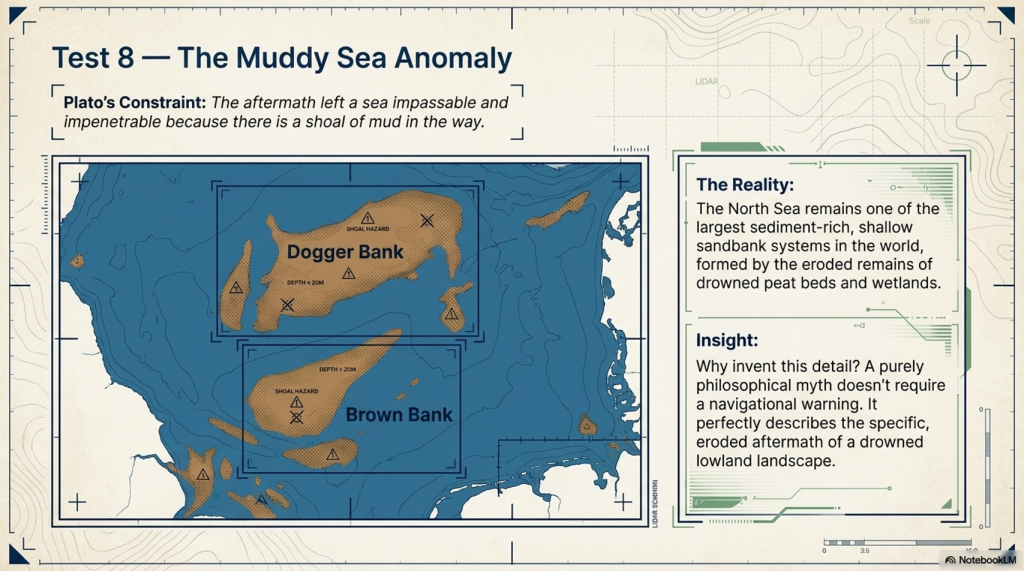
It was a vast low-lying plain composed largely of sediments deposited by rivers, glaciers, wetlands, and coastal processes. For thousands of years, enormous quantities of silt, clay, peat, and organic material accumulated across the North Sea basin.
As sea levels rose, these landscapes did not simply vanish.
They eroded.
River valleys became estuaries.
Peat beds were broken apart.
Coastal sediments were redistributed.
Vast quantities of material were mobilised by tides, storms, and flooding events.
The result was not a clean transition from land to sea.
It was a landscape of shifting banks, shoals, shallows, and submerged hazards.
This characteristic remains visible today.
Dogger Bank itself stands as the most obvious example. Stretching across a huge area of the central North Sea, it represents one of the largest sandbank systems in the world. Other features, including Brown Bank and numerous submerged ridges and shoals, continue to influence navigation and sediment movement throughout the region.
To a mariner unfamiliar with the area, these features could indeed make parts of the sea difficult or dangerous to traverse.
This observation becomes even more significant when viewed through the perspective of memory.
Imagine a civilisation witnessing the gradual loss of a vast lowland landscape. Rivers become estuaries. Forests become marshes. Settlements retreat from advancing waters. Eventually, the land disappears.
What remains?
Not an open ocean.
Not a deep abyss.
But a shallow, sediment-rich seascape filled with banks, mudflats, submerged channels, and navigational hazards.
In other words, precisely the environment Plato describes.
The significance of this passage extends beyond simple geography.
Throughout this investigation, many of Plato’s major descriptions have found parallels within the reconstructed landscape of Doggerland. Critics may argue that large features such as plains, rivers, mountains, or flooding are common and therefore unsurprising.
The muddy sea is different.
It is oddly specific.
It is not a feature that appears in most lost-civilisation myths.
Nor is it an obvious detail for a philosopher inventing a moral allegory.
Instead, it reads like the sort of practical observation one might expect from sailors operating in a drowned, sediment-filled landscape.
This is precisely why the muddy sea deserves more attention than it usually receives.
It may be one of the few details within the Atlantis account that serves no literary function at all.
Its value lies entirely in its description of the physical world.
And when that description is compared with the submerged landscapes of the North Sea, the correspondence is striking.
A great plain.
A network of rivers.
A maritime civilisation.
A flooded landscape.
And finally, a shallow sea made it difficult to navigate through mud and shoals.
Each individual match may be debated.
The cumulative pattern is harder to dismiss.
After more than two thousand years of speculation, we can finally ask the question that should have been asked from the beginning.
How many of Plato’s descriptions does Doggerland actually satisfy?
12. The Date Problem
Among all the details recorded by Plato, none has generated more controversy than the date of Atlantis.
For many researchers, it is also the easiest detail to dismiss.
According to the Egyptian priests who related the story to Solon, the war between Atlantis and the ancestors of the Athenians occurred:
“9,000 years before.”
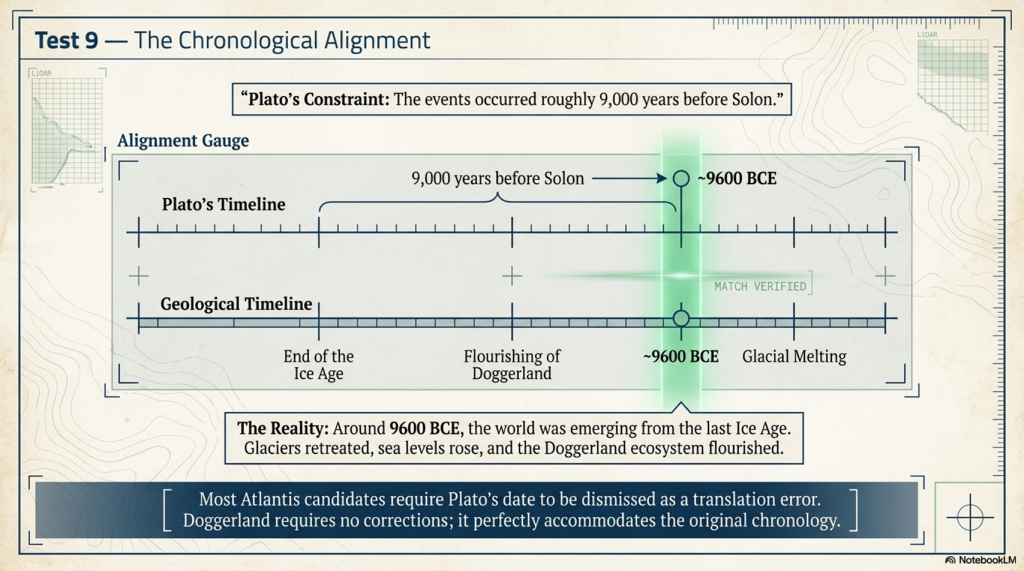
When combined with Solon’s visit to Egypt around the sixth century BCE, this places the destruction of Atlantis at approximately 9600 BCE.
For generations, this date has been regarded as impossible.
Various explanations have been proposed. Some suggest that the Egyptian priests confused lunar years with solar years. Others argue that a copying error occurred during transmission. Some simply dismiss the figure entirely and focus on other parts of the story.
Yet this creates an obvious problem.
If Plato’s measurements are accepted when they support a theory, but rejected when they do not, the investigation becomes subjective. The same standard must be applied throughout.
The date, therefore, deserves to be examined rather than dismissed.
The first observation is that Plato treats the chronology as factual information rather than symbolism. The Egyptian priests do not present the date as a metaphor, an allegory, or a philosophical concept. They present it as a historical interval spanning from Solon’s time to the destruction of Atlantis.
The second observation is more interesting.
If the date is accepted, even approximately, it points towards a very specific period in European prehistory.
Around 9600 BCE, the world was emerging from the last Ice Age.
Glaciers were retreating.
Sea levels were rising.
Coastlines were changing.
Entire landscapes were being transformed.
Most importantly, the North Sea basin was still largely dry land.
Doggerland existed.
This creates a remarkable correspondence.
Many proposed Atlantis locations fail immediately upon consideration of chronology. Bronze Age settlements are thousands of years too recent. Classical and Iron Age sites are even further removed. The entire theory depends upon ignoring Plato’s date altogether.
Doggerland does not suffer from this problem.
The chronology points directly to the period when Doggerland flourished.
This does not mean the date is exact.
Ancient chronologies are rarely exact.
Nor does it mean every event described by Plato occurred precisely in 9600 BCE.
What matters is the broad agreement between the period recorded by the Egyptian priests and the period during which the Doggerland landscape existed.
The significance becomes even greater when viewed alongside the evidence presented in previous chapters.
The location aligns.
The dimensions align.
The environmental reconstruction aligns.
The waterways align.
The trade networks align.
The flooding aligns.
The muddy sea aligns.
Now the chronology aligns as well.
This cumulative pattern is difficult to ignore.
Indeed, one of the most striking aspects of the Doggerland hypothesis is that it does not require Plato’s date to be rewritten, corrected, or discarded. Unlike many competing theories, it can accommodate the chronology largely as recorded.
This raises an important question.
If Plato’s figure is wrong, how do we know?
And if it is broadly correct, why does it point so directly towards the very period in which a vast North European landscape existed before being lost beneath the sea?
The answer remains uncertain.
What is clear, however, is that the date presents a challenge for almost every Atlantis theory except one.
For the first time, the chronology, geography, environment, and fate of the landscape all appear to be pointing towards the same place.
Doggerland.
The question is no longer whether individual elements of Plato’s account resemble the evidence.
The question is how many of those elements can be explained by the same landscape simultaneously.
That is the issue to which we now turn.
next section
13. Testing Plato Against Reality
After more than two thousand years of speculation, the Atlantis debate remains as divided as ever.
This is not because there is a shortage of theories.
The problem is that most Atlantis investigations begin with a conclusion. A location is selected first, and evidence is then gathered to support it. Features that appear to fit Plato’s description are highlighted. Features that do not are explained away, ignored, or reinterpreted.
The result is a landscape of competing theories, each claiming success while explaining only part of the story.
This investigation has followed a different approach.
Rather than beginning with Doggerland, it began with Plato.
The objective was not to prove Atlantis existed.
The objective was to examine Plato’s account as a series of geographical, environmental, engineering, and historical observations and ask a simple question:
How many of these observations correspond with a known prehistoric landscape?
The answer is surprising.
Plato places Atlantis beyond the Pillars of Heracles within the Atlantic realm.
Doggerland satisfies that requirement.
Plato describes a vast oblong plain measuring approximately 3,000 by 2,000 stadia.
Doggerland possesses a central plain of remarkably similar dimensions.
Plato describes mountains surrounding parts of the landscape and feeding rivers that crossed the plain.
Doggerland was bordered by the uplands of Britain and Scandinavia and contained one of the largest river systems in prehistoric Europe.
Plato describes abundant waterways, canals, harbours, and maritime activity.
The archaeological evidence increasingly points towards a civilisation organised around rivers, estuaries, shallow seas, and water transport.
Plato describes extensive trade and movement across large distances.
The archaeological record reveals obsidian, amber, jade, copper, wheat, tin, gold, and other materials moving across continental-scale networks.
Plato describes exceptional fertility and abundant wildlife.
The environmental reconstruction of Doggerland reveals one of the richest prehistoric ecosystems known from Europe.
Plato describes elephants.
The wider North Sea basin has produced evidence of elephant-family species alongside numerous other large mammals. More importantly, the presence of elephants appears as an unusual detail rather than a standard feature of Greek mythical geography.
Plato describes a landscape lost beneath the sea.
Doggerland is one of the few proposed Atlantis candidates known to have suffered precisely that fate.
Plato describes a muddy, difficult sea that remains after the destruction.
The North Sea contains some of the largest sediment banks, shoals, and submerged landscapes in Europe.
Finally, Plato records a date approximately 9,000 years before Solon.
Whether exact or approximate, the chronology points directly to the period when Doggerland existed and was undergoing a profound environmental transformation.
Individually, none of these observations proves that Doggerland was Atlantis.
Historical investigations rarely operate in such a simple manner.
The significance lies in the cumulative pattern.
Again and again, Plato’s descriptions appear to converge on the same landscape.
This is where the Doggerland hypothesis differs from many competing theories.
Most Atlantis candidates satisfy one or two major criteria.
Some satisfy the flooding.
Others satisfy aspects of the geography.
A few satisfy isolated archaeological observations.
Doggerland is unusual because multiple independent lines of evidence appear to point towards the same location.
This raises a question that becomes increasingly difficult to avoid.
If Plato invented Atlantis, why does the account contain so many details that correspond with a prehistoric landscape unknown to both Plato and the modern world until the development of marine archaeology?
The dimensions of the plain.
The maritime setting.
The flooding.
The muddy sea.
The chronology.
The environmental reconstruction.
The trade network.
The question becomes even more intriguing when compared with other Greek traditions.
The Greeks already possessed mythical lands beyond the known world. Hyperborea is perhaps the best-known example. Yet Hyperborea lacks many of the distinctive features that define Atlantis. There are no great canals, no maritime empire, no immense engineering works, no detailed geography, and no elephant populations.
If Plato simply wished to invent a distant paradise, he already had models available.
Instead, Atlantis contains a remarkable collection of specific observations that often appear unnecessary for a purely fictional narrative.
This does not prove the account is historical.
Nor does it prove that every detail must be literally correct.
What it does suggest is that Atlantis deserves to be examined more seriously than it often is.
For perhaps the first time, modern archaeology, geology, and environmental reconstruction allow Plato’s account to be tested against a real landscape.
The results are remarkable.
The final question, therefore, remains.
Does Doggerland ultimately pass Plato’s test?
Verdict: Does Doggerland Pass Plato’s Test?
At the beginning of this investigation, a simple principle was established.
The objective was not to prove Atlantis existed.
Nor was it to defend a predetermined theory.
Instead, the objective was to test Plato’s account against the evidence and determine whether any known prehistoric landscape satisfies the descriptions he recorded.
The results have been unexpected.
For more than two thousand years, Atlantis has occupied an unusual position in history. To some, it is a myth. To others, it is a philosophical allegory. To others, still, it is a lost civilisation waiting to be discovered. Entire libraries have been written attempting to locate Atlantis in the Mediterranean, the Atlantic, the Caribbean, Antarctica, and countless other locations.
Yet one problem remains constant.
Most proposed Atlantis locations satisfy only fragments of Plato’s account.
Some explain the flooding.
Some explain parts of the geography.
Some explain isolated archaeological observations.
Very few explain the entire narrative.
Throughout this investigation, Plato’s descriptions have been examined individually before being compared against the reconstructed landscape of Doggerland.
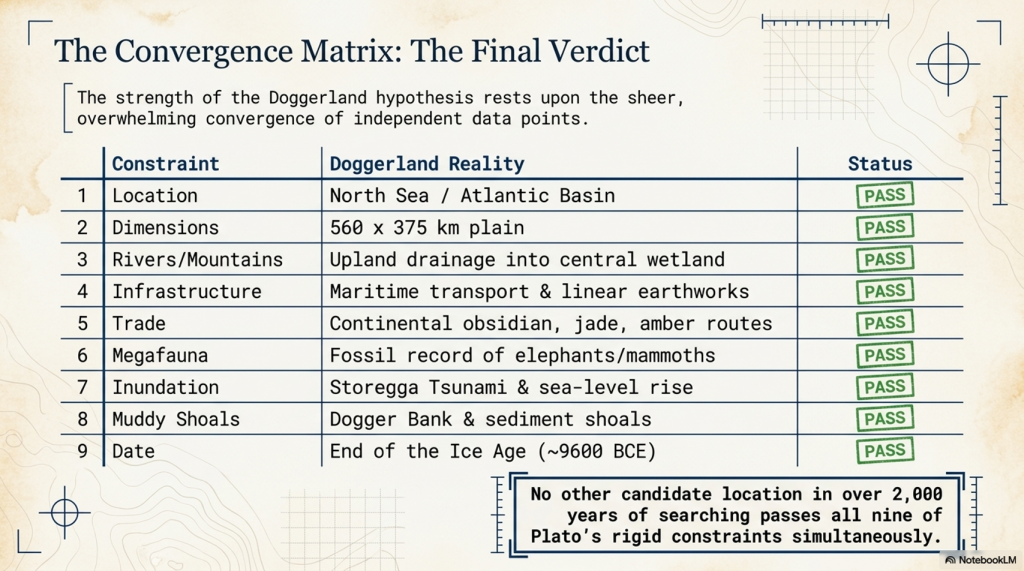
Again and again, the same pattern emerged.
The location corresponds.
The dimensions of the plain correspond.
The surrounding uplands correspond.
The rivers and wetlands correspond.
The maritime setting corresponds.
The trade networks correspond.
The environmental reconstruction corresponds.
The flooding corresponds.
The muddy sea corresponds.
Even the chronology points to the period when Doggerland existed and was ultimately lost.
Individually, any one of these observations might be dismissed as a coincidence.
Collectively, they become increasingly difficult to ignore.
This is perhaps the most important conclusion of the entire study.
The strength of the Doggerland hypothesis does not rest upon a single piece of evidence.
It rests upon convergence.
Multiple independent descriptions recorded by Plato appear to point towards the same landscape.
This is precisely what should be expected if the account preserves a genuine memory of a real place.
It is also where the traditional explanation begins to encounter difficulties.
If Atlantis were entirely fictional, many of Plato’s details would become surprisingly specific.
The dimensions of the plain were unnecessary.
The muddy sea was unnecessary.
The elephant populations were unnecessary.
The extensive waterways were unnecessary.
The chronology was unnecessary.
The description of a drowned landscape was unnecessary.
Plato could have written a moral tale about pride and decline without any of these details.
Indeed, Greek literature already possessed examples of distant and idealised lands. Hyperborea is perhaps the best known. Yet Hyperborea lacks many of the distinctive features that define Atlantis. There are no vast engineering works, no maritime empire, no extensive canal systems, no detailed geography, and no elephant populations.
This observation does not prove Atlantis was historical.
It does, however, create a question that every sceptical interpretation must answer.
Why include so many specific details if they served no purpose?
More importantly, why do so many of those details correspond with a prehistoric landscape that remained unknown until the development of modern marine archaeology?
No one in Plato’s time knew Doggerland existed.
No one in the Middle Ages knew Doggerland existed.
No one in the nineteenth century knew Doggerland existed.
Only within the last few decades has the scale of the lost North Sea landscape become apparent.
Yet many of the characteristics described by Plato appear remarkably familiar when viewed against this newly reconstructed world.
This does not mean every aspect of the Atlantis story must be accepted literally.
Oral traditions evolve.
Chronologies become compressed.
Events separated by centuries may become combined within a single narrative. Historical memories merge with symbolism, politics, and mythology. Such processes are common throughout human history.
The question is therefore not whether Plato preserved a perfect historical account.
The question is whether a historical memory exists beneath the narrative.
The evidence presented throughout this investigation suggests that the possibility can no longer be dismissed.
For the first time, there exists a prehistoric landscape that satisfies a substantial proportion of Plato’s descriptions without requiring major alterations to the text itself.
The landscape is real.
Its flooding is real.
Its disappearance is real.
Its chronology broadly fits.
Its environment broadly fits.
Its geography broadly fits.
Its maritime character broadly fits.
Whether that landscape should ultimately be called Atlantis remains a matter for debate.
But the conclusion is unavoidable.
Doggerland passes Plato’s test more successfully than any Atlantis candidate proposed so far.
The significance of that result extends beyond Atlantis itself.
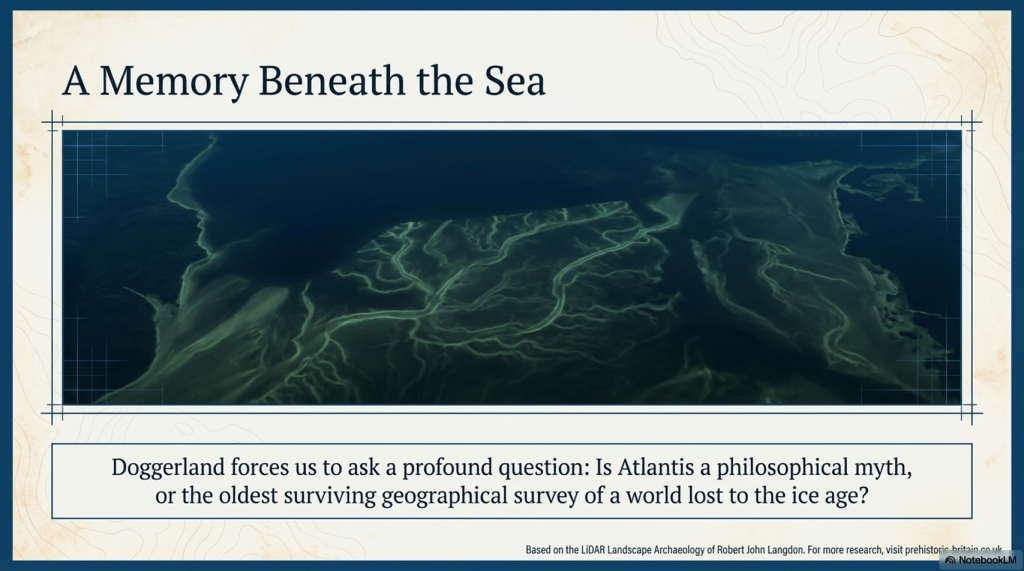
If Plato’s account preserves even a fragment of genuine memory, then the lost landscapes beneath the North Sea may represent one of the most important chapters of human history still waiting to be fully understood.
The Atlantis question, therefore, remains open.
But for the first time in over two thousand years, it is no longer a question without a plausible answer.
PODCAST

Author’s Biography
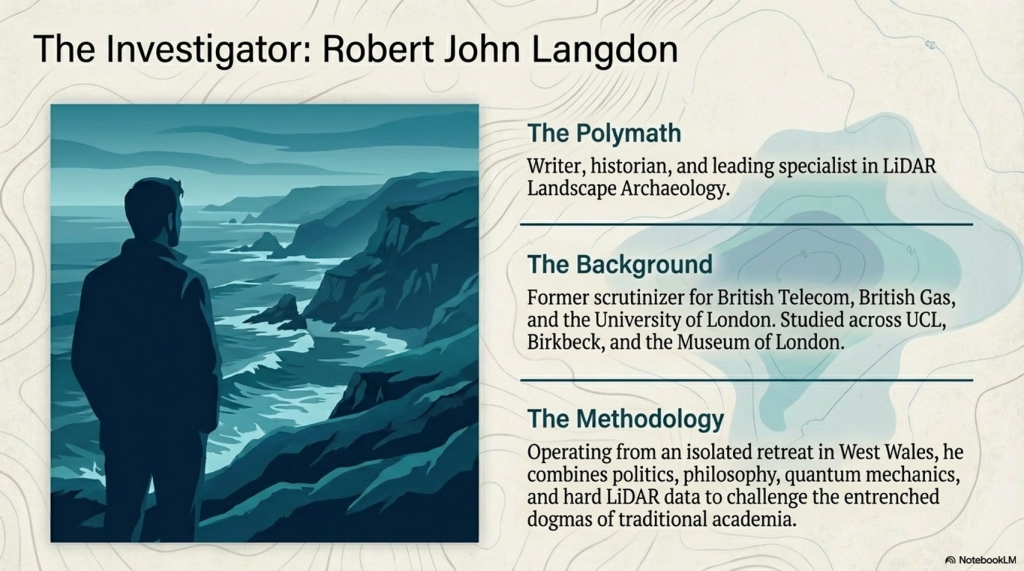
Robert John Langdon, a polymathic luminary, emerges as a writer, historian, and eminent specialist in LiDAR Landscape Archaeology.
His intellectual journey has included stints as an astute scrutineer in government and major corporate bastions, spanning British Telecommunications, Cable and Wireless, British Gas, and the esteemed University of London.
A decade hence, Robert’s transition into retirement unfurled a chapter of insatiable curiosity. He immersed himself in Politics, Archaeology, Philosophy, and the enigmatic realm of Quantum Mechanics. His academic odyssey took him through the venerable corridors of knowledge hubs such as the Museum of London, University College London, Birkbeck College, The City Literature Institute, and Chichester University.
In the symphony of his life, Robert is a custodian of three progeny and a pair of cherished grandchildren. His sanctuary lies ensconced in the embrace of West Wales, where he inhabits an isolated cottage, its windows framing a vista of the boundless sea – a retreat from the scrutinising gaze of Her Majesty’s Revenue and Customs, an amiable clandestinity in the lap of nature.
Exploring Prehistoric Britain: A Journey Through Time
My blog delves into the fascinating mysteries of prehistoric Britain, challenging conventional narratives and offering fresh perspectives grounded in cutting-edge research, particularly LiDAR technology. I invite you to explore some key areas of my research. For example, I re-examine the Wansdyke, often cited as a defensive structure, in light of new evidence. I’ve presented my findings in my blog post Wansdyke: A British Frontier Wall – ‘Debunked’, and a Wansdyke LiDAR Flyover video further visualises my conclusions.
My work also often challenges established archaeological dogma. I argue that many sites, such as Hambledon Hill, commonly identified as Iron Age hillforts, are not what they seem. My posts Lidar Investigation Hambledon Hill – NOT an ‘Iron Age Fort’ and Unmasking the “Iron Age Hillfort” Myth explore these ideas in detail and offer an alternative view. Similarly, I re-evaluated sites like Cissbury Ring and White Sheet Camp through LiDAR analysis in my posts “Lidar Investigation Cissbury Ring through time” and “Lidar Investigation White Sheet Camp,“ revealing fascinating insights into their true purpose. I have also examined South Cadbury Castle, often linked to the mythical Camelot56.
My research also extends to ancient water management, including the role of canals and other linear earthworks. I have discussed the true origins of Car Dyke in multiple posts, including Car Dyke – ABC News Podcast and Lidar Investigation Car Dyke – North Section, which suggest a Mesolithic origin 2357. I also explore the misidentification of Roman aqueducts, as seen in my posts on the Great Chesters (Roman) Aqueduct. My research has also been greatly informed by my post-glacial flooding hypothesis, which has helped explain landscape transformations over time. I have discussed this hypothesis in several posts, including AI now supports my Post-Glacial Flooding Hypothesis and Exploring Britain’s Flooded Past: A Personal Journey
Finally, my blog also investigates prehistoric burial practices, as seen in Prehistoric Burial Practices of Britain and explores the mystery of Pillow Mounds, often mistaken for medieval rabbit warrens, but with a potential link to Bronze Age cremation in my posts: Pillow Mounds: A Bronze Age Legacy of Cremation? and The Mystery of Pillow Mounds: Are They Really Medieval Rabbit Warrens?. My research also includes astronomical insights into ancient sites, for example, in Rediscovering the Winter Solstice: The Original Winter Festival. I also review new information about the construction of Stonehenge in The Stonehenge Enigma.
Yes. I’d make this far tighter, more inviting and more obviously a gateway into the rest of your work. The present version repeats the website several times and reads more like an author biography than a “what next?” section.
I’d also make the three routes immediately obvious: Explore the Research → Watch the Videos → Read the Books, with Facebook as the discussion/community route.
Further Reading — Explore the Evidence
The investigation doesn’t end with this article.
Prehistoric Britain brings together hundreds of articles, LiDAR investigations, field discoveries, archaeological studies and original research exploring Britain’s prehistoric landscape from a different perspective.
Follow the evidence across ancient waterways, lost landscapes, Stonehenge and Avebury, prehistoric engineering, submerged Britain, ancient DNA and the effects of post-glacial flooding — comparing established archaeological interpretations with alternative explanations suggested by the physical evidence.
🎬 Watch the Investigations
Prefer to watch rather than read?
The Robert John Langdon YouTube channel has more than 200 documentaries, investigations, and video presentations that bring the research to life through maps, LiDAR, archaeological evidence, and landscape reconstruction.
Discover investigations including 13 Things That Don’t Make Sense in History, Silbury Avenue – The Lost Stone Avenue, Stonehenge, prehistoric waterways, submerged landscapes and many more.
📚 Explore the Book Library
Go deeper into the evidence through Robert John Langdon’s growing collection of books and specialist studies, including:
- The Stonehenge Hoax – 13 Things That Don’t Make Sense in History
- Car Dyke – Prehistoric Dyke
- Wansdyke – Prehistoric Dyke
- Offa’s Dyke – Prehistoric Dyke
- Silbury Avenue – The Lost Stone Avenue
- The Vallum – At Hadrian’s Wall
- Stonehenge: The World’s First Computer
- Avebury’s Lost Stone Avenue
Many of these investigations connect directly with the evidence discussed throughout the website, allowing individual discoveries to be examined as part of the much wider prehistoric landscape.
🔎 Read the Main Trilogy
Three major works bring together the central strands of the research:
The Post-Glacial Flooding Hypothesis — investigates the evidence for radically different water levels, waterways and landscapes in prehistoric Britain.
The Stonehenge Enigma — re-examines the chronology, landscape and purpose of one of the world’s most famous prehistoric monuments.
Dawn of the Lost Civilisation — explores the evidence for sophisticated communities, technology and maritime connections far earlier than traditionally assumed.
💬 Join the Investigation
New discoveries, LiDAR surveys and research are discussed as they happen in the Prehistoric Britain Facebook Group.
Join the discussion, challenge the evidence, offer alternative interpretations and follow new investigations as they develop.
Don’t just read the accepted story. Explore the evidence, compare the interpretations, and decide for yourself.
Other Blogs
1
a
- Ackling Dyke – Facts and the Archaeological Fiction
- Ackling Dyke – Part II – Puddletown Forest: When a Roman Road Becomes an Assumption
- Ackling Dyke – Part III – The Roman Road Mystery Finally Makes Sense
- AI now Supports – Homo Superior
- AI now supports my Post-Glacial Flooding Hypothesis
- Alexander the Great sailed into India – where no rivers exist today
- Ancient Secrets of Althorp – debunked
- Antler Picks built Ancient Monuments – yet there is no real evidence
- Antonine Wall – Prehistoric Canals (Dykes)
- Archaeological ‘pulp fiction’ – has archaeology turned from science?
- Archaeological Pseudoscience
- Archaeology in the Post-Truth Era
- Archaeology: A Bad Science?
- Archaeology: A Harbour for Fantasists?
- Archaeology: Fact or Fiction?
- Archaeology: The Flaws of Peer Review
- Archaeology’s Bayesian Mistake: Stop Averaging the Past
- Are Raised Beaches Archaeological Pseudoscience?
- Atlantis Found: The Mathematical Proof That Plato’s Lost City Was Doggerland
- ATLANTIS: Discovery with Dan Snow Debunked
- Avebury Ditch – Avebury Phase 2
- Avebury through time
- Avebury’s great mystery revealed
- Avebury’s Lost Stone Avenue – Flipbook
b
- Battlesbury Hill – Wiltshire
- Beyond Stone and Bone: Rethinking the Megalithic Architects of Northern Europe
- BGS Prehistoric River Map
- Blackhenge: Debunking the Media misinterpretation of the Stonehenge Builders
- Brain capacity (Cro-Magnon Man)
- Britain’s First Road – Stonehenge Avenue
- Britain’s Giant Prehistoric Waterways
- British Roman Ports miles away from the coast
c
- Caerfai Promontory Fort – Archaeological Nonsense
- Car Dyke – ABC News PodCast
- Car Dyke – North Section
- Cardigan Bay: The Holocene Evidence the Old Geological Story Has Missed
- CASE STUDY – An Inconvenient TRUTH (Craig Rhos Y Felin)
- Case Study – River Avon
- Case Study – Woodhenge Reconstruction
- Chapter 2 – Craig Rhos-Y-Felin Debunked
- Chapter 2 – Stonehenge Phase I
- Chapter 2 – Variation of the Species
- Chapter 3 – Post Glacial Sea Levels
- Chapter 3 – Stonehenge Phase II
- Chapter 7 – Britain’s Post-Glacial Flooding
- Cissbury Ring through time
- Clement Reid, Doggerland, and the Archaeological Establishment
- Cro-Magnon Brain Capacity
- Cro-Magnon Megalithic Builders: Measurement, Biology, and the DNA
- Cro-Magnons – An Explainer
d
- Darwin’s Children – Flipbook
- Darwin’s Children – The Cro-Magnons
- Dawn of The Lost Civilisation – 1/10
- Dawn of the Lost Civilisation – Flipbook
- Dawn of the Lost Civilisation – Introduction
- Digging for Britain – Cerne Abbas
- Digging for Britain Debunked – Cerne Abbas 2
- Digging Up Britain’s Past – Debunked
- DLC Chapter 1 – The Ascent of Man
- Durrington Walls – Woodhenge through time
- Durrington Walls Revisited: Platforms, Fish Traps, and a Managed Mesolithic Landscape
- Dyke Construction – Hydrology 101
- Dykes Ditches and Earthworks
- DYKES of Britain
e
f
g
h
- Hadrian’s Wall – Military Way Hoax
- Hadrian’s Wall – the Stanegate Hoax
- Hadrian’s Wall Vallum – Prehistoric Canals – FREE Online Book
- Hadrian’s Wall LiDAR investigation
- Hambledon Hill – NOT an ‘Iron Age Fort’
- Hayling Island Lidar Maps
- Hidden Sources of Ancient Dykes: Tracing Underground Groundwater Fractals
- Historic River Avon
- Hollingsbury Camp Brighton – A Hillfort… or a Forgotten Harbour?
- Hollows, Sunken Lanes and Palaeochannels
- Homo Superior – Flipbook
- Homo Superior – History’s Giants
- How Lidar will change Archaeology
- Hydrology 101 Simplified: Why Britain’s Dykes Worked Without Rivers
i
l
m
- Maiden Castle through time
- Mathematics Meets Archaeology: Discovering the Mesolithic Origins of Car Dyke
- Mesolithic River Avon
- Mesolithic Stonehenge
- Minerals found in Prehistoric and Roman Quarries
- Mining in the Prehistoric to Roman Period
- Mount Caburn through time
- Mysteries of the Oldest Boatyard Uncovered
- Mythological Dragons – a non-existent animal that is shared by the World.
o
- Offa’s Dyke Flipbook
- Old Sarum Lidar Map
- Old Sarum Through Time…………….
- On Sunken Lands of the North Sea – Lived the World’s Greatest Civilisation.
- OSL Chronicles: Questioning Time in the Geological Tale of the Avon Valley
- Oswestry LiDAR Survey
- Oswestry through time
- Oysters in Archaeology: Nature’s Ancient Water Filters?
p
- Pillow Mounds: A Bronze Age Legacy of Cremation?
- Pinkery Canal
- Plato Was Right: The Archaeological Evidence the Academics Never Expected
- Post Glacial Flooding – Flipbook
- Prehistoric Burial Practices of Britain
- Prehistoric Canals – Wansdyke
- Prehistoric Canals – Wansdyke
- Prehistoric Canals (Dykes) – Great Chesters Aqueduct (The Vallum Pt. 4)
- Prehistoric Canals (Dykes) – Offa’s Dyke (Chepstow)
- Prehistoric Canals (Dykes) – Offa’s Dyke (LiDAR Survey)
- Prehistoric Canals (Dykes) – Offa’s Dyke Survey (End of Section A)
- Prehistoric Canals (Dykes) – Wansdyke (4)
- Prehistoric Canals Wansdyke 2
- Professor Bonkers and the mad, mad World of Archaeology
r
- Real-World Confirmation of Post-Glacial Flooding
- Rebirth in Stone: Decrypting the Winter Solstice Legacy of Stonehenge
- Rediscovering the Winter Solstice: The Original Winter Festival
- Rethinking Ancient Boundaries: The Vallum and Offa’s Dyke”
- Rethinking Ogham: Could Ireland’s Oldest Script Have Begun as a Tally System?
- Rethinking The Past: Mathematical Proof of Langdon’s Post-Glacial Flooding Hypothesis
- Revolutionising History: Car Dyke Unveiled as Prehistoric & the Launch of FusionBook 360
- Rising Evidence, Falling Rivers: The Real Story of Europe’s First Farmers
- Rivers of the Past Were Higher: A Fresh Perspective on Prehistoric Hydrology
s
- Sea Level Changes
- Section A – NY26SW
- Section B – NY25NE & NY26SE
- Section C – NY35NW
- Section D – NY35NE
- Section E – NY46SW & NY45NW
- Section F – NY46SE & NY45NE
- Section G – NY56SW
- Section H – NY56NE & NY56SE
- Section I – NY66NW
- Section J – NY66NE
- Section K – NY76NW
- Section L – NY76NE
- Section M – NY87SW & NY86NW
- Section N – NY87SE
- Section O – NY97SW & NY96NW
- Section P – NY96NE
- Section Q – NZ06NW
- Section R – NZ06NE
- Section S – NZ16NW
- Section T – NZ16NE
- Section U – NZ26NW & NZ26SW
- Section V – NZ26NE & NZ26SE
- Silbury Avenue – Avebury’s First Stone Avenue
- Silbury Hill
- Silbury Hill / Sanctuary – Avebury Phase 3
- Sky Maps of Prehistoric Britain
- Somerset Plain – Signs of Post-Glacial Flooding
- South Cadbury Castle – Camelot
- Statonbury Camp near Bath – an example of West Wansdyke
- Stone me – the druids are looking the wrong way on Solstice day
- Stone Transportation and Dumb Censorship
- Stonehenge – Monument to the Dead
- Stonehenge Hoax – Dating the Monument
- Stonehenge Hoax – Round Monument?
- Stonehenge Hoax – Summer Solstice
- Stonehenge LiDAR tour
- Stonehenge Phase 1 — Britain’s First Monument
- Stonehenge Phase I (The Stonehenge Landscape)
- Stonehenge Solved – Pythagorean maths put to use 4,000 years before he was born
- Stonehenge Through Time
- Stonehenge, Doggerland and Atlantis connection
- Stonehenge: Borehole Evidence of Post-Glacial Flooding
- Stonehenge: Discovery with Dan Snow Debunked
- Stonehenge: The World’s First Computer – FREE Book
- Stonehenge: The Worlds First Computer
- Stonehenge’s The Lost Circle Revealed – DEBUNKED
- Stonehenge’s Chronological Mirage
t
- Ten Reasons Why Car Dyke Blows Britain’s Earthwork Myths Out of the Water
- Ten Things You Didn’t Know About Britain’s Prehistoric Flooded Past
- Ten thousand year old boats found on Northern Europe’s Hillsides
- Ten thousand-year-old boats found on Northern Europe’s Hillsides
- Testing Plato’s Atlantis Against Reality
- The “Hunter-Gatherer” Myth: Why It’s Time to Bury This Outdated Term
- The Ancient Mariners – Flipbook
- The Ancient Mariners – Prehistoric seafarers of the Mesolithic
- The Ascent of Man — From Survival to Systems
- The Beringian Migration Myth: Why the Peopling of the Americas by Foot is Mathematically and Logistically Impossible
- The Bluestone Enigma
- The Bulford Hoax: The “Simpler, Older Stonehenge” That Wasn’t
- The Cheddar Man Hoax
- The Cro-Magnon Cover-Up: How DNA and PR Labels Erased Our Real Ancestry
- The Dolmen and Long Barrow Connection
- The Durrington Mega-Monument Hoax: What Lies Beneath? – Debunked
- The Durrington Walls Hoax – it’s not a henge?
- The Dyke Myth Collapses: Excavation and Dating Prove Britain’s Great Dykes Are Prehistoric Canals
- The First European Smelted Bronzes
- The Fury of the Past: Natural Disasters in Historical and Prehistoric Britain
- The Giant’s Graves of Cumbria
- The Giants of Prehistory: Cro-Magnon and the Ancient Monuments
- The Great Ancient DNA Illusion: How Statistical Models Became Archaeological “Facts”
- The Great Antler Pick Hoax
- The Great Bell Beaker Migration Myth
- The Great Chichester Hoax – A Bridge too far?
- The Great Dorchester Aqueduct Hoax
- The Great Farming Hoax – (Einkorn Wheat)
- The Great Farming Migration Hoax
- The Great Hadrian’s Wall Hoax
- The Great Iron Age Hill Fort Hoax
- The Great Offa’s Dyke Hoax
- The Great Prehistoric Migration Hoax
- The Great Stone Transportation Hoax
- The Great Stonehenge Hoax
- The Great Wansdyke Hoax
- THE GREAT WEST WOODS HOAX — WHEN ONE STONE BECOMES FIFTY
- The Henge and River Relationship
- The Logistical Impossibility of Defending Maiden Castle
- The Long Barrow and Dolmen Enigma
- The Long Barrow Mystery
- The Long Barrow Mystery: Unravelling Ancient Connections
- The Lost Island of Avalon – revealed
- The Maiden Way Hoax – A Closer Look at an Ancient Road’s Hidden History
- The Maths – LGM total ice volume
- The Mystery of Pillow Mounds: Are They Really Medieval Rabbit Warrens?
- THE ODYSSEY PROBLEM: WHY DID A WEEK-LONG VOYAGE BECOME A TEN-YEAR EPIC?
- The Old Sarum Hoax
- The Oldest Boat Yard in the World found in Wales
- The Perils of Paradigm Shifts: Why Unconventional Hypotheses Get Branded as Pseudoscience
- The Post-Glacial Flooding Hypothesis – 1/11
- The Post-Glacial Flooding Hypothesis – Flipbook
- The Post-Glacial Flooding Theory
- The Problem with Hadrian’s Vallum
- The Rise of the Cro-Magnon (Homo Superior)
- The Roman Military Way Hoax
- The Silbury Hill Lighthouse?
- The Stone Money – Credit System
- The Stonehenge Avenue
- The Stonehenge Avenue
- The Stonehenge Code: Unveiling its 10,000-Year-Old Secret
- The Stonehenge Crescent: A Monument to a Lost World
- The Stonehenge Enigma – Flipbook
- The Stonehenge Enigma: Part 1/6
- The Stonehenge Hoax – Bluestone Quarry Site
- The Stonehenge Hoax – Flipbook
- The Stonehenge Hoax – Moving the Bluestones
- The Stonehenge Hoax – Periglacial Stripes
- The Stonehenge Hoax – Station Stones
- The Stonehenge Hoax – Stonehenge’s Location
- The Stonehenge Hoax – The Ditch
- The Stonehenge Hoax – The Slaughter Stone
- The Stonehenge Hoax – The Stonehenge Layer
- The Stonehenge Hoax – Totem Poles
- The Stonehenge Hoax – Woodhenge
- The Stonehenge Hospital
- The Stonehenge Transportation Mystery
- The Subtropical Britain Hoax
- The Troy, Hyperborea and Atlantis Connection
- The Vallum @ Hadrian’s Wall – it’s Prehistoric!
- The Vallum at Hadrian’s Wall (Summary)
- The Woodhenge Hoax
- Thirty Years of CAU Archaeology Going Nowhere?
- Three Dykes – Kidland Forest
- Thurnam’s 137 Skulls: The Forgotten People Behind Britain’s Megaliths.
- Top Ten Misidentified Fire Beacons in British History
- Troy Debunked – Troy did not exist in Asia Minor, but in fact, the North Sea island of Doggerland
- TSE – DVD Barrows
- TSE DVD – An Inconvenient Truth
- TSE DVD – Antler Picks
- TSE DVD – Avebury
- TSE DVD – Durrington Walls & Woodhenge
- TSE DVD – Dykes
- TSE DVD – Epilogue
- TSE DVD – Stonehenge Phase I
- TSE DVD – Stonehenge Phase II
- TSE DVD – The Post-Glacial Hypothesis
- TSE DVD Introduction
- TSE DVD Old Sarum
- Twigs, Charcoal, and the Death of the Saxon Dyke Myth
w
- Wansdyke – Short Film
- Wansdyke East – Prehistoric Canals
- Wansdyke Flipbook
- Wansdyke LiDAR Flyover
- Wansdyke: A British Frontier Wall – ‘Debunked’
- Was Columbus the first European to reach America?
- What Archaeology Missed Beneath Stonehenge
- White Sheet Camp
- Why a Simple Fence Beats a Massive Dyke (and What That Means for History)
- Windmill Hill – Avebury Phase 1
- Winter Solstice – Science, Propaganda and Indoctrination
- Woodhenge – the World’s First Lighthouse?