Plato Was Right: The Archaeological Evidence the Academics Never Expected
Introduction
For more than a century, archaeology has treated Plato’s Atlantis as little more than an allegory. Students are taught that Atlantis was a philosophical invention. A morality tale. A fictional society created to demonstrate the dangers of arrogance and imperial ambition. (Plato’s Atlantis)
The problem with this explanation is simple.
Plato’s story contains an extraordinary number of specific claims.
He described a powerful maritime civilisation existing around 9,000 years before Solon. He placed it beyond the Pillars of Hercules in a sea that bears its name to this day – the Atlantic Ocean. He claimed it possessed fleets capable of travelling vast distances, maintained contact with distant lands, and ultimately disappeared beneath the sea following catastrophic flooding.
Most importantly, Plato claimed the survivors of this lost civilisation seeded both Egypt and Greece.
For generations, academics dismissed the entire account as fiction.
The archaeology now suggests they may have been wrong.
1. Atlantis and the Atlantic
One of the most overlooked aspects of Plato’s account is geography.
Atlantis was not described as a Mediterranean civilisation.
It lay beyond the Pillars of Hercules in the Atlantic Ocean.
Today, the ocean itself still carries the name.
Whether the ocean was named after Atlantis or Atlantis after the ocean is ultimately irrelevant. What matters is that Plato was clearly describing a civilisation connected to the Atlantic world rather than the eastern Mediterranean.
That distinction becomes critically important when we consider what archaeology has discovered during the last few decades.
2. The Lost World Beneath the North Sea
When Plato wrote his account, nobody knew that an enormous inhabited landscape once existed beneath the North Sea.
Today, we call it Doggerland.
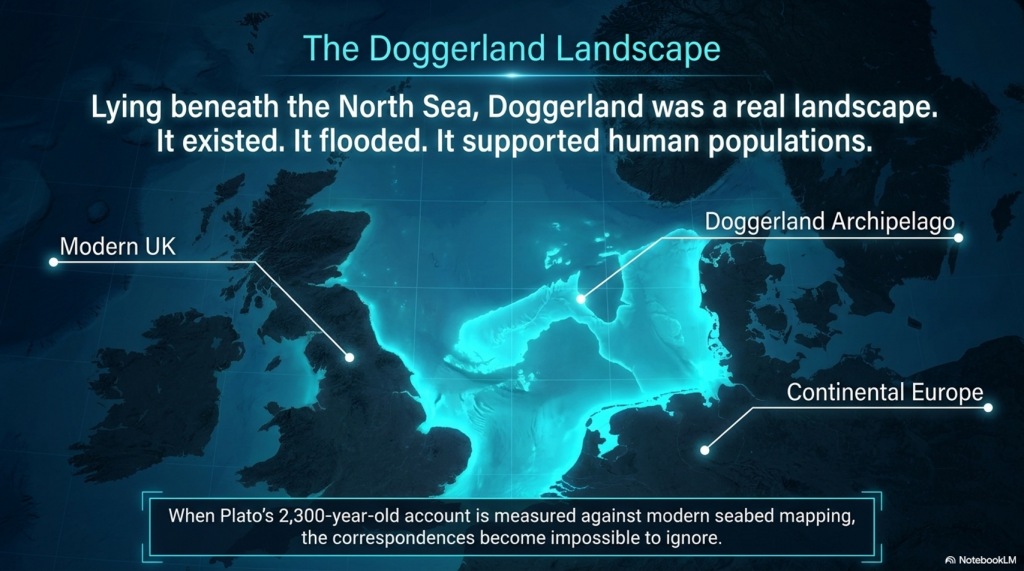
During the Late Ice Age, Britain was connected to Europe by a vast plain crossed by rivers, lakes, forests and wetlands. This was not a small island. It was an entire country-sized landscape supporting human populations for thousands of years.
Then the climate changed.
The ice sheets melted.
Sea levels rose.
The land disappeared beneath the waves.
For centuries, such a drowned world would have been dismissed as fantasy.
Today, it is accepted in archaeology.
The existence of Doggerland alone demonstrates that Plato’s central premise – that large inhabited lands were lost beneath the sea – was not fantasy at all.
3. The Great Flooding Event
Around 6200 BCE the Storegga tsunami and associated post-glacial flooding transformed the landscapes of north-west Europe.
Although flooding was not a single event, the combined effects of sea-level rise, coastal erosion and catastrophic inundation dramatically reduced the habitable land available to prehistoric populations.
The significance of this cannot be overstated.
An entire world disappeared.
Rivers vanished.
Coastlines moved.
Settlements were destroyed.
Migration became inevitable.
If a sophisticated maritime culture existed within Doggerland, it would have faced a simple choice:
Adapt, relocate or perish.
4. Bouldnor Cliff Changes Everything
The discovery at Bouldnor Cliff is one of the most important archaeological finds ever made in Britain.
Dating to the seventh millennium BC, the site revealed evidence of advanced woodworking, boat use and long-distance connections.
Most remarkably, researchers recovered evidence of einkorn wheat.
This is not a trivial discovery.
Einkorn was not adopted in Britain for approximately another 3,000 years.
The presence of einkorn demonstrates contact with regions where the crop was already known and cultivated.
In other words, maritime connections already existed between Britain and distant communities long before conventional history would have us believe.
This single discovery destroys the notion that Mesolithic Britain was isolated from the wider world.
5. Maritime Routes Create Ports
There is another implication that is rarely discussed.
Boats travelling between Britain and the Near East do not operate by magic.
They require food.
Fresh water.
Repairs.
Shelter.
Replacement crews.
Trade goods.
Every historical maritime network in history produced ports and anchorages.
The Phoenicians did it.
The Greeks did it.
The Romans did it.
The Vikings did it.
The Elizabethans did it.
There is no reason to imagine prehistoric sailors behaved differently.
Repeated voyages between the Atlantic and Anatolia would naturally create stopping points along the coasts of Iberia, southern France, Italy, Greece, and Egypt.
Over generations, these temporary anchorages would evolve into permanent trading communities.
Sailors would settle.
Families would form.
Local populations would mix.
Knowledge would spread.
This is how maritime civilisations have always operated.
6. Plato’s Most Important Claim
Plato did not merely describe a lost civilisation.
He claimed that the survivors seeded both Egypt and Greece.
This is an astonishingly specific statement.
It creates a testable archaeological prediction.
If the account preserves genuine historical memory, then traces of unusual founder populations should appear in both Egypt and Greece during the period following the destruction of the Atlantic homeland.
Remarkably, that is exactly what the archaeology appears to reveal.
7. Egypt: The First Foundation
The Egyptian evidence is striking.
The chronology reveals continuity rather than replacement.
| Egypt | Greece |
|---|---|
| Qarunian (7570–6200 BC) | Aceramic Neolithic |
| Transitional Phase (6200–5550 BC) | Early Neolithic |
| Early Faiyumian (5550–4650 BC) | Nea Nikomedeia |
| Merimde (c.5000–4300 BC) | Proto-Sesklo / Sesklo |
| Tasian (c.4500 BC onwards) | Prodromos / Dimini |
The populations associated with Merimde and the Tasian culture have been described as:
- Long-headed.
- Robust.
- Physically distinct from many later Egyptians.
- Generally taller than later predynastic populations.
Excavation reports also recorded individuals with sandy, ginger and even golden hair, leading archaeologists to suggest the existence of a fair strain within the population.
These are not modern interpretations.
They are observations recorded by the excavators themselves.
8. Greece: The Second Foundation
The Greek evidence follows a remarkably similar pattern.
Early Neolithic populations appear on a timeline virtually identical to that of Egypt.
Sites such as Nea Nikomedeia, Sesklo and Prodromos represent some of the earliest organised communities in Europe.
Anthropological studies repeatedly describe Thessalian populations as predominantly long-headed.
At Prodromos, archaeologists discovered a remarkable cache of eleven human skulls deliberately placed beneath a house floor.
Dedicated anthropological investigations were conducted into these populations, exactly as occurred in Egypt.
The similarities are difficult to ignore.
| Egypt | Greece |
|---|---|
| Merimde long-headed | Thessalian populations described as long-headed |
| Tasian long-headed | Prodromos skull assemblage |
| Robust populations | Founder populations under anthropological study |
| Taller than later Egyptians | Stature evidence incomplete |
| Fair-haired individuals | Evidence currently absent |
| Continuity from earlier populations | Continuity from Early Neolithic founder settlements |
9. The Chronology Fits
When the chronology is compared directly, the pattern becomes even more remarkable.
| Date | North Sea / Atlantis Model | Greece |
|---|---|---|
| 8000–7000 BC | Doggerland extensive | Mesolithic hunter-gatherers |
| 7000–6500 BC | Population displacement possible | Earliest Neolithic begins |
| 6500–6000 BC | Lowland reductions continuing | Thessaly settlements expanding |
| 6200–5500 BC | Transitional phase | Sesklo emerging |
| 5500–5000 BC | Doggerland fragmented | Major Sesklo centre |
| 5000–4500 BC | Survivor period | Dimini and advanced settlements |
| 4500–4000 BC | Megalithic Structures End | Increasing Aegean complexity |
| 3500–3000 BC | Farmers take over Britain | Cycladic maritime culture |
The sequence is not proof.
But it is exactly the pattern we would expect if populations displaced from the Atlantic world contributed to later civilisations.
10. The Allegory Has a Problem
The academic explanation has always been simple.
Atlantis was fictional.
The difficulty is that fictional stories are not supposed to generate accurate archaeological predictions.
Plato described:
- A maritime civilisation.
- An Atlantic homeland.
- Catastrophic flooding.
- A date close to the end of the Ice Age.
- Survivors.
- Egypt.
- Greece.
Archaeology has now confirmed:
- The drowned landscape.
- The flooding.
- The maritime networks.
- Long-distance contacts.
- Founder populations in Egypt.
- Founder populations in Greece.
Nobody is claiming that every detail of Plato’s account has been proven.
What can no longer be maintained is the lazy assumption that the story was merely an allegory.
Two thousand four hundred years ago, Plato described a lost maritime world destroyed by rising seas whose survivors helped shape the civilisations that followed.
Today, archaeology is beginning to uncover evidence that such a world may have existed.
The greatest irony of all may be that the man historians dismissed as a storyteller was closer to the truth than the experts who spent a century insisting he was wrong.
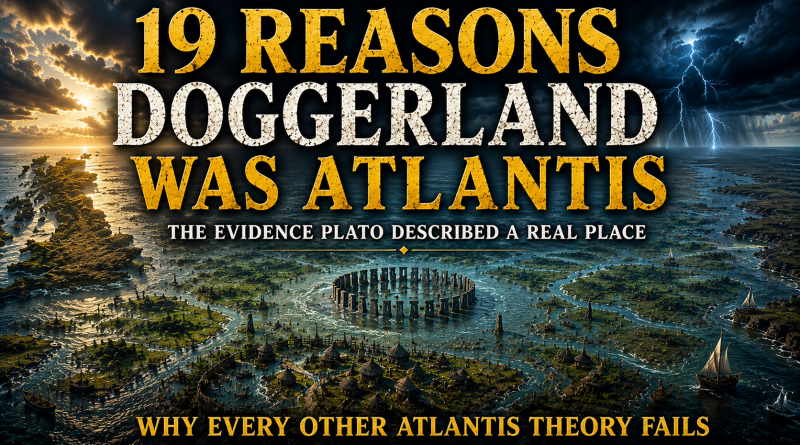
🌊 19 Reasons Why Doggerland Was Atlantis 🌊
The Atlantis Mystery Archaeology Doesn’t Want to Solve
For over 2,300 years, people have searched for Atlantis.
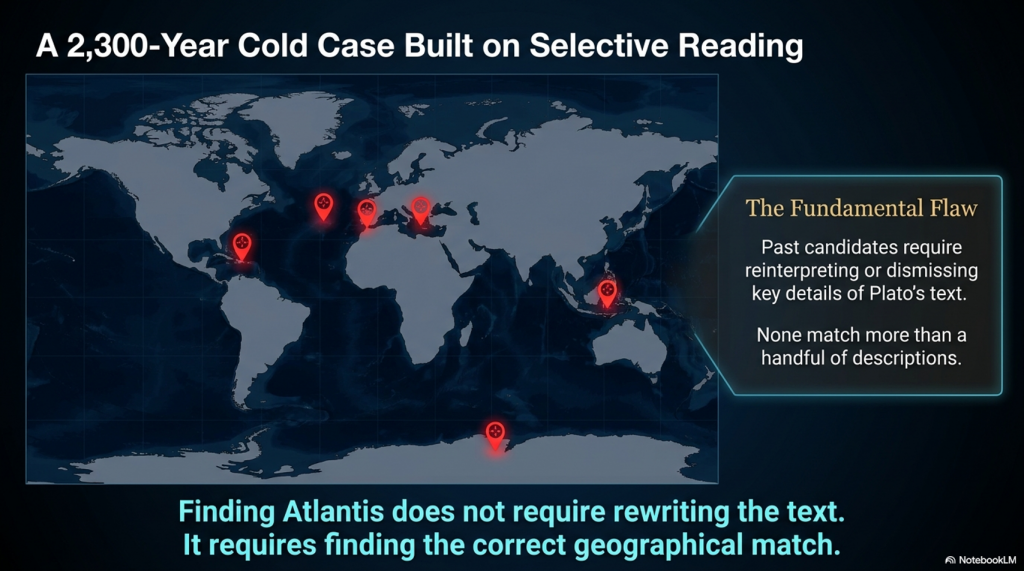
They have looked in the Mediterranean, the Atlantic Ocean, Antarctica, the Caribbean, Spain, Morocco, the Azores, and even Indonesia.
Yet there is a problem.
None of these proposed locations matches more than a handful of Plato’s descriptions.
Most require selective reading, reinterpretation, or outright dismissal of key details.
Doggerland is different.
Lying beneath the North Sea between Britain and Europe, Doggerland was a real landscape. It existed. It flooded. It supported human populations. And remarkably, when Plato’s account is compared to measurable evidence, the number of correspondences becomes difficult to ignore.
Here are 19 reasons why Doggerland remains the strongest candidate for Atlantis ever identified.
1️⃣ A Large Island Beyond the Mediterranean
Plato describes a vast landmass beyond the familiar world of the Mediterranean.
Doggerland once connected Britain to continental Europe and formed one of the largest habitable landscapes in north-west Europe before it disappeared beneath the sea.
2️⃣ A Vast Central Plain
Plato gives dimensions of approximately 2,000 by 3,000 stadia.
When converted into modern measurements, this equates to roughly 370 by 550 kilometres.
The reconstructed Doggerland plateau measures approximately 375 by 560 kilometres.
Few Atlantis candidates come anywhere close.
3️⃣ Mountains to the North
Plato describes mountains surrounding the northern edge of the plain.
Scotland, Norway and Scandinavia form exactly such a northern mountainous boundary around the North Sea basin.
4️⃣ A Landscape Dominated by Water
Atlantis was described as a landscape of rivers, channels and waterways.
Doggerland was criss-crossed by major river systems, wetlands, lakes, estuaries and palaeochannels now mapped beneath the North Sea.
5️⃣ A Maritime Civilisation
Plato repeatedly emphasises ships and seafaring.
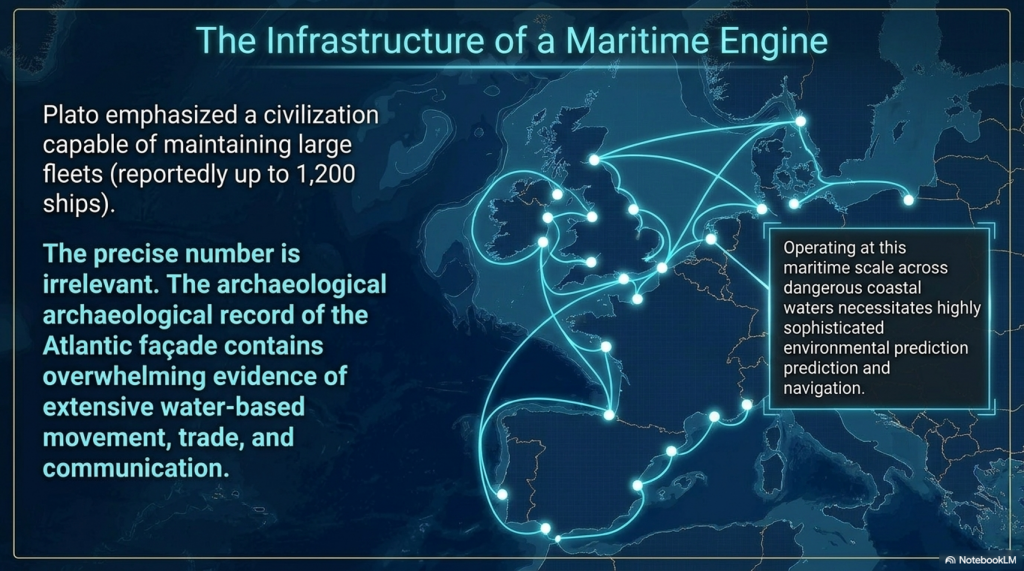
The Atlantic façade and North Sea region contain overwhelming evidence for water-based movement, trade and communication.
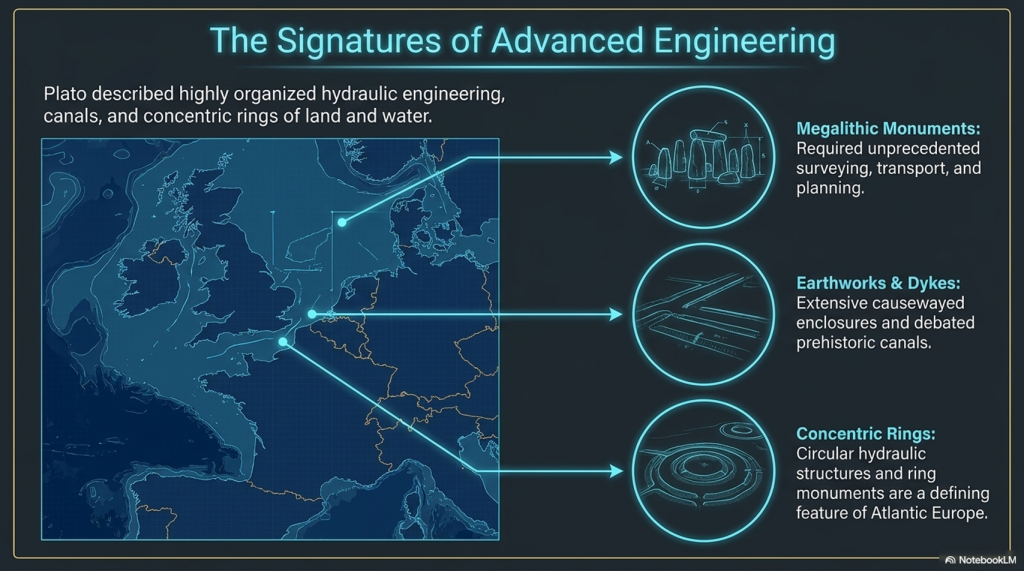
6️⃣ Large-Scale Hydraulic Engineering
Plato describes canals and water management on a huge scale.
Britain and north-west Europe preserve extensive dykes, canals, causewayed enclosures and engineered earthworks whose original purposes remain debated.
7️⃣ Concentric Rings of Land and Water
One of Atlantis’s most famous features.
Concentric enclosures, ring monuments and circular hydraulic structures occur throughout Atlantic Europe.
8️⃣ A Fertile Plain
Plato describes a rich agricultural landscape.
Pollen records, peat deposits and sediment analysis reveal that Doggerland supported extensive woodland, grassland and productive river valleys.
9️⃣ Marshes and Wetlands
Atlantis was rich in freshwater.
Geological reconstruction consistently shows Doggerland as a landscape dominated by lakes, marshes, rivers and elevated groundwater systems.
🔟 Elephants
Critics often dismiss this detail.
Yet elephant remains are not only known from Europe—they are known from Britain.
Elephant, mammoth and hippopotamus remains have all been recovered from Britain and the North Sea basin.
1️⃣1️⃣ Advanced Engineering
Plato describes a highly organised civilisation.
The megalithic monuments of north-west Europe required surveying, transport, planning and engineering on a remarkable scale.
1️⃣2️⃣ Large Fleets
Atlantis supposedly maintained a fleet of around 1,200 ships.
Whether the exact number is correct is irrelevant.
Any maritime civilisation operating at this scale would require sophisticated navigation and environmental prediction.
1️⃣3️⃣ Environmental Monitoring Systems
This is where Stonehenge becomes important.
Stonehenge Phase 1 appears to function as a predictive lunar and tidal system operating within a water-dominated landscape.
Such infrastructure would be essential to a maritime culture.
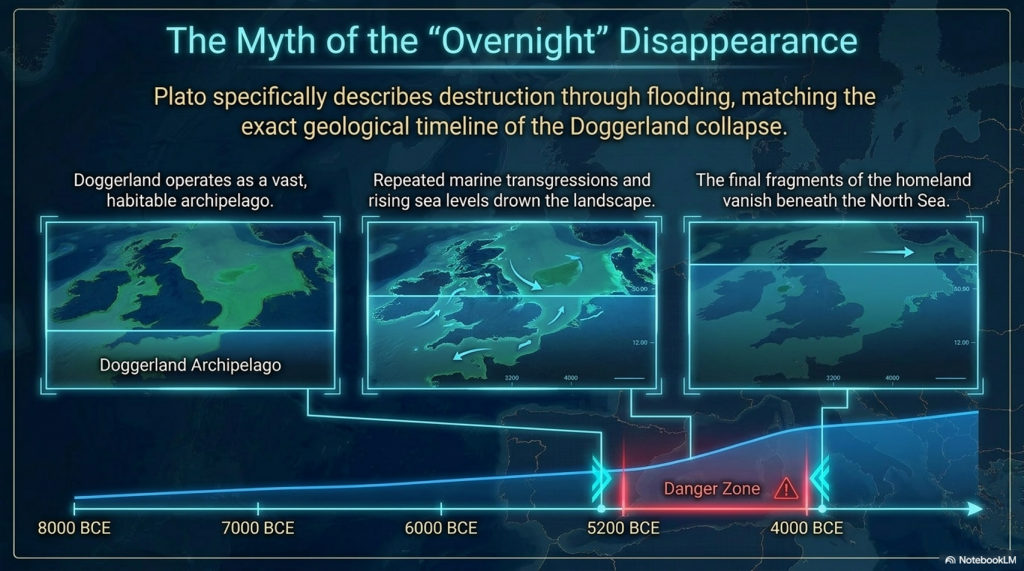
1️⃣4️⃣ Progressive Flooding
Plato does not describe Atlantis disappearing overnight.
He describes destruction through flooding.
Doggerland vanished over thousands of years through repeated marine transgressions and rising sea levels.
1️⃣5️⃣ The Loss of the Homeland
Eventually, only fragments remained.
Between approximately 5200 and 4200 BCE the final Doggerland archipelago disappeared beneath the North Sea.
1️⃣6️⃣ Population Dispersal
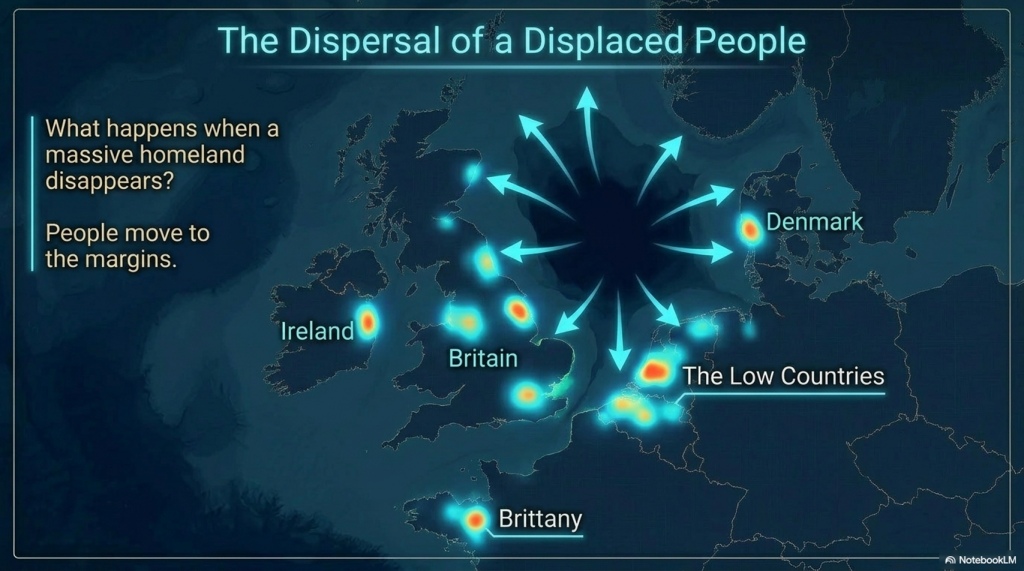
What happens when a homeland disappears?
People move.
The concentration of megalithic monuments across Britain, Ireland, Brittany, Denmark, and the Low Countries is consistent with populations relocating along the margins of the former basin.
1️⃣7️⃣ Preservation of Memory
Civilisations remember disasters.
Stonehenge Phase 2 may represent the monumentalisation of that memory, transforming an earlier functional system into a permanent stone memorial.
1️⃣8️⃣ Physical Links to the Lost Land
Memory is often preserved through objects.
The Altar Stone may provide a physical connection between Stonehenge and the broader northern landscape associated with Doggerland.
1️⃣9️⃣ A Great Civilisation Remembered
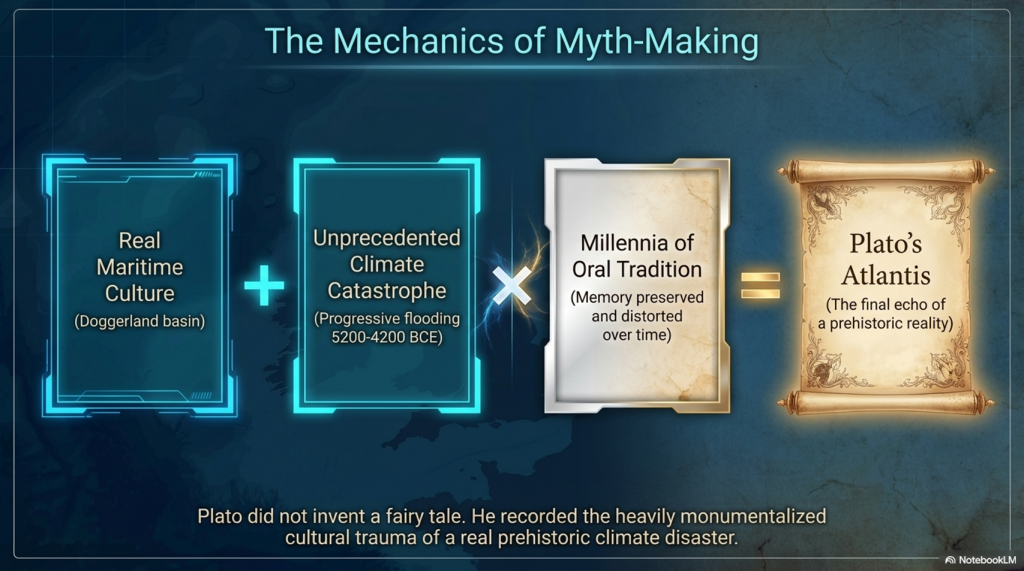
Plato claimed Atlantis survived as a story long after the land itself disappeared.
If a maritime culture occupied Doggerland and its destruction became embedded within oral tradition, Plato’s account may preserve the final echo of a real prehistoric catastrophe.
The Real Question
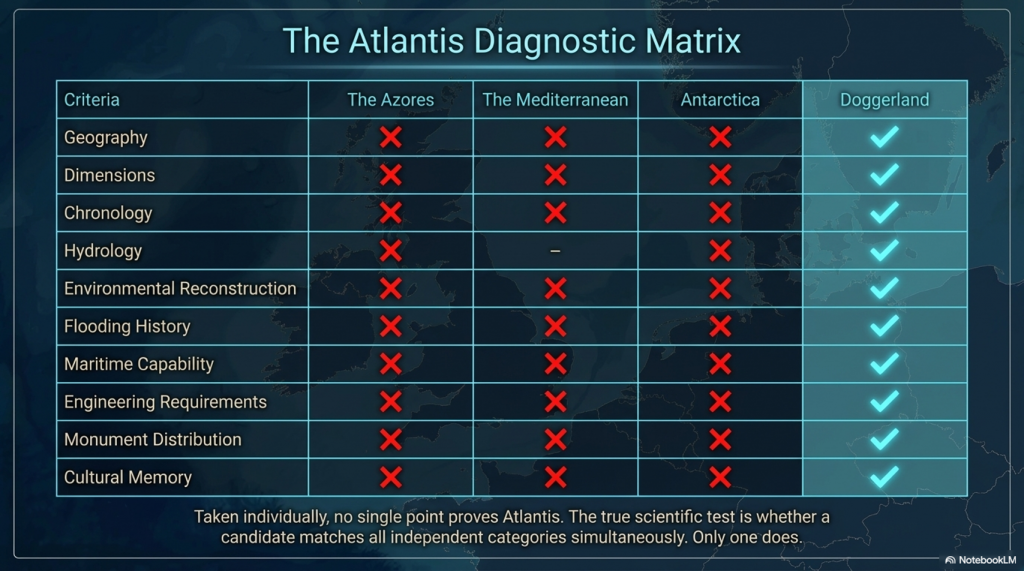
Taken individually, none of these points proves the existence of Atlantis.
But that is not the test.
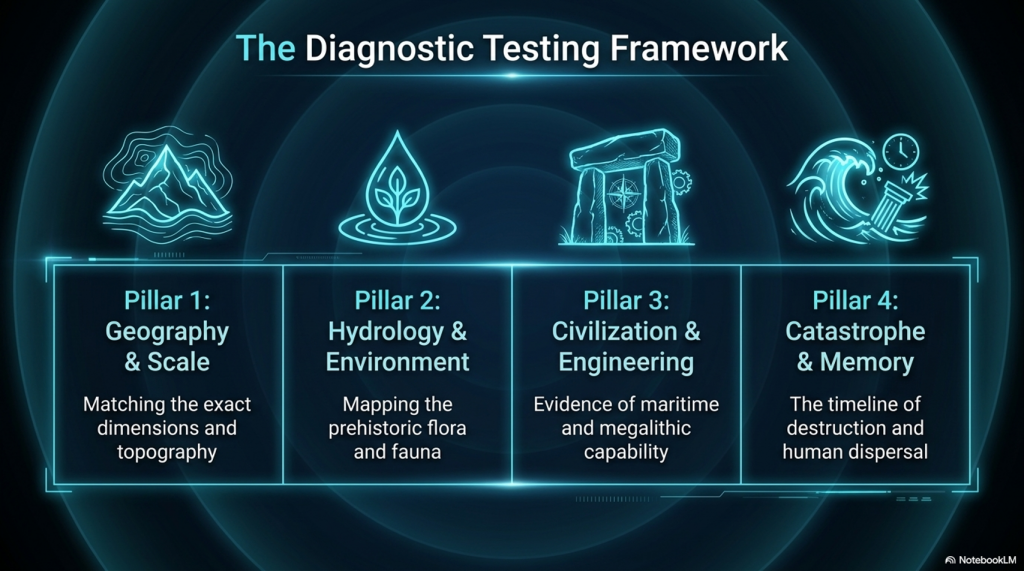
The test is whether any other Atlantis candidate matches so many independent categories simultaneously.
✅ Geography
✅ Dimensions
✅ Chronology
✅ Hydrology
✅ Environmental reconstruction
✅ Flooding history
✅ Maritime capability
✅ Engineering requirements
✅ Monument distribution
✅ Cultural memory
Most Atlantis theories match one or two features.
Doggerland matches nearly all of them.
The question is no longer:
“Could Plato have described a flooded landscape?”
The evidence suggests he probably did.
The real question is:
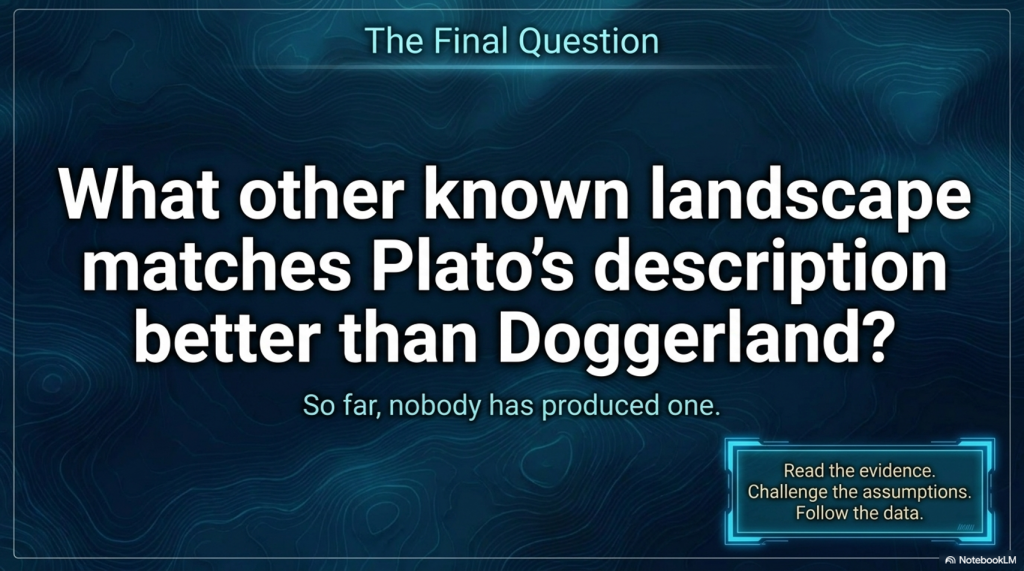
What other known landscape matches Plato’s description better than Doggerland?
So far, nobody has produced one.
PODCAST

Author’s Biography
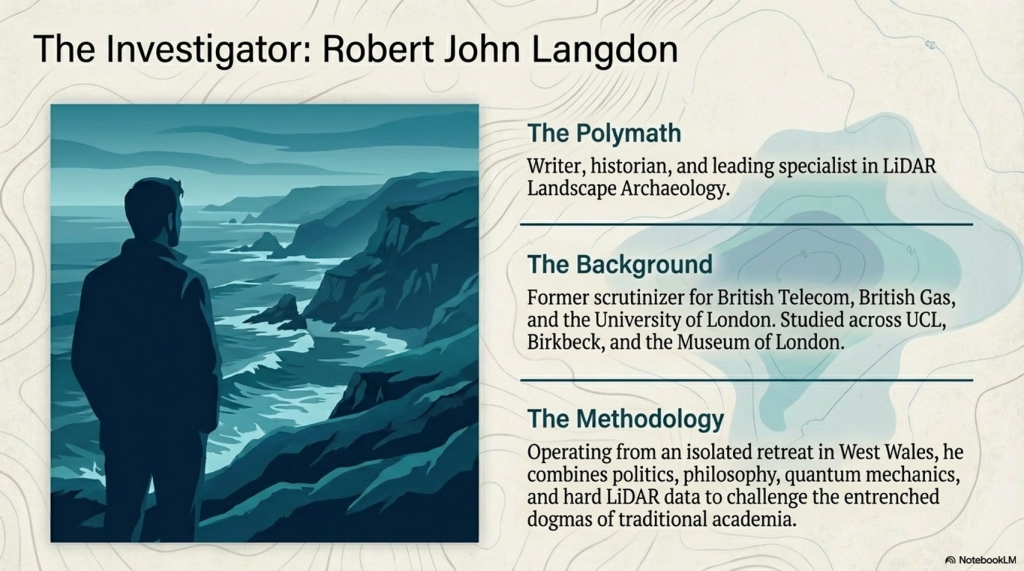
Robert John Langdon, a polymathic luminary, emerges as a writer, historian, and eminent specialist in LiDAR Landscape Archaeology.
His intellectual voyage has been interwoven with stints as an astute scrutineer in government and grand corporate bastions, a tapestry spanning British Telecommunications, Cable and Wireless, British Gas, and the esteemed University of London.
A decade hence, Robert’s transition into retirement unfurled a chapter of insatiable curiosity. This phase saw him immerse himself in Politics, Archaeology, Philosophy, and the enigmatic realm of Quantum Mechanics. His academic odyssey traversed the venerable corridors of knowledge hubs such as the Museum of London, University College London, Birkbeck College, The City Literature Institute, and Chichester University.
In the symphony of his life, Robert is a custodian of three progeny and a pair of cherished grandchildren. His sanctuary lies ensconced in the embrace of West Wales, where he inhabits an isolated cottage, its windows framing a vista of the boundless sea – a retreat from the scrutinising gaze of Her Majesty’s Revenue and Customs, an amiable clandestinity in the lap of nature.
Exploring Prehistoric Britain: A Journey Through Time
My blog delves into the fascinating mysteries of prehistoric Britain, challenging conventional narratives and offering fresh perspectives grounded in cutting-edge research, particularly LiDAR technology. I invite you to explore some key areas of my research. For example, the Wansdyke, often cited as a defensive structure, is re-examined in light of new evidence. I’ve presented my findings in my blog post Wansdyke: A British Frontier Wall – ‘Debunked’, and a Wansdyke LiDAR Flyover video further visualises my conclusions.
My work also often challenges established archaeological dogma. I argue that many sites, such as Hambledon Hill, commonly identified as Iron Age hillforts, are not what they seem. My posts Lidar Investigation Hambledon Hill – NOT an ‘Iron Age Fort’ and Unmasking the “Iron Age Hillfort” Myth explore these ideas in detail and offer an alternative view. Similarly, sites like Cissbury Ring and White Sheet Camp receive re-evaluations based on LiDAR analysis in my posts “Lidar Investigation Cissbury Ring through time” and “Lidar Investigation White Sheet Camp,“ revealing fascinating insights into their true purpose. I have also examined South Cadbury Castle, often linked to the mythical Camelot56.
My research also extends to ancient water management, including the role of canals and other linear earthworks. I have discussed the true origins of Car Dyke in multiple posts, including Car Dyke – ABC News Podcast and Lidar Investigation Car Dyke – North Section, which suggest a Mesolithic origin 2357. I also explore the misidentification of Roman aqueducts, as seen in my posts on the Great Chesters (Roman) Aqueduct. My research has also been greatly informed by my post-glacial flooding hypothesis, which has helped explain landscape transformations over time. I have discussed this hypothesis in several posts, including AI now supports my Post-Glacial Flooding Hypothesis and Exploring Britain’s Flooded Past: A Personal Journey
Finally, my blog also investigates prehistoric burial practices, as seen in Prehistoric Burial Practices of Britain and explores the mystery of Pillow Mounds, often mistaken for medieval rabbit warrens, but with a potential link to Bronze Age cremation in my posts: Pillow Mounds: A Bronze Age Legacy of Cremation? and The Mystery of Pillow Mounds: Are They Really Medieval Rabbit Warrens?. My research also includes astronomical insights into ancient sites, for example, in Rediscovering the Winter Solstice: The Original Winter Festival. I also review new information about the construction of Stonehenge in The Stonehenge Enigma.
Further Reading
For those interested in British Prehistory, visit www.prehistoric-britain.co.uk, a comprehensive resource featuring an extensive collection of archaeology articles, modern LiDAR investigations, and groundbreaking research. The site also includes insights and excerpts from the acclaimed Robert John Langdon Trilogy, a series of books that explore Britain during the Prehistoric period. Titles in the trilogy include The Stonehenge Enigma, Dawn of the Lost Civilisation, and The Post-Glacial Flooding Hypothesis, which offer compelling evidence of ancient landscapes shaped by post-glacial flooding.
To further explore these topics, Robert John Langdon has developed a dedicated YouTube channel featuring over 100 video documentaries and investigations that complement the trilogy. Notable discoveries and studies showcased on the channel include 13 Things that Don’t Make Sense in History and the revelation of Silbury Avenue – The Lost Stone Avenue, a rediscovered prehistoric feature at Avebury, Wiltshire.
In addition to his main works, Langdon has released a series of shorter, accessible publications, ideal for readers delving into specific topics. These include:
- The Ancient Mariners
- Stonehenge Built 8300 BCE
- Old Sarum
- Prehistoric Rivers
- Dykes, Ditches, and Earthworks
- Echoes of Atlantis
- Homo Superior
- 13 Things that Don’t Make Sense in History
- Silbury Avenue – The Lost Stone Avenue
- Offa’s Dyke
- The Stonehenge Enigma
- The Post-Glacial Flooding Hypothesis
- The Stonehenge Hoax
- Dawn of the Lost Civilisation
- Darwin’s Children
- Great Chester’s Roman Aqueduct
- Wansdyke
For active discussions and updates on the trilogy’s findings and recent LiDAR investigations, join our vibrant community on Facebook. Engage with like-minded enthusiasts by leaving a message or contributing to debates in our Facebook Group.
Whether through the books, the website, or interactive videos, we aim to provide a deeper understanding of Britain’s fascinating prehistoric past. We encourage you to explore these resources and uncover the mysteries of ancient landscapes through the lens of modern archaeology.
For more information, including chapter extracts and related publications, visit the Robert John Langdon Author Page. Dive into works such as The Stonehenge Enigma or Dawn of the Lost Civilisation, and explore cutting-edge theories that challenge traditional historical narratives.
Other Blogs
1
a
- Ackling Dyke – Facts and the Archaeological Fiction
- Ackling Dyke – Part II – Puddletown Forest: When a Roman Road Becomes an Assumption
- Ackling Dyke – Part III – The Roman Road Mystery Finally Makes Sense
- Ackling Dyke at Woodyates: Book content
- AI now Supports – Homo Superior
- AI now supports my Post-Glacial Flooding Hypothesis
- Alexander the Great sailed into India – where no rivers exist today
- Ancient Secrets of Althorp – debunked
- Antler Picks built Ancient Monuments – yet there is no real evidence
- Antonine Wall – Prehistoric Canals (Dykes)
- Archaeological ‘pulp fiction’ – has archaeology turned from science?
- Archaeological Pseudoscience
- Archaeology in the Post-Truth Era
- Archaeology: A Bad Science?
- Archaeology: A Harbour for Fantasists?
- Archaeology: Fact or Fiction?
- Archaeology: The Flaws of Peer Review
- Archaeology’s Bayesian Mistake: Stop Averaging the Past
- Are Raised Beaches Archaeological Pseudoscience?
- Atlantis Found: The Mathematical Proof That Plato’s Lost City Was Doggerland
- ATLANTIS: Discovery with Dan Snow Debunked
- Avebury Ditch – Avebury Phase 2
- Avebury through time
- Avebury’s great mystery revealed
- Avebury’s Lost Stone Avenue – Flipbook
b
- Battlesbury Hill – Wiltshire
- Beyond Stone and Bone: Rethinking the Megalithic Architects of Northern Europe
- BGS Prehistoric River Map
- Blackhenge: Debunking the Media misinterpretation of the Stonehenge Builders
- Brain capacity (Cro-Magnon Man)
- Britain’s First Road – Stonehenge Avenue
- Britain’s Giant Prehistoric Waterways
- British Roman Ports miles away from the coast
c
- Caerfai Promontory Fort – Archaeological Nonsense
- Car Dyke – ABC News PodCast
- Car Dyke – North Section
- Cardigan Bay: The Holocene Evidence the Old Geological Story Has Missed
- CASE STUDY – An Inconvenient TRUTH (Craig Rhos Y Felin)
- Case Study – River Avon
- Case Study – Woodhenge Reconstruction
- Chapter 2 – Craig Rhos-Y-Felin Debunked
- Chapter 2 – Stonehenge Phase I
- Chapter 2 – Variation of the Species
- Chapter 3 – Post Glacial Sea Levels
- Chapter 3 – Stonehenge Phase II
- Chapter 7 – Britain’s Post-Glacial Flooding
- Cissbury Ring through time
- Clement Reid, Doggerland, and the Archaeological Establishment
- Cro-Magnon Brain Capacity
- Cro-Magnon Megalithic Builders: Measurement, Biology, and the DNA
- Cro-Magnons – An Explainer
d
- Darwin’s Children – Flipbook
- Darwin’s Children – The Cro-Magnons
- Dawn of The Lost Civilisation – 1/10
- Dawn of the Lost Civilisation – Flipbook
- Dawn of the Lost Civilisation – Introduction
- Digging for Britain – Cerne Abbas
- Digging for Britain Debunked – Cerne Abbas 2
- Digging Up Britain’s Past – Debunked
- DLC Chapter 1 – The Ascent of Man
- Durrington Walls – Woodhenge through time
- Durrington Walls Revisited: Platforms, Fish Traps, and a Managed Mesolithic Landscape
- Dyke Construction – Hydrology 101
- Dykes Ditches and Earthworks
- DYKES of Britain
e
f
g
h
- Hadrian’s Wall – Military Way Hoax
- Hadrian’s Wall – the Stanegate Hoax
- Hadrian’s Wall Vallum – Prehistoric Canals – FREE Online Book
- Hadrian’s Wall LiDAR investigation
- Hambledon Hill – NOT an ‘Iron Age Fort’
- Hayling Island Lidar Maps
- Hidden Sources of Ancient Dykes: Tracing Underground Groundwater Fractals
- Historic River Avon
- Hollingsbury Camp Brighton – A Hillfort… or a Forgotten Harbour?
- Hollows, Sunken Lanes and Palaeochannels
- Homo Superior – Flipbook
- Homo Superior – History’s Giants
- How Lidar will change Archaeology
- Hydrology 101 Simplified: Why Britain’s Dykes Worked Without Rivers
i
l
m
- Maiden Castle through time
- Mathematics Meets Archaeology: Discovering the Mesolithic Origins of Car Dyke
- Mesolithic River Avon
- Mesolithic Stonehenge
- Minerals found in Prehistoric and Roman Quarries
- Mining in the Prehistoric to Roman Period
- Mount Caburn through time
- Mysteries of the Oldest Boatyard Uncovered
- Mythological Dragons – a non-existent animal that is shared by the World.
o
- Offa’s Dyke Flipbook
- Old Sarum Lidar Map
- Old Sarum Through Time…………….
- On Sunken Lands of the North Sea – Lived the World’s Greatest Civilisation.
- OSL Chronicles: Questioning Time in the Geological Tale of the Avon Valley
- Oswestry LiDAR Survey
- Oswestry through time
- Oysters in Archaeology: Nature’s Ancient Water Filters?
p
- Pillow Mounds: A Bronze Age Legacy of Cremation?
- Pinkery Canal
- Plato Was Right: The Archaeological Evidence the Academics Never Expected
- Post Glacial Flooding – Flipbook
- Prehistoric Burial Practices of Britain
- Prehistoric Canals – Wansdyke
- Prehistoric Canals – Wansdyke
- Prehistoric Canals (Dykes) – Great Chesters Aqueduct (The Vallum Pt. 4)
- Prehistoric Canals (Dykes) – Offa’s Dyke (Chepstow)
- Prehistoric Canals (Dykes) – Offa’s Dyke (LiDAR Survey)
- Prehistoric Canals (Dykes) – Offa’s Dyke Survey (End of Section A)
- Prehistoric Canals (Dykes) – Wansdyke (4)
- Prehistoric Canals Wansdyke 2
- Professor Bonkers and the mad, mad World of Archaeology
r
- Real-World Confirmation of Post-Glacial Flooding
- Rebirth in Stone: Decrypting the Winter Solstice Legacy of Stonehenge
- Rediscovering the Winter Solstice: The Original Winter Festival
- Rethinking Ancient Boundaries: The Vallum and Offa’s Dyke”
- Rethinking Ogham: Could Ireland’s Oldest Script Have Begun as a Tally System?
- Rethinking The Past: Mathematical Proof of Langdon’s Post-Glacial Flooding Hypothesis
- Revolutionising History: Car Dyke Unveiled as Prehistoric & the Launch of FusionBook 360
- Rising Evidence, Falling Rivers: The Real Story of Europe’s First Farmers
- Rivers of the Past Were Higher: A Fresh Perspective on Prehistoric Hydrology
s
- Sea Level Changes
- Section A – NY26SW
- Section B – NY25NE & NY26SE
- Section C – NY35NW
- Section D – NY35NE
- Section E – NY46SW & NY45NW
- Section F – NY46SE & NY45NE
- Section G – NY56SW
- Section H – NY56NE & NY56SE
- Section I – NY66NW
- Section J – NY66NE
- Section K – NY76NW
- Section L – NY76NE
- Section M – NY87SW & NY86NW
- Section N – NY87SE
- Section O – NY97SW & NY96NW
- Section P – NY96NE
- Section Q – NZ06NW
- Section R – NZ06NE
- Section S – NZ16NW
- Section T – NZ16NE
- Section U – NZ26NW & NZ26SW
- Section V – NZ26NE & NZ26SE
- Silbury Avenue – Avebury’s First Stone Avenue
- Silbury Hill
- Silbury Hill / Sanctuary – Avebury Phase 3
- Sky Maps of Prehistoric Britain
- Somerset Plain – Signs of Post-Glacial Flooding
- South Cadbury Castle – Camelot
- Statonbury Camp near Bath – an example of West Wansdyke
- Stone me – the druids are looking the wrong way on Solstice day
- Stone Transportation and Dumb Censorship
- Stonehenge – Monument to the Dead
- Stonehenge Hoax – Dating the Monument
- Stonehenge Hoax – Round Monument?
- Stonehenge Hoax – Summer Solstice
- Stonehenge LiDAR tour
- Stonehenge Phase 1 — Britain’s First Monument
- Stonehenge Phase I (The Stonehenge Landscape)
- Stonehenge Solved – Pythagorean maths put to use 4,000 years before he was born
- Stonehenge Through Time
- Stonehenge, Doggerland and Atlantis connection
- Stonehenge: Borehole Evidence of Post-Glacial Flooding
- Stonehenge: Discovery with Dan Snow Debunked
- Stonehenge: The World’s First Computer – FREE Book
- Stonehenge: The Worlds First Computer
- Stonehenge’s The Lost Circle Revealed – DEBUNKED
- Stonehenge’s Chronological Mirage
t
- Ten Reasons Why Car Dyke Blows Britain’s Earthwork Myths Out of the Water
- Ten Things You Didn’t Know About Britain’s Prehistoric Flooded Past
- Ten thousand year old boats found on Northern Europe’s Hillsides
- Ten thousand-year-old boats found on Northern Europe’s Hillsides
- Testing Plato’s Atlantis Against Reality
- The “Hunter-Gatherer” Myth: Why It’s Time to Bury This Outdated Term
- The Ancient Mariners – Flipbook
- The Ancient Mariners – Prehistoric seafarers of the Mesolithic
- The Ascent of Man — From Survival to Systems
- The Beringian Migration Myth: Why the Peopling of the Americas by Foot is Mathematically and Logistically Impossible
- The Bluestone Enigma
- The Bulford Hoax: The “Simpler, Older Stonehenge” That Wasn’t
- The Cheddar Man Hoax
- The Cro-Magnon Cover-Up: How DNA and PR Labels Erased Our Real Ancestry
- The Dolmen and Long Barrow Connection
- The Durrington Mega-Monument Hoax: What Lies Beneath? – Debunked
- The Durrington Walls Hoax – it’s not a henge?
- The Dyke Myth Collapses: Excavation and Dating Prove Britain’s Great Dykes Are Prehistoric Canals
- The First European Smelted Bronzes
- The Fury of the Past: Natural Disasters in Historical and Prehistoric Britain
- The Giant’s Graves of Cumbria
- The Giants of Prehistory: Cro-Magnon and the Ancient Monuments
- The Great Ancient DNA Illusion: How Statistical Models Became Archaeological “Facts”
- The Great Antler Pick Hoax
- The Great Bell Beaker Migration Myth
- The Great Chichester Hoax – A Bridge too far?
- The Great Dorchester Aqueduct Hoax
- The Great Farming Hoax – (Einkorn Wheat)
- The Great Farming Migration Hoax
- The Great Hadrian’s Wall Hoax
- The Great Iron Age Hill Fort Hoax
- The Great Offa’s Dyke Hoax
- The Great Prehistoric Migration Hoax
- The Great Stone Transportation Hoax
- The Great Stonehenge Hoax
- The Great Wansdyke Hoax
- THE GREAT WEST WOODS HOAX — WHEN ONE STONE BECOMES FIFTY
- The Henge and River Relationship
- The Logistical Impossibility of Defending Maiden Castle
- The Long Barrow and Dolmen Enigma
- The Long Barrow Mystery
- The Long Barrow Mystery: Unravelling Ancient Connections
- The Lost Island of Avalon – revealed
- The Maiden Way Hoax – A Closer Look at an Ancient Road’s Hidden History
- The Maths – LGM total ice volume
- The Mystery of Pillow Mounds: Are They Really Medieval Rabbit Warrens?
- THE ODYSSEY PROBLEM: WHY DID A WEEK-LONG VOYAGE BECOME A TEN-YEAR EPIC?
- The Old Sarum Hoax
- The Oldest Boat Yard in the World found in Wales
- The Perils of Paradigm Shifts: Why Unconventional Hypotheses Get Branded as Pseudoscience
- The Post-Glacial Flooding Hypothesis – 1/11
- The Post-Glacial Flooding Hypothesis – Flipbook
- The Post-Glacial Flooding Theory
- The Problem with Hadrian’s Vallum
- The Rise of the Cro-Magnon (Homo Superior)
- The Roman Military Way Hoax
- The Silbury Hill Lighthouse?
- The Stone Money – Credit System
- The Stonehenge Avenue
- The Stonehenge Avenue
- The Stonehenge Code: Unveiling its 10,000-Year-Old Secret
- The Stonehenge Crescent: A Monument to a Lost World
- The Stonehenge Enigma – Flipbook
- The Stonehenge Enigma: Part 1/6
- The Stonehenge Hoax – Bluestone Quarry Site
- The Stonehenge Hoax – Flipbook
- The Stonehenge Hoax – Moving the Bluestones
- The Stonehenge Hoax – Periglacial Stripes
- The Stonehenge Hoax – Station Stones
- The Stonehenge Hoax – Stonehenge’s Location
- The Stonehenge Hoax – The Ditch
- The Stonehenge Hoax – The Slaughter Stone
- The Stonehenge Hoax – The Stonehenge Layer
- The Stonehenge Hoax – Totem Poles
- The Stonehenge Hoax – Woodhenge
- The Stonehenge Hospital
- The Stonehenge Transportation Mystery
- The Subtropical Britain Hoax
- The Troy, Hyperborea and Atlantis Connection
- The Vallum @ Hadrian’s Wall – it’s Prehistoric!
- The Vallum at Hadrian’s Wall (Summary)
- The Woodhenge Hoax
- Thirty Years of CAU Archaeology Going Nowhere?
- Three Dykes – Kidland Forest
- Thurnam’s 137 Skulls: The Forgotten People Behind Britain’s Megaliths.
- Top Ten Misidentified Fire Beacons in British History
- Troy Debunked – Troy did not exist in Asia Minor, but in fact, the North Sea island of Doggerland
- TSE – DVD Barrows
- TSE DVD – An Inconvenient Truth
- TSE DVD – Antler Picks
- TSE DVD – Avebury
- TSE DVD – Durrington Walls & Woodhenge
- TSE DVD – Dykes
- TSE DVD – Epilogue
- TSE DVD – Stonehenge Phase I
- TSE DVD – Stonehenge Phase II
- TSE DVD – The Post-Glacial Hypothesis
- TSE DVD Introduction
- TSE DVD Old Sarum
- Twigs, Charcoal, and the Death of the Saxon Dyke Myth
w
- Wansdyke – Short Film
- Wansdyke East – Prehistoric Canals
- Wansdyke Flipbook
- Wansdyke LiDAR Flyover
- Wansdyke: A British Frontier Wall – ‘Debunked’
- Was Columbus the first European to reach America?
- What Archaeology Missed Beneath Stonehenge
- White Sheet Camp
- Why a Simple Fence Beats a Massive Dyke (and What That Means for History)
- Windmill Hill – Avebury Phase 1
- Winter Solstice – Science, Propaganda and Indoctrination
- Woodhenge – the World’s First Lighthouse?