The Cheddar Man Hoax
CSI Cheddar Man – Examining the Evidence
Before discussing skin colour, eye colour, hair colour, race, ancestry, or the famous BBC reconstruction, we must first examine the actual evidence.
Not the headlines.
Not the artwork.
Not the political arguments.
The DNA report itself.
Like any forensic investigation, the first question is simple:
How reliable is the evidence upon which the conclusions are based?
If the foundations are uncertain, then every subsequent interpretation must be treated with caution.
This chapter, therefore, examines the report exactly as a forensic investigator might examine witness testimony in a courtroom: statement by statement, assumption by assumption, conclusion by conclusion.
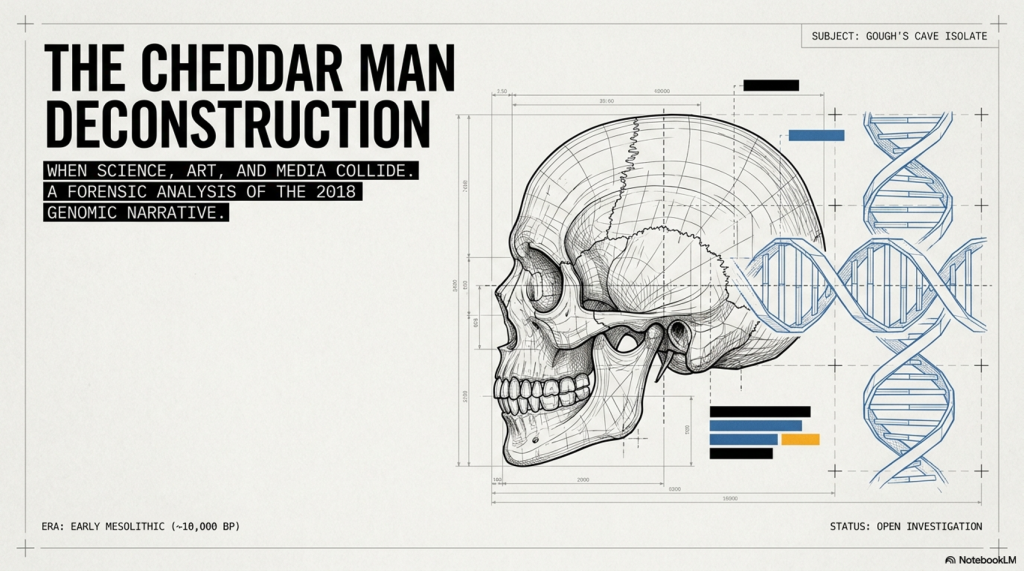
Exhibit A: Eye Colour
Report Statement
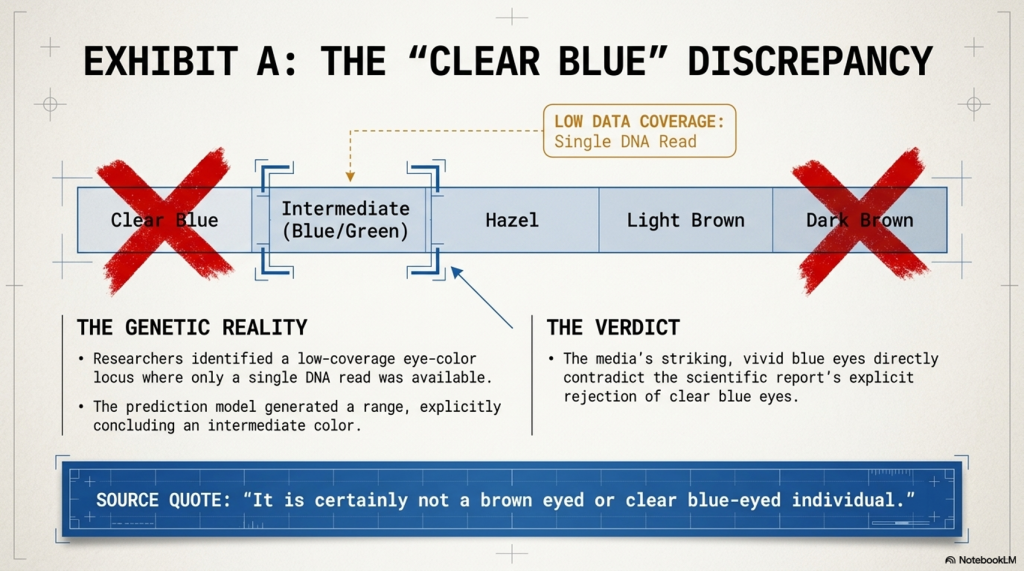
“There is 1 locus (LOC105374875 rs12896399) with low coverage (1x), hence a heterozygote is possible.”
CSI Observation
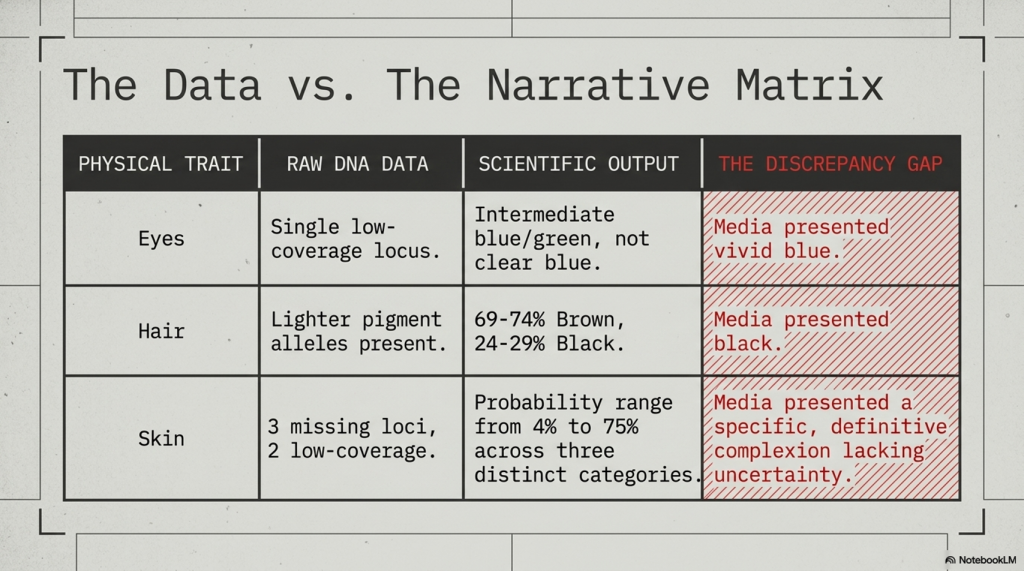
The report immediately acknowledges uncertainty. One of the key genetic markers used in the prediction was observed only once. In modern genetic analysis, a single read provides far less confidence than multiple independent observations. The authors, therefore, cannot be certain whether they are observing the complete genotype or only part of it.
Report Statement
“Prediction includes a range that includes what the 1x coverage found (ancestral G allele) and the possibility of an A-derived allele being present.”
CSI Observation
The prediction is therefore not based solely upon observed evidence. It is partly based on hypothetical genetic combinations that may exist but have not been directly observed.
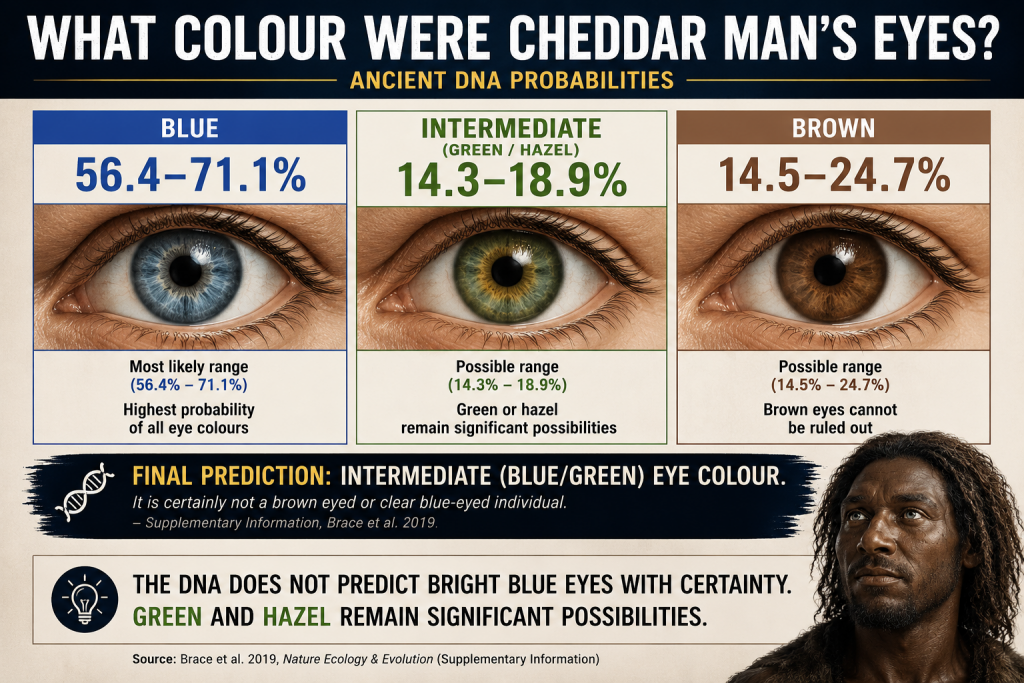
Report Statement
Blue eye: 0.564–0.711
Intermediate eye: 0.189–0.143
Brown eye: 0.247–0.145
CSI Observation
The software does not produce a single answer. It produces three competing probabilities. Brown remains possible. Intermediate remains possible. Blue remains possible. The model itself is expressing uncertainty.
Report Statement
“Final prediction: Intermediate (blue/green) eye colour.”
CSI Observation
Notice what has happened. Multiple probabilities have now been converted into a single descriptive conclusion. Yet the underlying model still contains alternative outcomes.
Report Statement
“It is certainly not a brown-eyed or clear blue-eyed individual.”
CSI Observation
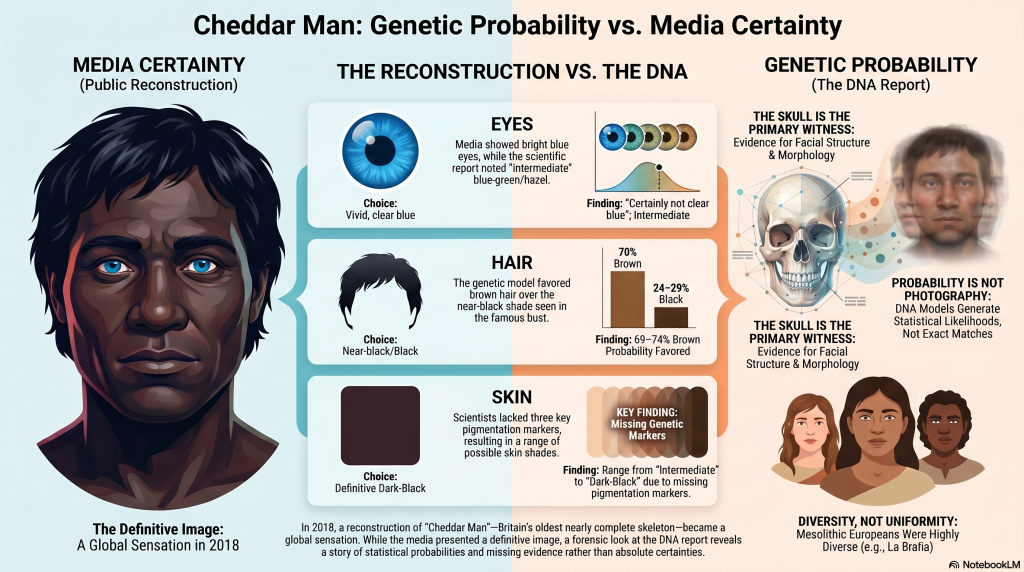
This is perhaps the most revealing sentence in the entire eye-colour section. The report explicitly states that Cheddar Man was neither brown-eyed nor clear blue-eyed. Yet many subsequent headlines simply described him as ‘blue-eyed’. The report and the headlines are not saying the same thing.
Exhibit B: Hair Colour
Report Statement
“There is 1 locus PIGU rs2378249 with low coverage (1x), hence a heterozygote is possible.”
CSI Observation
Again, we encounter the same problem. One of the markers used to predict hair colour was only observed once. The authors, therefore, acknowledge that an alternative genotype may exist but remain undetected.
Report Statement
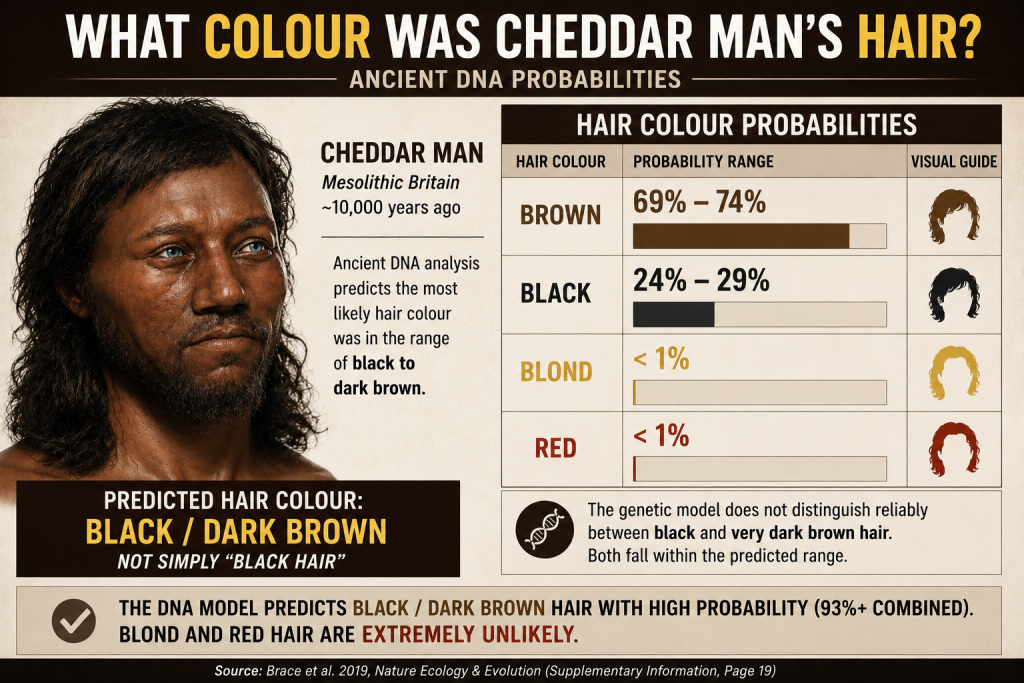
Blond: 0.009
Brown: 0.692–0.741
Red: 0.006–0.012
Black: 0.292–0.237
CSI Observation
The model strongly favours brown hair. Black hair remains a secondary possibility. Red hair and blond hair are assigned very low probabilities.
Report Statement
“Final Prediction: Dark Brown/Black hair colour.”
CSI Observation
This conclusion is reasonable based on the probability table. However, it is important to note that the strongest probability favours brown hair rather than black hair.
Report Statement
“This individual would be perceived as having dark brown hair. However, black cannot be ruled out.”
CSI Observation
The report itself is considerably more cautious than many later reconstructions. Dark brown is presented as the preferred interpretation. Black remains one possible alternative.
CSI Question
If the report favours dark brown hair, why do many reconstructions depict almost jet-black hair?
Exhibit C: Skin Pigmentation
Report Statement
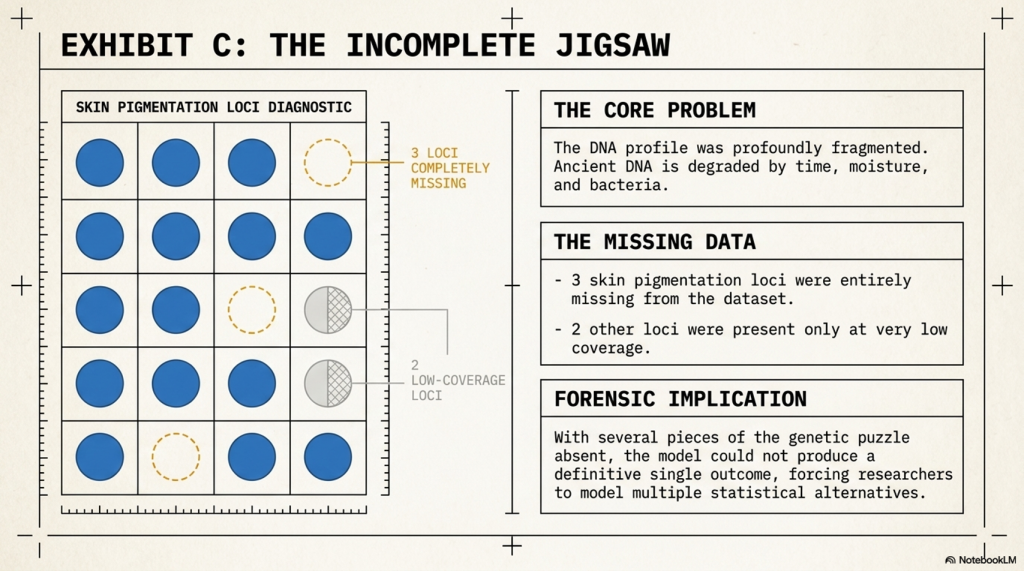
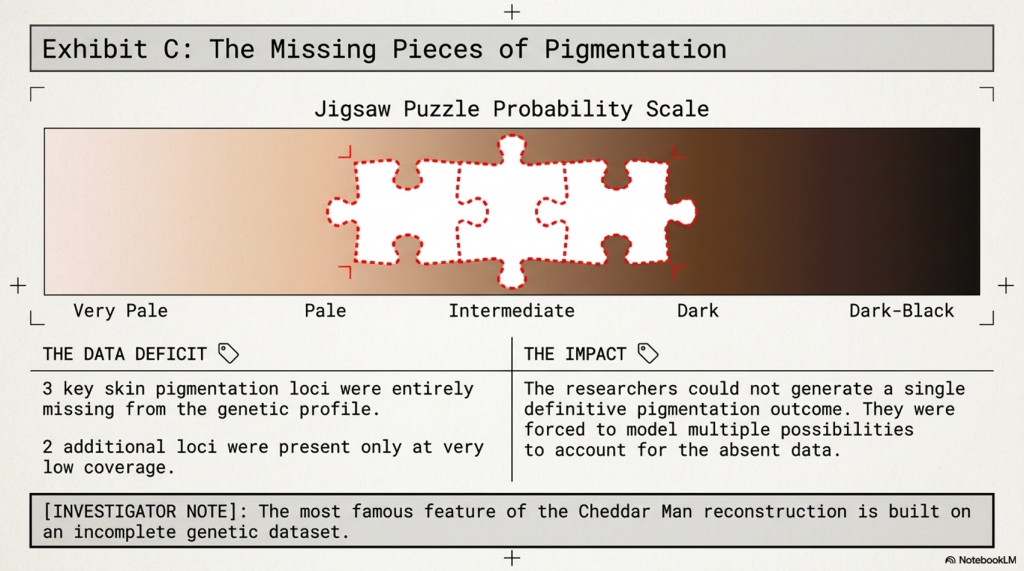
“There are 3 loci missing.”
CSI Observation
This is arguably the single most important sentence in the entire report. Three pigmentation markers contain no data whatsoever. They are absent from the genetic record.
Report Statement
“The profile does contain 2 loci with low coverage (n=1x).”
CSI Observation
In addition to the three missing markers, two additional markers were observed only once. The prediction, therefore, contains both missing information and uncertain information simultaneously.
Report Statement
“When factoring in possible genotype combinations, a prediction range may be generated.”
CSI Observation
The report is not calculating a single answer. It is generating multiple possible outcomes because the complete genetic profile is unknown.
Report Statement
“The range consists of assuming the two loci with low coverage are correct as homozygote for their sequenced allele…”
CSI Observation
The model must now make assumptions. It assumes that the single observed allele is representative of the complete genotype. This may be correct, but it remains an assumption rather than a direct observation.
Report Statement
“…and omitting the 3 missing loci from the prediction model as they have no coverage…”
CSI Observation
The model is now attempting to predict appearance while simultaneously lacking three pieces of relevant information.
Report Statement
“…to including these SNPs with their ancestral… and also their derived allele counterparts.”
CSI Observation
The software, therefore, models multiple genetic scenarios because the true genotype is unknown.
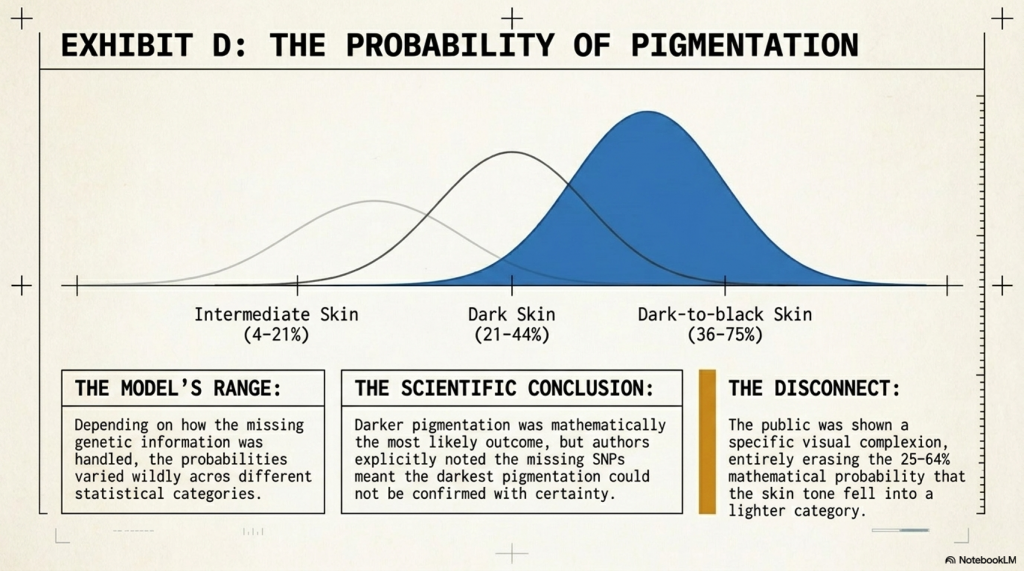
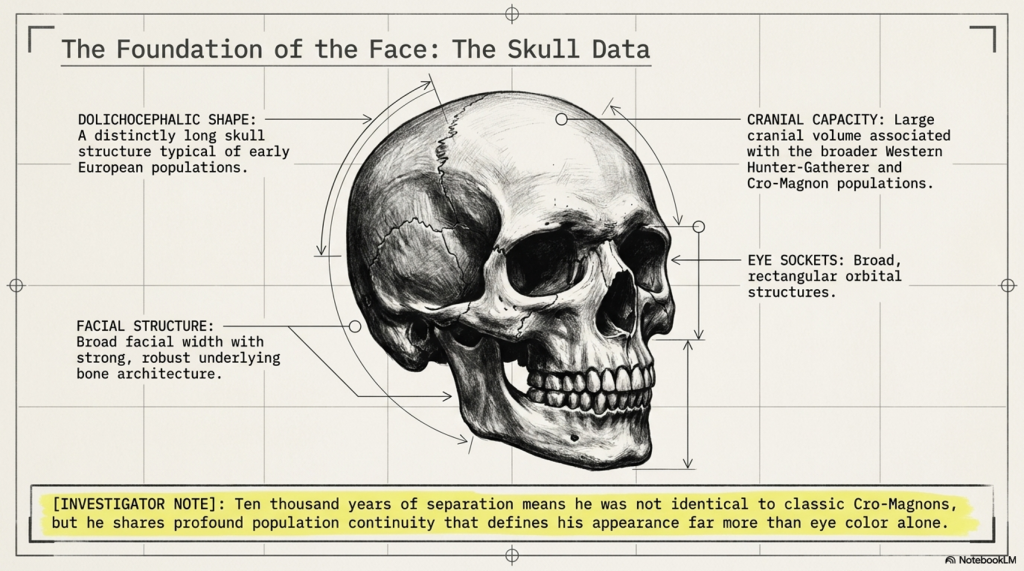
Report Statement
Intermediate: 0.152–0.038
Dark-Black: 0.848–0.962
CSI Observation
These values are not observations. They are statistical outputs generated from a model operating with missing loci, low-coverage loci, and multiple possible genotype combinations.
Report Statement
“If we omit the three missing alleles, our tool produces 0.752 and 0.248 probabilities…”
CSI Observation
This may be the most damaging sentence in the entire report. By changing the assumptions, the model produces dramatically different results. This demonstrates how sensitive the prediction is to missing information.
Report Statement
“The missing loci certainly impact on this prediction.”
CSI Observation
The authors explicitly acknowledge that the missing data affects the outcome.
Report Statement
“It is therefore best to have some allele present to infer the most probable range for Cheddar Man.”
CSI Observation
Notice the wording. The report is not observing the complete genotype. It is inferring a probable range from incomplete information.
Report Statement
“It is unlikely that this individual has the darkest possible pigmentation, but it cannot be ruled out.”
CSI Observation
Again, the report is discussing possibilities rather than certainties.
Report Statement
“Better sequencing coverage would clarify to what degree this individual has a dark complexion.”
CSI Observation
This sentence alone demonstrates that the issue remains unresolved. If better sequencing could alter the prediction, then the current prediction cannot be regarded as definitive.
Exhibit D: The Reliability Problem
At this point, a pattern emerges.
The report repeatedly uses the language of uncertainty:
“possible”
“heterozygote”
“prediction range”
“cannot be ruled out”
“better coverage would clarify”
“missing loci”
“infer”
These are not the words of certainty.
They are the words of probability.
The authors themselves repeatedly acknowledge uncertainty.
Yet by the time the public encountered Cheddar Man, much of this uncertainty had vanished.
CSI Verdict
The report does not present a photograph.
The report does not present certainty.
The report presents a statistical model operating on incomplete ancient DNA.
The eye-colour prediction contains low-coverage markers.
The hair-colour prediction contains low-coverage markers.
The skin-colour prediction contains both low-coverage markers and completely missing loci.
The authors repeatedly acknowledge these limitations.
The real mystery, therefore, is not Cheddar Man.
The real mystery is how a report built upon uncertainty, assumptions, probability ranges and incomplete genetic information became a single face presented to millions of people as historical reality.
How DNA Predictions Actually Work
Before continuing our investigation, we need to understand what the Cheddar Man report is actually doing.
Many people imagine that scientists recover ancient DNA and simply read the result:
Eye colour: Blue
Hair colour: Brown
Skin colour: Dark
Unfortunately, it is nothing like that.
The reality is considerably more complicated.
Understanding this process is essential because many of the report’s conclusions depend not on direct observation but on statistical prediction.
DNA Does Not Contain Labels
DNA does not contain a sentence that says:
“This individual had blue eyes.”
Nor does it contain a sentence that says:
“This individual had dark skin.”
Instead, scientists examine specific locations within the genome known as SNPs (Single Nucleotide Polymorphisms).
Think of these as tiny switches.
Certain combinations of switches are statistically associated with particular traits.
For example:
Some combinations are more common among people with blue eyes.
Some combinations are more common among people with brown eyes.
Some combinations are more common among people with darker pigmentation.
The prediction system, therefore, works backwards.
Instead of observing the colour directly, it attempts to infer the most likely appearance from a collection of genetic markers.
Why Multiple Markers Are Needed
No single marker determines eye colour.
No single marker determines hair colour.
No single marker determines skin colour.
Instead, multiple genes interact.
The software, therefore, examines many locations simultaneously and combines them into a probability model.
This is important.
The software is not identifying a colour.
It is calculating the likelihood of different colours.
This is why the report produces percentages.
The model is effectively asking:
“Based upon the markers available, how often does this genetic pattern occur in people with blue eyes?”
The answer might be:
71%.
That does not mean the individual had blue eyes.
It means the model estimates a 71% probability.
Why The Results Are Not Yes Or No
Most people expect science to provide definitive answers.
The problem is that biology rarely behaves that way.
Imagine a genetic profile that resembles:
70% of blue-eyed people
20% of green-eyed people
10% of brown-eyed people
The software cannot honestly answer:
Blue.
Instead, it produces probabilities.
This is exactly what we see in the Cheddar Man report.
What Is Coverage?
This is where the report becomes particularly important.
When scientists sequence DNA, they do not read a marker once and immediately trust the result.
Instead, they attempt to read it repeatedly.
Each successful read is known as coverage.
For example:
1x coverage = read once
5x coverage = read five times
10x coverage = read ten times
30x coverage = read thirty times
The more times a marker is observed, the greater the confidence that the result is correct.
Why Ancient DNA Is Different
Modern forensic DNA usually comes from living individuals or recent biological samples.
Ancient DNA is very different.
Cheddar Man died approximately 10,000 years ago.
During that time, the DNA has been exposed to:
- moisture
- bacteria
- chemical degradation
- temperature change
- physical decay
As a result, much of the original DNA has been damaged or lost.
Scientists, therefore, recover fragments rather than complete genetic sequences.
Why 1x Coverage Is A Problem
Imagine tossing a coin.
If you toss it once and obtain heads, can you conclude that the coin always lands heads?
Of course not.
You need multiple observations.
The same principle applies to DNA.
If a marker is observed only once, scientists cannot be completely certain they have captured the full genetic picture.
This is exactly why the report repeatedly states:
“A heterozygote is possible.”
The authors acknowledge that a second allele may exist, but it was simply not observed.
What Is A Heterozygote?
Every person carries two copies of most genetic markers.
One inherited from their mother.
One inherited from their father.
Suppose the possible variants are:
A
and
G
The possible combinations are:
AA
AG
GG
If scientists only observe one G because coverage is 1x, they cannot know whether the actual genotype is:
GG
or
AG
This uncertainty forces the software to model multiple possibilities.
Why Missing Loci Matter
The report repeatedly refers to missing loci.
A missing locus means:
No data.
No observation.
No result.
The software, therefore, has a choice:
Ignore the marker completely.
Or estimate possible outcomes using statistical modelling.
Neither option is ideal.
This is why the report repeatedly discusses prediction ranges.
Why The Predictions Change
One of the most revealing passages in the report shows that changing the assumptions yields dramatically different probabilities of pigmentation.
This happens because the model is attempting to fill gaps in incomplete information.
In simple terms:
Change the assumptions.
Change the outcome.
That does not mean the model is wrong.
It means the model is sensitive to missing information.
The Critical Distinction
This is the single most important point in the entire debate.
The report does not directly observe:
Eye colour.
Hair colour.
Skin colour.
Instead, it observes genetic markers and then uses a statistical model to estimate the most likely appearance.
The final result is therefore not an observation.
It is an inference.
And the reliability of that inference depends entirely upon the quality and completeness of the DNA available.
This distinction will become crucial when we examine how a report filled with probabilities, assumptions, missing loci and low-coverage markers eventually became a single face presented to the public as historical reality.
The Wider Dataset – Do The Other Hunter-Gatherers Support The Headlines?
Having examined the Cheddar Man report in detail, the next question is obvious:
Was Cheddar Man unique?
Or do the other Mesolithic genomes support the popular narrative that Europe’s early hunter-gatherers were a uniform population of dark-skinned, blue-eyed people?
The answer is no.
The wider dataset reveals considerably more variation than most newspaper headlines ever acknowledged.
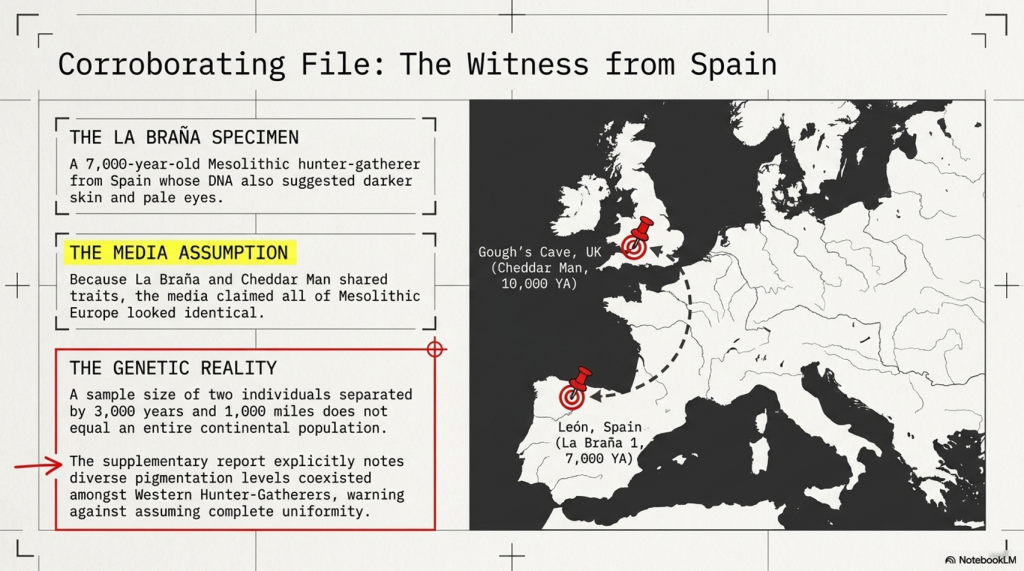
Exhibit 1: La Braña (Spain)
La Braña is often cited alongside Cheddar Man because the DNA results appear superficially similar.
Report Conclusion
Eyes:
Intermediate (green/hazel)
Hair:
Black/Dark Brown
Skin:
Dark to Dark-Black
CSI Observation
At first glance, La Braña appears to support the Cheddar Man narrative.
However, the same limitations remain present:
- phenotype prediction rather than direct observation
- probability modelling
- incomplete ancient DNA
- reconstruction through statistical inference
Most importantly, La Braña does not demonstrate that all Western Hunter-Gatherers looked alike.
It merely shows that another individual produced a similar probability profile.
One additional example is not proof of a continental population.
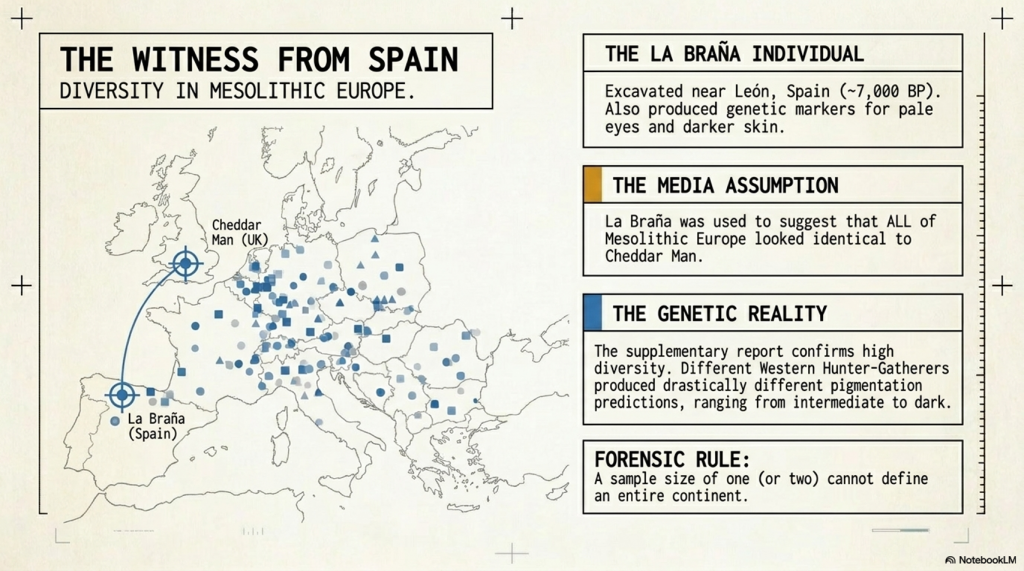
Exhibit 2: Loschbour (Luxembourg)
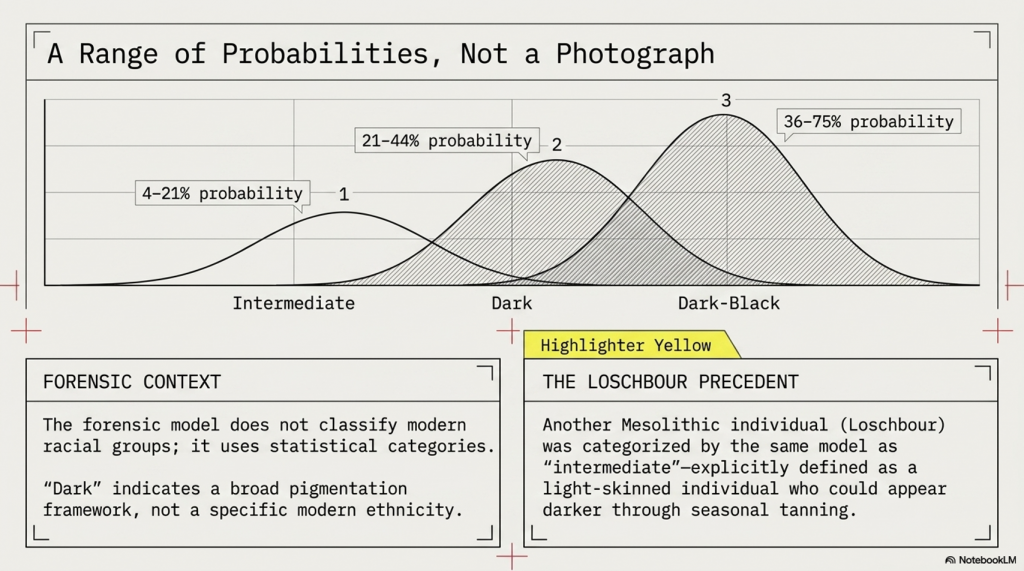
Loschbour is where the simplistic narrative begins to break down.
Report Conclusion
Eyes:
Intermediate blue/green
Hair:
Dark Brown/Black
Skin:
Intermediate
CSI Observation
This result differs significantly from both Cheddar Man and La Braña.
The same prediction system now produces a substantially lighter complexion.
If the popular narrative were correct, we would expect all three individuals to cluster tightly together.
Instead, variation immediately appears.
The dataset itself, therefore, demonstrates that pigmentation diversity already existed among Western Hunter-Gatherers.
Exhibit 3: Sven (Carsington Pasture Cave)
Sven is rarely mentioned in media discussions.
Report Conclusion
Dark Hair
Intermediate to Dark Skin
CSI Observation
Again the prediction does not fit a simplistic black-versus-white framework.
Instead we find another combination occupying the middle ground.
The reality is considerably more complex than the headlines suggest.
What The Authors Actually Concluded
Perhaps the most overlooked part of the entire study is the authors’ own summary.
Rather than claiming a single uniform appearance, the report identifies variation between individuals and suggests that pigmentation characteristics may have varied geographically and temporally.
This is a very different conclusion from the one often presented to the public.
The Statistical Problem
The media effectively reduced the dataset to:
Cheddar Man = dark skin
Therefore:
All Mesolithic Europeans = dark skin.
This is not how science works.
Three or four individuals cannot be assumed to represent an entire continent.
Even less can they be assumed to represent thousands of years of population history.
The actual dataset demonstrates variation, not uniformity.
The Reconstruction Problem
The public rarely encountered the probability tables.
They rarely encountered the caveats.
They rarely encountered the missing loci or low-coverage markers.
Instead they encountered reconstructed faces.
Once a face is produced, uncertainty tends to disappear.
The reconstruction becomes remembered as evidence, even though it is actually the final stage of a long chain of interpretation.
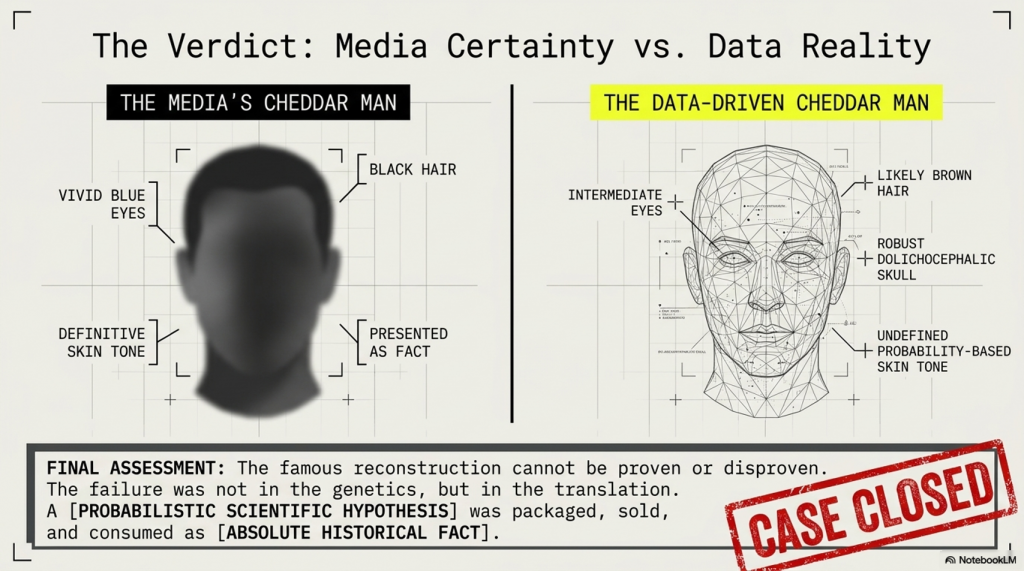
CSI Verdict
The wider dataset does not support the simplistic narrative often promoted in newspapers and documentaries.
Instead it demonstrates:
• significant variation between individuals
• differing pigmentation predictions
• differing eye-colour probabilities
• differing skin-colour probabilities
• and the continued presence of uncertainty throughout the dataset.
Far from proving that all Western Hunter-Gatherers shared a single appearance, the study itself suggests a much more diverse and complex picture.
The further we move away from the original DNA and towards the final reconstructions, the more certainty appears.
Yet the underlying evidence remains probabilistic, incomplete and open to multiple interpretations.
That chapter then sets up Chapter 4 perfectly, where you introduce the Cro-Magnon evidence and ask the obvious question:
If blue eyes, lighter pigmentation alleles, and long-headed Cro-Magnon populations already existed in prehistoric Europe, why did the public end up with a reconstruction that many people instinctively associate with a modern African phenotype rather than a Mesolithic European hunter-gatherer?
That’s where the argument starts to become genuinely interesting.
The Discovery
The Skeleton That Rewrote British History
Few archaeological discoveries in Britain have generated as much public attention as Cheddar Man.
Found in 1903 within Gough’s Cave in Cheddar Gorge, Somerset, the skeleton was immediately recognised as something extraordinary. Unlike the fragmented remains often recovered from prehistoric sites, Cheddar Man was remarkably complete and quickly became one of the most important human discoveries ever made in Britain. Later radiocarbon dating placed the individual in the Early Mesolithic period, approximately 10,000 years ago, making him one of the oldest nearly complete Homo sapiens skeletons ever found in Britain.
For over a century, Cheddar Man remained primarily an archaeological curiosity. He was important because of his age, his preservation, and what he could tell us about the hunter-gatherers who recolonised Britain after the retreat of the last Ice Age. Few outside archaeological circles paid much attention to him. (The Cheddar Man Hoax)
That changed dramatically in 2018.
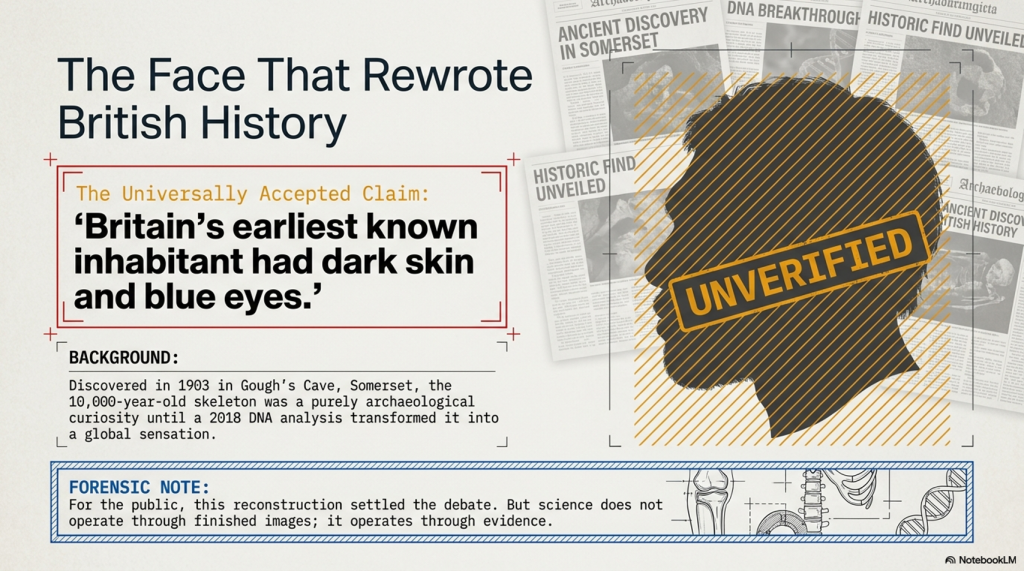
Suddenly, Cheddar Man was no longer simply Britain’s oldest skeleton. He became a global news story.
Newspapers, television documentaries, museums, and websites across the world announced a remarkable discovery:
Britain’s earliest known inhabitant had dark skin and blue eyes.
The headline spread rapidly.
For some, it was a fascinating scientific revelation. For others, it challenged long-held assumptions about Britain’s ancient population. Social media exploded with debate. Politicians, commentators, journalists, and activists all weighed in on what the discovery supposedly meant.
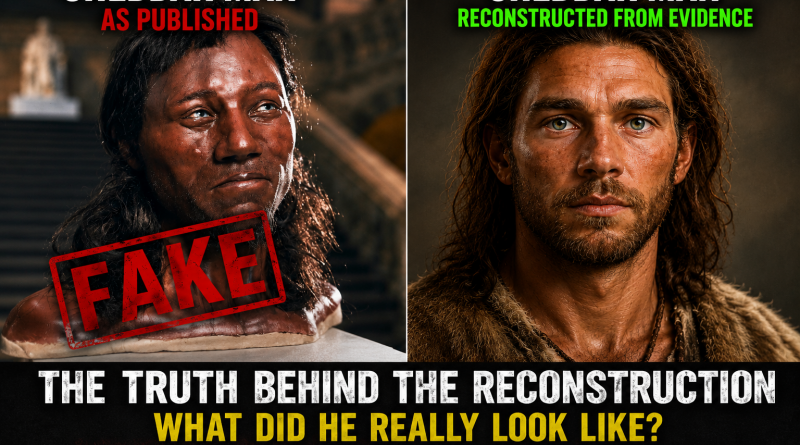
The reconstruction itself was striking. The face presented to the public showed a man with very dark skin, dark curly hair, and vivid blue eyes. It was an image designed to challenge expectations, and it succeeded spectacularly. Within days, the reconstruction had become one of the most recognisable prehistoric faces in the world.
Yet buried beneath the headlines was a much more interesting question.
What exactly had scientists discovered?
At first glance the answer appears straightforward. Researchers extracted ancient DNA from the petrous portion of Cheddar Man’s skull, one of the densest bones in the human body and often the best source of preserved genetic material. Using modern sequencing techniques, they recovered enough DNA to investigate ancestry, physical traits, and population relationships. The resulting analysis was then used to create a facial reconstruction for television and museum audiences.
Case closed.
Or so it seemed.
However, archaeology has a long history of transforming cautious scientific observations into definitive public narratives. The journey from excavation trench to newspaper headline is rarely straightforward. Data must be interpreted. Models must be constructed. Probabilities must be assigned. Artists must make decisions. Journalists must simplify complex science into a few memorable sentences.
At every stage, uncertainty can become reduced until the final public story appears far more certain than the original evidence ever allowed.
This is particularly important in the case of Cheddar Man because the public generally encountered only the final reconstruction. Few people ever read the genetic reports, the supplementary data, or the technical discussions surrounding the limitations of ancient DNA analysis. Most simply saw the finished image and accepted it as a scientific fact.
But science does not operate through finished images.
Science operates through evidence.
This raises a crucial question.
Was the famous reconstruction simply a visual representation of the available evidence?
Or did the reconstruction become more definitive than the evidence itself?
To answer that question, we must set aside modern assumptions, political arguments, and media headlines. Instead, we must approach the case exactly as a forensic investigator would.
We begin not with conclusions, but with evidence.
The skeleton is our first witness.
The DNA is our second.
The prediction models are our third.
And the media narrative is our fourth.
Only when all four witnesses have been questioned can we determine whether the famous image of Cheddar Man represents a scientific certainty—or merely one possible interpretation among several.
The investigation begins.
The Media Story
How a Scientific Study Became a Global Headline
Before examining the DNA, we must first examine the story that most people believe.
After all, very few members of the public have ever read a genetics paper. Even fewer have examined supplementary DNA datasets. What most people know about Cheddar Man comes from newspaper articles, television documentaries, museum websites, and social media posts.
In other words, they know the story rather than the evidence.
That distinction is important because the story that emerged in 2018 was remarkably simple.
Britain’s oldest known inhabitant had dark skin and blue eyes.
It was a powerful headline.
It was memorable.
Most importantly, it challenged modern assumptions about ancestry and appearance.
The Natural History Museum described Cheddar Man as a Mesolithic hunter-gatherer with dark skin and blue eyes, and further suggested that populations across Mesolithic Europe possessed similar characteristics.
The accompanying reconstruction reinforced that message visually.
The public was presented with a man possessing very dark skin, tightly curled dark hair, and striking pale blue eyes. The image rapidly became one of the most widely reproduced prehistoric reconstructions ever created.
For journalists, it was the perfect story.
It contained science.
It contained surprise.
It challenged conventional expectations.
And perhaps most importantly, it could be summarised in a single sentence.
Unfortunately, science rarely fits into a single sentence.
The moment a scientific finding is compressed into a headline, something is inevitably lost. Complex statistical probabilities become certainties. Nuance disappears. Caveats vanish. Alternative interpretations are quietly forgotten.
This process is not unique to archaeology.
It happens throughout science.
However, the Cheddar Man story provides a fascinating opportunity to observe the process in real time.
Consider the wording used throughout media reports.
The public repeatedly encountered phrases such as:
“Cheddar Man had dark skin and blue eyes.”
Not:
“The available genetic markers suggest.”
Not:
“The prediction model indicates.”
Not:
“One possible reconstruction.”
Instead, uncertainty largely disappeared, replaced by definitive statements.
This transformation is subtle but important.
Scientific investigations generally deal in probabilities.
Media reports generally deal in conclusions.
The gap between those two approaches is often where misunderstanding begins.
The Natural History Museum article provides a useful example. While discussing pigmentation, the article states:
“He is just one person, but also indicative of the population of Europe at the time. They had dark skin and most of them had pale coloured eyes, either blue or green, and dark brown hair.”
This is a significant claim.
A single individual has effectively become representative of an entire population spanning thousands of kilometres and many generations.
Yet anyone familiar with human populations knows that variation is the rule rather than the exception.
Even within modern populations, physical appearance varies enormously. It would therefore be surprising if Mesolithic Europe, stretching from Iberia to Scandinavia, displayed no comparable diversity.
This raises our first forensic question.
How much of the reconstruction is supported directly by Cheddar Man’s DNA?
And how much derives from broader assumptions regarding Mesolithic populations?
The distinction matters.
Because the public was not shown a range of possibilities.
They were shown a face.
A single face.
A definitive face.
A face that appeared to settle a debate before most people had even seen the evidence.
The reconstruction itself introduces another layer of interpretation.
Facial reconstruction is not the same as photography.
The artists responsible for the reconstruction openly acknowledge that the process combines science and artistic judgement. Measurements are taken from the skull. Tissue depths are estimated using modern comparative datasets. Missing details must be inferred. Hair texture, skin tone, facial expression, and numerous subtle characteristics require interpretation.
This does not make facial reconstruction unscientific.
Far from it.
But it does mean that every reconstruction contains assumptions.
Those assumptions may be reasonable.
They may even be highly probable.
Yet they remain assumptions nonetheless.
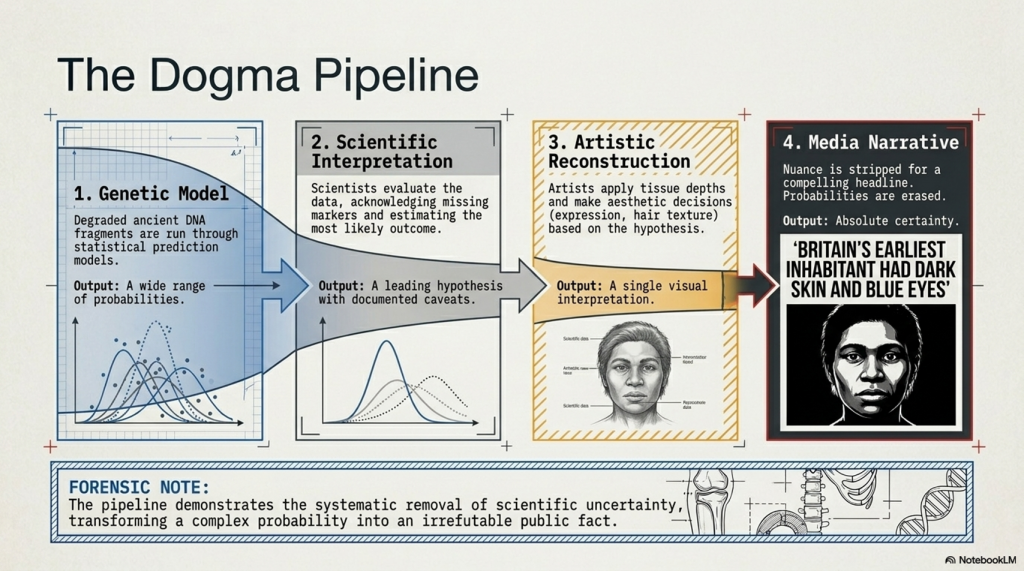
This creates an important chain of events:
DNA is analysed.
Genetic markers are selected.
Prediction models generate probabilities.
Scientists interpret those probabilities.
Artists interpret those interpretations.
Journalists simplify the result.
The public receives a finished image.
By the time the process is complete, the final product may appear far more certain than the original evidence ever was.
This is the central issue facing any forensic investigation of Cheddar Man.
The question is not whether the scientists acted in good faith.
Nor is it whether the artists were skilled.
The question is much simpler.
Did the certainty presented to the public accurately reflect the certainty contained within the underlying genetic evidence?
To answer that question, we must leave the headlines behind and examine the primary evidence itself.
The next witness is the DNA.
The Blue-Eye Mystery
A Trait That Should Not Exist?
If there is one feature that has consistently puzzled geneticists, anthropologists, and evolutionary biologists, it is blue eyes.
Unlike skin colour, which varies continuously across human populations, blue eyes are unusual. They are rare globally and concentrated largely within populations of European ancestry.
For most of human history, the assumption was simple.
Blue eyes evolved relatively recently in northern Europe.
The logic appeared sound. Northern Europe receives less sunlight than equatorial regions. Fair skin and lighter pigmentation were thought to be evolutionary adaptations that improved vitamin D production in low-light environments. Consequently, blue eyes were often viewed as part of the same package of traits.
Then the ancient DNA evidence arrived.
Suddenly, that simple narrative began to unravel.
The genetic analysis of La Braña in Spain suggested that blue eyes were already present amongst European hunter-gatherers thousands of years before the arrival of later farming populations.
Cheddar Man appeared to tell a similar story.
The implication was profound.
Blue eyes may not have originated amongst later northern European populations at all.
They may have been inherited from a much older ancestral population.
Where Do Blue Eyes Come From?
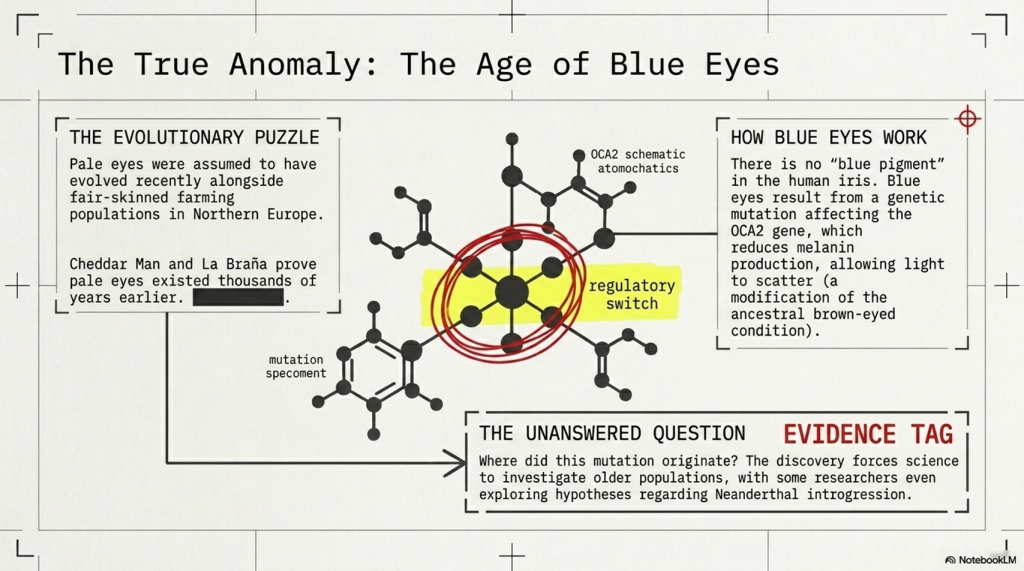
Modern genetic studies suggest that most blue-eyed individuals share a common mutation affecting the regulation of the OCA2 gene.
This gene plays a major role in melanin production, the pigment responsible for skin, hair, and eye colour.
Research discussed in earlier studies suggested that all modern blue-eyed individuals ultimately trace their eye colour to a common ancestral mutation that altered how melanin was expressed within the iris. Rather than producing the high concentrations associated with brown eyes, the mutation reduced melanin production, creating the blue appearance we recognise today.
The important point is that blue eyes are not produced by a separate blue pigment.
There is no blue colouring within the iris.
Instead, blue eyes result from reduced melanin and the way light scatters through the eye.
In other words, blue eyes are a genetic modification of the ancestral brown-eyed condition.
The question, therefore, becomes:
When did this mutation first appear?
The Problem for Traditional Narratives
The discovery of blue-eyed Mesolithic hunter-gatherers created an immediate problem.
If blue eyes already existed amongst populations such as La Braña and Cheddar Man, then the trait must predate many of the later migrations traditionally used to explain European pigmentation patterns.
This does not automatically tell us where the mutation originated.
However, it does demonstrate that the standard picture of blue eyes emerging alongside fair-skinned farming populations is incomplete.
Blue eyes clearly existed earlier.
The question is how much earlier.
And within which population?

The Neanderthal Question
This is where the investigation becomes considerably more controversial.
Langdon research notes that Neanderthals possessed several pigmentation variants not commonly found in modern populations and that some Neanderthal individuals appear to have possessed lighter pigmentation traits, including red hair and fair skin.
Furthermore, it is now widely accepted that interbreeding occurred between Homo sapiens and Neanderthals, leaving a measurable genetic legacy within modern Eurasian populations.
This naturally raises an intriguing question.
Could traits such as blue eyes have originated within Neanderthal populations and later entered the Homo sapiens gene pool through interbreeding?
At present, the answer is unknown.
The evidence currently available does not allow such a conclusion to be demonstrated.
Nor does it allow it to be completely dismissed.
What can be said is that the existence of blue-eyed hunter-gatherers long before many later population movements suggests that the history of eye colour is likely to be far older and more complex than the simplified narratives often presented in popular media.
The important point is not whether the Neanderthal hypothesis is correct.
The important point is that alternative explanations exist and deserve investigation.
Science progresses by examining possibilities, not by prematurely closing them.
A Trait Looking for an Explanation
By now, the original Cheddar Man story is beginning to look very different.
The popular narrative suggests a simple conclusion:
Cheddar Man had blue eyes.
Yet the supplementary report itself actually describes an intermediate blue-green eye colour rather than clear blue eyes.
The wider European evidence reveals that similar eye-colour patterns already existed elsewhere in Mesolithic Europe.
The genetic history of blue eyes appears considerably older than once believed.
And the ultimate origin of the mutation remains a matter of continuing investigation.
Rather than answering questions, blue eyes create new ones.
Where did the mutation originate?
Why did it spread?
Why did it survive?
And what does its presence reveal about the populations that occupied Europe at the end of the Ice Age?
To answer those questions, we must move beyond pigmentation alone and examine the people themselves.
The next witness is not a genetic marker.
The next witness is the Cro-Magnon population.
The Forgotten Evidence – The Skull Itself
Looking Beyond Pigmentation
By this point in our investigation, we have spent considerable time discussing skin colour, eye colour and hair colour.
That is understandable.
After all, these are the characteristics that dominated the headlines.
Yet there is an obvious problem.
Pigmentation is only a tiny fraction of what makes a person recognisable.
If two individuals share the same skin colour but have completely different skull shapes, facial structures, and body proportions, they can appear entirely unrelated.
Conversely, individuals with different pigmentation but similar skeletal anatomy may appear closely connected.
This raises an important question.
Why did the public debate surrounding Cheddar Man become almost entirely focused on colouration while largely ignoring the actual skeleton?
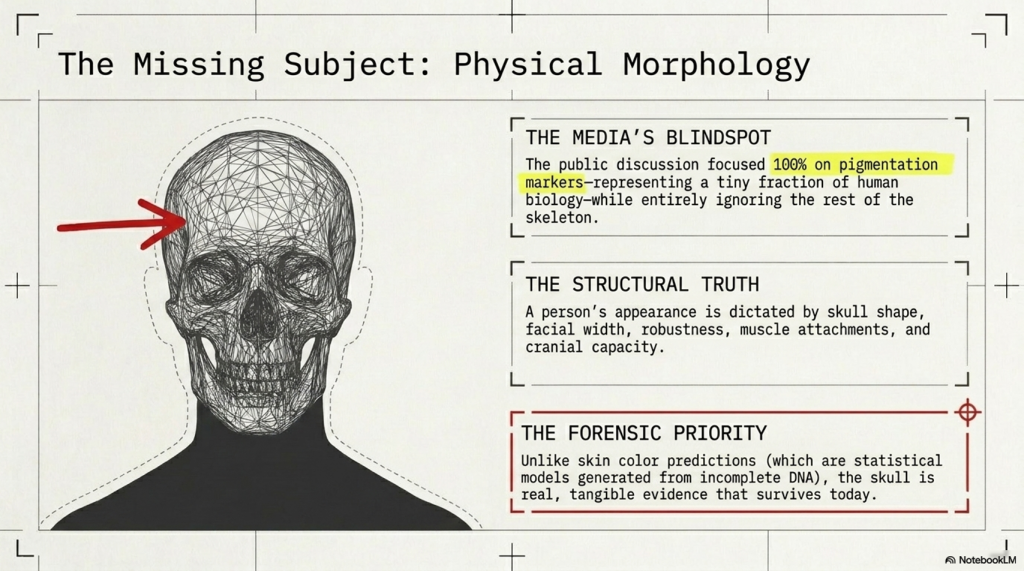
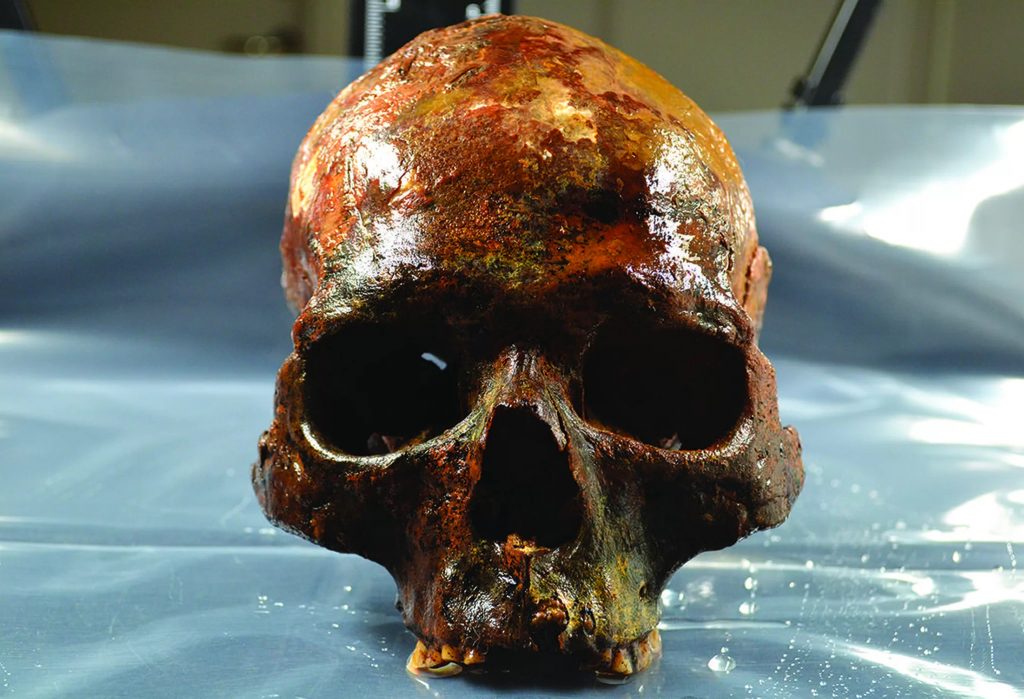
Because, unlike the pigmentation predictions, the skull is not a probability.
The skull is evidence.
How Anthropologists Originally Identified Ancient Populations
Long before the development of ancient DNA analysis, anthropologists classified prehistoric populations using skeletal morphology.
They examined:
- skull shape
- cranial length
- cranial height
- forehead profile
- eye socket shape
- nasal aperture
- cheekbones
- jaw structure
- dentition
These characteristics allowed researchers to compare populations across both time and geography.
The presenter in the Cheddar Man documentary notes that Mesolithic hunter-gatherers were traditionally recognised by precisely these skeletal features, and that many displayed robust facial anatomy, powerful mandibles, and pronounced cranial characteristics.
In other words, before DNA entered the discussion, researchers already possessed a substantial body of evidence regarding the physical appearance of these populations.
That evidence did not disappear simply because genetic testing became available.
The Long-Headed Europeans
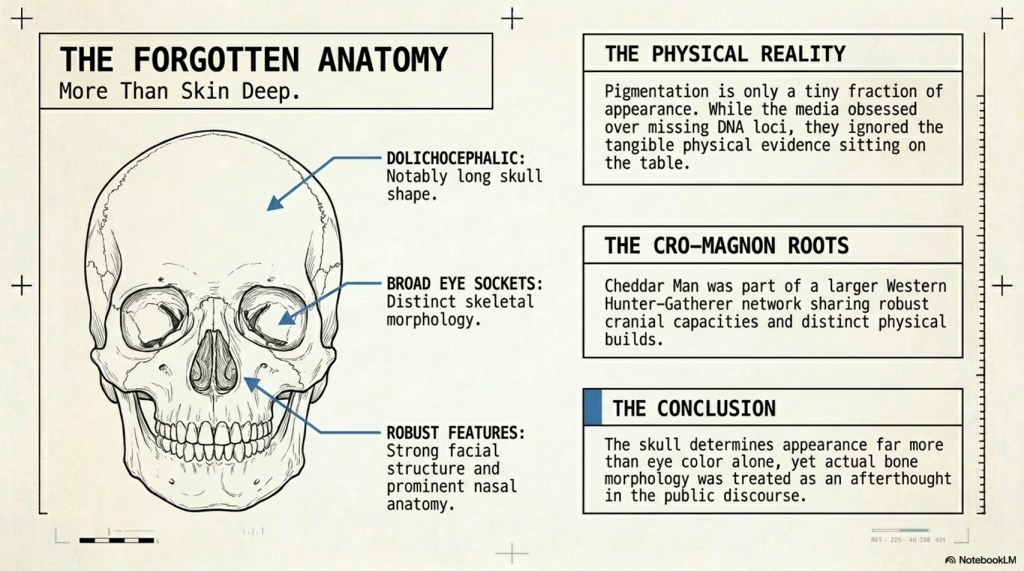
One of the most frequently recorded observations concerning Europe’s Upper Palaeolithic and Mesolithic populations was their tendency towards long skulls.
Traditional anthropologists referred to these populations as dolichocephalic.
The famous Cro-Magnon skeletons discovered in France were described as possessing:
- long skulls
- broad faces
- low-set square eye sockets
- strong jaws
- powerful facial structure
These features became defining characteristics of Europe’s earliest modern populations.
Although many of the racial classifications used by nineteenth-century anthropologists have since been abandoned, the measurements themselves remain part of the archaeological record.
The skulls have not changed.
The measurements have not changed.
Only the terminology has changed.
The Curious Absence of Morphology
This is where the Cheddar Man story becomes rather strange.
The reconstruction was widely discussed because of its skin colour.
Yet comparatively little public attention was paid to the underlying skull morphology.
Most newspaper articles focused on:
- black skin
- blue eyes
- dark hair
Very few discussed:
- cranial proportions
- facial architecture
- jaw structure
- orbital shape
- skeletal robustness
Yet these are arguably the characteristics that define a face far more than pigmentation alone.
A person’s skull determines:
- head shape
- facial width
- eye placement
- nose shape
- jaw profile
- chin structure
These features dominate the appearance.
Skin colour merely overlays them.
What The Skull Suggests
The surviving skull formed the foundation of every reconstruction produced.
Without it, there would be no face to reconstruct.
Genetics can estimate pigmentation.
The skull determines the individual.
This distinction is often forgotten.
A pigmentation model can suggest probabilities.
A skull provides measurable anatomy.
Consequently, any attempt to reconstruct Cheddar Man should begin not with skin colour but with the physical evidence of the skeleton itself.
This is exactly how forensic reconstructions are normally performed.
The skeletal structure comes first.
The pigmentation is added later.
Yet much of the public discussion surrounding Cheddar Man reversed this process.
The pigmentation became the story.
The skeleton became secondary.
The Bigger Picture
The result is that many people now associate Cheddar Man with a skin colour rather than a population.
Yet the archaeological evidence suggests he was part of a wider Western Hunter-Gatherer community that occupied much of post-glacial Europe.
These populations possessed physical characteristics extending far beyond pigmentation alone.
To reduce them to a single skin-tone category risks losing sight of the broader biological reality.
The real lesson of Cheddar Man may therefore be that the most important evidence was present from the beginning.
Not the DNA.
Not the reconstruction.
Not the headlines.
But the skull itself.
And it is to that skull, combined with the genetic evidence, that we now turn for our final reconstruction.
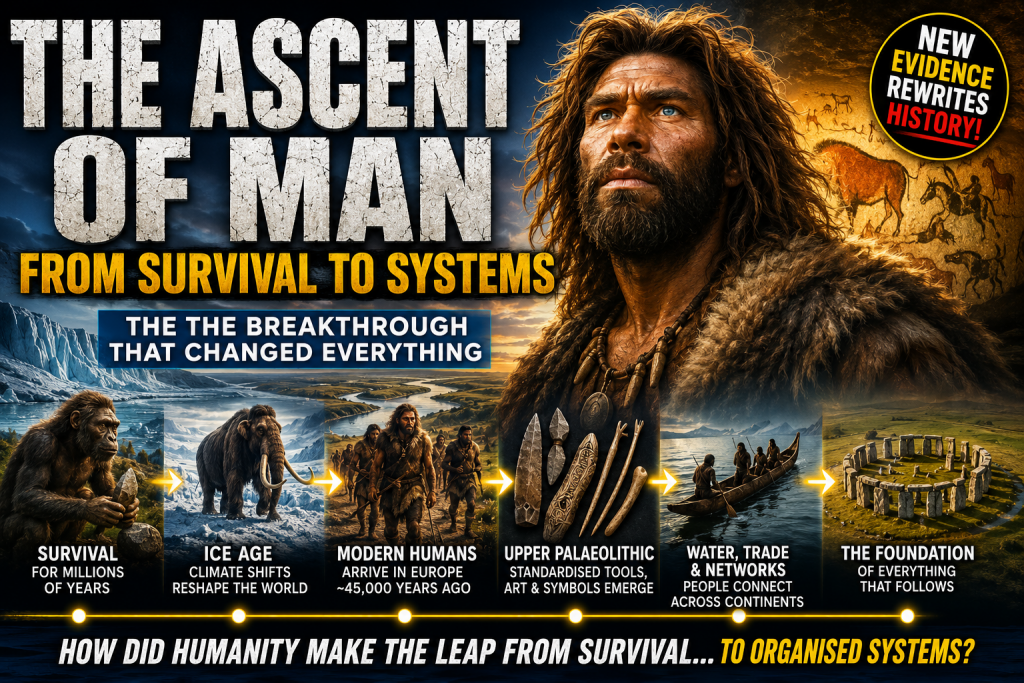
The Cro-Magnon Connection
The Evidence Everyone Forgot
By this point in our investigation, we have spent considerable time examining pigmentation.
Eye colour.
Hair colour.
Skin colour.
Yet there is an obvious problem.
Pigmentation is only a tiny fraction of what makes a human being look the way they do.
A person’s overall appearance is determined by dozens of other characteristics, including skull shape, facial structure, height, robustness, muscle attachment, cranial capacity and body proportions.
This raises an important question.
Why did the public discussion surrounding Cheddar Man become almost entirely focused on skin colour while largely ignoring the rest of the skeleton?
The answer may be because pigmentation generates headlines.
Skull morphology does not.
Yet if we wish to understand who Cheddar Man really was, the rest of the skeleton deserves equal attention.
The Wider Western Hunter-Gatherer Population
The genetic analysis places Cheddar Man within the Western Hunter-Gatherer population that occupied much of Europe following the end of the last Ice Age.
La Braña, the famous Spanish individual frequently cited alongside Cheddar Man, also belongs to this broader population.
This is important because it means that Cheddar Man was not an isolated individual.
He was part of a much larger population network stretching across post-glacial Europe.
The question, therefore, becomes:
What did these people actually look like?
Unfortunately, this is where the public narrative becomes surprisingly selective.
The newspapers focused on skin colour.
The documentaries focused on eye colour.
The headlines focused on race.
Very little attention was paid to the wider physical characteristics of the people themselves.
The Long-Headed Europeans
Long before the development of DNA analysis, Victorian anthropologists devoted enormous effort to measuring prehistoric skeletons.
Their methods were often imperfect, and many of their conclusions are now outdated. However, one observation repeatedly appeared throughout their studies.
Many early European skeletons possessed long skulls.
These were traditionally described as dolichocephalic populations.
The classic Cro-Magnon skeletons discovered in France displayed long skulls, large cranial capacities, strong facial structures and robust physiques. They differed sufficiently from modern Europeans that early researchers initially regarded them as a distinct variety of humanity.
Today, archaeologists classify these individuals as fully modern humans.
However, the physical characteristics remain.
The skulls did not suddenly become round.
The facial structure did not disappear.
The underlying morphology still exists within the archaeological record.
An Uncomfortable Coincidence
This is where the story becomes interesting.
The two most famous Mesolithic individuals associated with pale eyes and darker pigmentation are:
- Cheddar Man
- La Braña
Both belong to the Western Hunter-Gatherer population.
Both lived before the arrival of later Neolithic farming populations.
Both are repeatedly used as examples of Europe’s original post-glacial inhabitants.
Yet when modern articles discuss these individuals, almost all attention is directed towards pigmentation, while the wider physical characteristics of these populations receive little mention.
The result is a strange distortion.
Readers are encouraged to focus on a handful of pigmentation markers while largely ignoring the broader biological picture.
It is rather like trying to identify a suspect from their eye colour while ignoring the rest of their face.
More Than Skin Deep
The irony is that the genetic evidence itself repeatedly warns against oversimplification.
The pigmentation models generate probabilities.
The eye-colour predictions contain uncertainty.
The skin-colour predictions contain missing loci.
The hair-colour predictions contain alternative outcomes.
Yet despite all this uncertainty, the public discussion became increasingly focused upon a single characteristic:
Skin colour.
The wider physical appearance of Europe’s hunter-gatherers largely disappeared from view.
This is particularly surprising because prehistoric populations are often identified through combinations of traits rather than isolated characteristics.
Height matters.
Facial structure matters.
Cranial morphology matters.
Body proportions matter.
Population history is rarely written in a single SNP.
The Cro-Magnon Question
This brings us to a question that rarely appears in discussions of Cheddar Man.
If Western Hunter-Gatherers formed part of a wider European population with roots stretching back into the Upper Palaeolithic, how much continuity existed between these Mesolithic groups and the populations traditionally described as Cro-Magnons?
The question is not whether they were identical.
Ten thousand years of separation would make that unlikely.
The question is whether the pigmentation evidence has distracted attention away from broader population continuity.
Because if the discussion focuses solely on skin colour, an enormous amount of archaeological and biological evidence remains unexplored.
The reality may be that Cheddar Man was neither the modern racial symbol presented by some journalists nor the simplistic caricature presented by his critics.
Instead, he may represent part of a much older European population whose appearance was considerably more diverse and complex than modern labels allow.
The Real Lesson
The greatest weakness of the public narrative is not its discussion of pigmentation.
Pigmentation is important.
The weakness is that it discussed little else.
The public was shown a face.
A skin colour.
A pair of eyes.
A headline.
What they were not shown was the uncertainty within genetics, the diversity within Mesolithic populations, or the broader physical characteristics of the people themselves.
In short, they were shown a conclusion before they were shown the evidence.
And that brings us to the final stage of our investigation.
How did a series of probabilities become one of the most famous prehistoric faces ever created?
The next witness is the reconstruction itself.
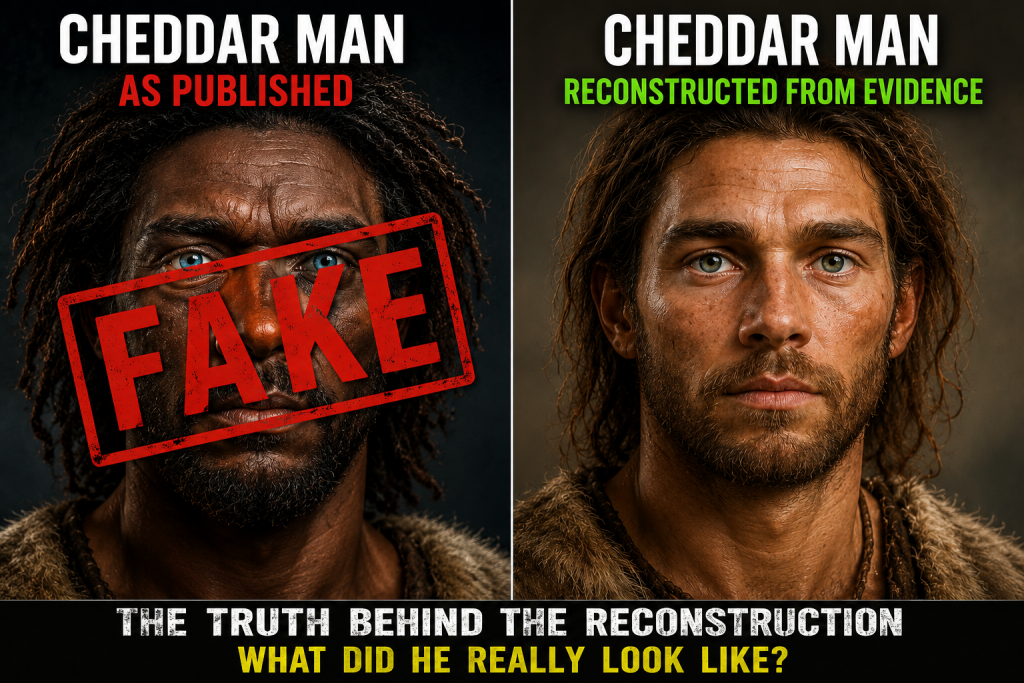
Reconstructing Cheddar Man – The Final Verdict
The Most Important Piece of Evidence
Throughout this investigation, enormous attention has been devoted to pigmentation.
Dark skin.
Blue eyes.
Brown hair.
Yet the most important piece of evidence has been sitting in front of us from the beginning.
The skull.
Unlike the pigmentation predictions, which are generated from incomplete DNA and statistical modelling, the skull is real evidence. It belonged to a living individual and survives today.
If a forensic scientist were reconstructing a suspect, they would begin with the skull and only then consider pigmentation.
The public discussion surrounding Cheddar Man largely reversed this process.
What The Skull Tells Us
The skull determines:
- overall head shape
- forehead profile
- facial width
- eye socket shape
- nasal structure
- jaw shape
- chin shape
- cheekbone position
These characteristics influence appearance far more than eye colour alone.
Traditional descriptions of Upper Palaeolithic and Mesolithic European populations frequently describe robust facial anatomy, long skulls and broad facial structures associated with the populations historically referred to as Cro-Magnons.
Whether every characteristic applied directly to Cheddar Man is less important than the broader observation:
The skull itself provides the foundation of the reconstruction.
Not the pigmentation.
What The DNA Actually Suggests
Having established the skeletal framework, we can then add the genetic evidence.
The DNA suggests:
Eyes
Not bright blue.
Instead, the report concludes:
Intermediate (blue/green)
and specifically states:
Not a clear blue-eyed individual.
Hair
Brown hair was the strongest prediction.
Dark brown was the author’s interpretation.
Black remained possible but was not the primary result.
Skin
The highest probabilities fell within darker pigmentation categories.
However, three loci were missing, and two others had low coverage, yielding a range of probabilities rather than certainty.
The CSI Reconstruction
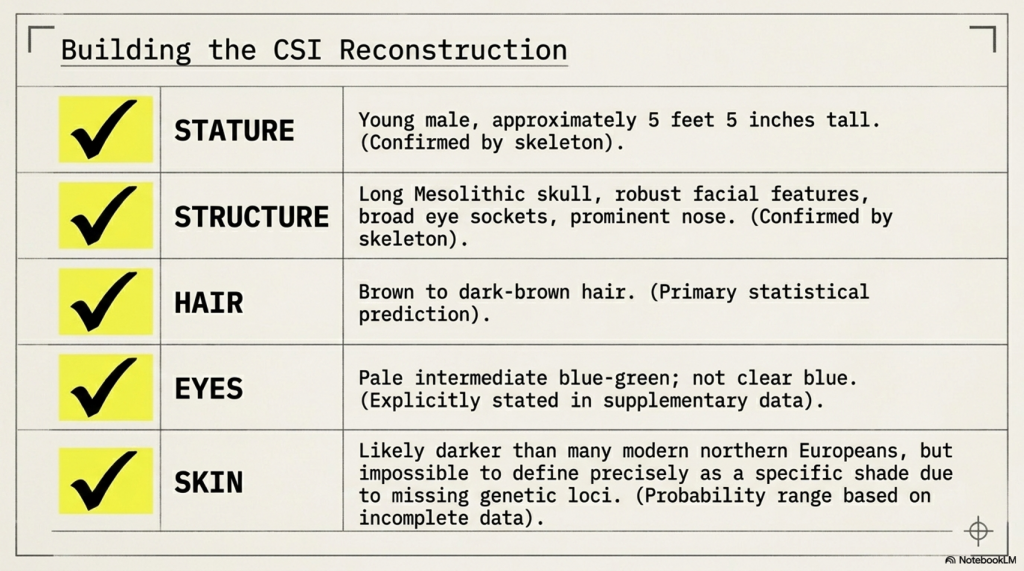
If we reconstruct Cheddar Man using only the evidence presented during this investigation, the result would be:
A young Western Hunter-Gatherer male, approximately 5 feet 5 inches tall, with a long Mesolithic skull, robust facial features, broad eye sockets, a prominent nose, brown to dark-brown hair, pale intermediate blue-green eyes and skin pigmentation likely darker than many modern northern Europeans but impossible to define precisely from the available DNA evidence.
That reconstruction is less dramatic than the famous museum version.
It is also closer to the evidence.
The Verdict
After examining the genetics, the supplementary report, the pigmentation models and the wider Mesolithic evidence, the verdict is surprisingly simple.
The famous reconstruction cannot be proven.
Nor can it be disproven.
The evidence supports the possibility of darker pigmentation.
The evidence supports pale eyes.
The evidence supports brown hair.
What the evidence does not support is the level of certainty with which these features were presented to the public.
The DNA produced probabilities.
The scientists produced interpretations.
The artists produced a face.
The media produced a certainty.
And that certainty became the story.
The real lesson of the Cheddar Man case is not that the reconstruction is necessarily wrong.
It is that one possible interpretation became presented as though it were the only interpretation.
The skull is real.
The DNA is incomplete.
The reconstruction is a hypothesis.
And as every good investigator knows, a hypothesis is not the same thing as a proven fact.
PODCAST

Author’s Biography
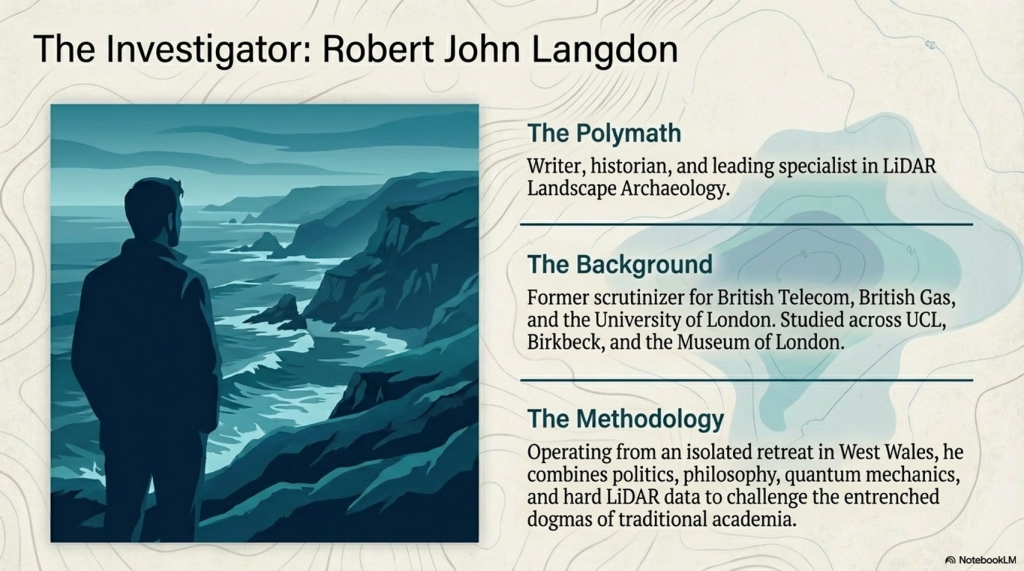
Robert John Langdon, a polymathic luminary, emerges as a writer, historian, and eminent specialist in LiDAR Landscape Archaeology.
His intellectual voyage has been interwoven with stints as an astute scrutineer in government and grand corporate bastions, a tapestry spanning British Telecommunications, Cable and Wireless, British Gas, and the esteemed University of London.
A decade hence, Robert’s transition into retirement unfurled a chapter of insatiable curiosity. This phase saw him immerse himself in Politics, Archaeology, Philosophy, and the enigmatic realm of Quantum Mechanics. His academic odyssey traversed the venerable corridors of knowledge hubs such as the Museum of London, University College London, Birkbeck College, The City Literature Institute, and Chichester University.
In the symphony of his life, Robert is a custodian of three progeny and a pair of cherished grandchildren. His sanctuary lies ensconced in the embrace of West Wales, where he inhabits an isolated cottage, its windows framing a vista of the boundless sea – a retreat from the scrutinising gaze of Her Majesty’s Revenue and Customs, an amiable clandestinity in the lap of nature.
Exploring Prehistoric Britain: A Journey Through Time
My blog delves into the fascinating mysteries of prehistoric Britain, challenging conventional narratives and offering fresh perspectives grounded in cutting-edge research, particularly LiDAR technology. I invite you to explore some key areas of my research. For example, the Wansdyke, often cited as a defensive structure, is re-examined in light of new evidence. I’ve presented my findings in my blog post Wansdyke: A British Frontier Wall – ‘Debunked’, and a Wansdyke LiDAR Flyover video further visualises my conclusions.
My work also often challenges established archaeological dogma. I argue that many sites, such as Hambledon Hill, commonly identified as Iron Age hillforts, are not what they seem. My posts Lidar Investigation Hambledon Hill – NOT an ‘Iron Age Fort’ and Unmasking the “Iron Age Hillfort” Myth explore these ideas in detail and offer an alternative view. Similarly, sites like Cissbury Ring and White Sheet Camp receive re-evaluations based on LiDAR analysis in my posts “Lidar Investigation Cissbury Ring through time” and “Lidar Investigation White Sheet Camp,“ revealing fascinating insights into their true purpose. I have also examined South Cadbury Castle, often linked to the mythical Camelot56.
My research also extends to ancient water management, including the role of canals and other linear earthworks. I have discussed the true origins of Car Dyke in multiple posts, including Car Dyke – ABC News Podcast and Lidar Investigation Car Dyke – North Section, which suggest a Mesolithic origin 2357. I also explore the misidentification of Roman aqueducts, as seen in my posts on the Great Chesters (Roman) Aqueduct. My research has also been greatly informed by my post-glacial flooding hypothesis, which has helped explain landscape transformations over time. I have discussed this hypothesis in several posts, including AI now supports my Post-Glacial Flooding Hypothesis and Exploring Britain’s Flooded Past: A Personal Journey
Finally, my blog also investigates prehistoric burial practices, as seen in Prehistoric Burial Practices of Britain and explores the mystery of Pillow Mounds, often mistaken for medieval rabbit warrens, but with a potential link to Bronze Age cremation in my posts: Pillow Mounds: A Bronze Age Legacy of Cremation? and The Mystery of Pillow Mounds: Are They Really Medieval Rabbit Warrens?. My research also includes astronomical insights into ancient sites, for example, in Rediscovering the Winter Solstice: The Original Winter Festival. I also review new information about the construction of Stonehenge in The Stonehenge Enigma.
Further Reading
For those interested in British Prehistory, visit www.prehistoric-britain.co.uk, a comprehensive resource featuring an extensive collection of archaeology articles, modern LiDAR investigations, and groundbreaking research. The site also includes insights and excerpts from the acclaimed Robert John Langdon Trilogy, a series of books that explore Britain during the Prehistoric period. Titles in the trilogy include The Stonehenge Enigma, Dawn of the Lost Civilisation, and The Post-Glacial Flooding Hypothesis, which offer compelling evidence of ancient landscapes shaped by post-glacial flooding.
To further explore these topics, Robert John Langdon has developed a dedicated YouTube channel featuring over 100 video documentaries and investigations that complement the trilogy. Notable discoveries and studies showcased on the channel include 13 Things that Don’t Make Sense in History and the revelation of Silbury Avenue – The Lost Stone Avenue, a rediscovered prehistoric feature at Avebury, Wiltshire.
In addition to his main works, Langdon has released a series of shorter, accessible publications, ideal for readers delving into specific topics. These include:
- The Ancient Mariners
- Stonehenge Built 8300 BCE
- Old Sarum
- Prehistoric Rivers
- Dykes, Ditches, and Earthworks
- Echoes of Atlantis
- Homo Superior
- 13 Things that Don’t Make Sense in History
- Silbury Avenue – The Lost Stone Avenue
- Offa’s Dyke
- The Stonehenge Enigma
- The Post-Glacial Flooding Hypothesis
- The Stonehenge Hoax
- Dawn of the Lost Civilisation
- Darwin’s Children
- Great Chester’s Roman Aqueduct
- Wansdyke
For active discussions and updates on the trilogy’s findings and recent LiDAR investigations, join our vibrant community on Facebook. Engage with like-minded enthusiasts by leaving a message or contributing to debates in our Facebook Group.
Whether through the books, the website, or interactive videos, we aim to provide a deeper understanding of Britain’s fascinating prehistoric past. We encourage you to explore these resources and uncover the mysteries of ancient landscapes through the lens of modern archaeology.
For more information, including chapter extracts and related publications, visit the Robert John Langdon Author Page. Dive into works such as The Stonehenge Enigma or Dawn of the Lost Civilisation, and explore cutting-edge theories that challenge traditional historical narratives.
Other Blogs
1
a
- Ackling Dyke – Facts and the Archaeological Fiction
- Ackling Dyke – Part II – Puddletown Forest: When a Roman Road Becomes an Assumption
- Ackling Dyke – Part III – The Roman Road Mystery Finally Makes Sense
- AI now Supports – Homo Superior
- AI now supports my Post-Glacial Flooding Hypothesis
- Alexander the Great sailed into India – where no rivers exist today
- Ancient Secrets of Althorp – debunked
- Antler Picks built Ancient Monuments – yet there is no real evidence
- Antonine Wall – Prehistoric Canals (Dykes)
- Archaeological ‘pulp fiction’ – has archaeology turned from science?
- Archaeological Pseudoscience
- Archaeology in the Post-Truth Era
- Archaeology: A Bad Science?
- Archaeology: A Harbour for Fantasists?
- Archaeology: Fact or Fiction?
- Archaeology: The Flaws of Peer Review
- Archaeology’s Bayesian Mistake: Stop Averaging the Past
- Are Raised Beaches Archaeological Pseudoscience?
- Atlantis Found: The Mathematical Proof That Plato’s Lost City Was Doggerland
- ATLANTIS: Discovery with Dan Snow Debunked
- Avebury Ditch – Avebury Phase 2
- Avebury through time
- Avebury’s great mystery revealed
- Avebury’s Lost Stone Avenue – Flipbook
b
- Battlesbury Hill – Wiltshire
- Beyond Stone and Bone: Rethinking the Megalithic Architects of Northern Europe
- BGS Prehistoric River Map
- Blackhenge: Debunking the Media misinterpretation of the Stonehenge Builders
- Brain capacity (Cro-Magnon Man)
- Britain’s First Road – Stonehenge Avenue
- Britain’s Giant Prehistoric Waterways
- British Roman Ports miles away from the coast
c
- Caerfai Promontory Fort – Archaeological Nonsense
- Car Dyke – ABC News PodCast
- Car Dyke – North Section
- Cardigan Bay: The Holocene Evidence the Old Geological Story Has Missed
- CASE STUDY – An Inconvenient TRUTH (Craig Rhos Y Felin)
- Case Study – River Avon
- Case Study – Woodhenge Reconstruction
- Chapter 2 – Craig Rhos-Y-Felin Debunked
- Chapter 2 – Stonehenge Phase I
- Chapter 2 – Variation of the Species
- Chapter 3 – Post Glacial Sea Levels
- Chapter 3 – Stonehenge Phase II
- Chapter 7 – Britain’s Post-Glacial Flooding
- Cissbury Ring through time
- Clement Reid, Doggerland, and the Archaeological Establishment
- Cro-Magnon Brain Capacity
- Cro-Magnon Megalithic Builders: Measurement, Biology, and the DNA
- Cro-Magnons – An Explainer
d
- Darwin’s Children – Flipbook
- Darwin’s Children – The Cro-Magnons
- Dawn of The Lost Civilisation – 1/10
- Dawn of the Lost Civilisation – Flipbook
- Dawn of the Lost Civilisation – Introduction
- Digging for Britain – Cerne Abbas
- Digging for Britain Debunked – Cerne Abbas 2
- Digging Up Britain’s Past – Debunked
- DLC Chapter 1 – The Ascent of Man
- Durrington Walls – Woodhenge through time
- Durrington Walls Revisited: Platforms, Fish Traps, and a Managed Mesolithic Landscape
- Dyke Construction – Hydrology 101
- Dykes Ditches and Earthworks
- DYKES of Britain
e
f
g
h
- Hadrian’s Wall – Military Way Hoax
- Hadrian’s Wall – the Stanegate Hoax
- Hadrian’s Wall Vallum – Prehistoric Canals – FREE Online Book
- Hadrian’s Wall LiDAR investigation
- Hambledon Hill – NOT an ‘Iron Age Fort’
- Hayling Island Lidar Maps
- Hidden Sources of Ancient Dykes: Tracing Underground Groundwater Fractals
- Historic River Avon
- Hollingsbury Camp Brighton – A Hillfort… or a Forgotten Harbour?
- Hollows, Sunken Lanes and Palaeochannels
- Homo Superior – Flipbook
- Homo Superior – History’s Giants
- How Lidar will change Archaeology
- Hydrology 101 Simplified: Why Britain’s Dykes Worked Without Rivers
i
l
m
- Maiden Castle through time
- Mathematics Meets Archaeology: Discovering the Mesolithic Origins of Car Dyke
- Mesolithic River Avon
- Mesolithic Stonehenge
- Minerals found in Prehistoric and Roman Quarries
- Mining in the Prehistoric to Roman Period
- Mount Caburn through time
- Mysteries of the Oldest Boatyard Uncovered
- Mythological Dragons – a non-existent animal that is shared by the World.
o
- Offa’s Dyke Flipbook
- Old Sarum Lidar Map
- Old Sarum Through Time…………….
- On Sunken Lands of the North Sea – Lived the World’s Greatest Civilisation.
- OSL Chronicles: Questioning Time in the Geological Tale of the Avon Valley
- Oswestry LiDAR Survey
- Oswestry through time
- Oysters in Archaeology: Nature’s Ancient Water Filters?
p
- Pillow Mounds: A Bronze Age Legacy of Cremation?
- Pinkery Canal
- Plato Was Right: The Archaeological Evidence the Academics Never Expected
- Post Glacial Flooding – Flipbook
- Prehistoric Burial Practices of Britain
- Prehistoric Canals – Wansdyke
- Prehistoric Canals – Wansdyke
- Prehistoric Canals (Dykes) – Great Chesters Aqueduct (The Vallum Pt. 4)
- Prehistoric Canals (Dykes) – Offa’s Dyke (Chepstow)
- Prehistoric Canals (Dykes) – Offa’s Dyke (LiDAR Survey)
- Prehistoric Canals (Dykes) – Offa’s Dyke Survey (End of Section A)
- Prehistoric Canals (Dykes) – Wansdyke (4)
- Prehistoric Canals Wansdyke 2
- Professor Bonkers and the mad, mad World of Archaeology
r
- Real-World Confirmation of Post-Glacial Flooding
- Rebirth in Stone: Decrypting the Winter Solstice Legacy of Stonehenge
- Rediscovering the Winter Solstice: The Original Winter Festival
- Rethinking Ancient Boundaries: The Vallum and Offa’s Dyke”
- Rethinking Ogham: Could Ireland’s Oldest Script Have Begun as a Tally System?
- Rethinking The Past: Mathematical Proof of Langdon’s Post-Glacial Flooding Hypothesis
- Revolutionising History: Car Dyke Unveiled as Prehistoric & the Launch of FusionBook 360
- Rising Evidence, Falling Rivers: The Real Story of Europe’s First Farmers
- Rivers of the Past Were Higher: A Fresh Perspective on Prehistoric Hydrology
s
- Sea Level Changes
- Section A – NY26SW
- Section B – NY25NE & NY26SE
- Section C – NY35NW
- Section D – NY35NE
- Section E – NY46SW & NY45NW
- Section F – NY46SE & NY45NE
- Section G – NY56SW
- Section H – NY56NE & NY56SE
- Section I – NY66NW
- Section J – NY66NE
- Section K – NY76NW
- Section L – NY76NE
- Section M – NY87SW & NY86NW
- Section N – NY87SE
- Section O – NY97SW & NY96NW
- Section P – NY96NE
- Section Q – NZ06NW
- Section R – NZ06NE
- Section S – NZ16NW
- Section T – NZ16NE
- Section U – NZ26NW & NZ26SW
- Section V – NZ26NE & NZ26SE
- Silbury Avenue – Avebury’s First Stone Avenue
- Silbury Hill
- Silbury Hill / Sanctuary – Avebury Phase 3
- Sky Maps of Prehistoric Britain
- Somerset Plain – Signs of Post-Glacial Flooding
- South Cadbury Castle – Camelot
- Statonbury Camp near Bath – an example of West Wansdyke
- Stone me – the druids are looking the wrong way on Solstice day
- Stone Transportation and Dumb Censorship
- Stonehenge – Monument to the Dead
- Stonehenge Hoax – Dating the Monument
- Stonehenge Hoax – Round Monument?
- Stonehenge Hoax – Summer Solstice
- Stonehenge LiDAR tour
- Stonehenge Phase 1 — Britain’s First Monument
- Stonehenge Phase I (The Stonehenge Landscape)
- Stonehenge Solved – Pythagorean maths put to use 4,000 years before he was born
- Stonehenge Through Time
- Stonehenge, Doggerland and Atlantis connection
- Stonehenge: Borehole Evidence of Post-Glacial Flooding
- Stonehenge: Discovery with Dan Snow Debunked
- Stonehenge: The World’s First Computer – FREE Book
- Stonehenge: The Worlds First Computer
- Stonehenge’s The Lost Circle Revealed – DEBUNKED
- Stonehenge’s Chronological Mirage
t
- Ten Reasons Why Car Dyke Blows Britain’s Earthwork Myths Out of the Water
- Ten Things You Didn’t Know About Britain’s Prehistoric Flooded Past
- Ten thousand year old boats found on Northern Europe’s Hillsides
- Ten thousand-year-old boats found on Northern Europe’s Hillsides
- Testing Plato’s Atlantis Against Reality
- The “Hunter-Gatherer” Myth: Why It’s Time to Bury This Outdated Term
- The Ackling Dyke Smoking Gun
- The Ancient Mariners – Flipbook
- The Ancient Mariners – Prehistoric seafarers of the Mesolithic
- The Ascent of Man — From Survival to Systems
- The Beringian Migration Myth: Why the Peopling of the Americas by Foot is Mathematically and Logistically Impossible
- The Bluestone Enigma
- The Bulford Hoax: The “Simpler, Older Stonehenge” That Wasn’t
- The Cheddar Man Hoax
- The Cro-Magnon Cover-Up: How DNA and PR Labels Erased Our Real Ancestry
- The Dolmen and Long Barrow Connection
- The Durrington Mega-Monument Hoax: What Lies Beneath? – Debunked
- The Durrington Walls Hoax – it’s not a henge?
- The Dyke Myth Collapses: Excavation and Dating Prove Britain’s Great Dykes Are Prehistoric Canals
- The First European Smelted Bronzes
- The Fury of the Past: Natural Disasters in Historical and Prehistoric Britain
- The Giant’s Graves of Cumbria
- The Giants of Prehistory: Cro-Magnon and the Ancient Monuments
- The Great Ancient DNA Illusion: How Statistical Models Became Archaeological “Facts”
- The Great Antler Pick Hoax
- The Great Bell Beaker Migration Myth
- The Great Chichester Hoax – A Bridge too far?
- The Great Dorchester Aqueduct Hoax
- The Great Farming Hoax – (Einkorn Wheat)
- The Great Farming Migration Hoax
- The Great Hadrian’s Wall Hoax
- The Great Iron Age Hill Fort Hoax
- The Great Offa’s Dyke Hoax
- The Great Prehistoric Migration Hoax
- The Great Stone Transportation Hoax
- The Great Stonehenge Hoax
- The Great Wansdyke Hoax
- THE GREAT WEST WOODS HOAX — WHEN ONE STONE BECOMES FIFTY
- The Henge and River Relationship
- The Logistical Impossibility of Defending Maiden Castle
- The Long Barrow and Dolmen Enigma
- The Long Barrow Mystery
- The Long Barrow Mystery: Unravelling Ancient Connections
- The Lost Island of Avalon – revealed
- The Maiden Way Hoax – A Closer Look at an Ancient Road’s Hidden History
- The Maths – LGM total ice volume
- The Mystery of Pillow Mounds: Are They Really Medieval Rabbit Warrens?
- THE ODYSSEY PROBLEM: WHY DID A WEEK-LONG VOYAGE BECOME A TEN-YEAR EPIC?
- The Old Sarum Hoax
- The Oldest Boat Yard in the World found in Wales
- The Perils of Paradigm Shifts: Why Unconventional Hypotheses Get Branded as Pseudoscience
- The Post-Glacial Flooding Hypothesis – 1/11
- The Post-Glacial Flooding Hypothesis – Flipbook
- The Post-Glacial Flooding Theory
- The Problem with Hadrian’s Vallum
- The Rise of the Cro-Magnon (Homo Superior)
- The Roman Military Way Hoax
- The Silbury Hill Lighthouse?
- The Stone Money – Credit System
- The Stonehenge Avenue
- The Stonehenge Avenue
- The Stonehenge Code: Unveiling its 10,000-Year-Old Secret
- The Stonehenge Crescent: A Monument to a Lost World
- The Stonehenge Enigma – Flipbook
- The Stonehenge Enigma: Part 1/6
- The Stonehenge Hoax – Bluestone Quarry Site
- The Stonehenge Hoax – Flipbook
- The Stonehenge Hoax – Moving the Bluestones
- The Stonehenge Hoax – Periglacial Stripes
- The Stonehenge Hoax – Station Stones
- The Stonehenge Hoax – Stonehenge’s Location
- The Stonehenge Hoax – The Ditch
- The Stonehenge Hoax – The Slaughter Stone
- The Stonehenge Hoax – The Stonehenge Layer
- The Stonehenge Hoax – Totem Poles
- The Stonehenge Hoax – Woodhenge
- The Stonehenge Hospital
- The Stonehenge Transportation Mystery
- The Subtropical Britain Hoax
- The Troy, Hyperborea and Atlantis Connection
- The Vallum @ Hadrian’s Wall – it’s Prehistoric!
- The Vallum at Hadrian’s Wall (Summary)
- The Woodhenge Hoax
- Thirty Years of CAU Archaeology Going Nowhere?
- Three Dykes – Kidland Forest
- Thurnam’s 137 Skulls: The Forgotten People Behind Britain’s Megaliths.
- Top Ten Misidentified Fire Beacons in British History
- Troy Debunked – Troy did not exist in Asia Minor, but in fact, the North Sea island of Doggerland
- TSE – DVD Barrows
- TSE DVD – An Inconvenient Truth
- TSE DVD – Antler Picks
- TSE DVD – Avebury
- TSE DVD – Durrington Walls & Woodhenge
- TSE DVD – Dykes
- TSE DVD – Epilogue
- TSE DVD – Stonehenge Phase I
- TSE DVD – Stonehenge Phase II
- TSE DVD – The Post-Glacial Hypothesis
- TSE DVD Introduction
- TSE DVD Old Sarum
- Twigs, Charcoal, and the Death of the Saxon Dyke Myth
w
- Wansdyke – Short Film
- Wansdyke East – Prehistoric Canals
- Wansdyke Flipbook
- Wansdyke LiDAR Flyover
- Wansdyke: A British Frontier Wall – ‘Debunked’
- Was Columbus the first European to reach America?
- What Archaeology Missed Beneath Stonehenge
- White Sheet Camp
- Why a Simple Fence Beats a Massive Dyke (and What That Means for History)
- Windmill Hill – Avebury Phase 1
- Winter Solstice – Science, Propaganda and Indoctrination
- Woodhenge – the World’s First Lighthouse?