
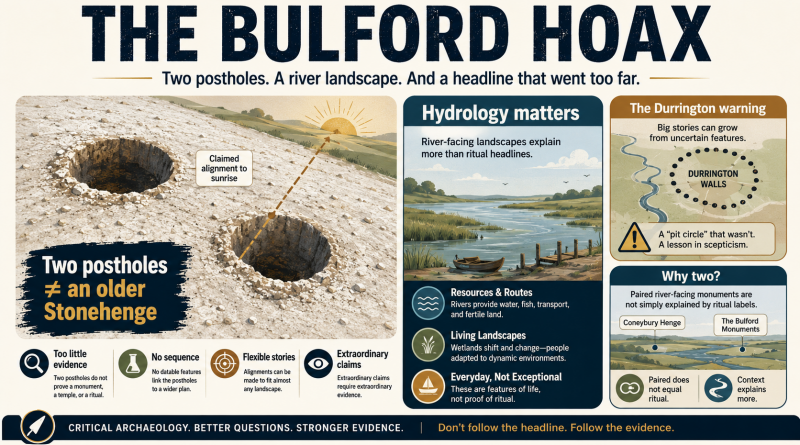
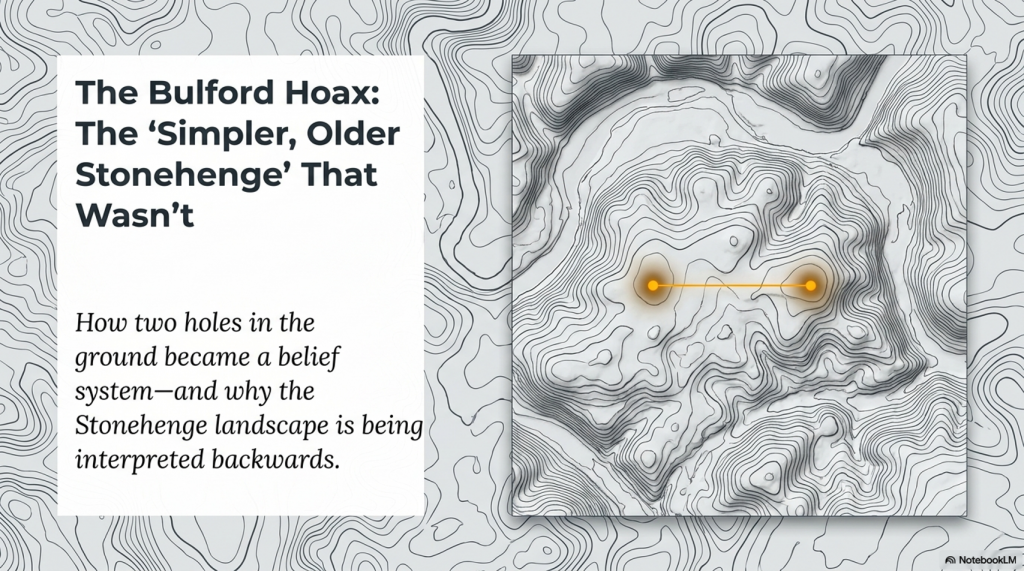
The Bulford Hoax: The “Simpler, Older Stonehenge” That Wasn’t
Introduction
Before we examine Bulford itself, one point must be made clear.
The archaeology is not the problem. The postholes, pits, circular features and later activity are real and important. What is being challenged here is the story built on top of them.
Once again, the Stonehenge landscape is being interpreted backwards. A few physical features are lifted from their environmental setting, joined by lines on a plan, wrapped in ritual language, and then presented to the public as another breakthrough in sacred Neolithic astronomy.
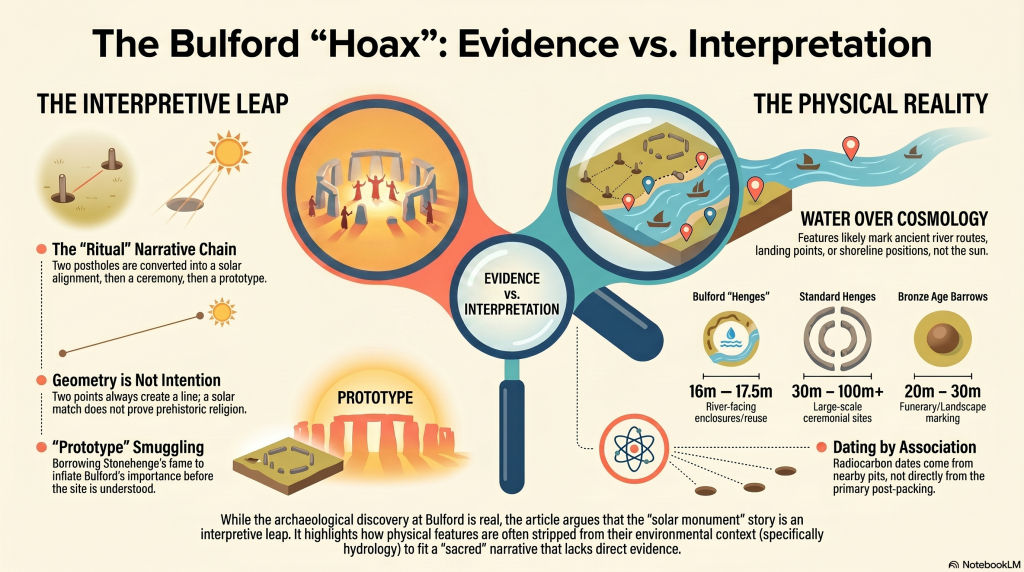
But prehistoric landscapes were not flat ceremonial diagrams. They were working environments shaped by rivers, groundwater, dry valleys, palaeochannels, springs, ditches, routeways and changing water levels. Before any feature is called a temple, a henge, a sacred boundary, or an “older Stonehenge,” the physical landscape must be understood first.
That is the failure this article addresses.
Bulford may be important for archaeology. It may even tell us something valuable about the wider Stonehenge landscape. But it does not yet prove a Stonehenge prototype, a solar monument, or a lost ceremonial masterplan.
It proves something far more revealing: how quickly archaeology can turn holes in the ground into a belief system.
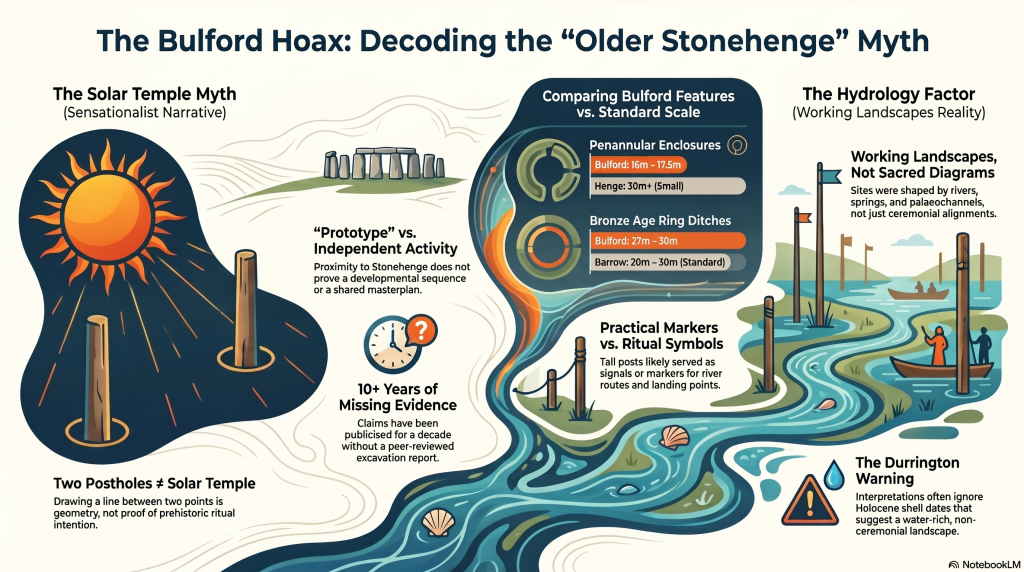
1. The Discovery Is Real — The Story Is the Problem
The Bulford discovery should not be dismissed. It is real archaeology, found in a genuinely important part of the wider Stonehenge landscape. The site lies only a few kilometres from Stonehenge, within a landscape already packed with prehistoric activity: pits, postholes, ring ditches, circular features, burials, routeways, river valleys and later reuse. Nobody serious should pretend that Bulford is insignificant. The issue is not whether something was found. The issue is what has been claimed from it.
At the centre of the new story are two substantial postholes, positioned about 120 metres apart. These are interpreted as the remains of two large timber posts, possibly standing several metres high. When a line is drawn between them, the axis is said to match the midsummer sunrise in one direction and the midwinter sunset in the other, around 2950 BC. From that observation, the public story has grown quickly: Bulford becomes a solar monument, perhaps a ritual gathering place, perhaps even a prototype for Stonehenge’s later solstitial alignment.
That is the point where caution should begin.
Two postholes are evidence for two posts. They are not, by themselves, proof of a monument. A line drawn between two posts is evidence of geometry. It is not, by itself, proof of prehistoric intention. A possible alignment with the sun is interesting, but it does not automatically prove religion, ceremony, sacred architecture, or a direct ancestral link to Stonehenge.
The difference matters because archaeology often changes shape as it moves from excavation report to media headline. In the ground, the evidence is limited and physical: holes, fills, deposits, artefacts, relationships, levels, cuts and dates. In the headline, that evidence can become something much larger: belief systems, sacred landscapes, cosmic order and lost temples. The danger is not that archaeologists find nothing. The danger is that they find something real, then overload it with meaning before the basic physical questions have been answered.
Bulford is a perfect example of that problem.
The site was not a simple empty field containing two isolated posts. It contained numerous other features: smaller pits, late Neolithic activity, animal bone, pottery, flint, prehistoric ring ditches and later phases of landscape use. That complexity should make interpretation slower, not faster. A crowded archaeological landscape increases the danger of selection. If many pits, cuts, alignments and later features exist within the same excavated area, then choosing two large postholes and drawing a meaningful line between them requires strong independent support. Otherwise, the interpretation risks becoming circular: the posts are important because they align, and the alignment is important because the posts are assumed to be important.
The date also needs care. A Late Neolithic date of around 2950–3000 BC may place the feature in a significant period, but a date alone does not automatically explain its function. Radiocarbon dating can tell us when the sampled material died or entered a deposit. It does not automatically tell us why a post was erected, how long it stood, whether it belonged to a wider structure, or whether later activity has been folded into the same story. The more complex the site, the more dangerous it becomes to treat one attractive date as a label for the entire interpretation.
The same caution applies to the word “prototype.” That word sounds exciting, but it smuggles in a historical relationship that has not yet been proven. To call Bulford a prototype for Stonehenge implies developmental sequence: first Bulford, then Stonehenge; first timber posts, then stones; first simple alignment, then monumental architecture. That may be possible, but possibility is not proof. Similarity is not descent. Earlier is not necessarily ancestral. Nearby is not necessarily connected.
This does not make the Bulford discovery unimportant. It may be very important. It may show that people in this part of Salisbury Plain were using timber posts, pits and landscape markers before the later stone phases of Stonehenge. It may show that the solstitial axis mattered to some communities earlier than usually assumed. It may even eventually prove part of a wider prehistoric pattern.
But that has not yet been demonstrated.
The excavation is real. The archaeology is valuable. The postholes deserve serious study. But the interpretation has already moved beyond the secure evidence. Before Bulford can be called an older Stonehenge, a solar temple, or a ceremonial prototype, the basic questions must be answered.
Why only two posts?
Why 120 metres apart?
Why this exact location?
What was the surrounding landscape like at the time? Were the nearby pits, ring ditches and circular features contemporary, or are separate phases being compressed into one narrative? Was the alignment designed by the builders, or recognised later by modern researchers looking back across a crowded plan?
Until those questions are answered, Bulford proves something important, but much narrower than the headline suggests.
It proves repeated prehistoric activity in a significant landscape.
It does not yet prove the existence of an older Stonehenge.
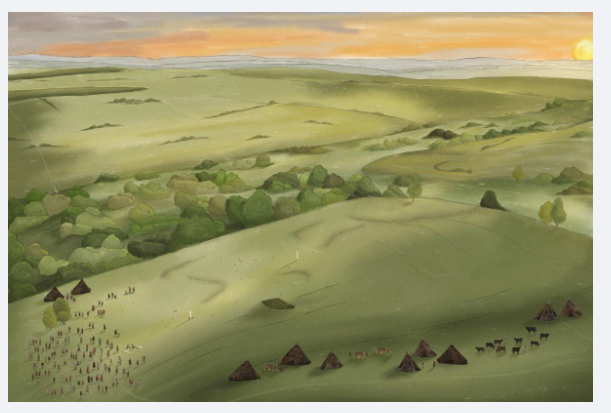
2. From Two Postholes to an Older Stonehenge
The problem with the Bulford story is not that the postholes are imaginary. The problem is the speed at which two postholes have been converted into an “older Stonehenge.”
The interpretive chain is easy to see. First, two substantial postholes are identified. Then a line is drawn between them. That line is said to align with the midsummer sunrise and midwinter sunset around 2950 BC. The alignment is then treated as deliberate. Once deliberate, it becomes astronomical. Once astronomical, it becomes ritual. Once a ritual, it becomes ceremonial. Once ceremonial, it becomes a possible prototype for Stonehenge itself, given its proximity.
That is a very long journey from two holes in the ground.
Each step in that chain needs proof. It is not enough for each step to sound interesting. Archaeology should not work by accumulating attractive possibilities until they begin to look like a conclusion. The question is not whether the Bulford line can be drawn. Of course it can. The question is whether the line was intended by the people who dug the postholes.
That is a much harder thing to prove.
Two points always create a line. That is geometry, not archaeology. If the two points are large postholes, the line may be worth examining. If that line corresponds to a solar event, it becomes more interesting. But “interesting” is not the same as “proven.” To move from coincidence to intention, there must be supporting evidence: repeated alignment, structured layout, associated sighting features, restricted viewing position, consistent construction logic, or independent evidence that the same alignment governed other features at the site.
Without that support, the interpretation risks becoming backwards. Instead of starting with the whole site and asking what pattern the evidence produces, the process begins with an attractive alignment and then searches for meaning around it.
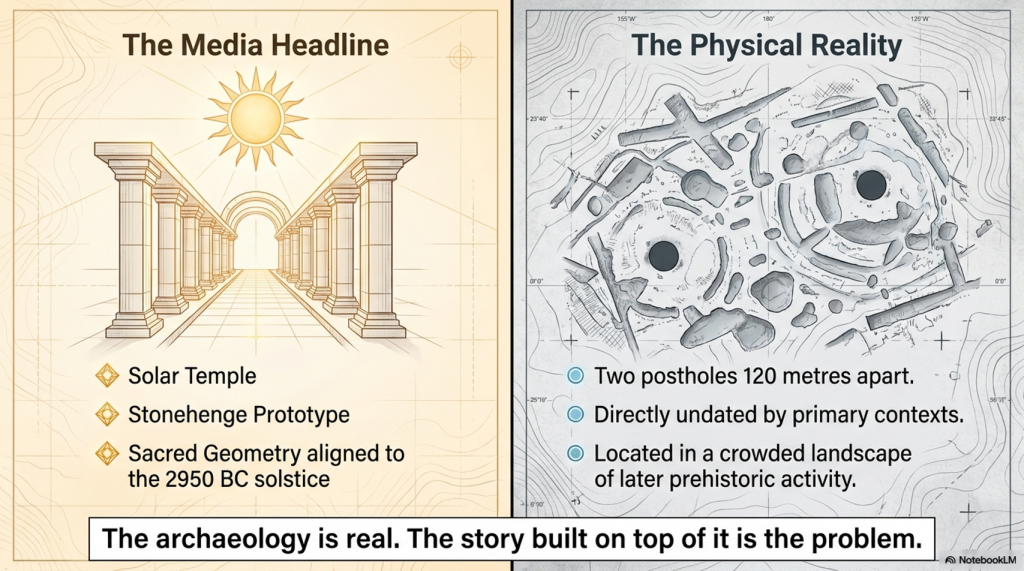
This is especially dangerous in a dense archaeological landscape. Bulford was not an empty field containing only two posts. It contained many pits, postholes, finds, ring ditches and later prehistoric activity. In such a landscape, selection is everything. If enough features exist, lines can be drawn between them. Some will point to something interesting. Some may match the sun, moon, horizon, river, valley, hilltop or another monument. The existence of a line does not prove that the line was the site’s purpose.
That is why the “gunsight” idea needs caution. Two posts 120 metres apart could create a visual axis, but they could also have served another function entirely. They may have marked a route, entrance, boundary, landing point, working area, viewing corridor, territorial signal, seasonal marker, or something more practical connected to the local river landscape. They may not even have belonged to the same original conceptual phase as later features now being drawn into the interpretation.
The problem becomes worse when the alignment is turned into a solar monument.
A solar alignment does not automatically make a monument religious. Prehistoric people certainly observed the sky. Nobody needs to deny that. Seasonal knowledge mattered in every farming, hunting, fishing, travelling and trading society. The movement of the sun helped organise time, weather, light, animal behaviour, plant growth and movement through the landscape. But recognising the importance of the sun is not the same as proving that a specific pair of posts formed a ceremonial temple.
This is where modern language starts doing too much work. Once words such as “ritual,” “ceremonial,” “sacred,” and “cosmological” are introduced, the evidence becomes harder to challenge because the claim becomes less physical. A posthole can be measured. A fill can be sampled. A date can be tested. A horizon can be modelled. But “ritual significance” can expand to cover almost anything. It becomes a label placed over uncertainty.
Then comes the final leap: Bulford as an older Stonehenge.
That is the weakest step of all. For Bulford to be an older Stonehenge, it is not enough to say it is older, nearby and possibly aligned. There must be a demonstrated structural or functional relationship between the two sites. Otherwise, the phrase “older Stonehenge” is doing more media work than archaeological work. It borrows the fame of Stonehenge to inflate the importance of Bulford before Bulford has been understood on its own terms.
This is a common problem in the Stonehenge landscape. Every new discovery is tempted into the same orbit. A pit becomes a ritual pit. A post becomes a solar marker. A ditch becomes ceremonial. A circular feature becomes a henge. A henge becomes a sacred site. And once Stonehenge is mentioned, the interpretation begins to feel larger than the evidence.
Bulford deserves better than that.
The correct starting point is not Stonehenge. It is Bulford itself: its topography, its water setting, its local features, its sequence, its fills, its dates, its relationship to the Nine Mile River and Avon landscape, and the possibility that later activity has been compressed into a single attractive story.
A line between two postholes is interesting.
It is not proof of intention by itself.
And it is certainly not proof of an older Stonehenge.
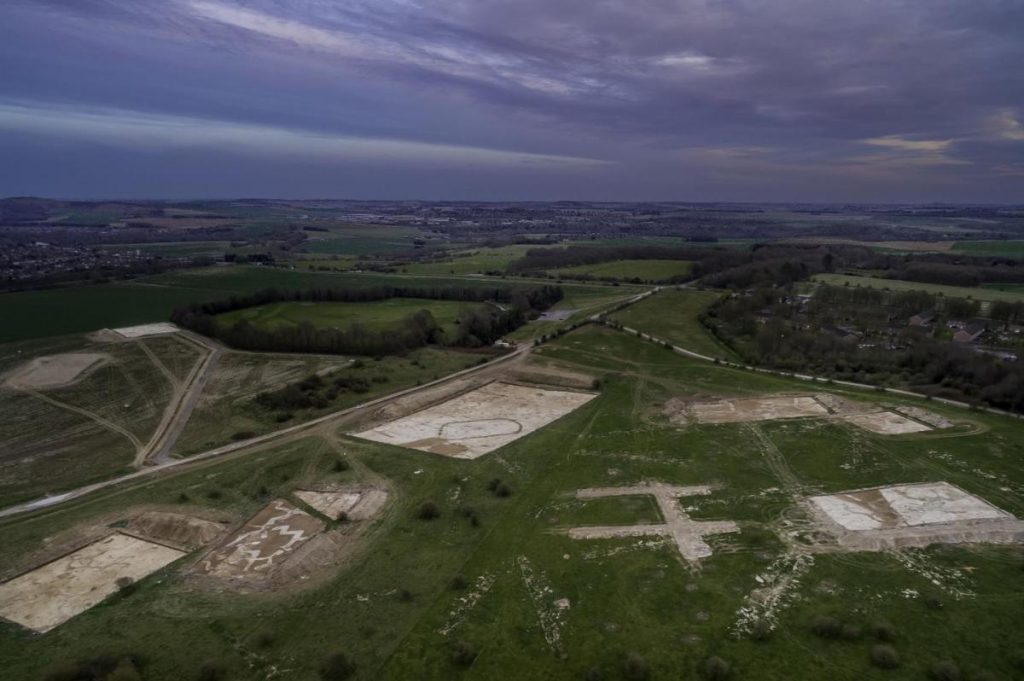
3. The Durrington Warning: When Pits Become Cosmology
Bulford is not the first time the Stonehenge landscape has produced this problem. Durrington Walls provides the warning.
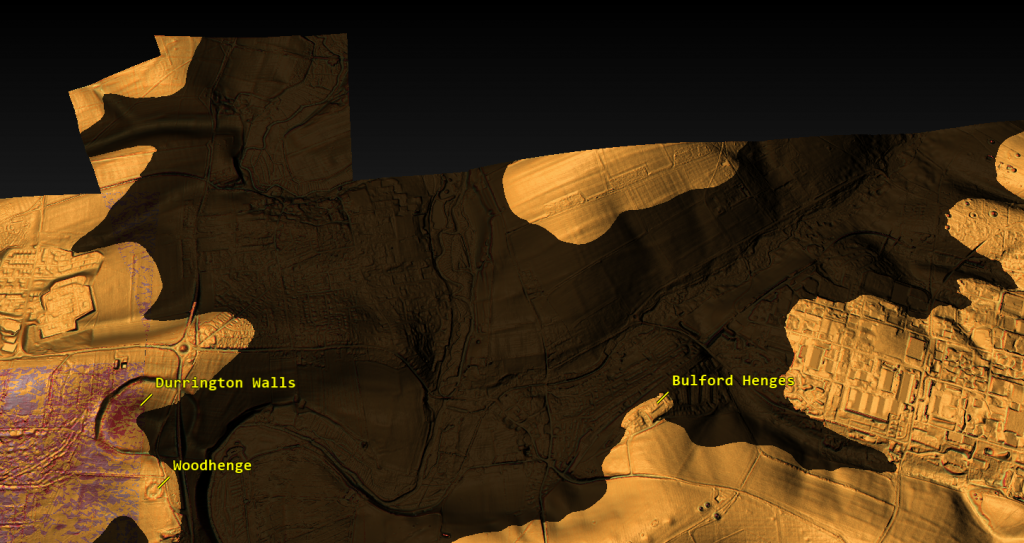
In 2020, archaeologists announced what was described as a major new prehistoric structure around Durrington Walls. The claim was dramatic: a circuit of large pits or shafts, more than two kilometres across, apparently arranged around Durrington Walls and Woodhenge. Some of these features were described as more than ten metres wide and up to five metres deep. The suggested date was around 2500 BC, broadly contemporary with major Late Neolithic activity in the Stonehenge landscape.
That was the physical claim.
The interpretation then moved much further.
The pits were not simply presented as pits. They became a boundary. The boundary became a sacred precinct. The sacred precinct was linked to Durrington Walls, Woodhenge and the earlier Larkhill Causewayed Enclosure. The spacing was then interpreted as evidence of planning, counting, pacing and cosmological order. What began as a group of subsurface features evolved into a vast sacred landscape organised around religious meaning.
That is the same interpretive inflation now being seen at Bulford.
The issue is not whether Durrington contains real archaeology. It clearly does. Nor is the issue whether some of the large features may have been human-made or modified. They may well have been. The problem is the leap from physical evidence to cosmology. A large pit is not automatically a ritual shaft. A group of pits is not automatically a sacred boundary. A wide arc of features does not automatically prove a planned religious enclosure. And a relationship to nearby monuments does not automatically make the whole arrangement ceremonial.
This matters because the Stonehenge landscape is not a flat drawing board. It is a chalk landscape cut by valleys, dry river systems, solution hollows, palaeochannels, springs, slopes, buried deposits and former water routes. Features that look convincing when plotted on a plan may have been shaped by the physical landscape long before they were given ritual meaning.
That is the hydrology problem at Durrington.
Some of the Durrington features sit in or near valley systems trending towards the Avon. Others have been discussed in relation to natural solution features, sinkholes, soft patches, head deposits or complex subsurface formations. Once that is admitted, the interpretation changes. The question is no longer simply, “Do these pits form a circle?” The better question is, “Are we looking at a single sacred boundary, or a mixture of pits, modified hollows, water-related features, palaeochannel activity, extraction cuts and later reuse being forced into one monumental pattern?”
That question was never properly allowed to lead the discussion.
If an ancient water landscape existed around Durrington, then the so-called pit circle may not represent a sacred exclusion zone at all. Some features may relate to former drainage lines, water access, shoreline positions, dykes, routeways or changing river levels. A palaeochannel can create lines. A former river edge can attract repeated activity. A changing water table can expose, fill, preserve and distort features across long periods. None of this requires a cosmological boundary.
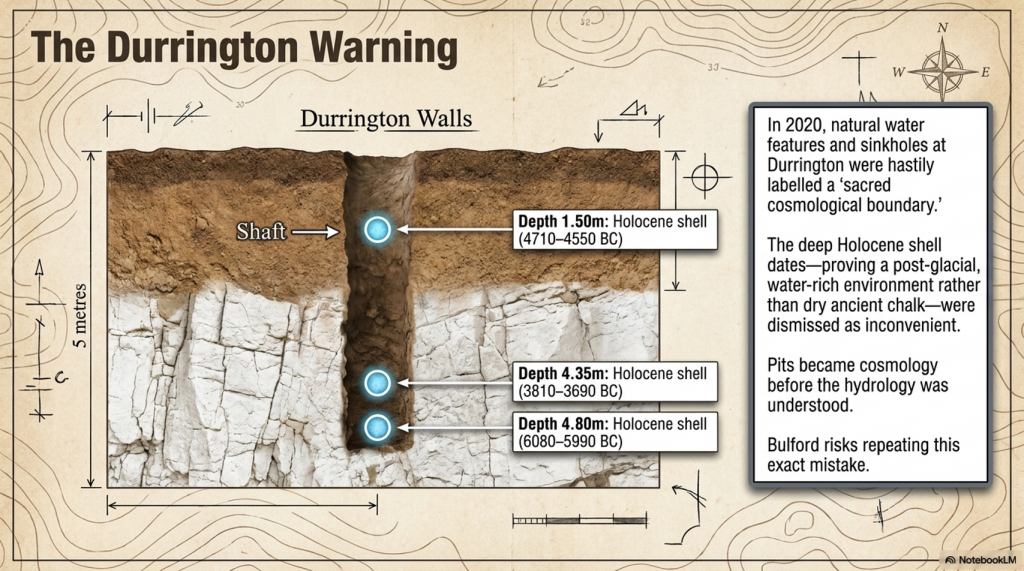
The shell dates make this harder to ignore.
In the published Durrington radiocarbon data, shell samples from cored features produced Holocene dates. One shell sample from 4.80–4.85 metres produced a calibrated date of 6080–5990 BC. Another, from 1.50–1.55 metres, produced 4710–4550 BC. A third, from 4.35–4.40 metres, yielded a date of around 3810–3690 BC.
These are not Cretaceous fossil numbers. They are Holocene numbers.
That matters enormously for the wider Stonehenge debate. One of the standard objections to shell evidence in Stonehenge boreholes is that shells in chalk must be ancient fossils and therefore irrelevant to recent water activity. But Durrington creates a problem for that dismissal. Here, a shell was recovered from deep chalkland contexts, submitted for radiocarbon dating, and produced dates in the post-glacial and early/mid-Holocene window.
The official response was to treat the early shell dates as unreliable, possibly affected by calcium in the sediment. That may be possible. But it does not remove the problem. It simply exposes it. If shell dates support a neat Neolithic monument story, they are useful. If shell dates suggest an older water-rich landscape, they become inconvenient.
That is not good enough.
The correct response should have been a further environmental investigation. What species of shell were recovered? Were they freshwater, terrestrial, intrusive, redeposited, or connected to standing water? Why were they present at those depths? What do they say about water, sediment movement and local hydrology? And why should similar shell evidence in the Stonehenge borehole record be dismissed as meaningless fossil contamination before it has been properly tested?
This is why Durrington matters for Bulford.
Durrington shows how easily a complicated physical landscape can be converted into sacred geometry. It also shows how water-related evidence can be pushed aside when it does not fit the preferred ceremonial model. Bulford risks repeating the same mistake on a smaller scale. Two postholes become an alignment. The alignment becomes solar. The solar axis becomes ritual. The ritual interpretation becomes an older Stonehenge.
But before that chain is accepted, the physical landscape must come first.
The lesson from Durrington is simple: do not turn pits into cosmology until the water has been explained.
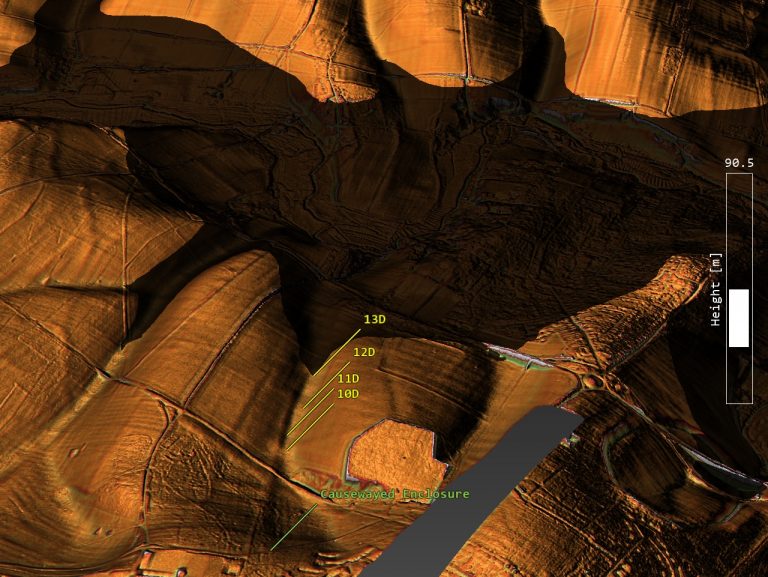
4. The Missing Water at Bulford
The first question at Bulford should not be astronomical. It should be geographical.
Where was the water?
That question is almost absent from the public interpretation, yet it should come before any claim about ceremony, solar worship or a Stonehenge prototype. Bulford sits within the wider Avon landscape, close to the Nine Mile River system and within a region where dry valleys, palaeochannels, river terraces, springs, groundwater movement and changing post-glacial water levels all matter. A prehistoric feature cannot be properly understood if it is lifted out of that physical setting and treated as if it stood in the same dry, open landscape we see today.
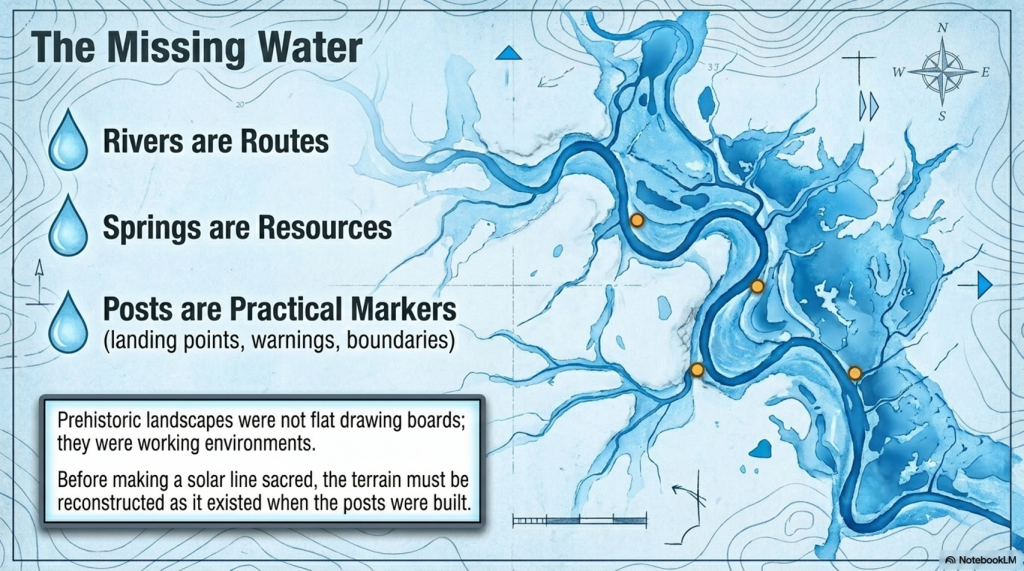
This is the central failure. The interpretation begins with two postholes and a solar line, then moves quickly towards ritual meaning. But before that line is made sacred, the entire terrain needs to be reconstructed to match its condition when the posts were built. Was the valley wetter? Was the Nine Mile River larger? Were there seasonal floods, marsh edges, channels, routeways or landing points nearby? Did the site overlook a water corridor? Were people moving through this landscape by river, along river edges, or between water-connected activity zones?
Without answering those questions, the interpretation is incomplete.
Water is not a decorative background to prehistoric life. It is infrastructure. Rivers are routes. Springs are resources. Wetlands are food zones. River edges are working margins. Palaeochannels preserve memory in the landscape long after active water has gone. If post-glacial rivers and groundwater levels were higher, then many features that now seem stranded in dry fields may originally have stood beside water, above water, or in relation to former channels.
That matters directly at Bulford.
If the two large posts stood near a route through the river landscape, their function may have been practical before it was symbolic. They could have marked access, direction, visibility, landing, movement, boundary, crossing, warning, gathering, or seasonal use connected to water. A tall post beside a water route is not automatically a religious object. It may be a marker. It may be a signal. It may be part of a working landscape.
The same applies to the so-called henges or circular features nearby. Before they are labelled ceremonial, their position and orientation need to be tested against the water landscape. If their entrances, openings, or strongest lines of access face the river system rather than Stonehenge, the usual interpretation changes. They may not be facing a sacred monument at all. They may be facing the practical landscape that made the site useful.
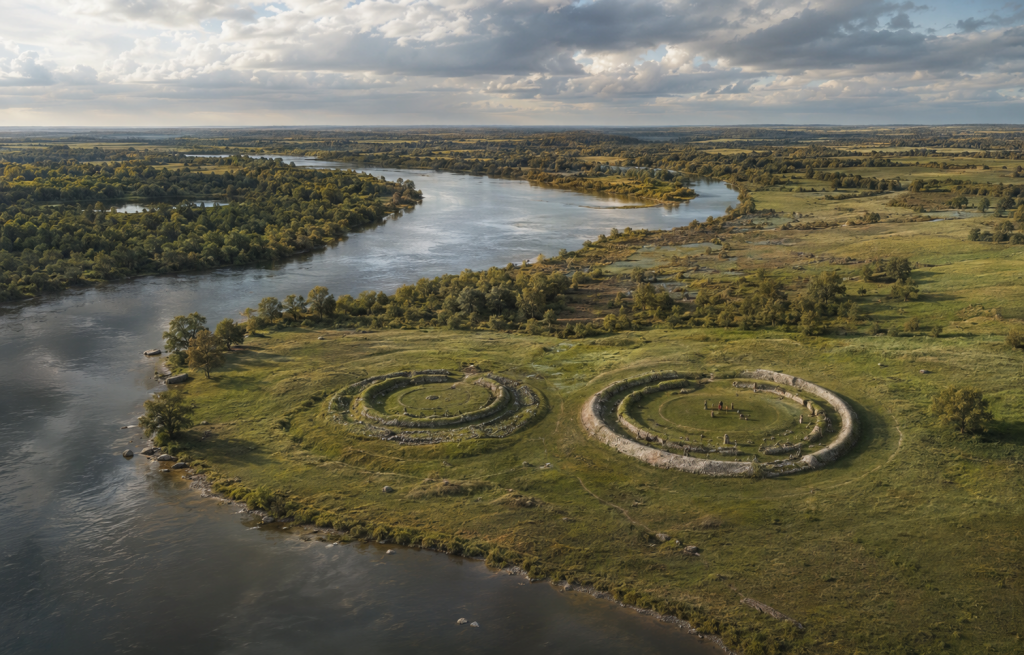
The size of the so-called Bulford henges should also make us cautious. Historic England records the western example as only about 17.5 metres across and the eastern example as about 16 metres in internal width, each with a northern entrance. These are not grand henge monuments. They are very small penannular enclosures, later encircled by Bronze Age ring ditches that enlarged them to about 27-30 metres in diameter.
That matters. Henges commonly range far larger, with even a 30-metre example described as being at the small end of the scale. By contrast, Bronze Age round barrows and ring ditches commonly fall within the 20–30 metre range. So when Bulford’s later ring ditches enlarge the features to 27 and 30 metres, they begin to look far more like barrow/ring-ditch reuse than a clear ceremonial henge pair.
This does not prove they were barrows. No central burial was found, and the western example only appears to have had a low internal bank or mound. But it does show that the word “henge” is carrying too much authority. A small penannular ditch with a northern entrance, later remodelled by Bronze Age ring ditches, overlooking the Nine Mile River, should not be rushed into the same ceremonial category as Stonehenge.
The better question is not “what ritual did these henges serve?”
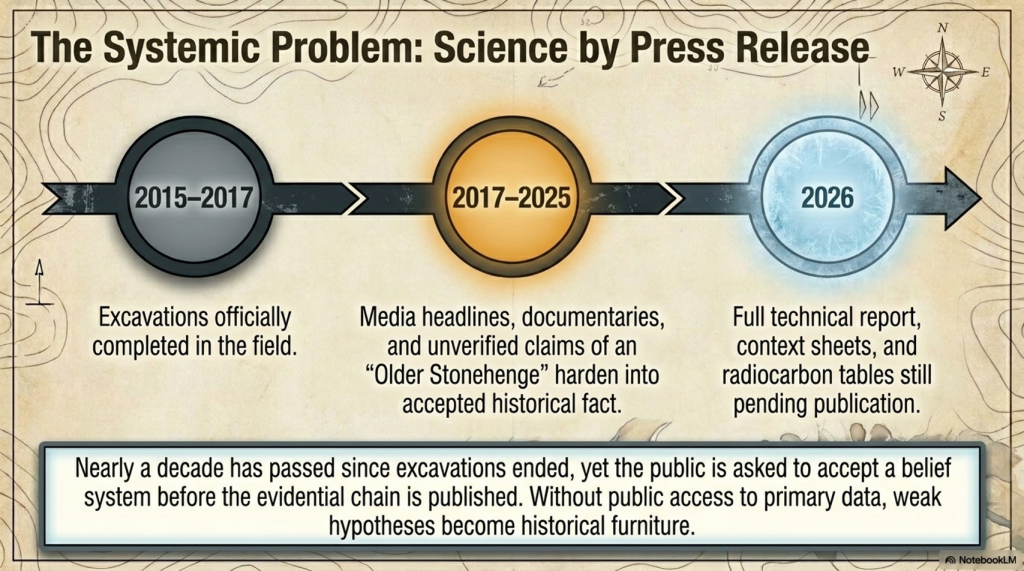
The better question is: were these small river-facing features later reused, enlarged, altered, or reclassified as part of a ceremonial story because the landscape is now being interpreted backwards from Stonehenge?
This is where the “older Stonehenge” claim becomes especially weak. Stonehenge is being used as the interpretive magnet. Because Bulford is near Stonehenge, its features are pulled into a Stonehenge-centred story. But proximity is not a function. A feature near Stonehenge does not automatically exist because of Stonehenge, point to Stonehenge, anticipate Stonehenge, or explain Stonehenge. It may belong to an older and broader water-based system that Stonehenge itself later reused.
That possibility is far more important than the headline.
The same mistake recurs in the landscape of Stonehenge. Durrington becomes a sacred boundary before its hydrology is fully understood. Shell dates are considered inconvenient when they indicate older, water-rich conditions. Palaeochannels and dry valleys are treated as background geology rather than active prehistoric infrastructure. Linear earthworks are dismissed or mislabelled rather than tested as water-management features. Then the remaining unexplained features are wrapped in ritual language.
Bulford should not be allowed to follow the same path.
The correct method is simple. First, reconstruct the Mesolithic and Neolithic landscape. Map the Nine Mile River and Avon relationship. Identify former channels, springs, terraces, damp zones, routeways and possible shoreline positions. Compare the posts, pits, ring ditches and circular features against that reconstructed water system. Only then, ask whether a solar alignment was primary, secondary, coincidental, or later imposed by interpretation.
Until that work is done, the water explanation has not been eliminated.
And if the water explanation has not been eliminated, the ceremonial explanation has not been proven.
Bulford may still prove significant. But its significance may lie not in being an older Stonehenge, but in preserving another fragment of the working water landscape that existed before Stonehenge became the centre of the story.
5. Dating and Alignment Do Not Prove Function
Two things are being asked to carry the Bulford interpretation: a date and a line.
Both may be important. Neither proves the story by itself.
The public claim gives Bulford a Late Neolithic date, usually around 2950–3000 BC. That date is then attached to the proposed alignment between the two large postholes and used to suggest an early solar monument, possibly older than Stonehenge. But this is where the first major problem appears.
At present, the public information does not clearly show that the two large postholes themselves were directly dated from secure primary contexts. The published publicity refers to a wider group of pits radiocarbon dated to around 2950 BC. That is not the same thing as saying that the two large postholes were directly dated by material from their original post-packing, post-pipes, construction deposits, or base fills.
That distinction is crucial.
A date from the wider pit group is not automatically a date for the two-post alignment. It may date activity in the same landscape. It may date rubbish deposition. It may date to nearby occupation, feasting, burning, discarding, or later infilling. It may date material associated with the broader Bulford activity complex. But unless the dated samples came from secure contexts directly tied to the two large postholes, the alignment has been dated by association.
Association is not proof.
This is not a small technical objection. It goes to the centre of the claim. If the postholes were not directly dated, then the argument becomes a chain of assumptions: nearby pits are dated to around 2950 BC; two larger postholes are identified within the same excavated area; a line is drawn between them; that line is modelled against the sky at 2950 BC; the alignment is then interpreted as intentional; and finally the whole thing is presented as a possible prototype for Stonehenge.
That is not a secure sequence. It is an interpretive staircase, and every step needs evidence.
The correct question is simple: what exactly was dated?
Was the sample taken from the bottom of one of the two large postholes? Was it from primary post-packing? Was it from a post-pipe left by a decayed timber? Was it from the earliest fill after the post was removed? Was it from a later fill? Was it from nearby rubbish pits? Was it charcoal, bone, pottery-associated material, or something redeposited? Was there old wood? Was there later contamination? Were both postholes dated independently, or is one date being stretched across both?
Until those details are available, the claimed date should be treated as a date for Bulford’s wider Late Neolithic activity, not as a secure direct date for the supposed solar alignment.
This matters because prehistoric landscapes are often reused. A posthole can be earlier than surrounding pits, later than them, cut through them, respected by them, ignored by them, or reinterpreted by later activity. A landscape can contain several phases compressed into one archaeological plan. Without a clear formation sequence, a date becomes a label rather than proof.
The same caution applies to the alignment.
Two points always create a line. That is geometry, not archaeology. A line between two substantial postholes may be interesting, especially if it appears to match a solar event. But a solar match is not enough. To prove intention, there must be independent supporting evidence: repeated layout, associated sighting positions, consistent structural design, horizon control, entrance alignment, matching features, or a pattern too strong to be explained by selection.
Without that support, the alignment risks becoming retrospective. A modern researcher looks at a complex plan, notices two larger features, draws a line, checks the sky, and finds a possible match. That may be worth investigating. It is not yet proven that Neolithic builders created a solar monument.
The danger increases because the landscape contains many features. Bulford was not a clean two-post structure standing alone. It contained numerous pits, finds and later activity. In a crowded plan, some alignments will always appear meaningful if enough points are available. The more features there are, the more important it becomes to prove that the selected line was meaningful to the builders, not merely attractive to the interpreter.
This is where the claim becomes too ambitious.
A possible date does not prove a function. A possible alignment does not prove intention. Together, they still do not prove an older Stonehenge unless the connection is demonstrated by context, sequence and structure.
The date must be direct.
The alignment must be intentional.
The function must be evidenced.
Until then, Bulford remains an important Late Neolithic activity site with two substantial postholes and a possible solar alignment. That is interesting enough. It does not need to be inflated into a Stonehenge prototype before the basic archaeological chain has been proven.
6. What Bulford Actually Proves
Bulford proves that this part of the Stonehenge landscape was important. That is the strongest safe conclusion. It does not need dressing up as an older Stonehenge to matter.
The site contains substantial postholes, numerous pits, finds of pottery, flint, animal bone, and charcoal, later ring ditches, and evidence of repeated prehistoric activity. That is already significant. It shows that people returned to this landscape, cut into it, deposited material, marked it, reused it and altered it across time. The archaeology deserves serious attention.
But that is exactly why the public claim should have waited for proper publication.
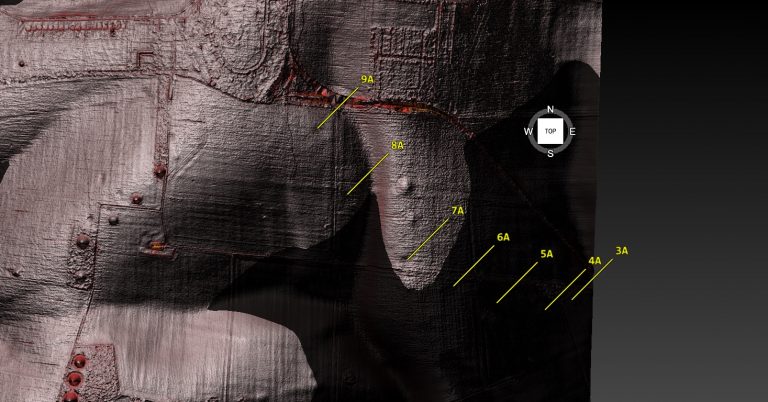
The Bulford excavations were carried out between 2015 and 2017. Yet in 2026, the full major publication is still not available, with the report promised later in the year. That means nearly a decade has passed since the excavation ended, and eleven years since it began, before the public has been given the detailed evidence needed to test the claims now being made.
That is not a minor issue. It is a fundamental archaeological weakness.
Before the plans, sections, context sheets, sample positions, radiocarbon tables, environmental data, stratigraphy and post-excavation reasoning are publicly available, the public is already being asked to accept a story: two posts become a solar alignment, the alignment becomes a religious monument, the religious monument becomes a Stonehenge prototype, and the whole thing becomes a breakthrough in our understanding of the ceremonial landscape.
But where is the published evidential chain?
Were the two large postholes directly dated from secure primary contexts, or has the date been imposed from associated pits? Were both postholes dated independently? Were the samples taken from post-pipes, packing deposits, base fills or later infill? What is the full sequence of the surrounding pits? Which features are contemporary and which belong to later reuse? How were the nearby ring ditches phased? How was the Nine Mile River landscape reconstructed? What was the local hydrology? Were former channels, springs, terraces or shoreline positions mapped before the solar interpretation was imposed?
Until those questions are answered in a full report, the headline is ahead of the archaeology.
This is the old Stonehenge problem in a new field. The interpretation is released first. The evidence follows later. By the time the technical report appears, the public story has already hardened into “fact.” Journalists have repeated it. Websites have archived it. Documentaries will quote it. Social media will simplify it. And critics will then be told they are challenging accepted archaeology, even though the original claim was accepted before the evidence was fully available.
That is how weak hypotheses become historical furniture.
Bulford may eventually prove part of an early solstitial tradition. It may show that timber markers were used in the wider Stonehenge landscape before the stone monument took its later form. It may even show that people gathered here seasonally. But those are conclusions that must come from the published evidence, not from a press release wrapped around a famous name.
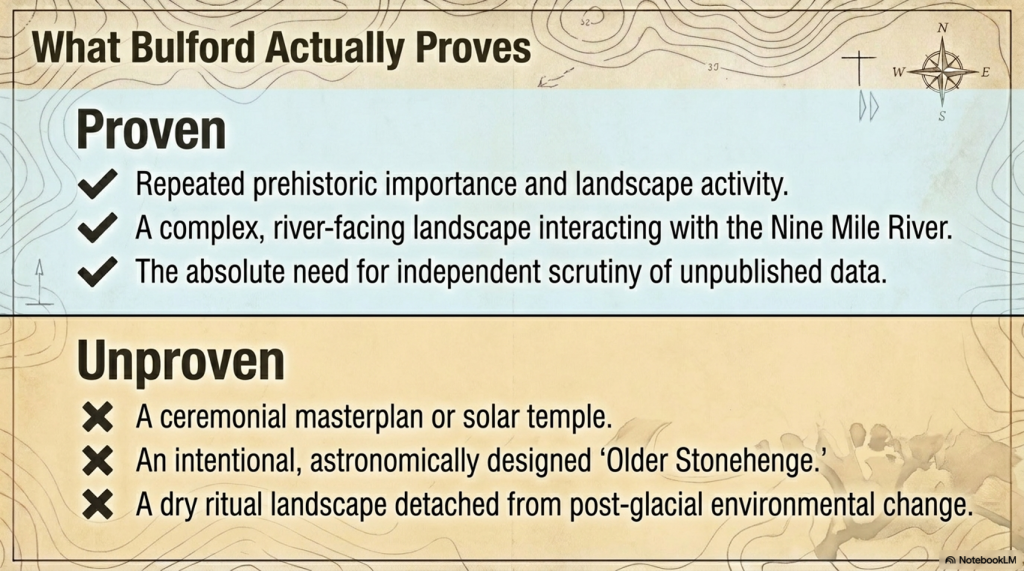
At present, Bulford proves repeated prehistoric importance.
It proves activity.
It proves complexity.
It proves that the area needs proper publication and independent scrutiny.
It proves that the river-facing landscape east of Stonehenge has been underestimated.
It does not yet prove the existence of an older Stonehenge.
It has not yet proved to be a solar temple.
It does not yet prove a ceremonial masterplan.
It does not yet prove a Stonehenge prototype.
And it does not prove a dry ritual landscape detached from water, palaeochannels, groundwater, river access and post-glacial environmental change.
The proper conclusion is not that Bulford is unimportant. The proper conclusion is that it is too important to be sold by headline before the evidence can be tested.
Archaeology should not work on a press-release-first, proof-later basis.
Bulford does not reveal an older Stonehenge.
It reveals how quickly two holes in the ground can become a belief system — and how slowly archaeology sometimes publishes the evidence needed to challenge it.
PODCAST

Author’s Biography
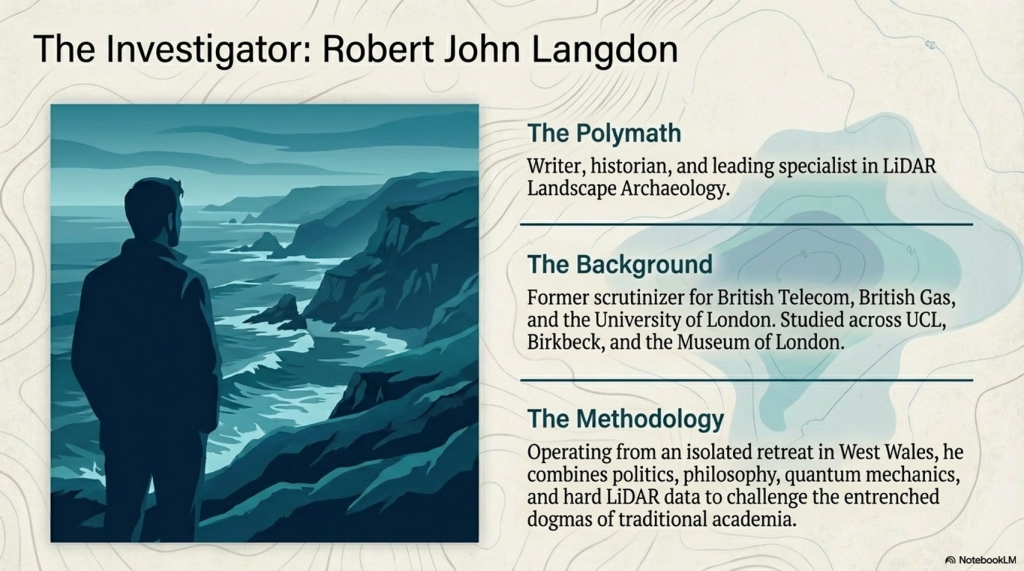
Robert John Langdon, a polymathic luminary, emerges as a writer, historian, and eminent specialist in LiDAR Landscape Archaeology.
His intellectual journey has included stints as an astute scrutineer in government and major corporate bastions, spanning British Telecommunications, Cable and Wireless, British Gas, and the esteemed University of London.
A decade hence, Robert’s transition into retirement unfurled a chapter of insatiable curiosity. He immersed himself in Politics, Archaeology, Philosophy, and the enigmatic realm of Quantum Mechanics. His academic odyssey took him through the venerable corridors of knowledge hubs such as the Museum of London, University College London, Birkbeck College, The City Literature Institute, and Chichester University.
In the symphony of his life, Robert is a custodian of three progeny and a pair of cherished grandchildren. His sanctuary lies ensconced in the embrace of West Wales, where he inhabits an isolated cottage, its windows framing a vista of the boundless sea – a retreat from the scrutinising gaze of Her Majesty’s Revenue and Customs, an amiable clandestinity in the lap of nature.
Exploring Prehistoric Britain: A Journey Through Time
My blog delves into the fascinating mysteries of prehistoric Britain, challenging conventional narratives and offering fresh perspectives grounded in cutting-edge research, particularly LiDAR technology. I invite you to explore some key areas of my research. For example, I re-examine the Wansdyke, often cited as a defensive structure, in light of new evidence. I’ve presented my findings in my blog post Wansdyke: A British Frontier Wall – ‘Debunked’, and a Wansdyke LiDAR Flyover video further visualises my conclusions.
My work also often challenges established archaeological dogma. I argue that many sites, such as Hambledon Hill, commonly identified as Iron Age hillforts, are not what they seem. My posts Lidar Investigation Hambledon Hill – NOT an ‘Iron Age Fort’ and Unmasking the “Iron Age Hillfort” Myth explore these ideas in detail and offer an alternative view. Similarly, I re-evaluated sites like Cissbury Ring and White Sheet Camp through LiDAR analysis in my posts “Lidar Investigation Cissbury Ring through time” and “Lidar Investigation White Sheet Camp,“ revealing fascinating insights into their true purpose. I have also examined South Cadbury Castle, often linked to the mythical Camelot56.
My research also extends to ancient water management, including the role of canals and other linear earthworks. I have discussed the true origins of Car Dyke in multiple posts, including Car Dyke – ABC News Podcast and Lidar Investigation Car Dyke – North Section, which suggest a Mesolithic origin 2357. I also explore the misidentification of Roman aqueducts, as seen in my posts on the Great Chesters (Roman) Aqueduct. My research has also been greatly informed by my post-glacial flooding hypothesis, which has helped explain landscape transformations over time. I have discussed this hypothesis in several posts, including AI now supports my Post-Glacial Flooding Hypothesis and Exploring Britain’s Flooded Past: A Personal Journey
Finally, my blog also investigates prehistoric burial practices, as seen in Prehistoric Burial Practices of Britain and explores the mystery of Pillow Mounds, often mistaken for medieval rabbit warrens, but with a potential link to Bronze Age cremation in my posts: Pillow Mounds: A Bronze Age Legacy of Cremation? and The Mystery of Pillow Mounds: Are They Really Medieval Rabbit Warrens?. My research also includes astronomical insights into ancient sites, for example, in Rediscovering the Winter Solstice: The Original Winter Festival. I also review new information about the construction of Stonehenge in The Stonehenge Enigma.
Yes. I’d make this far tighter, more inviting and more obviously a gateway into the rest of your work. The present version repeats the website several times and reads more like an author biography than a “what next?” section.
I’d also make the three routes immediately obvious: Explore the Research → Watch the Videos → Read the Books, with Facebook as the discussion/community route.
Further Reading — Explore the Evidence
The investigation doesn’t end with this article.
Prehistoric Britain brings together hundreds of articles, LiDAR investigations, field discoveries, archaeological studies and original research exploring Britain’s prehistoric landscape from a different perspective.
Follow the evidence across ancient waterways, lost landscapes, Stonehenge and Avebury, prehistoric engineering, submerged Britain, ancient DNA and the effects of post-glacial flooding — comparing established archaeological interpretations with alternative explanations suggested by the physical evidence.
🎬 Watch the Investigations
Prefer to watch rather than read?
The Robert John Langdon YouTube channel has more than 200 documentaries, investigations, and video presentations that bring the research to life through maps, LiDAR, archaeological evidence, and landscape reconstruction.
Discover investigations including 13 Things That Don’t Make Sense in History, Silbury Avenue – The Lost Stone Avenue, Stonehenge, prehistoric waterways, submerged landscapes and many more.
📚 Explore the Book Library
Go deeper into the evidence through Robert John Langdon’s growing collection of books and specialist studies, including:
- The Stonehenge Hoax – 13 Things That Don’t Make Sense in History
- Car Dyke – Prehistoric Dyke
- Wansdyke – Prehistoric Dyke
- Offa’s Dyke – Prehistoric Dyke
- Silbury Avenue – The Lost Stone Avenue
- The Vallum – At Hadrian’s Wall
- Stonehenge: The World’s First Computer
- Avebury’s Lost Stone Avenue
Many of these investigations connect directly with the evidence discussed throughout the website, allowing individual discoveries to be examined as part of the much wider prehistoric landscape.
🔎 Read the Main Trilogy
Three major works bring together the central strands of the research:
The Post-Glacial Flooding Hypothesis — investigates the evidence for radically different water levels, waterways and landscapes in prehistoric Britain.
The Stonehenge Enigma — re-examines the chronology, landscape and purpose of one of the world’s most famous prehistoric monuments.
Dawn of the Lost Civilisation — explores the evidence for sophisticated communities, technology and maritime connections far earlier than traditionally assumed.
💬 Join the Investigation
New discoveries, LiDAR surveys and research are discussed as they happen in the Prehistoric Britain Facebook Group.
Join the discussion, challenge the evidence, offer alternative interpretations and follow new investigations as they develop.
Don’t just read the accepted story. Explore the evidence, compare the interpretations, and decide for yourself.
Other Blogs
1
a
- Ackling Dyke – Facts and the Archaeological Fiction
- Ackling Dyke – Part II – Puddletown Forest: When a Roman Road Becomes an Assumption
- Ackling Dyke – Part III – The Roman Road Mystery Finally Makes Sense
- AI now Supports – Homo Superior
- AI now supports my Post-Glacial Flooding Hypothesis
- Alexander the Great sailed into India – where no rivers exist today
- Ancient Secrets of Althorp – debunked
- Antler Picks built Ancient Monuments – yet there is no real evidence
- Antonine Wall – Prehistoric Canals (Dykes)
- Archaeological ‘pulp fiction’ – has archaeology turned from science?
- Archaeological Pseudoscience
- Archaeology in the Post-Truth Era
- Archaeology: A Bad Science?
- Archaeology: A Harbour for Fantasists?
- Archaeology: Fact or Fiction?
- Archaeology: The Flaws of Peer Review
- Archaeology’s Bayesian Mistake: Stop Averaging the Past
- Are Raised Beaches Archaeological Pseudoscience?
- Atlantis Found: The Mathematical Proof That Plato’s Lost City Was Doggerland
- ATLANTIS: Discovery with Dan Snow Debunked
- Avebury Ditch – Avebury Phase 2
- Avebury through time
- Avebury’s great mystery revealed
- Avebury’s Lost Stone Avenue – Flipbook
b
- Battlesbury Hill – Wiltshire
- Beyond Stone and Bone: Rethinking the Megalithic Architects of Northern Europe
- BGS Prehistoric River Map
- Blackhenge: Debunking the Media misinterpretation of the Stonehenge Builders
- Brain capacity (Cro-Magnon Man)
- Britain’s First Road – Stonehenge Avenue
- Britain’s Giant Prehistoric Waterways
- British Roman Ports miles away from the coast
c
- Caerfai Promontory Fort – Archaeological Nonsense
- Car Dyke – ABC News PodCast
- Car Dyke – North Section
- Cardigan Bay: The Holocene Evidence the Old Geological Story Has Missed
- CASE STUDY – An Inconvenient TRUTH (Craig Rhos Y Felin)
- Case Study – River Avon
- Case Study – Woodhenge Reconstruction
- Chapter 2 – Craig Rhos-Y-Felin Debunked
- Chapter 2 – Stonehenge Phase I
- Chapter 2 – Variation of the Species
- Chapter 3 – Post Glacial Sea Levels
- Chapter 3 – Stonehenge Phase II
- Chapter 7 – Britain’s Post-Glacial Flooding
- Cissbury Ring through time
- Clement Reid, Doggerland, and the Archaeological Establishment
- Cro-Magnon Brain Capacity
- Cro-Magnon Megalithic Builders: Measurement, Biology, and the DNA
- Cro-Magnons – An Explainer
d
- Darwin’s Children – Flipbook
- Darwin’s Children – The Cro-Magnons
- Dawn of The Lost Civilisation – 1/10
- Dawn of the Lost Civilisation – Flipbook
- Dawn of the Lost Civilisation – Introduction
- Digging for Britain – Cerne Abbas
- Digging for Britain Debunked – Cerne Abbas 2
- Digging Up Britain’s Past – Debunked
- DLC Chapter 1 – The Ascent of Man
- Durrington Walls – Woodhenge through time
- Durrington Walls Revisited: Platforms, Fish Traps, and a Managed Mesolithic Landscape
- Dyke Construction – Hydrology 101
- Dykes Ditches and Earthworks
- DYKES of Britain
e
f
g
h
- Hadrian’s Wall – Military Way Hoax
- Hadrian’s Wall – the Stanegate Hoax
- Hadrian’s Wall Vallum – Prehistoric Canals – FREE Online Book
- Hadrian’s Wall LiDAR investigation
- Hambledon Hill – NOT an ‘Iron Age Fort’
- Hayling Island Lidar Maps
- Hidden Sources of Ancient Dykes: Tracing Underground Groundwater Fractals
- Historic River Avon
- Hollingsbury Camp Brighton – A Hillfort… or a Forgotten Harbour?
- Hollows, Sunken Lanes and Palaeochannels
- Homo Superior – Flipbook
- Homo Superior – History’s Giants
- How Lidar will change Archaeology
- Hydrology 101 Simplified: Why Britain’s Dykes Worked Without Rivers
i
l
m
- Maiden Castle through time
- Mathematics Meets Archaeology: Discovering the Mesolithic Origins of Car Dyke
- Mesolithic River Avon
- Mesolithic Stonehenge
- Minerals found in Prehistoric and Roman Quarries
- Mining in the Prehistoric to Roman Period
- Mount Caburn through time
- Mysteries of the Oldest Boatyard Uncovered
- Mythological Dragons – a non-existent animal that is shared by the World.
o
- Offa’s Dyke Flipbook
- Old Sarum Lidar Map
- Old Sarum Through Time…………….
- On Sunken Lands of the North Sea – Lived the World’s Greatest Civilisation.
- OSL Chronicles: Questioning Time in the Geological Tale of the Avon Valley
- Oswestry LiDAR Survey
- Oswestry through time
- Oysters in Archaeology: Nature’s Ancient Water Filters?
p
- Pillow Mounds: A Bronze Age Legacy of Cremation?
- Pinkery Canal
- Plato Was Right: The Archaeological Evidence the Academics Never Expected
- Post Glacial Flooding – Flipbook
- Prehistoric Burial Practices of Britain
- Prehistoric Canals – Wansdyke
- Prehistoric Canals – Wansdyke
- Prehistoric Canals (Dykes) – Great Chesters Aqueduct (The Vallum Pt. 4)
- Prehistoric Canals (Dykes) – Offa’s Dyke (Chepstow)
- Prehistoric Canals (Dykes) – Offa’s Dyke (LiDAR Survey)
- Prehistoric Canals (Dykes) – Offa’s Dyke Survey (End of Section A)
- Prehistoric Canals (Dykes) – Wansdyke (4)
- Prehistoric Canals Wansdyke 2
- Professor Bonkers and the mad, mad World of Archaeology
r
- Real-World Confirmation of Post-Glacial Flooding
- Rebirth in Stone: Decrypting the Winter Solstice Legacy of Stonehenge
- Rediscovering the Winter Solstice: The Original Winter Festival
- Rethinking Ancient Boundaries: The Vallum and Offa’s Dyke”
- Rethinking Ogham: Could Ireland’s Oldest Script Have Begun as a Tally System?
- Rethinking The Past: Mathematical Proof of Langdon’s Post-Glacial Flooding Hypothesis
- Revolutionising History: Car Dyke Unveiled as Prehistoric & the Launch of FusionBook 360
- Rising Evidence, Falling Rivers: The Real Story of Europe’s First Farmers
- Rivers of the Past Were Higher: A Fresh Perspective on Prehistoric Hydrology
s
- Sea Level Changes
- Section A – NY26SW
- Section B – NY25NE & NY26SE
- Section C – NY35NW
- Section D – NY35NE
- Section E – NY46SW & NY45NW
- Section F – NY46SE & NY45NE
- Section G – NY56SW
- Section H – NY56NE & NY56SE
- Section I – NY66NW
- Section J – NY66NE
- Section K – NY76NW
- Section L – NY76NE
- Section M – NY87SW & NY86NW
- Section N – NY87SE
- Section O – NY97SW & NY96NW
- Section P – NY96NE
- Section Q – NZ06NW
- Section R – NZ06NE
- Section S – NZ16NW
- Section T – NZ16NE
- Section U – NZ26NW & NZ26SW
- Section V – NZ26NE & NZ26SE
- Silbury Avenue – Avebury’s First Stone Avenue
- Silbury Hill
- Silbury Hill / Sanctuary – Avebury Phase 3
- Sky Maps of Prehistoric Britain
- Somerset Plain – Signs of Post-Glacial Flooding
- South Cadbury Castle – Camelot
- Statonbury Camp near Bath – an example of West Wansdyke
- Stone me – the druids are looking the wrong way on Solstice day
- Stone Transportation and Dumb Censorship
- Stonehenge – Monument to the Dead
- Stonehenge Hoax – Dating the Monument
- Stonehenge Hoax – Round Monument?
- Stonehenge Hoax – Summer Solstice
- Stonehenge LiDAR tour
- Stonehenge Phase 1 — Britain’s First Monument
- Stonehenge Phase I (The Stonehenge Landscape)
- Stonehenge Solved – Pythagorean maths put to use 4,000 years before he was born
- Stonehenge Through Time
- Stonehenge, Doggerland and Atlantis connection
- Stonehenge: Borehole Evidence of Post-Glacial Flooding
- Stonehenge: Discovery with Dan Snow Debunked
- Stonehenge: The World’s First Computer – FREE Book
- Stonehenge: The Worlds First Computer
- Stonehenge’s The Lost Circle Revealed – DEBUNKED
- Stonehenge’s Chronological Mirage
t
- Ten Reasons Why Car Dyke Blows Britain’s Earthwork Myths Out of the Water
- Ten Things You Didn’t Know About Britain’s Prehistoric Flooded Past
- Ten thousand year old boats found on Northern Europe’s Hillsides
- Ten thousand-year-old boats found on Northern Europe’s Hillsides
- Testing Plato’s Atlantis Against Reality
- The “Hunter-Gatherer” Myth: Why It’s Time to Bury This Outdated Term
- The Ackling Dyke Smoking Gun
- The Ancient Mariners – Flipbook
- The Ancient Mariners – Prehistoric seafarers of the Mesolithic
- The Ascent of Man — From Survival to Systems
- The Beringian Migration Myth: Why the Peopling of the Americas by Foot is Mathematically and Logistically Impossible
- The Bluestone Enigma
- The Bulford Hoax: The “Simpler, Older Stonehenge” That Wasn’t
- The Cheddar Man Hoax
- The Cro-Magnon Cover-Up: How DNA and PR Labels Erased Our Real Ancestry
- The Dolmen and Long Barrow Connection
- The Durrington Mega-Monument Hoax: What Lies Beneath? – Debunked
- The Durrington Walls Hoax – it’s not a henge?
- The Dyke Myth Collapses: Excavation and Dating Prove Britain’s Great Dykes Are Prehistoric Canals
- The First European Smelted Bronzes
- The Fury of the Past: Natural Disasters in Historical and Prehistoric Britain
- The Giant’s Graves of Cumbria
- The Giants of Prehistory: Cro-Magnon and the Ancient Monuments
- The Great Ancient DNA Illusion: How Statistical Models Became Archaeological “Facts”
- The Great Antler Pick Hoax
- The Great Bell Beaker Migration Myth
- The Great Chichester Hoax – A Bridge too far?
- The Great Dorchester Aqueduct Hoax
- The Great Farming Hoax – (Einkorn Wheat)
- The Great Farming Migration Hoax
- The Great Hadrian’s Wall Hoax
- The Great Iron Age Hill Fort Hoax
- The Great Offa’s Dyke Hoax
- The Great Prehistoric Migration Hoax
- The Great Stone Transportation Hoax
- The Great Stonehenge Hoax
- The Great Wansdyke Hoax
- THE GREAT WEST WOODS HOAX — WHEN ONE STONE BECOMES FIFTY
- The Henge and River Relationship
- The Logistical Impossibility of Defending Maiden Castle
- The Long Barrow and Dolmen Enigma
- The Long Barrow Mystery
- The Long Barrow Mystery: Unravelling Ancient Connections
- The Lost Island of Avalon – revealed
- The Maiden Way Hoax – A Closer Look at an Ancient Road’s Hidden History
- The Maths – LGM total ice volume
- The Mystery of Pillow Mounds: Are They Really Medieval Rabbit Warrens?
- THE ODYSSEY PROBLEM: WHY DID A WEEK-LONG VOYAGE BECOME A TEN-YEAR EPIC?
- The Old Sarum Hoax
- The Oldest Boat Yard in the World found in Wales
- The Perils of Paradigm Shifts: Why Unconventional Hypotheses Get Branded as Pseudoscience
- The Post-Glacial Flooding Hypothesis – 1/11
- The Post-Glacial Flooding Hypothesis – Flipbook
- The Post-Glacial Flooding Theory
- The Problem with Hadrian’s Vallum
- The Rise of the Cro-Magnon (Homo Superior)
- The Roman Military Way Hoax
- The Silbury Hill Lighthouse?
- The Stone Money – Credit System
- The Stonehenge Avenue
- The Stonehenge Avenue
- The Stonehenge Code: Unveiling its 10,000-Year-Old Secret
- The Stonehenge Crescent: A Monument to a Lost World
- The Stonehenge Enigma – Flipbook
- The Stonehenge Enigma: Part 1/6
- The Stonehenge Hoax – Bluestone Quarry Site
- The Stonehenge Hoax – Flipbook
- The Stonehenge Hoax – Moving the Bluestones
- The Stonehenge Hoax – Periglacial Stripes
- The Stonehenge Hoax – Station Stones
- The Stonehenge Hoax – Stonehenge’s Location
- The Stonehenge Hoax – The Ditch
- The Stonehenge Hoax – The Slaughter Stone
- The Stonehenge Hoax – The Stonehenge Layer
- The Stonehenge Hoax – Totem Poles
- The Stonehenge Hoax – Woodhenge
- The Stonehenge Hospital
- The Stonehenge Transportation Mystery
- The Subtropical Britain Hoax
- The Troy, Hyperborea and Atlantis Connection
- The Vallum @ Hadrian’s Wall – it’s Prehistoric!
- The Vallum at Hadrian’s Wall (Summary)
- The Woodhenge Hoax
- Thirty Years of CAU Archaeology Going Nowhere?
- Three Dykes – Kidland Forest
- Thurnam’s 137 Skulls: The Forgotten People Behind Britain’s Megaliths.
- Top Ten Misidentified Fire Beacons in British History
- Troy Debunked – Troy did not exist in Asia Minor, but in fact, the North Sea island of Doggerland
- TSE – DVD Barrows
- TSE DVD – An Inconvenient Truth
- TSE DVD – Antler Picks
- TSE DVD – Avebury
- TSE DVD – Durrington Walls & Woodhenge
- TSE DVD – Dykes
- TSE DVD – Epilogue
- TSE DVD – Stonehenge Phase I
- TSE DVD – Stonehenge Phase II
- TSE DVD – The Post-Glacial Hypothesis
- TSE DVD Introduction
- TSE DVD Old Sarum
- Twigs, Charcoal, and the Death of the Saxon Dyke Myth
w
- Wansdyke – Short Film
- Wansdyke East – Prehistoric Canals
- Wansdyke Flipbook
- Wansdyke LiDAR Flyover
- Wansdyke: A British Frontier Wall – ‘Debunked’
- Was Columbus the first European to reach America?
- What Archaeology Missed Beneath Stonehenge
- White Sheet Camp
- Why a Simple Fence Beats a Massive Dyke (and What That Means for History)
- Windmill Hill – Avebury Phase 1
- Winter Solstice – Science, Propaganda and Indoctrination
- Woodhenge – the World’s First Lighthouse?