Stonehenge’s Chronological Mirage
Are Archaeologists Dating the Monument — or Dating the Material That Later Fell Into It?
Stonehenge has one of the most familiar archaeological timelines in the world.
The public version is beautifully simple:
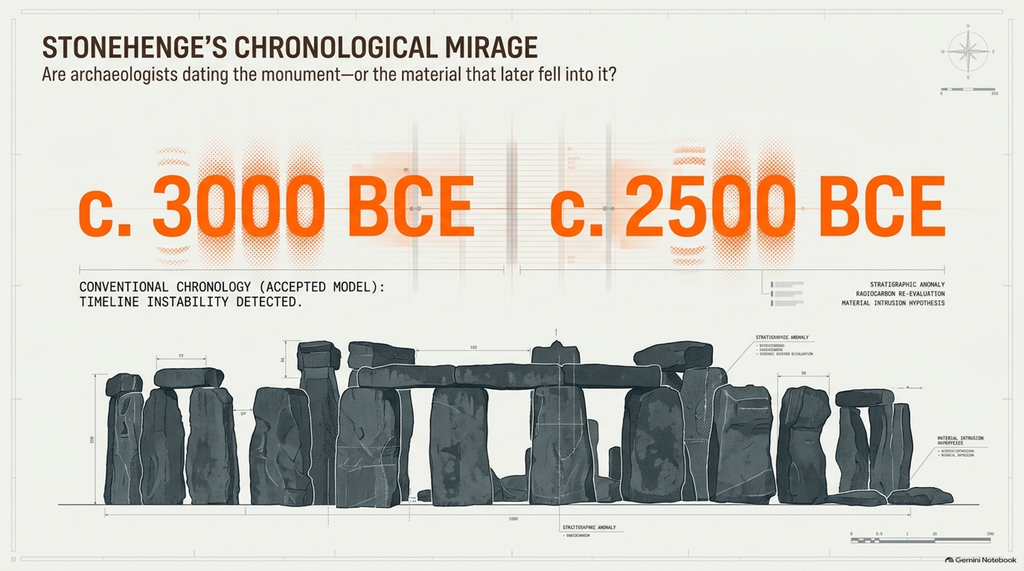
c.3000 BCE — the ditch, bank and Aubrey Holes are constructed.
c.2500 BCE — the great sarsen monument is erected.
c.2300 BCE — the Avenue and later alterations follow.
English Heritage still presents essentially this sequence today: the first Stonehenge is described as an earthwork enclosure constructed about 3000 BCE, containing 56 timber or stone posts and subsequently used as a cremation cemetery; the great central stone settings then appear around 2500 BCE. (English Heritage)
It looks wonderfully precise.
But once we ask the most elementary scientific question —
What exactly has been dated?
—the apparent certainty starts to unravel.
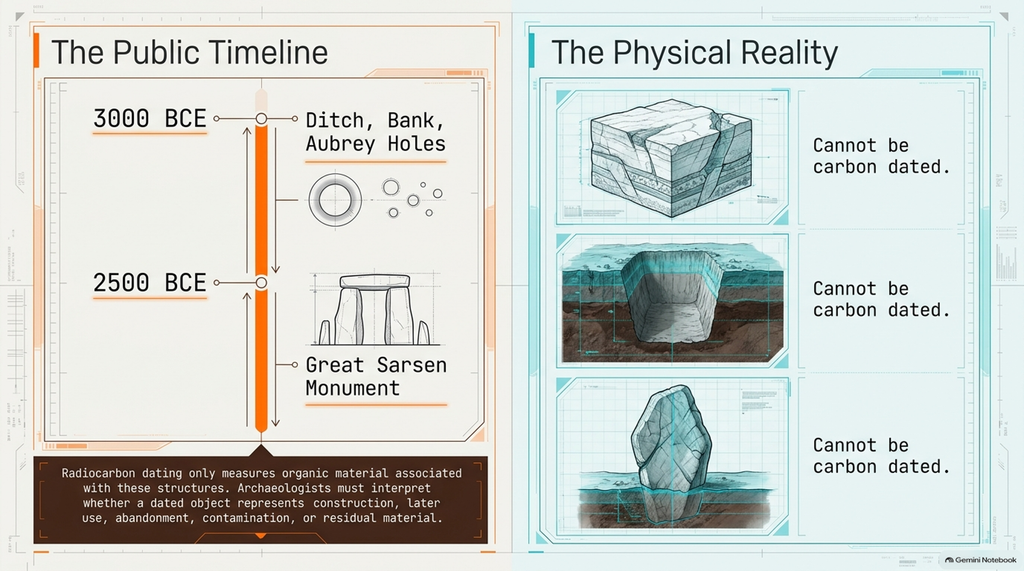
Stonehenge itself cannot be carbon dated.
Chalk cannot be carbon dated.
A hole cannot be carbon dated.
A standing stone cannot be carbon dated.
Radiocarbon dating measures organic material associated with those structures. Archaeologists must then decide whether the dated object represents the moment of construction, later use, abandonment, contamination, residual material or subsequent reuse.
That interpretation is where the Stonehenge chronology becomes far less secure than the familiar dates suggest.
And the Aubrey Holes provide perhaps the clearest demonstration.
The Aubrey Hole Paradox
There are 56 Aubrey Holes forming a remarkably regular circuit inside the Stonehenge earthwork.
For decades they have been intimately associated with the earliest recognised phase of Stonehenge and with its cremation cemetery.
But Timothy Darvill’s 2022 reassessment of Karen Walker’s original stratigraphic work presents a very different picture.
The excavated Aubrey Holes contain two separate archaeological phases.
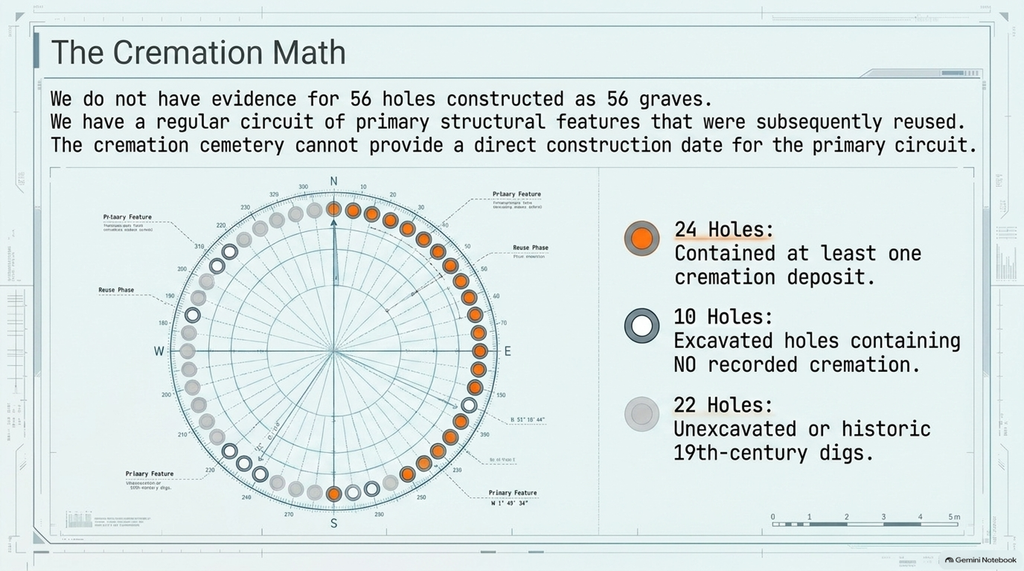
The original — primary — cuts were filled with chalk rubble surrounding a vertically sided central feature that Walker interpreted as a post-setting.
Later, after those posts had disappeared or been removed, the holes were recut as secondary pits or scoops.
It is predominantly within this second phase that the cremations appear. (Cambridge)
That distinction is fundamental.
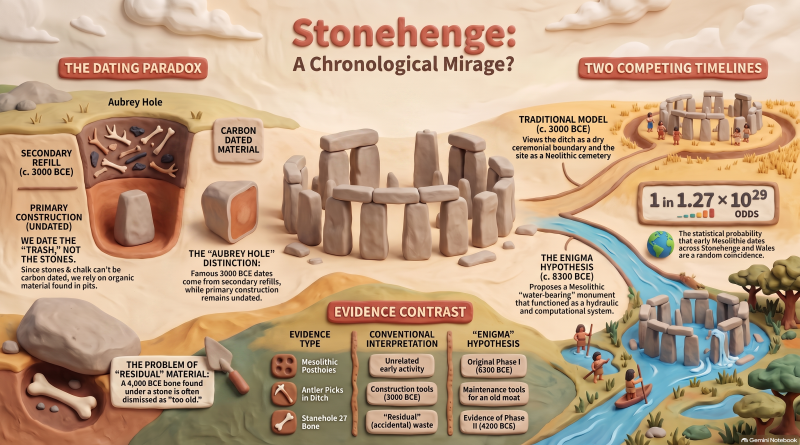
Because the famous radiocarbon date from Aubrey Hole 32 — 3080–2890 BCE — does not come from the primary fill.
It comes from the:
secondary fill.
And Darvill states something even more damaging to the simplistic chronology:
“No radiocarbon dates are currently available from these [primary] deposits.” (Cambridge)
So what does the AH32 date actually establish?
It demonstrates cremation activity around 3000 BCE.
It does not directly date the digging of the original Aubrey Hole.
That may have happened shortly beforehand.
Or considerably beforehand.
The radiocarbon evidence itself does not tell us.
The Cremation Numbers Make the Problem Even Clearer
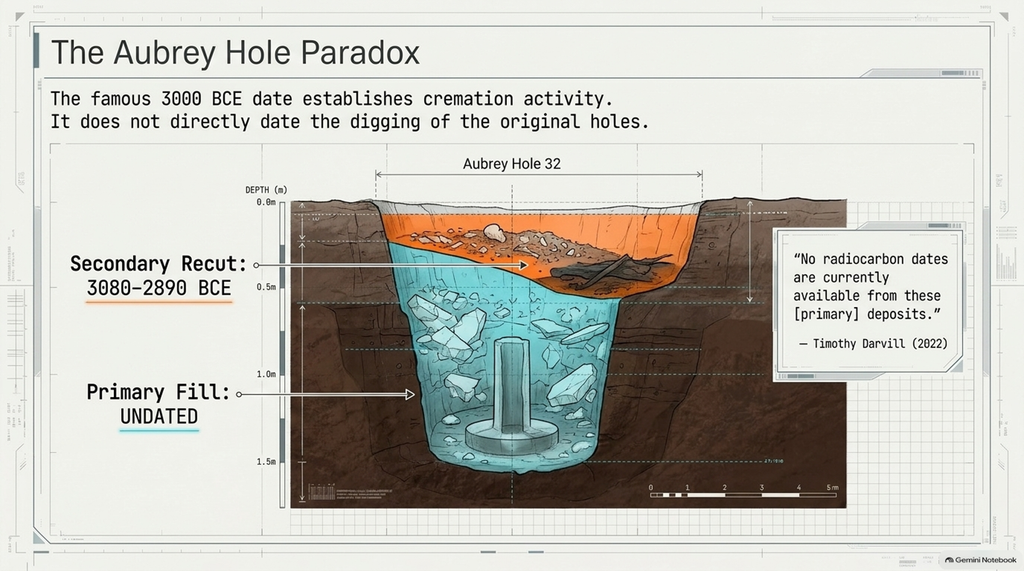
Of the 34 Aubrey Holes excavated during the twentieth century, Darvill reports:
24 contained at least one cremation deposit.
10 contained no recorded cremation at all.
The ten excavated holes without recorded cremation are:
AH1, AH19, AH22, AH25, AH26, AH27, AH30, AH31, AH55 and AH56.
Another 21 Aubrey Holes remain unexcavated, while AH46 was probably encountered during nineteenth-century antiquarian digging.
So we do not have evidence for:
56 holes constructed as 56 cremation graves.
We have a regular circuit of primary structural features, subsequently reused, with cremated remains found in 24 of 34 twentieth-century excavations.
That is a completely different proposition.
The corrected archaeological diagram makes this distinction visually obvious.
More importantly, the cremation cemetery cannot provide a direct construction date for the primary Aubrey Hole circuit.
This Was Already a Known Dating Problem
Remarkably, this is not some objection invented by critics of conventional archaeology.
The archaeologists responsible for the major Stonehenge dating programme were explicit about the problem nearly thirty years ago.
In the British Academy’s 1997 Dating Stonehenge study, Bayliss, Bronk Ramsey and McCormac wrote that the Aubrey Holes, timber settings and other Phase 1 and Phase 2 structural elements remained essentially undated apart from the old AH32 determination. (The British Academy)
They then made an extraordinarily important observation when discussing the ditch:
the relationship between the date of the samples and the archaeological event being dated is “both fundamental and interpretative.” (The British Academy)
That sentence should be printed underneath every Stonehenge chronology.
Because it describes the problem perfectly.
The Ditch Is Not Carbon Dated Either
The enormous circular ditch surrounding Stonehenge is conventionally placed around 3000 BCE.
English Heritage currently states that it was excavated with antler tools and that it formed the first major monument at Stonehenge. (English Heritage)
But again:
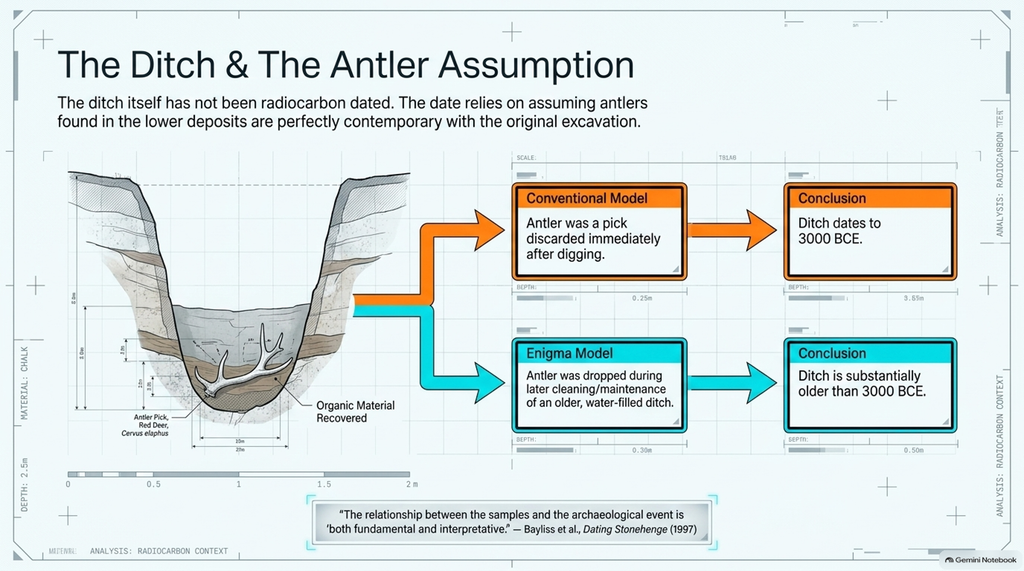
The ditch itself has not been radiocarbon-dated.
The construction date is inferred primarily from red deer antlers and other organic material recovered from the lower deposits.
The traditional reasoning is straightforward.
Antlers showing wear were recovered near the bottom of the ditch.
Therefore, they were interpreted as picks used to excavate it.
If they were discarded immediately after digging, their radiocarbon ages should approximate the construction date.
That may be correct.
But notice the assumption:
the antlers must be contemporary with excavation.
Bayliss and colleagues explicitly described this as a postulated functional relationship between the dated antlers and the construction of the ditch. (The British Academy)
Even their statistical analysis found that the antler determinations did not behave as neatly as a single, identical population would be expected to; they considered alternative explanations for the spread. (The British Academy)
The chronology was then constrained using archaeological interpretation, stratigraphy, and Bayesian modelling to estimate the construction of the ditch around the beginning of the third millennium BCE. An early version of the model produced 3015–2935 cal BCE, while subsequent modelling broadened the range. (The British Academy)
That is legitimate archaeological modelling.
But it is not equivalent to directly dating the moment the chalk was excavated.
The Forgotten 2500 BCE Stonehenge
This becomes particularly revealing when we look at the history of Stonehenge dating.
An early radiocarbon determination from an antler found near the western ditch terminal produced a calibrated range of:
2920–2460 BCE.
That meant the original scientific chronology comfortably extended towards approximately 2500 BCE.
That particular determination was subsequently rejected because the laboratory treatment apparently failed to remove humic acid contamination, rendering it too young. (Historic England)
Stonehenge therefore literally changed age as dating technology improved.
There is nothing scientifically wrong with that.
It is what should happen.
But it demonstrates why statements such as:
“Stonehenge was built in 3000 BCE.”
should be treated as modelled conclusions rather than immutable measurements.
And Here Appears the First Architectural Paradox
Suppose we accepted an older late-third-millennium date for the ditch while simultaneously accepting that the Aubrey Holes originally held stones at an earlier date.
What would the earliest Stonehenge actually have been?
A massive circular arrangement of stones or posts —
without the surrounding henge ditch.
In other words, the defining feature by which we visually identify Stonehenge’s supposedly earliest monument would not yet have existed.
That does not make such a sequence impossible.
Indeed, modern dating at Woodhenge has shown that the internal timber monument appears to have preceded construction of its surrounding henge earthwork by roughly two centuries. (Historic England)
But it does expose a much deeper problem.
What archaeologists call “Phase 1” need not represent one construction event at all.
It may be an artificial grouping of structures created at different times.
And that brings us directly back to the Aubrey Holes.
Their primary phase remains undated.
Then We Have the Bluestone Paradox
For several years, a popular hypothesis has proposed that the Aubrey Holes originally contained Welsh bluestones.
If correct, this would make the first Stonehenge a vast stone circle approximately 87 metres across.
Yet Darvill’s 2022 reassessment points out that:
- no bluestone pieces were securely recovered from the primary fills;
- none were securely recovered from the secondary fills;
- known bluestone fragments belong to later intrusions and overburden.
He therefore concludes that a Stage 1 bluestone circle is intriguing but not supported by the currently available evidence. (Cambridge)
Again, we find ourselves with a supposedly familiar reconstruction built upon evidence that is considerably more ambiguous than it suggests.
Were the Aubrey Holes:
stone sockets?
timber postholes?
working pits?
part of a computational arrangement?
or structures whose function changed repeatedly?
The evidence does not yet compel one answer.
The Sarsen Date Is Surprisingly Thin Too
Surely the enormous standing stones must provide firmer chronology?
Not nearly as firm as most people imagine.
English Heritage itself acknowledges that there is only:
one radiocarbon determination associated with the sarsen circle — 2620–2470 BCE
and
one associated with the trilithon horseshoe — 2620–2340 BCE. (English Heritage)
Again:
the stones cannot be carbon-dated.
The chronology depends upon associated organic material and stratigraphy.
And buried among those dates is one of Stonehenge’s most extraordinary anomalies.
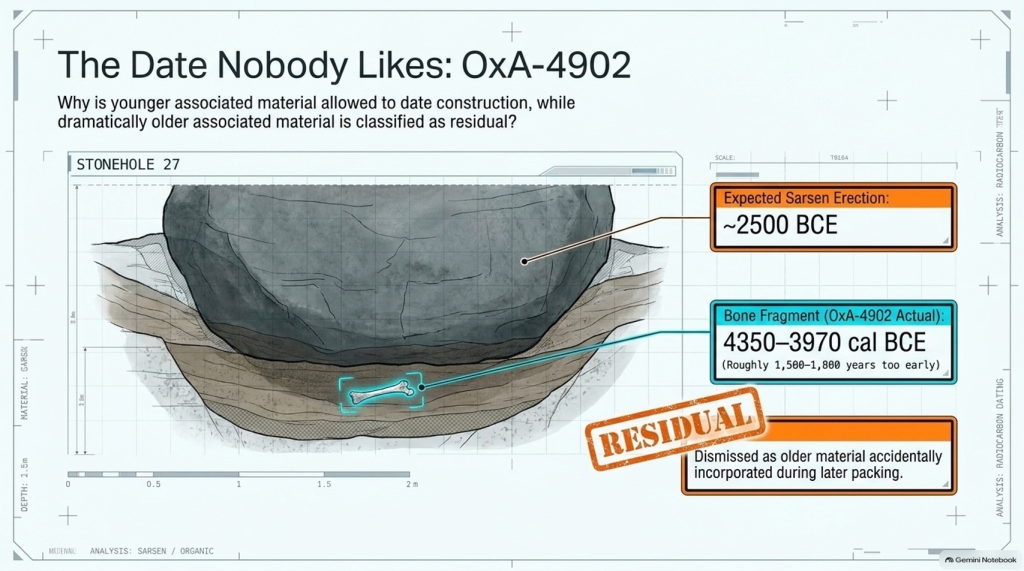
The Date Nobody Likes: OxA-4902
A cattle-sized long-bone fragment recovered among the packing stones of Stonehole 27 in the sarsen circle produced:
4350–3970 cal BCE
(OxA-4902). (Historic England)
That is roughly 1,500–1,800 years earlier than the accepted erection of the sarsen circle.
Conventional interpretation regards the bone as residual — old material accidentally incorporated during the packing of the stonehole.
The Stonehenge Research Framework says exactly this: it may represent otherwise invisible pre-henge activity. (Historic England)
That interpretation is possible.
But it is still an interpretation.
And this produces another uncomfortable question:
Why is the younger associated material allowed to date construction while dramatically older associated material is classified as residual?
Sometimes there are excellent contextual reasons.
But every rejection must be demonstrated rather than assumed simply because the date does not fit the expected chronology.
That is precisely where the alternative chronology developed in The Stonehenge Enigma begins.
Now Introduce the Evidence That the Traditional Model Leaves Outside Stonehenge
So far we have done nothing more than examine the conventional model on its own terms.
And it already produces several paradoxes:
The primary Aubrey Hole fills are undated.
The AH32 cremation belongs to secondary reuse.
Ten excavated holes contained no cremation.
The date of ditch construction depends on an inferred relationship with antler tools.
The sarsen chronology has remarkably few directly associated dates.
A securely dated fourth-millennium bone is found within the packing of Stonehole 27 but is interpreted as residual.
At this point the obvious scientific question becomes:
Yes.
And some are thousands of years older.
The Mesolithic Structures Beside Stonehenge
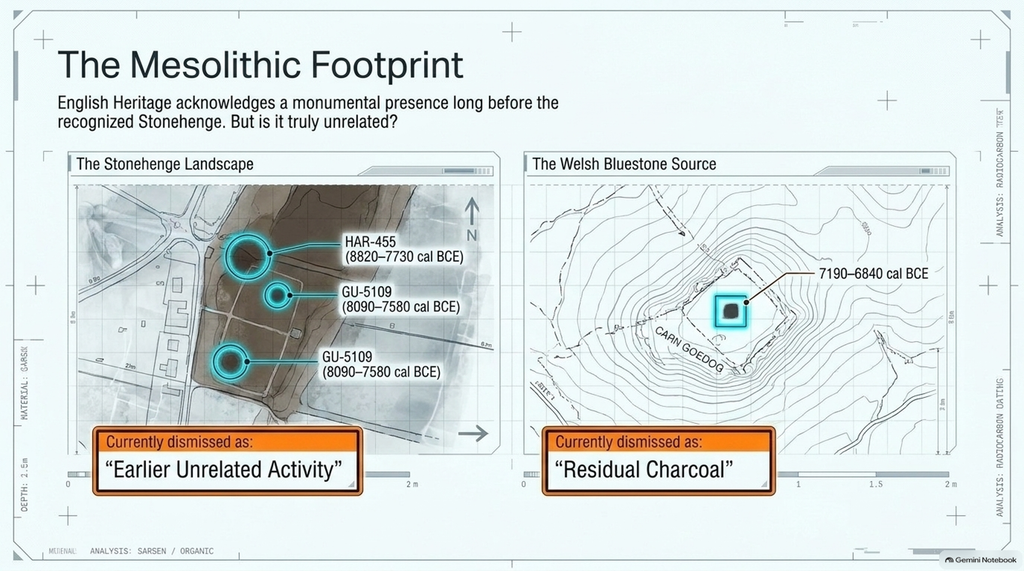
When the old Stonehenge car park was extended in 1966, archaeologists discovered enormous postholes.
They had held substantial pine posts.
Radiocarbon dating produced unmistakably Mesolithic results.
Published determinations include:
HAR-455 — approximately 8820–7730 cal BCE
GU-5109 — approximately 8090–7580 cal BCE
together with additional Mesolithic determinations from the associated features. (The British Academy)
The Stonehenge Research Framework acknowledges substantial Mesolithic postholes in this immediate landscape, including one dated approximately 8560–8200 BCE and another feature around 8300–7750 BCE. (Stonehenge & Avebury)
English Heritage itself describes these as evidence for a monumental presence in the landscape long before the conventionally recognised Stonehenge. (English Heritage)
The conventional solution is therefore:
Mesolithic monumentality existed here — but it was not Stonehenge.
That is a hypothesis.
The Stonehenge Enigma asks whether that separation has actually been demonstrated.
The Stonehenge Enigma C14 Hypothesis
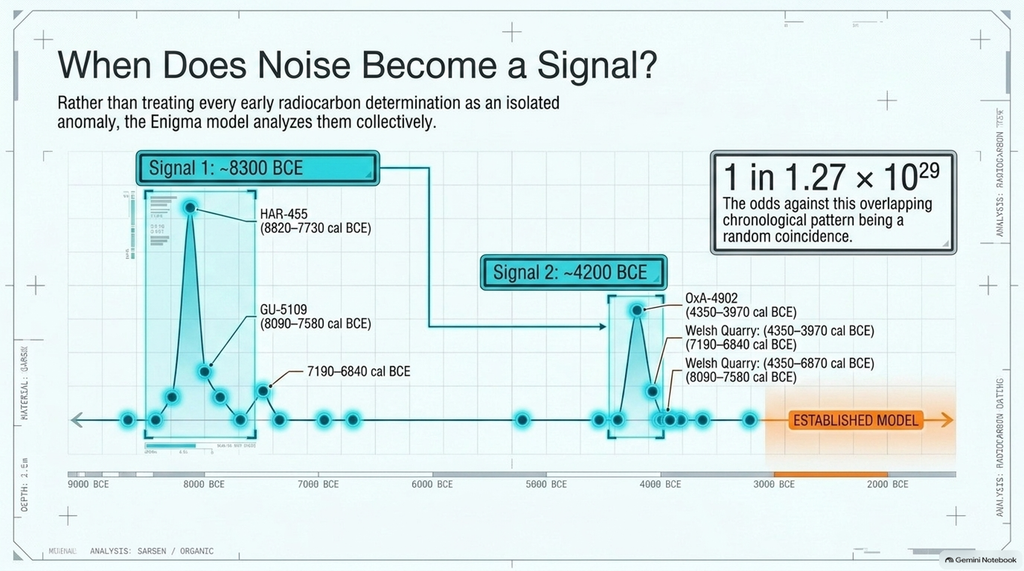
Rather than treating every early radiocarbon determination as an isolated anomaly, the Stonehenge Enigma analyses them collectively.
The method compares Mesolithic dates from the Stonehenge landscape — including HAR-455, GU-5109 and related determinations — with early radiocarbon material from the Welsh bluestone source landscapes.
The working hypothesis is that if these separate groups repeatedly converge in the same chronological window, we should test whether that convergence is random rather than simply label each result as residual.
This analysis identifies approximately:
8300 BCE
as the strongest common working horizon for Phase I activity.
The internal statistical overlap calculation developed in the book yields odds of about 1 in 1.27 × 10²⁹ that the observed pattern is a random coincidence.
That calculation is part of the Langdon hypothesis and has not yet been independently used to establish a new archaeological chronology.
But that is exactly why it needs to be tested.
Because the dates themselves are real.
What is disputed is their relationship to Stonehenge.
The Welsh Quarry Dates Are Particularly Interesting
The official excavation of Carn Goedog found a hearth containing charcoal dated to:
7190–6840 cal BCE
alongside a much later Neolithic sample. (Cambridge)
Other Mesolithic charcoal occurred in quarry-related deposits.
The excavators interpreted this material as residual — older charcoal disturbed during later quarrying. (Cambridge)
Again, that is possible.
But it creates a repeating pattern:
Mesolithic dates at Stonehenge?
Earlier unrelated activity.
Mesolithic dates at the bluestone source?
Residual charcoal.
A fourth-millennium date inside Stonehole 27?
Residual bone.
An early date that conflicts with the expected model is repeatedly explained as activity that happened earlier but was unrelated to construction.
The Stonehenge Enigma asks a different question:
At what point does a collection of “residual” dates cease being noise and become a signal?
That is the enquiry we should be conducting.
But Carbon Dating Is Only One Half of the Alternative Model
An older Stonehenge cannot be established merely by accumulating old dates.
That would simply replace one form of circular reasoning with another.
An alternative chronology needs an independent physical test.
That is where the Post-Glacial Flooding Hypothesis becomes important.
Hydrology: The Missing Clock
The conventional Stonehenge chronology is largely artefact-led.
The Post-Glacial Flooding Hypothesis approaches the problem from the opposite direction.
Instead of asking:
What period does this pottery fragment or antler belong to?
It asks:
What physical landscape existed when this structure could actually have functioned?
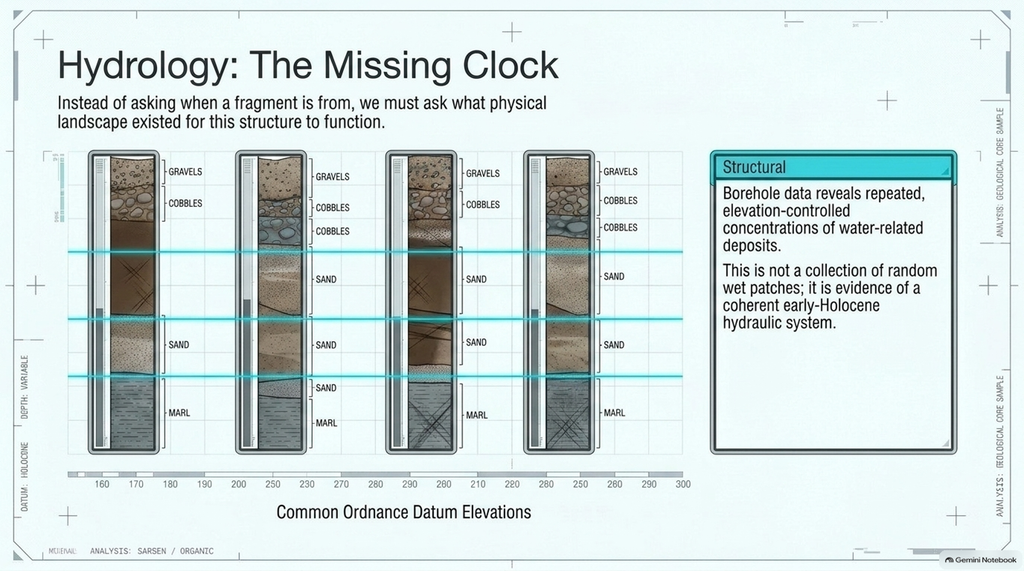
The latest hydrological work analyses borehole deposits around Stonehenge Bottom by converting simple depth measurements into Ordnance Datum elevations.
No archaeological chronology is imposed at this stage.
The test is simply whether water-related deposits occur randomly underground or repeatedly cluster at common elevations across different boreholes.
The analysis finds repeated elevation-controlled concentrations of:
gravels,
cobbles,
sand,
silt,
marl,
shell material,
organic staining,
and solution features.
Different materials repeatedly converge at the same elevation across separate boreholes.
Within the hypothesis, this is interpreted as evidence for a coherent former hydraulic system rather than isolated wet patches.
That conclusion is then compared with wider evidence for persistent elevated early-Holocene groundwater and post-glacial river systems.
Now the Stonehenge Ditch Looks Completely Different
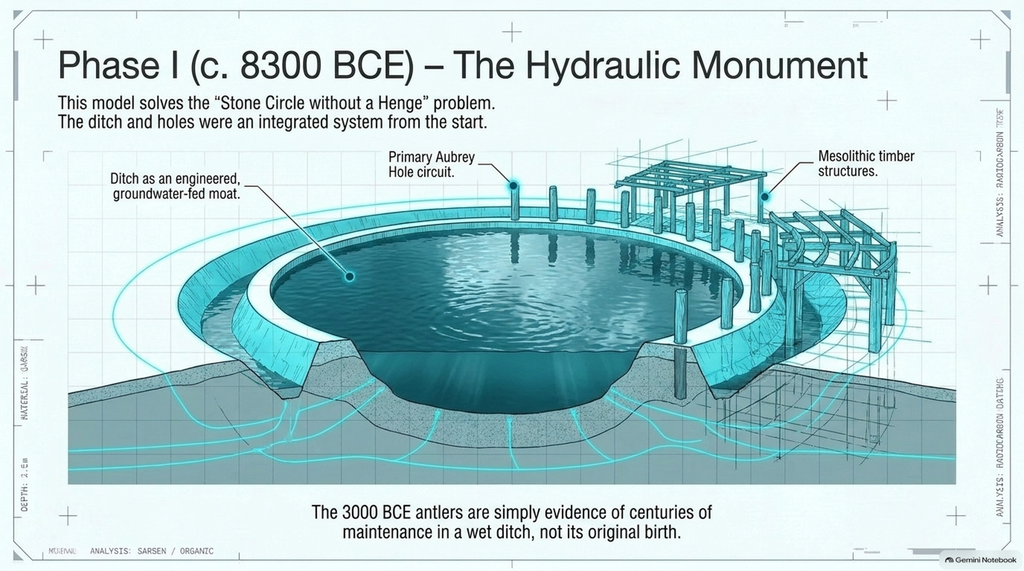
The Stonehenge Enigma does not interpret the Stonehenge ditch primarily as a dry ceremonial boundary.
It treats it as a water-bearing engineered feature.
The model proposes that the deep linked cuts intersected the chalk aquifer under early-Holocene conditions, creating a groundwater-fed moat or basin.
That produces a completely different interpretation of the antler evidence.
If the ditch was a dry feature dug once and immediately silted, antlers deposited upon its fresh bottom may indeed closely date its excavation.
But if the ditch was:
water-filled,
periodically cleaned,
reworked,
used for centuries or millennia,
and only later allowed to silt,
then organic material eventually found near its lower deposits need not date the original cutting.
It could date:
maintenance,
cleaning,
modification,
re-cutting,
or abandonment.
This does not prove the antler picks are later.
It demonstrates why the traditional assumption must itself be tested against the site’s hydrology.
The older Stonehenge Enigma formulation makes precisely this argument: in a functioning water-filled moat, antler material could represent a later stage in the ditch’s history rather than its original excavation.
This Resolves the “Stone Circle Without a Henge” Problem
And here we reach an important point that the traditional chronology struggles to make intuitive sense of.
If the Aubrey Holes really represent an early circle — whether of posts or stones — but the ditch dates significantly later, then the supposed first “henge” begins life without its defining earthwork.
The Stonehenge Enigma does not require that contradiction.
Its Phase I is conceived as an integrated early system:
ditch/moat + Aubrey Hole circuit + surrounding hydrological landscape
rather than one feature being bolted onto another thousands of years later.
The alternative chronology therefore proposes that the antler dates represent later activity within an already ancient hydraulic monument, rather than the monument’s birth.
That is a radically different interpretation.
But critically, it makes a testable prediction:
Direct dating of uncontaminated primary construction contexts should eventually yield dates substantially older than those of the secondary cremations and ditch-use material.
That is how the hypothesis should be tested.
Then Phase II Produces a Second Independent Chronology
The Stonehenge Enigma also makes another important distinction.
It does not claim that the great sarsen Stonehenge visible today was standing in 8300 BCE.
It separates the site into fundamentally different phases.
Phase I belongs to the proposed early hydraulic/computational monument.
Phase II represents a later monumental rebuilding.
And here another independent dating method appears.
The Avenue Alignment
The Stonehenge Avenue is not perfectly aligned with today’s solstitial sunrise.
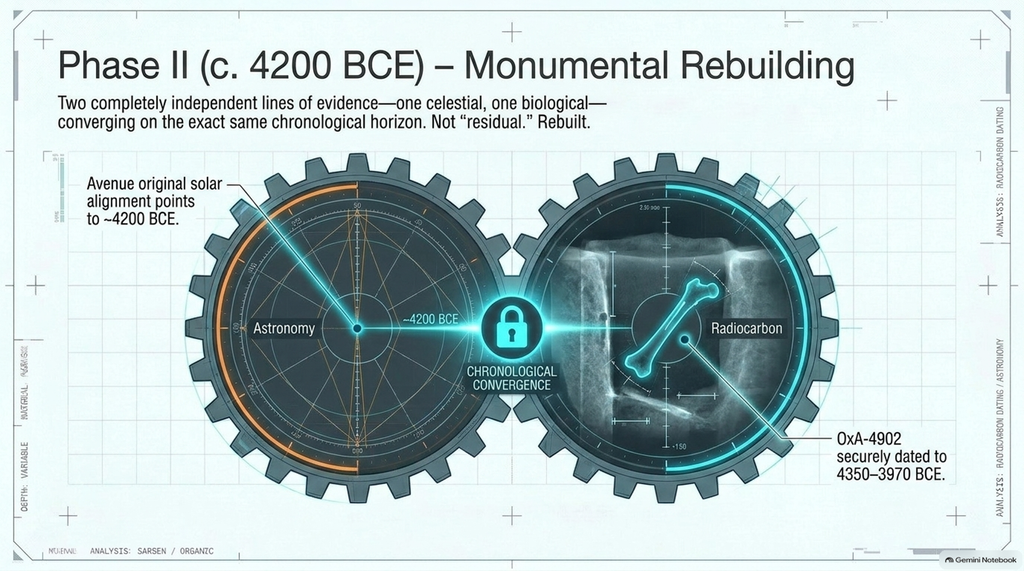
The Stonehenge Enigma works backwards from the centreline of the Avenue and the Sun’s changing position over long astronomical timescales.
That calculation produces an approximate construction horizon of:
c.4200 BCE
for the later monumental phase.
Astronomical dating of this kind has uncertainties — horizon reconstruction, exact original sight-lines, changes in obliquity and the precise construction axis all matter.
So it should not stand alone.
But remarkably, another completely different piece of evidence occupies almost exactly the same period.
Stonehole 27 Again
Remember OxA-4902?
The animal bone recovered amongst the packing stones of Sarsen Stonehole 27?
Its published calibrated date is approximately:
4350–3970 BCE. (Historic England)
The conventional model labels it residual because the sarsen circle is supposed to have been erected about 2500 BCE.
The Stonehenge Enigma reverses the enquiry.
Instead of asking:
How did a 4200 BCE bone accidentally get underneath a much later stone?
it asks:
What happens if the bone and the astronomical alignment are actually telling us the same thing?
Within the alternative model:
Avenue alignment ≈ 4200 BCE
and
Stonehole 27 associated bone ≈ 4350–3970 BCE
are independent lines of evidence converging on the same general chronological horizon.
That does not automatically prove the stone was erected then.
But neither is “residual” an explanation that should be accepted merely because the date is inconvenient.
It must be demonstrated.
Two Competing Chronologies
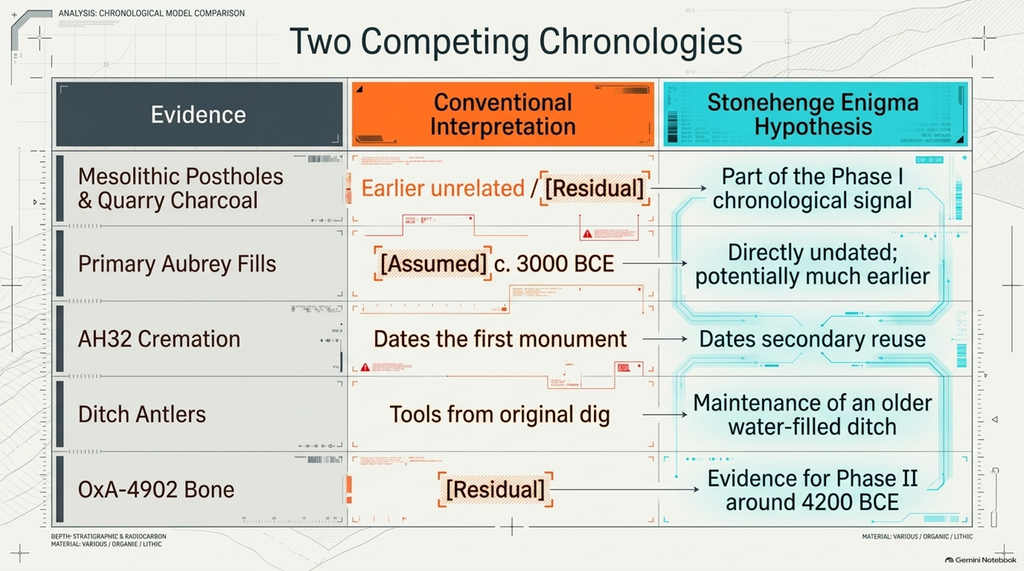
We can now place the models side by side.
| Evidence | Conventional interpretation | Stonehenge Enigma hypothesis |
|---|---|---|
| Mesolithic Stonehenge postholes | Earlier unrelated activity | Part of the Phase I chronological signal |
| Mesolithic Preseli charcoal | Residual earlier activity | Part of a wider repeated early activity horizon |
| Primary Aubrey Hole fills | c.3000 BCE by association | Currently directly undated; potentially much earlier |
| AH32 cremation 3080–2890 BCE | Supports early Stonehenge cemetery chronology | Dates secondary reuse, not original hole construction |
| Ditch antler picks | Tools discarded during construction, therefore c.3000 BCE | Could represent later maintenance/reuse of an older water-filled ditch |
| OxA-4902, 4350–3970 BCE | Residual material in Stonehole 27 | Potential evidence for Phase II around 4200 BCE |
| Avenue orientation | Later Neolithic solstitial architecture | Astronomical dating suggests c.4200 BCE |
| Stonehenge hydrology | Environmental background | Independent chronological/function constraint on Phase I |
The crucial point is not that every traditional interpretation must be wrong.
It is that the traditional chronology is itself a hypothesis constructed by selecting particular relationships between samples and structures.
The alternative model changes those relationships and produces a radically different chronology.
The Proposed Stonehenge Enigma Sequence
The working chronology now becomes:
Phase I — approximately 8300 BCE
An early Stonehenge within the post-glacial hydraulic landscape.
Proposed components include:
the chalk-cut water-bearing ditch,
the Aubrey Hole circuit,
timber activity,
Mesolithic structures,
water management,
and the earliest computational system.
The chronological argument rests upon the collective Mesolithic C14 signal plus an independent hydrological landscape model.
Phase II — approximately 4200 BCE
A major re-engineering and monumentalisation of the site.
The working date is derived independently from:
the proposed original solar alignment of the Avenue,
and the 4350–3970 BCE OxA-4902 bone from Stonehole 27.
The Stonehenge Computer explicitly treats the later sarsens, Avenue, and geometric architecture as belonging to a different construction logic from that of Phase I.
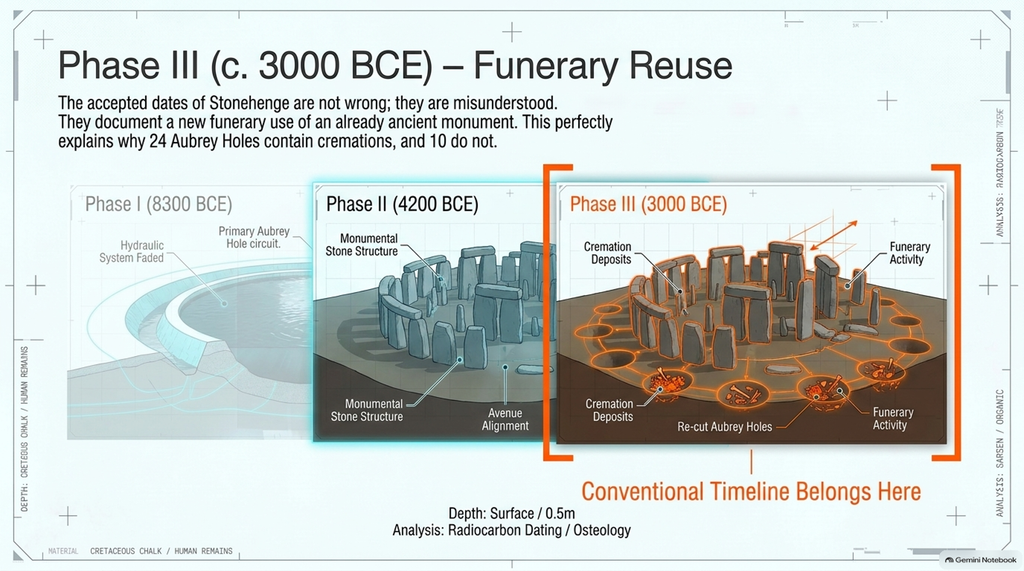
Around 3000 BCE and afterwards
The Aubrey Hole circuit undergoes secondary reuse.
Cremated human remains are inserted into many of the recut holes.
Under this model, these dates document a new funerary use of an ancient monument, not its original construction.
That interpretation immediately explains why some excavated Aubrey Holes contain cremations and others do not.
The Real Chronological Mirage
What makes Stonehenge so fascinating, therefore, is not that we have no scientific evidence.
We have enormous quantities of evidence.
The problem is how that evidence is connected.
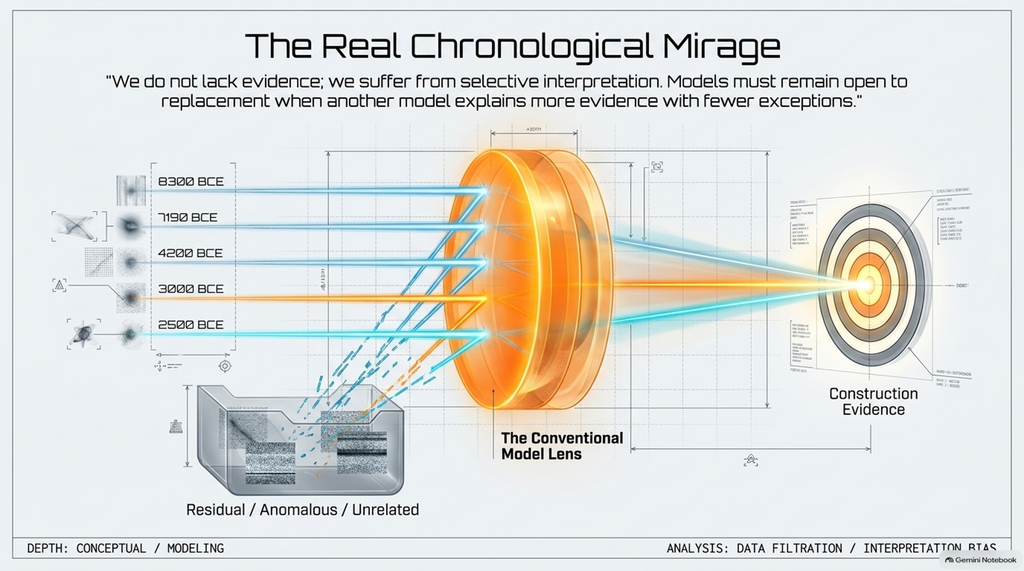
The conventional chronology says:
antlers at the bottom of the ditch date the ditch.
cremations in Aubrey Holes help date the first Stonehenge.
an early bone beneath Stone 27 is residual.
Mesolithic postholes nearby predate Stonehenge and are unrelated.
Mesolithic charcoal at the bluestone sources is residual.
Each statement is individually possible.
But placed together they reveal an extraordinarily selective chronological structure.
Older evidence repeatedly becomes:
residual, anomalous, pre-monument, unrelated.
Evidence matching the expected Neolithic chronology becomes:
construction evidence.
That does not mean archaeologists are falsifying data.
It means the data are being interpreted through an existing archaeological model.
And models must always remain open to replacement when another model explains more evidence with fewer exceptions.
The Test Is Now Very Simple
The Stonehenge Enigma should not be accepted because it is radical.
Nor should the conventional chronology be accepted because it is traditional.
Both must face the same test.
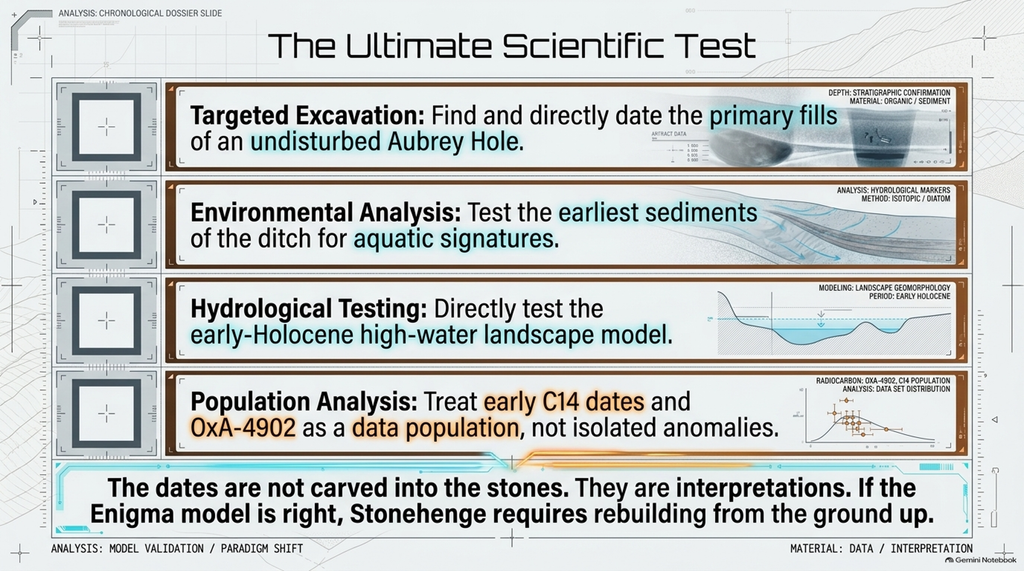
Find and directly date the primary contexts.
The Aubrey Hole primary fills currently have no radiocarbon dates. (Cambridge)
We need targeted excavation of an undisturbed Aubrey Hole.
We need securely stratified material from the original construction fill.
We need modern AMS dating.
We need environmental analysis of the ditch’s earliest sediments.
We need direct testing of the hydrological model.
We need the early Stonehenge C14 determinations recalibrated and analysed as a population rather than dismissed individually.
And we need the fourth-millennium Stonehole 27 date investigated rather than simply filed away under “residual.”
Conclusion — Perhaps We Have Been Dating the Reuse of Stonehenge
The discovery that AH32’s famous cremation belongs to a secondary fill changes the nature of the debate over Stonehenge dating.
It does not prove that Stonehenge was built in 8300 BCE.
But it removes one of the apparent chronological foundations for confidently declaring that the Aubrey Hole circuit was constructed around 3000 BCE.
And when this is combined with the other evidence, the problem becomes much larger.
We have:
undated primary Aubrey Hole fills;
Mesolithic monumental postholes immediately beside Stonehenge;
multiple early-Holocene C14 determinations;
Mesolithic activity at the Welsh bluestone source landscape;
an anomalously early 4350–3970 BCE date sealed among Stonehole 27 packing;
an independent Avenue alignment calculation pointing towards approximately 4200 BCE;
and
a hydrological model predicting that Stonehenge’s earliest functional landscape belongs to the high-water conditions of the early Holocene.
Taken separately, each can be explained away.
Taken together, they demand investigation.
The alternative hypothesis presented in The Stonehenge Enigma is therefore not simply:
“Stonehenge is older.”
It is much more specific:
Stonehenge has been repeatedly rebuilt, reused and reinterpreted, and archaeology may have mistaken dates from those later episodes for the construction dates of structures that already existed.
The familiar dates of 3000 BCE and 2500 BCE are therefore not measurements carved into the stones.
They are interpretations.
And if the C14 population analysis, astronomical alignment and hydrological calibration presented in this research survive independent testing, then the accepted chronology of Stonehenge will require something far more substantial than another minor adjustment.
It will require rebuilding from the ground up.
- Darvill, T. (2022) — Mythical rings? Waun Mawn and Stonehenge Stage 1.
Antiquity 96(390), 1515–1529.
DOI: 10.15184/aqy.2022.82
Important for the Aubrey Hole primary/secondary sequence, the 34 excavated holes, 24 with cremations, and the statement that no radiocarbon dates are currently available from the primary fills. (Cambridge) - Willis, C. et al. (2016) — The dead of Stonehenge.
Antiquity 90(350), 337–356.
DOI: 10.15184/aqy.2016.26
Important for the distribution and dating of the Stonehenge cremations. (Cambridge) - Cleal, R.M.J., Walker, K.E. & Montague, R. (1995) — Stonehenge in its Landscape: Twentieth-Century Excavations.
English Heritage.
This is the definitive excavation monograph and the basis of Karen Walker’s reconstruction of the Aubrey Hole stratigraphy. (Cambridge) - Bayliss, A., Bronk Ramsey, C. & McCormac, F.G. (1997) — Dating Stonehenge, in Science and Stonehenge, Proceedings of the British Academy 92, pp. 39–59.
Important for the early radiocarbon chronology and the acknowledgement that linking a dated sample to a construction event is fundamentally interpretative. (The British Academy) - Marshall, P., Darvill, T., Parker Pearson, M. & Wainwright, G. (2012) — Stonehenge, Amesbury, Wiltshire: Chronological Modelling.
English Heritage Research Report 1/2012.
Contains the Stonehenge radiocarbon dataset and competing Bayesian chronological models. (Historic England) - Parker Pearson, M. et al. (2019) — Megalith quarries for Stonehenge’s bluestones.
Antiquity 93(367), 45–62.
DOI: 10.15184/aqy.2018.111
Important for the Preseli quarry evidence and the early charcoal dates found there. (Cambridge) - Bayliss, A. & Marshall, P. (2022) — Radiocarbon Dating and Chronological Modelling: Guidelines and Best Practice.
Historic England.
Useful background on exactly how archaeological events are inferred from radiocarbon samples and Bayesian models. (Historic England)
PODCAST

Author’s Biography
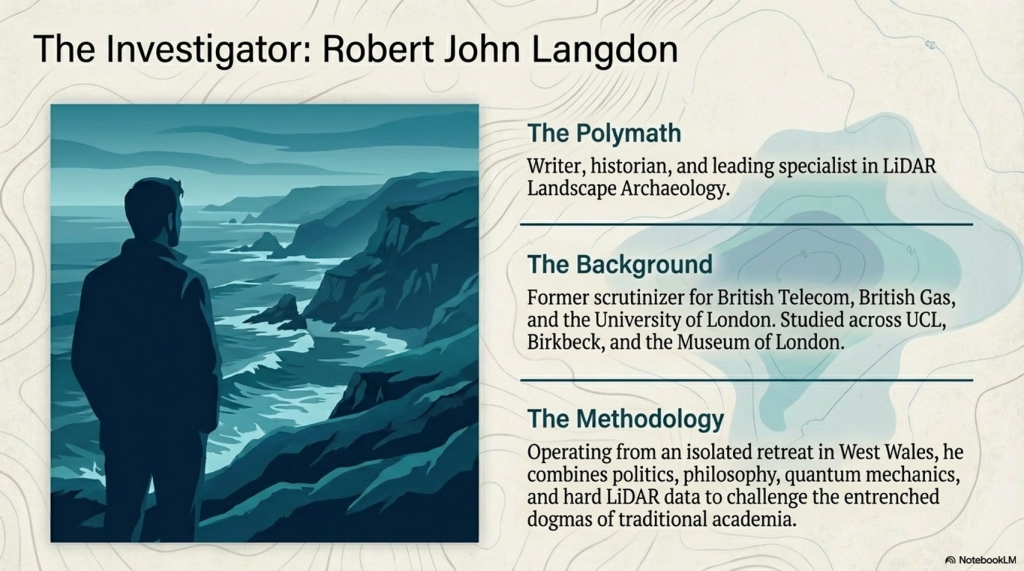
Robert John Langdon, a polymathic luminary, emerges as a writer, historian, and eminent specialist in LiDAR Landscape Archaeology.
His intellectual journey has included stints as an astute scrutineer in government and major corporate bastions, spanning British Telecommunications, Cable and Wireless, British Gas, and the esteemed University of London.
A decade hence, Robert’s transition into retirement unfurled a chapter of insatiable curiosity. He immersed himself in Politics, Archaeology, Philosophy, and the enigmatic realm of Quantum Mechanics. His academic odyssey took him through the venerable corridors of knowledge hubs such as the Museum of London, University College London, Birkbeck College, The City Literature Institute, and Chichester University.
In the symphony of his life, Robert is a custodian of three progeny and a pair of cherished grandchildren. His sanctuary lies ensconced in the embrace of West Wales, where he inhabits an isolated cottage, its windows framing a vista of the boundless sea – a retreat from the scrutinising gaze of Her Majesty’s Revenue and Customs, an amiable clandestinity in the lap of nature.
Exploring Prehistoric Britain: A Journey Through Time
My blog delves into the fascinating mysteries of prehistoric Britain, challenging conventional narratives and offering fresh perspectives grounded in cutting-edge research, particularly LiDAR technology. I invite you to explore some key areas of my research. For example, I re-examine the Wansdyke, often cited as a defensive structure, in light of new evidence. I’ve presented my findings in my blog post Wansdyke: A British Frontier Wall – ‘Debunked’, and a Wansdyke LiDAR Flyover video further visualises my conclusions.
My work also often challenges established archaeological dogma. I argue that many sites, such as Hambledon Hill, commonly identified as Iron Age hillforts, are not what they seem. My posts Lidar Investigation Hambledon Hill – NOT an ‘Iron Age Fort’ and Unmasking the “Iron Age Hillfort” Myth explore these ideas in detail and offer an alternative view. Similarly, I re-evaluated sites like Cissbury Ring and White Sheet Camp through LiDAR analysis in my posts “Lidar Investigation Cissbury Ring through time” and “Lidar Investigation White Sheet Camp,“ revealing fascinating insights into their true purpose. I have also examined South Cadbury Castle, often linked to the mythical Camelot56.
My research also extends to ancient water management, including the role of canals and other linear earthworks. I have discussed the true origins of Car Dyke in multiple posts, including Car Dyke – ABC News Podcast and Lidar Investigation Car Dyke – North Section, which suggest a Mesolithic origin 2357. I also explore the misidentification of Roman aqueducts, as seen in my posts on the Great Chesters (Roman) Aqueduct. My research has also been greatly informed by my post-glacial flooding hypothesis, which has helped explain landscape transformations over time. I have discussed this hypothesis in several posts, including AI now supports my Post-Glacial Flooding Hypothesis and Exploring Britain’s Flooded Past: A Personal Journey
Finally, my blog also investigates prehistoric burial practices, as seen in Prehistoric Burial Practices of Britain and explores the mystery of Pillow Mounds, often mistaken for medieval rabbit warrens, but with a potential link to Bronze Age cremation in my posts: Pillow Mounds: A Bronze Age Legacy of Cremation? and The Mystery of Pillow Mounds: Are They Really Medieval Rabbit Warrens?. My research also includes astronomical insights into ancient sites, for example, in Rediscovering the Winter Solstice: The Original Winter Festival. I also review new information about the construction of Stonehenge in The Stonehenge Enigma.
Yes. I’d make this far tighter, more inviting and more obviously a gateway into the rest of your work. The present version repeats the website several times and reads more like an author biography than a “what next?” section.
I’d also make the three routes immediately obvious: Explore the Research → Watch the Videos → Read the Books, with Facebook as the discussion/community route.
Further Reading — Explore the Evidence
The investigation doesn’t end with this article.
Prehistoric Britain brings together hundreds of articles, LiDAR investigations, field discoveries, archaeological studies and original research exploring Britain’s prehistoric landscape from a different perspective.
Follow the evidence across ancient waterways, lost landscapes, Stonehenge and Avebury, prehistoric engineering, submerged Britain, ancient DNA and the effects of post-glacial flooding — comparing established archaeological interpretations with alternative explanations suggested by the physical evidence.
🎬 Watch the Investigations
Prefer to watch rather than read?
The Robert John Langdon YouTube channel has more than 200 documentaries, investigations, and video presentations that bring the research to life through maps, LiDAR, archaeological evidence, and landscape reconstruction.
Discover investigations including 13 Things That Don’t Make Sense in History, Silbury Avenue – The Lost Stone Avenue, Stonehenge, prehistoric waterways, submerged landscapes and many more.
📚 Explore the Book Library
Go deeper into the evidence through Robert John Langdon’s growing collection of books and specialist studies, including:
- The Stonehenge Hoax – 13 Things That Don’t Make Sense in History
- Car Dyke – Prehistoric Dyke
- Wansdyke – Prehistoric Dyke
- Offa’s Dyke – Prehistoric Dyke
- Silbury Avenue – The Lost Stone Avenue
- The Vallum – At Hadrian’s Wall
- Stonehenge: The World’s First Computer
- Avebury’s Lost Stone Avenue
Many of these investigations connect directly with the evidence discussed throughout the website, allowing individual discoveries to be examined as part of the much wider prehistoric landscape.
🔎 Read the Main Trilogy
Three major works bring together the central strands of the research:
The Post-Glacial Flooding Hypothesis — investigates the evidence for radically different water levels, waterways and landscapes in prehistoric Britain.
The Stonehenge Enigma — re-examines the chronology, landscape and purpose of one of the world’s most famous prehistoric monuments.
Dawn of the Lost Civilisation — explores the evidence for sophisticated communities, technology and maritime connections far earlier than traditionally assumed.
💬 Join the Investigation
New discoveries, LiDAR surveys and research are discussed as they happen in the Prehistoric Britain Facebook Group.
Join the discussion, challenge the evidence, offer alternative interpretations and follow new investigations as they develop.
Don’t just read the accepted story. Explore the evidence, compare the interpretations, and decide for yourself.
Other Blogs
1
a
- Ackling Dyke – Facts and the Archaeological Fiction
- Ackling Dyke – Part II – Puddletown Forest: When a Roman Road Becomes an Assumption
- Ackling Dyke – Part III – The Roman Road Mystery Finally Makes Sense
- AI now Supports – Homo Superior
- AI now supports my Post-Glacial Flooding Hypothesis
- Alexander the Great sailed into India – where no rivers exist today
- Ancient Secrets of Althorp – debunked
- Antler Picks built Ancient Monuments – yet there is no real evidence
- Antonine Wall – Prehistoric Canals (Dykes)
- Archaeological ‘pulp fiction’ – has archaeology turned from science?
- Archaeological Pseudoscience
- Archaeology in the Post-Truth Era
- Archaeology: A Bad Science?
- Archaeology: A Harbour for Fantasists?
- Archaeology: Fact or Fiction?
- Archaeology: The Flaws of Peer Review
- Archaeology’s Bayesian Mistake: Stop Averaging the Past
- Are Raised Beaches Archaeological Pseudoscience?
- Atlantis Found: The Mathematical Proof That Plato’s Lost City Was Doggerland
- ATLANTIS: Discovery with Dan Snow Debunked
- Avebury Ditch – Avebury Phase 2
- Avebury through time
- Avebury’s great mystery revealed
- Avebury’s Lost Stone Avenue – Flipbook
b
- Battlesbury Hill – Wiltshire
- Beyond Stone and Bone: Rethinking the Megalithic Architects of Northern Europe
- BGS Prehistoric River Map
- Blackhenge: Debunking the Media misinterpretation of the Stonehenge Builders
- Brain capacity (Cro-Magnon Man)
- Britain’s First Road – Stonehenge Avenue
- Britain’s Giant Prehistoric Waterways
- British Roman Ports miles away from the coast
c
- Caerfai Promontory Fort – Archaeological Nonsense
- Car Dyke – ABC News PodCast
- Car Dyke – North Section
- Cardigan Bay: The Holocene Evidence the Old Geological Story Has Missed
- CASE STUDY – An Inconvenient TRUTH (Craig Rhos Y Felin)
- Case Study – River Avon
- Case Study – Woodhenge Reconstruction
- Chapter 2 – Craig Rhos-Y-Felin Debunked
- Chapter 2 – Stonehenge Phase I
- Chapter 2 – Variation of the Species
- Chapter 3 – Post Glacial Sea Levels
- Chapter 3 – Stonehenge Phase II
- Chapter 7 – Britain’s Post-Glacial Flooding
- Cissbury Ring through time
- Clement Reid, Doggerland, and the Archaeological Establishment
- Cro-Magnon Brain Capacity
- Cro-Magnon Megalithic Builders: Measurement, Biology, and the DNA
- Cro-Magnons – An Explainer
d
- Darwin’s Children – Flipbook
- Darwin’s Children – The Cro-Magnons
- Dawn of The Lost Civilisation – 1/10
- Dawn of the Lost Civilisation – Flipbook
- Dawn of the Lost Civilisation – Introduction
- Digging for Britain – Cerne Abbas
- Digging for Britain Debunked – Cerne Abbas 2
- Digging Up Britain’s Past – Debunked
- DLC Chapter 1 – The Ascent of Man
- Durrington Walls – Woodhenge through time
- Durrington Walls Revisited: Platforms, Fish Traps, and a Managed Mesolithic Landscape
- Dyke Construction – Hydrology 101
- Dykes Ditches and Earthworks
- DYKES of Britain
e
f
g
h
- Hadrian’s Wall – Military Way Hoax
- Hadrian’s Wall – the Stanegate Hoax
- Hadrian’s Wall Vallum – Prehistoric Canals – FREE Online Book
- Hadrian’s Wall LiDAR investigation
- Hambledon Hill – NOT an ‘Iron Age Fort’
- Hayling Island Lidar Maps
- Hidden Sources of Ancient Dykes: Tracing Underground Groundwater Fractals
- Historic River Avon
- Hollingsbury Camp Brighton – A Hillfort… or a Forgotten Harbour?
- Hollows, Sunken Lanes and Palaeochannels
- Homo Superior – Flipbook
- Homo Superior – History’s Giants
- How Lidar will change Archaeology
- Hydrology 101 Simplified: Why Britain’s Dykes Worked Without Rivers
i
l
m
- Maiden Castle through time
- Mathematics Meets Archaeology: Discovering the Mesolithic Origins of Car Dyke
- Mesolithic River Avon
- Mesolithic Stonehenge
- Minerals found in Prehistoric and Roman Quarries
- Mining in the Prehistoric to Roman Period
- Mount Caburn through time
- Mysteries of the Oldest Boatyard Uncovered
- Mythological Dragons – a non-existent animal that is shared by the World.
o
- Offa’s Dyke Flipbook
- Old Sarum Lidar Map
- Old Sarum Through Time…………….
- On Sunken Lands of the North Sea – Lived the World’s Greatest Civilisation.
- OSL Chronicles: Questioning Time in the Geological Tale of the Avon Valley
- Oswestry LiDAR Survey
- Oswestry through time
- Oysters in Archaeology: Nature’s Ancient Water Filters?
p
- Pillow Mounds: A Bronze Age Legacy of Cremation?
- Pinkery Canal
- Plato Was Right: The Archaeological Evidence the Academics Never Expected
- Post Glacial Flooding – Flipbook
- Prehistoric Burial Practices of Britain
- Prehistoric Canals – Wansdyke
- Prehistoric Canals – Wansdyke
- Prehistoric Canals (Dykes) – Great Chesters Aqueduct (The Vallum Pt. 4)
- Prehistoric Canals (Dykes) – Offa’s Dyke (Chepstow)
- Prehistoric Canals (Dykes) – Offa’s Dyke (LiDAR Survey)
- Prehistoric Canals (Dykes) – Offa’s Dyke Survey (End of Section A)
- Prehistoric Canals (Dykes) – Wansdyke (4)
- Prehistoric Canals Wansdyke 2
- Professor Bonkers and the mad, mad World of Archaeology
r
- Real-World Confirmation of Post-Glacial Flooding
- Rebirth in Stone: Decrypting the Winter Solstice Legacy of Stonehenge
- Rediscovering the Winter Solstice: The Original Winter Festival
- Rethinking Ancient Boundaries: The Vallum and Offa’s Dyke”
- Rethinking Ogham: Could Ireland’s Oldest Script Have Begun as a Tally System?
- Rethinking The Past: Mathematical Proof of Langdon’s Post-Glacial Flooding Hypothesis
- Revolutionising History: Car Dyke Unveiled as Prehistoric & the Launch of FusionBook 360
- Rising Evidence, Falling Rivers: The Real Story of Europe’s First Farmers
- Rivers of the Past Were Higher: A Fresh Perspective on Prehistoric Hydrology
s
- Sea Level Changes
- Section A – NY26SW
- Section B – NY25NE & NY26SE
- Section C – NY35NW
- Section D – NY35NE
- Section E – NY46SW & NY45NW
- Section F – NY46SE & NY45NE
- Section G – NY56SW
- Section H – NY56NE & NY56SE
- Section I – NY66NW
- Section J – NY66NE
- Section K – NY76NW
- Section L – NY76NE
- Section M – NY87SW & NY86NW
- Section N – NY87SE
- Section O – NY97SW & NY96NW
- Section P – NY96NE
- Section Q – NZ06NW
- Section R – NZ06NE
- Section S – NZ16NW
- Section T – NZ16NE
- Section U – NZ26NW & NZ26SW
- Section V – NZ26NE & NZ26SE
- Silbury Avenue – Avebury’s First Stone Avenue
- Silbury Hill
- Silbury Hill / Sanctuary – Avebury Phase 3
- Sky Maps of Prehistoric Britain
- Somerset Plain – Signs of Post-Glacial Flooding
- South Cadbury Castle – Camelot
- Statonbury Camp near Bath – an example of West Wansdyke
- Stone me – the druids are looking the wrong way on Solstice day
- Stone Transportation and Dumb Censorship
- Stonehenge – Monument to the Dead
- Stonehenge Hoax – Dating the Monument
- Stonehenge Hoax – Round Monument?
- Stonehenge Hoax – Summer Solstice
- Stonehenge LiDAR tour
- Stonehenge Phase 1 — Britain’s First Monument
- Stonehenge Phase I (The Stonehenge Landscape)
- Stonehenge Solved – Pythagorean maths put to use 4,000 years before he was born
- Stonehenge Through Time
- Stonehenge, Doggerland and Atlantis connection
- Stonehenge: Borehole Evidence of Post-Glacial Flooding
- Stonehenge: Discovery with Dan Snow Debunked
- Stonehenge: The World’s First Computer – FREE Book
- Stonehenge: The Worlds First Computer
- Stonehenge’s The Lost Circle Revealed – DEBUNKED
- Stonehenge’s Chronological Mirage
t
- Ten Reasons Why Car Dyke Blows Britain’s Earthwork Myths Out of the Water
- Ten Things You Didn’t Know About Britain’s Prehistoric Flooded Past
- Ten thousand year old boats found on Northern Europe’s Hillsides
- Ten thousand-year-old boats found on Northern Europe’s Hillsides
- Testing Plato’s Atlantis Against Reality
- The “Hunter-Gatherer” Myth: Why It’s Time to Bury This Outdated Term
- The Ackling Dyke Smoking Gun
- The Ancient Mariners – Flipbook
- The Ancient Mariners – Prehistoric seafarers of the Mesolithic
- The Ascent of Man — From Survival to Systems
- The Beringian Migration Myth: Why the Peopling of the Americas by Foot is Mathematically and Logistically Impossible
- The Bluestone Enigma
- The Bulford Hoax: The “Simpler, Older Stonehenge” That Wasn’t
- The Cheddar Man Hoax
- The Cro-Magnon Cover-Up: How DNA and PR Labels Erased Our Real Ancestry
- The Dolmen and Long Barrow Connection
- The Durrington Mega-Monument Hoax: What Lies Beneath? – Debunked
- The Durrington Walls Hoax – it’s not a henge?
- The Dyke Myth Collapses: Excavation and Dating Prove Britain’s Great Dykes Are Prehistoric Canals
- The First European Smelted Bronzes
- The Fury of the Past: Natural Disasters in Historical and Prehistoric Britain
- The Giant’s Graves of Cumbria
- The Giants of Prehistory: Cro-Magnon and the Ancient Monuments
- The Great Ancient DNA Illusion: How Statistical Models Became Archaeological “Facts”
- The Great Antler Pick Hoax
- The Great Bell Beaker Migration Myth
- The Great Chichester Hoax – A Bridge too far?
- The Great Dorchester Aqueduct Hoax
- The Great Farming Hoax – (Einkorn Wheat)
- The Great Farming Migration Hoax
- The Great Hadrian’s Wall Hoax
- The Great Iron Age Hill Fort Hoax
- The Great Offa’s Dyke Hoax
- The Great Prehistoric Migration Hoax
- The Great Stone Transportation Hoax
- The Great Stonehenge Hoax
- The Great Wansdyke Hoax
- THE GREAT WEST WOODS HOAX — WHEN ONE STONE BECOMES FIFTY
- The Henge and River Relationship
- The Logistical Impossibility of Defending Maiden Castle
- The Long Barrow and Dolmen Enigma
- The Long Barrow Mystery
- The Long Barrow Mystery: Unravelling Ancient Connections
- The Lost Island of Avalon – revealed
- The Maiden Way Hoax – A Closer Look at an Ancient Road’s Hidden History
- The Maths – LGM total ice volume
- The Mystery of Pillow Mounds: Are They Really Medieval Rabbit Warrens?
- THE ODYSSEY PROBLEM: WHY DID A WEEK-LONG VOYAGE BECOME A TEN-YEAR EPIC?
- The Old Sarum Hoax
- The Oldest Boat Yard in the World found in Wales
- The Perils of Paradigm Shifts: Why Unconventional Hypotheses Get Branded as Pseudoscience
- The Post-Glacial Flooding Hypothesis – 1/11
- The Post-Glacial Flooding Hypothesis – Flipbook
- The Post-Glacial Flooding Theory
- The Problem with Hadrian’s Vallum
- The Rise of the Cro-Magnon (Homo Superior)
- The Roman Military Way Hoax
- The Silbury Hill Lighthouse?
- The Stone Money – Credit System
- The Stonehenge Avenue
- The Stonehenge Avenue
- The Stonehenge Code: Unveiling its 10,000-Year-Old Secret
- The Stonehenge Crescent: A Monument to a Lost World
- The Stonehenge Enigma – Flipbook
- The Stonehenge Enigma: Part 1/6
- The Stonehenge Hoax – Bluestone Quarry Site
- The Stonehenge Hoax – Flipbook
- The Stonehenge Hoax – Moving the Bluestones
- The Stonehenge Hoax – Periglacial Stripes
- The Stonehenge Hoax – Station Stones
- The Stonehenge Hoax – Stonehenge’s Location
- The Stonehenge Hoax – The Ditch
- The Stonehenge Hoax – The Slaughter Stone
- The Stonehenge Hoax – The Stonehenge Layer
- The Stonehenge Hoax – Totem Poles
- The Stonehenge Hoax – Woodhenge
- The Stonehenge Hospital
- The Stonehenge Transportation Mystery
- The Subtropical Britain Hoax
- The Troy, Hyperborea and Atlantis Connection
- The Vallum @ Hadrian’s Wall – it’s Prehistoric!
- The Vallum at Hadrian’s Wall (Summary)
- The Woodhenge Hoax
- Thirty Years of CAU Archaeology Going Nowhere?
- Three Dykes – Kidland Forest
- Thurnam’s 137 Skulls: The Forgotten People Behind Britain’s Megaliths.
- Top Ten Misidentified Fire Beacons in British History
- Troy Debunked – Troy did not exist in Asia Minor, but in fact, the North Sea island of Doggerland
- TSE – DVD Barrows
- TSE DVD – An Inconvenient Truth
- TSE DVD – Antler Picks
- TSE DVD – Avebury
- TSE DVD – Durrington Walls & Woodhenge
- TSE DVD – Dykes
- TSE DVD – Epilogue
- TSE DVD – Stonehenge Phase I
- TSE DVD – Stonehenge Phase II
- TSE DVD – The Post-Glacial Hypothesis
- TSE DVD Introduction
- TSE DVD Old Sarum
- Twigs, Charcoal, and the Death of the Saxon Dyke Myth
w
- Wansdyke – Short Film
- Wansdyke East – Prehistoric Canals
- Wansdyke Flipbook
- Wansdyke LiDAR Flyover
- Wansdyke: A British Frontier Wall – ‘Debunked’
- Was Columbus the first European to reach America?
- What Archaeology Missed Beneath Stonehenge
- White Sheet Camp
- Why a Simple Fence Beats a Massive Dyke (and What That Means for History)
- Windmill Hill – Avebury Phase 1
- Winter Solstice – Science, Propaganda and Indoctrination
- Woodhenge – the World’s First Lighthouse?