
Dawn of The Lost Civilisation – 1/10
Chapter 1 – The Ascent of Man – Book Extract
“Man is unique not because he does science, and he is unique not because he does art, but because science and art equally are expressions of his marvellous plasticity of mind.” Dr Jacob Bronowski
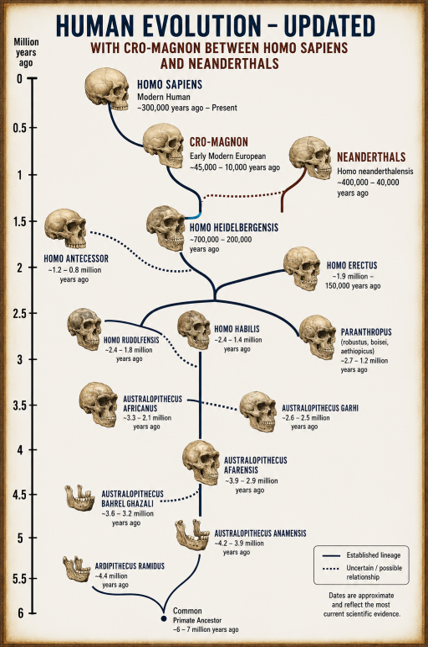
The Homo Lineage
The genus Homo represents a group of closely related human species that emerged during the Pleistocene and developed across Africa, Europe, and Asia. The classification of these species is based primarily on fossil evidence, including skeletal structure, cranial capacity, and, where available, genetic data. Over the past century, this evidence has been used to construct a broad framework describing the development and dispersal of early human populations.
One of the earliest widely recognised members of this genus is Homo erectus, which appears in the fossil record approximately 1.9 million years ago. This species is associated with a significant increase in brain size relative to earlier hominins and is generally considered the first to expand beyond Africa into Eurasia. Fossil remains attributed to Homo erectus have been identified across East Africa, the Middle East, and parts of Asia, including well-known sites such as Dmanisi in Georgia and Zhoukoudian in China.
Following Homo erectus, a number of later populations have been identified, often grouped under the designation Homo heidelbergensis. These populations are typically dated between approximately 700,000 and 300,000 years before present and are regarded by many researchers as a transitional form. Fossil evidence from this group displays further increases in cranial capacity and variation in skeletal structure.
Sites attributed to Homo heidelbergensis have been found in Europe, including Boxgrove in England, and in Africa, although classification remains debated due to overlapping characteristics with both earlier and later populations. (Dawn of the Lost Civilisation – The Ascent of Man)
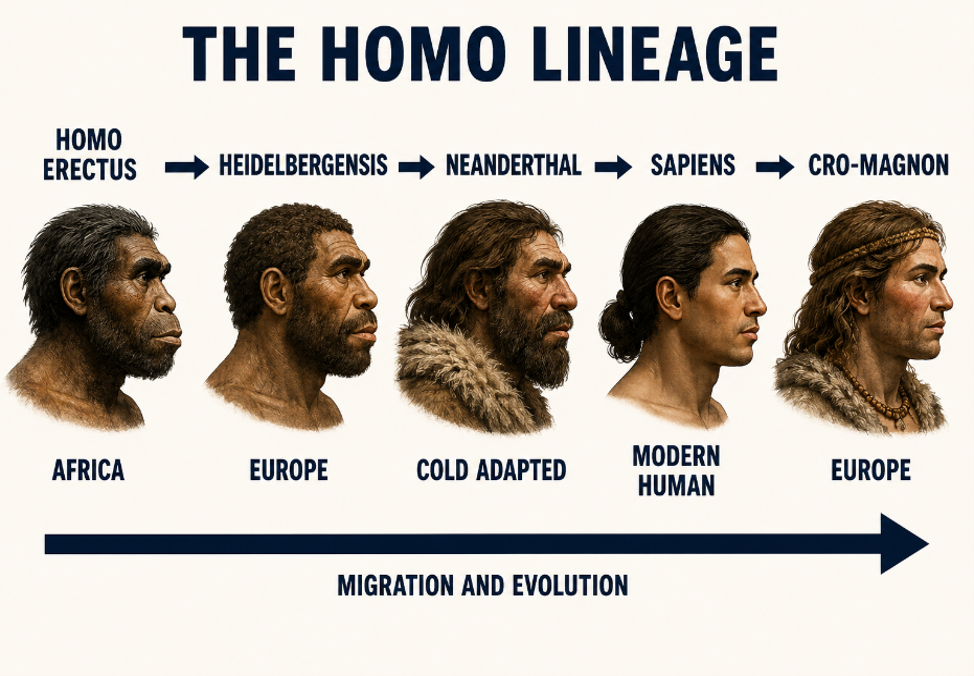
From these populations, two distinct evolutionary paths are generally identified. In Europe and western Asia, Homo heidelbergensis is thought to have given rise to Neanderthals (Homo neanderthalensis), while in Africa it is associated with the emergence of anatomically modern humans, Homo sapiens. Neanderthals appear in the fossil record from approximately 400,000 years ago and persist until around 40,000 years before present. They are characterised by a robust skeletal build, large cranial capacity often comparable to or exceeding that of modern humans, and physical adaptations suited to colder climates. Neanderthal remains are widely distributed across Europe and parts of western Asia, and are frequently associated with Middle Palaeolithic stone tool industries.
Anatomically modern humans, Homo sapiens, are generally dated to around 300,000 years ago, with early fossil evidence from sites such as Jebel Irhoud in Morocco and Omo Kibish in Ethiopia. These populations display a more gracile skeletal structure, reduced brow ridges, and a cranial form consistent with modern human morphology. From Africa, Homo sapiens expanded into Europe and Asia, with the earliest confirmed presence in Europe dating to approximately 45,000 years before present.
Within Europe, these early modern human populations are associated with Upper Palaeolithic cultures, characterised by a distinct set of material remains, including advanced stone tool industries, worked bone and antler, and art. Fossil remains from sites such as Cro-Magnon in France, Kostenki in Russia, and Paviland in Britain demonstrate the presence of these populations across a wide geographical range.
Despite this broad framework, the classification of the genus Homo is not fixed. Fossil evidence is incomplete, and the boundaries between species and subspecies are often defined by gradual variation rather than clear separation. As new discoveries are made, interpretations are revised, and previously distinct classifications are sometimes redefined or merged. The result is a system that provides a useful structure for organising evidence, but one that remains subject to change.
It is within this evolving framework that later European populations, commonly referred to as Cro-Magnon, are identified and interpreted.
Cro-Magnon Man
The term “Cro-Magnon” originates from the discovery of human skeletal remains in 1868 at the Cro-Magnon rock shelter in Les Eyzies, in the Dordogne region of south-west France. These remains were among the first identified as belonging to early modern humans in Europe and subsequently became the reference point for describing Upper Palaeolithic populations across the continent. Although the term has largely fallen out of formal scientific use, it remains widely recognised as a convenient label for early European Homo sapiens.
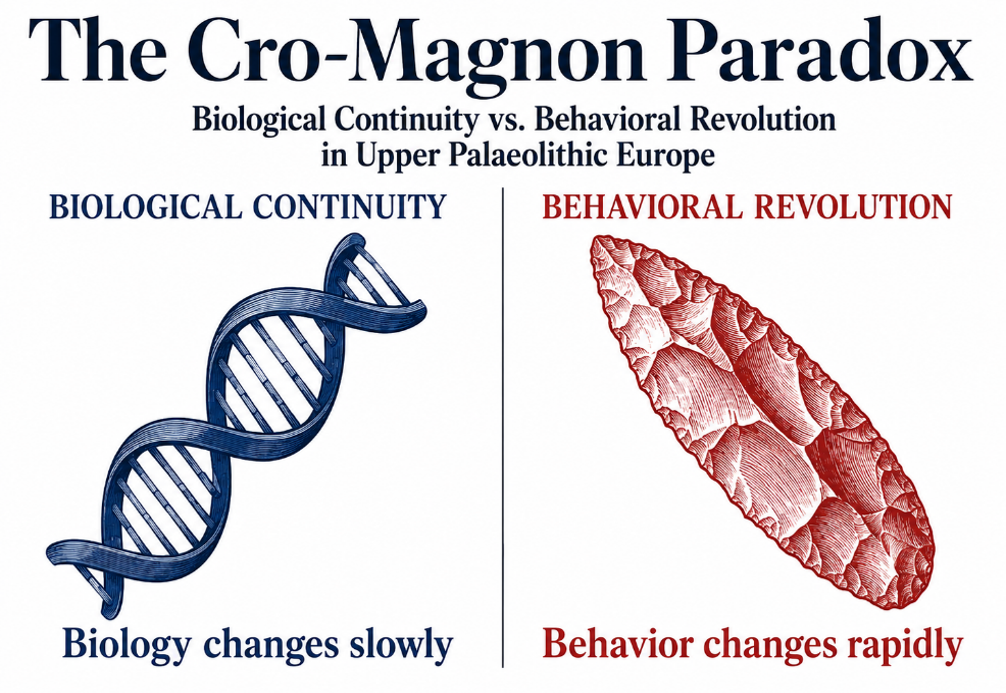
Cro-Magnon populations are generally dated to between approximately 45,000 and 10,000 years before present, corresponding to the Upper Palaeolithic period. This period marks a transition from the earlier Middle Palaeolithic, primarily associated with Neanderthal populations, to a phase in which the archaeological record displays a marked increase in consistency, structure, and geographic spread.
This transition is central.
For much of the preceding record, human activity is characterised by continuity and local variation. Tool forms persist over long periods, and production reflects individual execution rather than shared systems. In contrast, the Upper Palaeolithic record associated with Cro-Magnon populations displays a different pattern. Toolkits become standardised, methods are repeated across regions, and activity follows recognisable and consistent forms.
The population identified as Cro-Magnon is therefore not defined solely by skeletal remains, but by its association with this shift in the archaeological record.
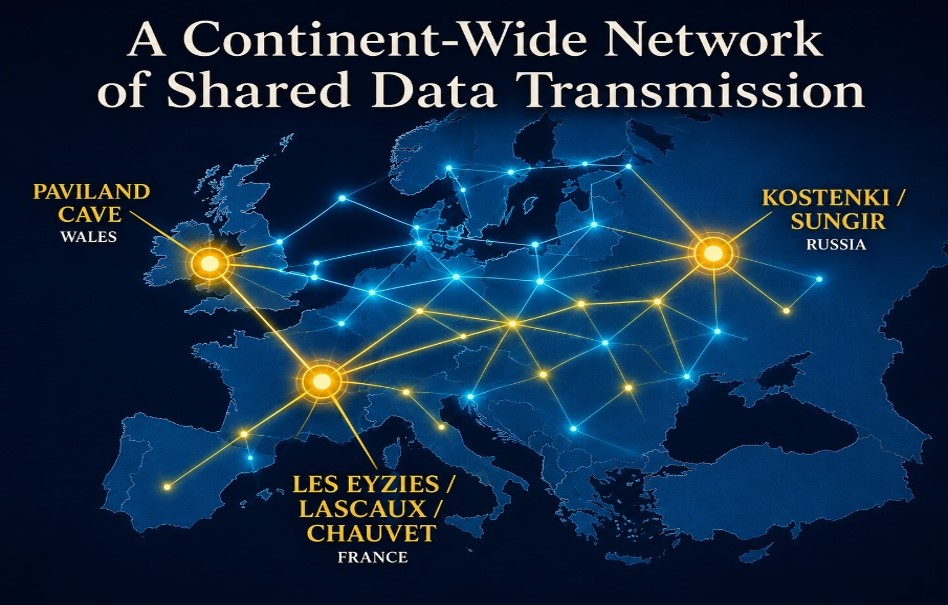
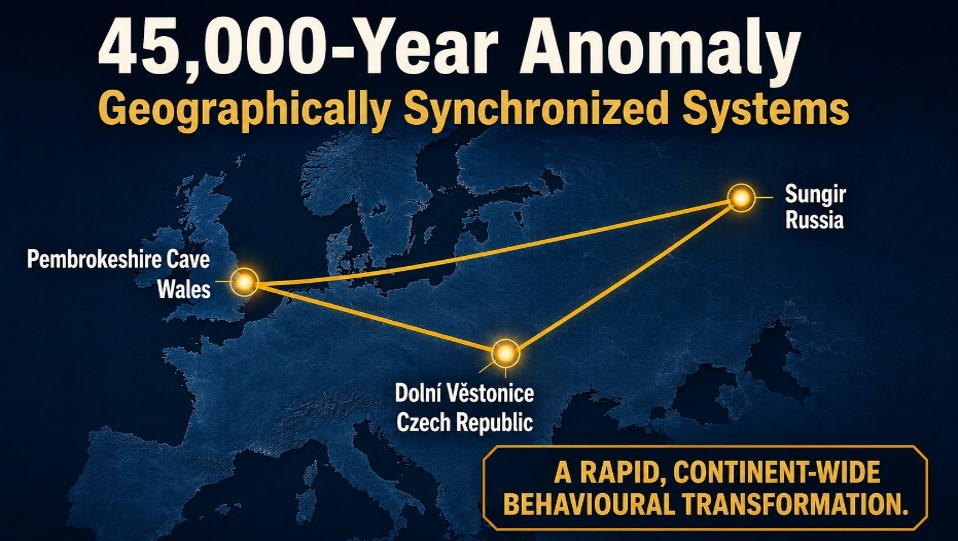
Fossil remains attributed to these populations have been identified across a wide range of European sites. In addition to the original Cro-Magnon shelter, important discoveries have been made at locations such as Kostenki on the Don River in Russia, Sungir near Vladimir, Dolní Věstonice in the Czech Republic, and Paviland Cave in Wales. The Paviland burial, discovered in 1823 and dated to approximately 33,000 years before present, represents one of the earliest confirmed occurrences of anatomically modern humans in Britain.

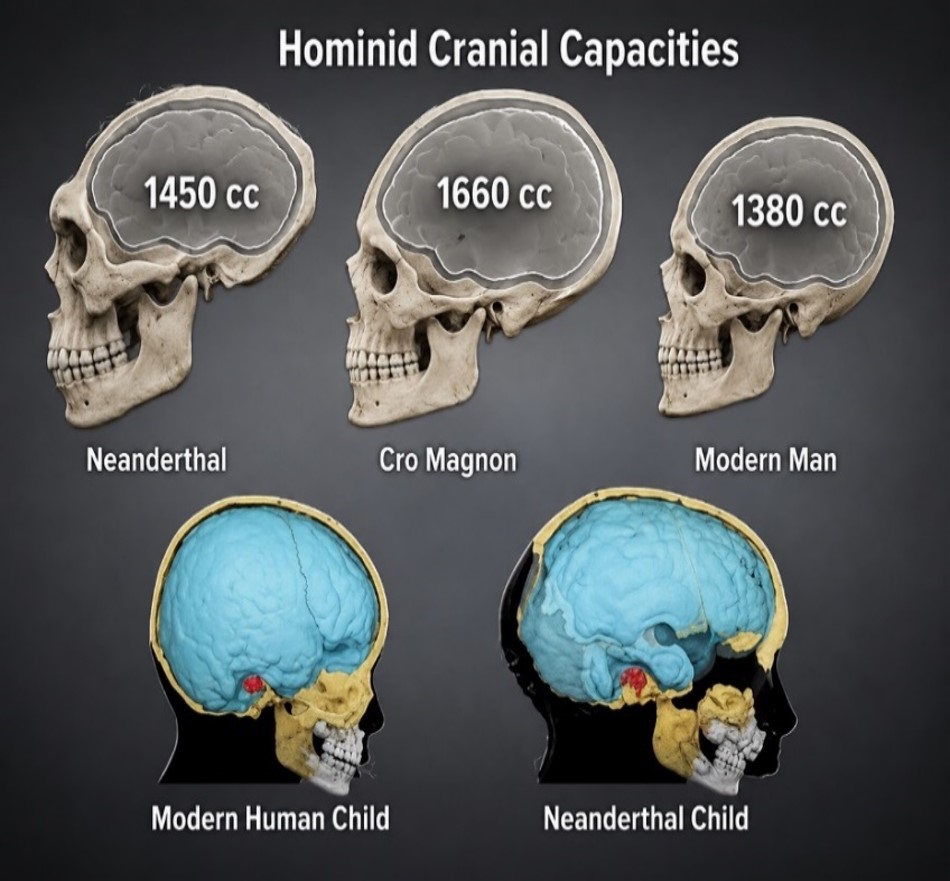
Skeletal evidence indicates that these individuals fall within the range of anatomically modern humans and display consistent physical characteristics across multiple sites. These include a relatively robust skeletal structure, well-defined muscle attachment sites, and cranial capacities at the upper end of known human variation. Detailed analysis of these features is addressed in the following sections.
The material culture associated with Cro-Magnon populations is equally significant. Upper Palaeolithic industries, including the Aurignacian, Gravettian, and Magdalenian, demonstrate the production of long, standardised blades, specialised tools, and the increasing use of materials such as bone, antler, and ivory. These industries are not isolated developments but are distributed across wide geographical areas, displaying consistent forms and methods of manufacture.
This consistency extends beyond tools. Evidence of symbolic activity, including cave art and portable objects, appears across multiple regions, often displaying recurring techniques and motifs. Burial practices also follow recognisable patterns, with repeated use of ochre and the placement of objects alongside the deceased at sites such as Sungir and Paviland.
Taken together, these features describe a population that is not only widespread but also operating in a manner that produces repeatable, structured outcomes across the landscape.
Geographically, Cro-Magnon populations are distributed across much of Europe, from the Iberian Peninsula to eastern Europe and into parts of western Asia. In Britain, although the archaeological record is more limited, sites such as Paviland, Kent’s Cavern, and Creswell Crags confirm their presence during the Upper Palaeolithic, forming part of the wider European pattern.
Dating of these remains and associated material is primarily achieved through radiocarbon analysis. As with all prehistoric evidence, the record is incomplete, and interpretation depends on the quality and context of the material available.
Despite these limitations, the combined evidence provides a consistent picture. Cro-Magnon populations are not simply early modern humans occupying Europe, but are associated with a distinct phase in the archaeological record in which human activity becomes increasingly standardised, repeatable, and structured.
It is this association that makes them central to the discussion that follows.
The Loss of the Cro-Magnon Classification
The term “Cro-Magnon” was widely used throughout the late nineteenth and much of the twentieth century to describe early modern human populations in Europe. Derived from the original discoveries at Les Eyzies in France, it provided a practical label for skeletal remains associated with Upper Palaeolithic material culture and distinguished these populations from both Neanderthals and later historic groups.
| Over time, however, its use has declined |
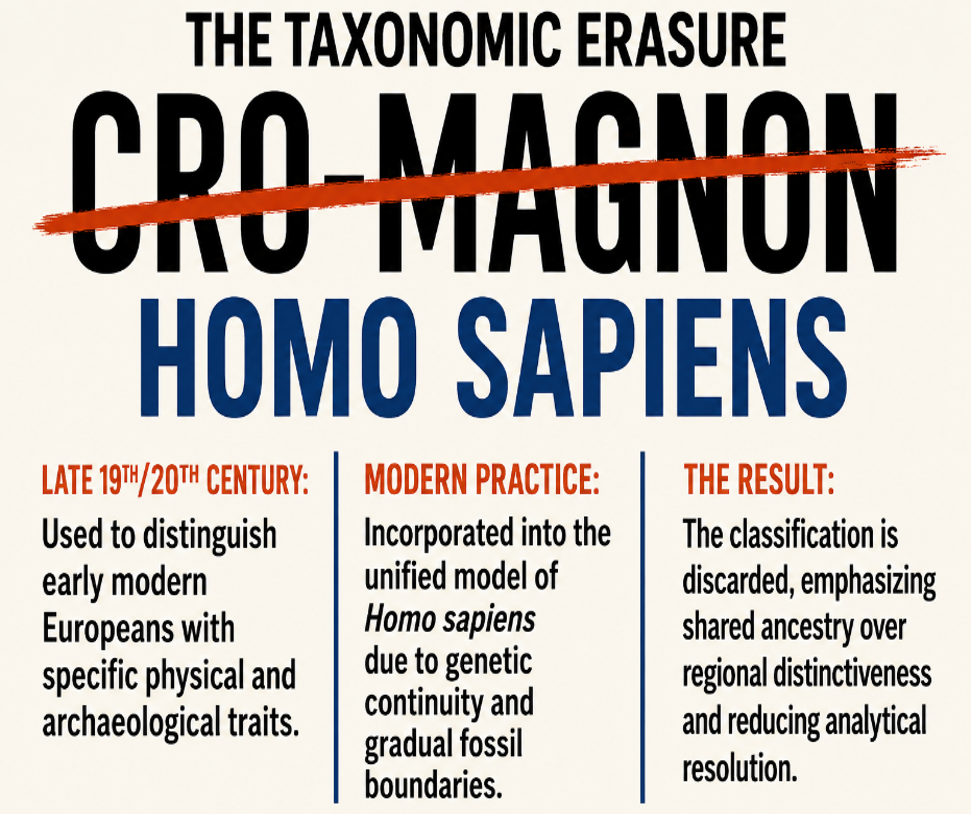
In modern anthropological practice, Cro-Magnon is no longer treated as a formal classification. Instead, the populations it refers to are incorporated into the broader category of Homo sapiens, reflecting a shift toward a unified model of human variation. This change has been driven in part by developments in genetic research, which emphasise shared ancestry and continuity across human populations, and in part by the limitations of the fossil record, where boundaries between groups are often gradual rather than clearly defined.
The result is a simplification of classification.
Where earlier frameworks used specific labels to describe regional populations associated with particular physical characteristics and archaeological contexts, modern approaches tend to consolidate these distinctions into a single species designation. In doing so, variation is retained within the data, but is no longer emphasised through formal categorisation.
This has implications for how the evidence is interpreted.
The populations historically described as Cro-Magnon remain present within the archaeological and fossil record. Their associated characteristics—physical traits, material culture, and patterns of activity—have not been removed. What has changed is the framework through which those characteristics are described. Instead of being identified as features of a specific population, they are now treated as part of a broader range of variation within Homo sapiens.
| This represents a reduction in resolution |
Where distinctions are not formally recognised, the analytical focus shifts away from identifying specific population-level patterns and toward describing general trends. While this approach provides consistency, it can also obscure the relationship between particular populations and the patterns associated with them.
In the context of the Upper Palaeolithic, this is significant.
As outlined in the previous section, this period is characterised by a shift toward standardised, repeatable, and structured forms of activity across wide geographical areas. The population historically associated with this transition has been absorbed into a broader classification, but the pattern itself remains visible within the archaeological record.
| The issue, therefore is not one of terminology |
Whether the label “Cro-Magnon” is retained or discarded does not alter the underlying data. However, removing the classification reduces the emphasis on the population associated with that data and, in doing so, weakens the connection between observed patterns and the groups through which they are expressed.
The question that follows is not whether Cro-Magnon represents a separate species, but whether the current model, by consolidating these populations into a single category, fully accounts for the variation and patterns still observable in the record.
Variation Within Homo sapiens
The classification of Homo sapiens as a single species reflects shared ancestry and genetic continuity across human populations. Within this classification, however, a wide range of physical variation is observed. Differences in stature, skeletal structure, cranial form, and physiological adaptation are well documented in both modern and prehistoric populations and are considered normal within a species distributed across diverse environments.
Variation in human stature provides a clear example. Modern populations display substantial differences in average height, influenced by both genetic and environmental factors. Adult male stature in contemporary groups ranges from averages below 1.6 metres in some regions to above 1.8 metres in others. These differences are not treated as indicators of separate species, but as expected outcomes of adaptation and population history.
Cranial capacity also varies within human populations. Modern global averages are typically estimated at approximately 1,300-1,400 cubic centimetres, but individual values extend beyond this range. Such variation is recognised within Homo sapiens and does not, in isolation, define separate classification.
Skeletal robustness represents another dimension of variation. Populations engaged in sustained physical activity often exhibit more pronounced muscle attachment sites and increased bone density. Comparisons between mobile hunter-gatherer groups and later agricultural populations demonstrate that lifestyle changes can produce measurable differences in skeletal structure within the same species.
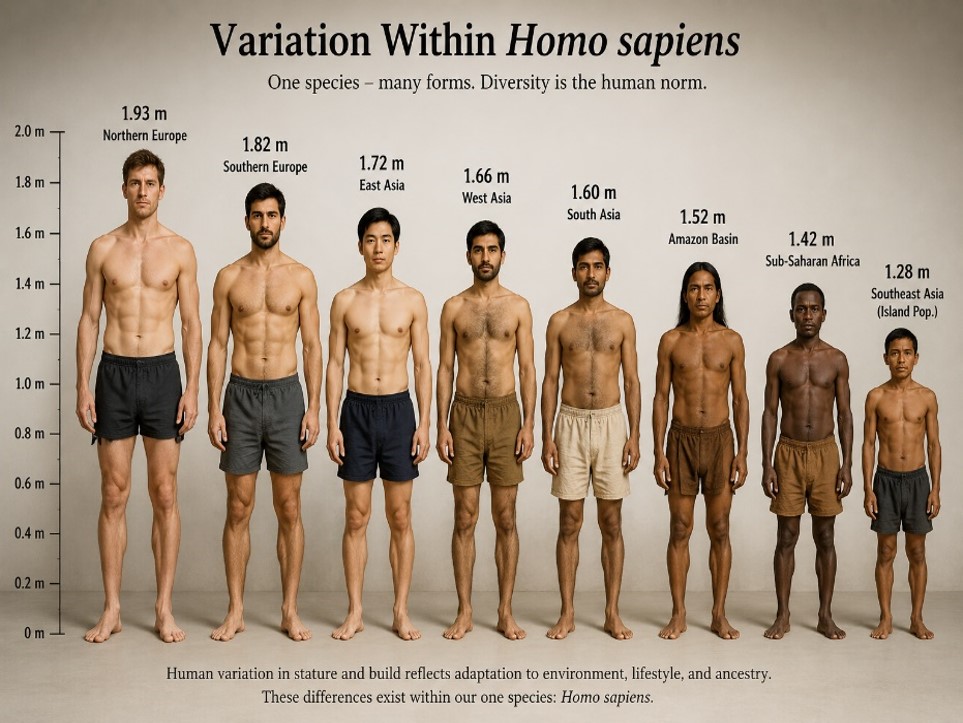
Environmental adaptation contributes further to variation. Populations living in colder climates often exhibit body proportions that reduce heat loss, including shorter distal limb segments and more compact forms, consistent with Bergmann’s and Allen’s rules. In contrast, populations in warmer climates tend to display longer limbs and more linear body proportions. These differences reflect adaptation to environmental conditions rather than divergence into separate species.
Taken together, these examples demonstrate that significant physical variation can exist within Homo sapiens without requiring additional classification. Differences in size, structure, and physiology are expected outcomes of population distribution across varied environments and conditions.
This has direct implications for the interpretation of prehistoric populations.
Where a set of physical characteristics appears repeatedly across multiple individuals and sites, those characteristics may be described either as part of normal variation or as features associated with a more specific population grouping. The underlying data remains the same; what differs is the level at which distinction is applied.
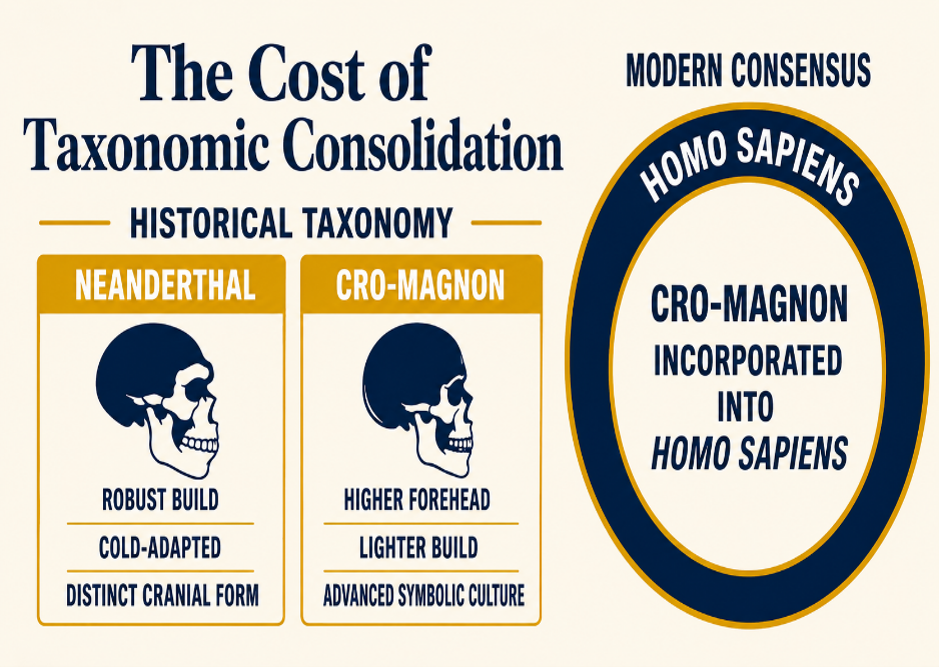
The consolidation of classifications, as outlined in the previous section, does not remove variation from the record. It alters how that variation is described. Where distinctions are not formally maintained, patterns that might otherwise be attributed to specific populations are instead absorbed into a broader spectrum.
The issue is therefore not whether variation exists within Homo sapiens, but how that variation is interpreted when it appears in consistent and repeated forms.
Origins and Genetic Evidence
The origins of Upper Palaeolithic European populations, commonly referred to as Cro-Magnon, are understood within the broader framework of modern human dispersal out of Africa. Current models, based on fossil evidence and genetic analysis, indicate that anatomically modern humans (Homo sapiens) emerged in Africa approximately 300,000 years ago and later expanded into other regions.
The movement of these populations into Europe is generally dated to around 45,000 years before present. This expansion is supported by both archaeological evidence and radiocarbon dating of early modern human remains found across the continent.
Sites such as Bacho Kiro in Bulgaria, Oase in Romania, and Kostenki in Russia provide early evidence of modern human presence in Europe during this period.
Genetic analysis has refined this model. Studies of ancient DNA demonstrate that modern non-African populations share a common ancestry derived from a relatively small group of humans who left Africa and dispersed across Eurasia. These populations form the basis of later human diversity.
One of the most consistent findings from ancient DNA research is the presence of Neanderthal admixture in modern human genomes. Non-African populations typically carry between approximately 1% and 4% Neanderthal DNA, indicating interbreeding between incoming Homo sapiens and resident Neanderthal groups.
This pattern is confirmed in both modern populations and early European remains.
Upper Palaeolithic individuals associated with Cro-Magnon populations display this same pattern of ancestry. Genetic evidence indicates that these populations were not isolated, but formed part of a wider network of interacting human groups across Eurasia. Regional variation is present, reflecting both local adaptation and population movement over time.
Ancient DNA from European Upper Palaeolithic sites also indicates continuity between early populations and later prehistoric groups. While population structure changes through time, including evidence of migration and replacement during periods such as the Last Glacial Maximum, genetic links can be traced across successive phases of occupation.
The genetic record therefore reflects a pattern of continuity combined with episodes of change. Early European populations contribute to later groups through processes of mixture and adaptation, rather than disappearing from the record.
Genetic classification operates at a different level from morphological or archaeological description. Populations that are genetically continuous may still display variation in physical form and material culture.
As a result, genetic continuity does not in itself resolve how such variation should be interpreted within the archaeological record.
Ancient DNA studies have also provided evidence of continuity between some Upper Palaeolithic European populations and later European populations. Caramelli et al. (2008), analysing mitochondrial DNA from the 28,000-year-old Paglicci 23 specimen from southern Italy, identified a sequence identical to the Cambridge Reference Sequence, which is still present in modern European populations today. The study therefore supports the survival of at least some maternal lineages from Upper Palaeolithic Europeans into later populations, indicating partial genetic continuity rather than complete population replacement.
At the same time, interpretation of Eurasian genetic ancestry remains an active area of debate. Klyosov and Rozhanski (2012), using a methodology they termed “DNA genealogy”, argued that certain Y-chromosome haplogroups reflected a more complex Eurasian population history than conventional models propose.
These interpretations remain controversial and have not been widely accepted within mainstream population genetics, which continues to support an African origin for anatomically modern humans combined with later admixture with regional populations such as Neanderthals.
Nevertheless, both genetic continuity and regional admixture are now well established within the ancient DNA record. The evidence increasingly suggests that Upper Palaeolithic populations were not isolated or abruptly replaced, but rather formed part of a long, interconnected process of migration, interaction, adaptation, and continuity extending across Eurasia.
Climate Fluctuation, Migration, and Human Expansion
While the melting of the northern ice sheets transformed the hydrology of Europe and Britain, equally profound environmental changes were occurring further south across North Africa and the Near East. These climatic oscillations played a decisive role in shaping the movement and dispersal of early human populations during the Late Pleistocene and early Holocene.
Unlike northern Europe, where the Ice Age was characterised primarily by cold conditions and glaciation, much of North Africa experienced increasing aridity during major glacial phases. The expansion and contraction of the Sahara Desert created cycles of environmental isolation followed by sudden periods of opportunity and migration. During wetter intervals, vast regions of the Sahara transformed from hyper-arid desert into grasslands, lakes, marshes, and savannah systems capable of supporting both animals and substantial human populations.
Palaeoclimate evidence demonstrates that these transitions could occur rapidly. Research undertaken across the Sahara by the University of Cologne, using more than five hundred radiocarbon dates from over 150 archaeological sites, showed that the transformation of the Sahara into a savannah environment around 8500 BCE occurred within only a few centuries. Stefan Kröpelin described this environmental shift as occurring “certainly within less than 500 years.”
This rapid climatic change opened enormous new territories for human settlement and movement across regions that had previously been inhospitable desert.
The last major humid phase of the Sahara occurred approximately 12,000 years ago, when monsoon systems intensified, and rainfall expanded northwards across Africa. Before this transformation, habitable regions within eastern North Africa had been concentrated largely along the Nile Valley. Such environmental restrictions would naturally have led to increasing population density and competition for resources within these confined corridors.
Archaeological evidence from Jebel Sahaba (Cemetery 117) in the Upper Nile region provides insight into the social pressures that may have emerged within these overcrowded environments. Numerous individuals within the cemetery display evidence of violent trauma, suggesting repeated interpersonal conflict during a period of environmental and territorial stress.
While the precise causes remain debated, the site illustrates the instability that can develop when human populations become concentrated into limited habitable zones during climatic deterioration.
As climatic conditions improved, populations expanded outward from these constrained refugia into newly habitable landscapes.
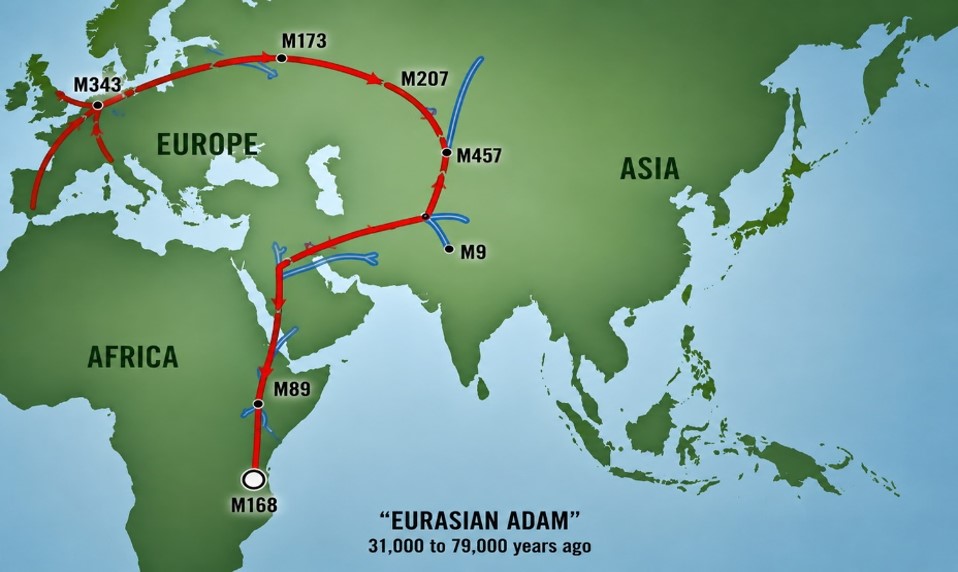
Genetic lineage studies suggest that one of the major dispersals from this broader region occurred approximately 45,000 years ago, associated with haplogroup M89. Descendants of this lineage would ultimately contribute ancestry to a substantial proportion of later Eurasian populations. Some groups moved eastward along the southern coastal routes toward South Asia and Australia, while others travelled north through the Levant and into Central Asia, following expanding ecological corridors and migrating game populations.
Subsequent genetic diversification occurred as populations spread across increasingly varied environments. Around 40,000 BCE, haplogroup M9 emerged across a wide Eurasian zone stretching from the Near East toward Central and South Asia.
By approximately 30,000 years ago, further population expansions carried groups westward into Europe and southward into the Indian subcontinent. These migrations brought Homo sapiens into direct contact with established Neanderthal populations already occupying much of Europe and western Asia. Genetic evidence now confirms that interbreeding occurred between these populations, with Neanderthal ancestry still detectable in many modern Eurasian populations.
The disappearance of the Neanderthals remains one of prehistory’s unresolved questions. Climate instability, ecological competition, demographic absorption, disease, or conflict may all have contributed to their decline.
What is clear, however, is that the Late Pleistocene world was one of repeated environmental upheaval, migration, adaptation, and interaction between human populations. These same climatic forces that reshaped rivers, coastlines, and floodplains also shaped the movement and development of humanity itself.
Within the context of the Post-Glacial Flooding Hypothesis, these migrations are not isolated historical events but part of a broader global environmental transformation occurring as the Earth emerged from the last Ice Age.
Maritime Adaptation and the Rise of Mobility
As human populations expanded across Eurasia during the Upper Palaeolithic, movement became increasingly linked to rivers, coastlines, estuaries, and inland seas. In a world still heavily influenced by post-glacial flooding and fluctuating water levels, water was not simply an obstacle to movement — it was often the most efficient route available.
This relationship between people and water represents an important stage in human development.
Archaeological evidence from regions surrounding the Caspian Sea indicates that Upper Palaeolithic populations had already begun exploiting waterways with simple watercraft.
One of the most significant sites associated with this development is Gobustan, located in present-day Azerbaijan along the western shores of the Caspian Sea.
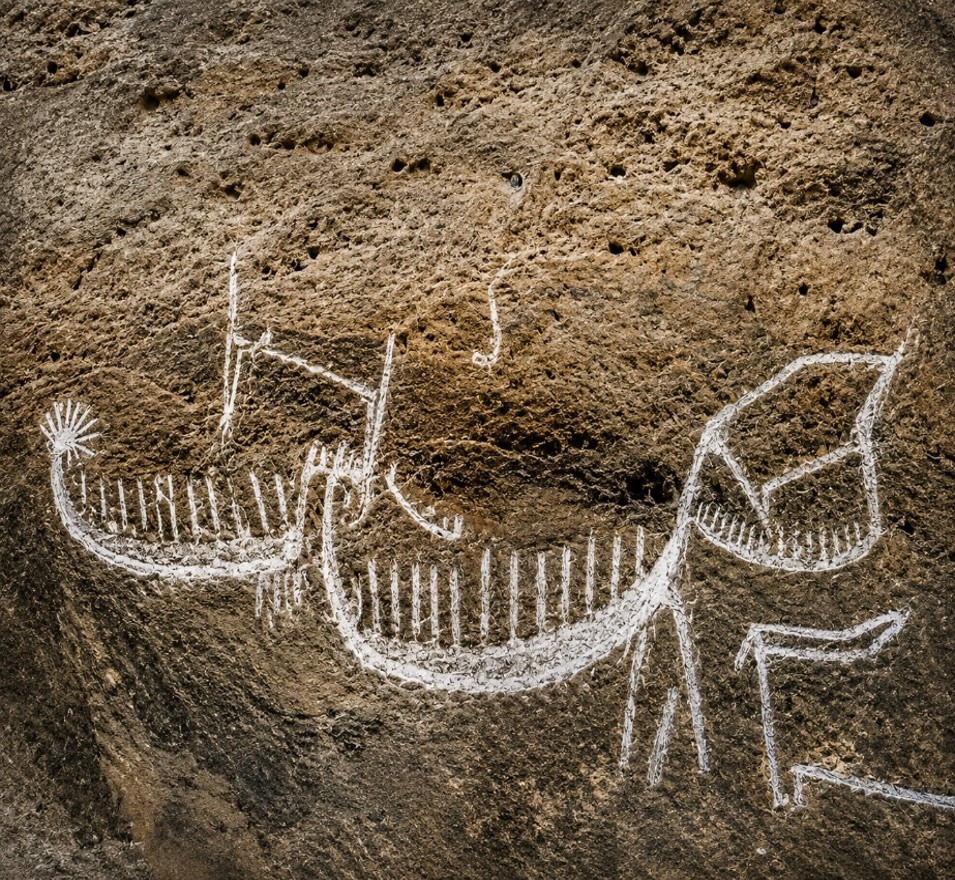
| These boat engravings are particularly important |
Gobustan contains one of the largest collections of prehistoric rock art in Eurasia.
The reserve includes more than six thousand rock engravings spanning a long chronological sequence, with estimates ranging from approximately 40,000 years ago through to the historic period. The site contains depictions of hunting scenes, ritual activity, animals, warfare, astronomical symbols, and most significantly, boats containing groups of human figures.
Many depict long narrow vessels carrying multiple individuals arranged in sequence, often interpreted as organised rowing crews or hunting parties. Although the precise construction methods of these boats remain unknown, the images strongly suggest that these populations possessed an understanding of coordinated water transport and organised maritime activity.
The environmental context of Gobustan is equally significant.
During wetter climatic phases following the last Ice Age, the Caspian region supported a substantially richer environment than it does today, with extensive wetlands, grasslands, river systems, and productive coastal zones. The rock art itself reflects this landscape, portraying fishing, hunting, and repeated interaction with water-based environments.
| This development carried major implications for human mobility |
Watercraft dramatically increase the range and efficiency of movement. Rivers become transport corridors rather than barriers. Coastlines become navigable routes linking distant populations. Trade, communication, migration, and resource exchange can occur across far greater distances than would be possible through overland travel alone.
In practical terms, maritime adaptation alters the scale at which human societies can operate.
The environmental conditions of the late Ice Age and early Holocene would likely have reinforced this process. Large areas of Eurasia were dominated by wetlands, estuaries, flooded valleys, and expanding coastlines. Within such landscapes, populations capable of navigating water systems possessed a substantial advantage in mobility, trade, and survival.
Similar boat imagery appears elsewhere across Eurasia, including later Scandinavian rock art traditions. These recurring maritime motifs suggest that the use of watercraft formed part of a broader behavioural adaptation associated with increasingly mobile Upper Palaeolithic and Mesolithic populations.
| The significance of this transition extends beyond transport alone for human mobility |
Movement across water encourages contact between groups, and contact accelerates the spread of tools, techniques, ideas, and genetic exchange. Technologies no longer remain isolated within local populations but begin to diffuse across interconnected networks. In this context, waterways become conduits not only for movement, but for cultural and technological transmission.
This represents a major behavioural shift within human history.
For much of the earlier Palaeolithic record, populations appear comparatively localised, with technological change occurring gradually over immense timescales. During the Upper Palaeolithic, however, innovation becomes increasingly rapid and geographically widespread. Standardised tool industries, symbolic behaviour, long-distance material transport, and maritime adaptation all emerge within this broader pattern of expanding connectivity.
The development of water transport was therefore more than a technical improvement. It changed how human populations interacted with both landscape and each other.
Within the framework of the Post-Glacial Flooding Hypothesis, this adaptation becomes particularly important. If early Holocene landscapes were dominated by elevated rivers, wetlands, estuaries, and partially flooded lowlands, then populations able to exploit water routes would possess clear advantages over purely land-based groups.
The emergence of maritime mobility may therefore represent one of the key thresholds separating earlier hunter-gatherer populations from the increasingly interconnected societies that later shaped the Atlantic world.
Physical Characteristics and Stature
The physical characteristics of Upper Palaeolithic European populations are known primarily from skeletal remains recovered at archaeological sites across Europe. These remains provide measurable evidence relating to stature, skeletal robustness, body proportions, and cranial morphology, allowing direct comparison with both earlier human populations and later prehistoric societies.
For more than a century, anthropologists have attempted to reconstruct the stature of these populations from surviving skeletal material. The resulting estimates have formed the basis of almost every discussion concerning the physical capabilities of Cro-Magnon populations and, by extension, their ability to undertake the increasingly sophisticated engineering and organisational tasks that appear throughout the archaeological record.
However, these published estimates deserve careful re-examination.
Most Upper Palaeolithic skeletons are incomplete. Complete skeletons are comparatively rare, while isolated or fragmentary long bones are common. Traditional reconstructions therefore rely upon regression equations developed from modern populations, often using a single surviving bone such as the femur or tibia. Formulae including those developed by Trotter and Gleser have become widely used throughout physical anthropology, despite being calibrated using twentieth-century populations whose body proportions may differ significantly from those of Upper Palaeolithic Europeans.
Additional uncertainty arises from the composition of published samples. Many datasets combine males and females, include juvenile remains, or conservatively estimate missing skeletal dimensions. While entirely appropriate for broad population studies, these approaches inevitably reduce calculated averages and tend to compress the upper end of the height distribution.
The consequence is that the published literature almost certainly underestimates the true physical stature of many Upper Palaeolithic Europeans.
Reconstructing Upper Palaeolithic Stature
To examine this problem, a new anthropometric database has been assembled from published European skeletal measurements spanning the Upper Palaeolithic through to the Neolithic. Rather than relying upon previously published stature estimates, every available long bone was independently re-evaluated.
Where multiple long bones survive for the same individual, each bone was reconstructed separately before calculating a combined average stature. This approach reduces the influence of anomalies within any single bone and produces a more stable estimate than traditional single-bone reconstruction.
| The results reveal a consistent pattern |
The revised database includes individuals from across Europe and incorporates measurements from numerous well-known archaeological sites, allowing direct comparison between published anthropological estimates and revised reconstructions derived from the original skeletal measurements.
In many individuals, reconstructed stature exceeds the values published within the original anthropological literature. The differences are often modest, but in some cases exceed several centimetres. Importantly, these revisions are not isolated examples. They occur repeatedly throughout the database.
This suggests that much of the traditional literature has systematically underestimated the stature of Upper Palaeolithic Europeans, not because the skeletal evidence is incorrect, but because the methods used to reconstruct incomplete skeletons tend to produce conservative estimates.
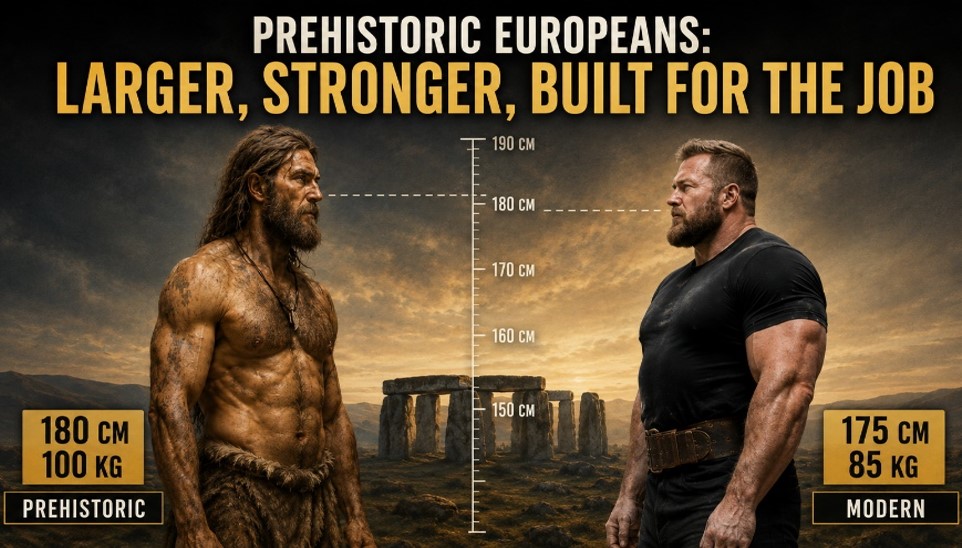
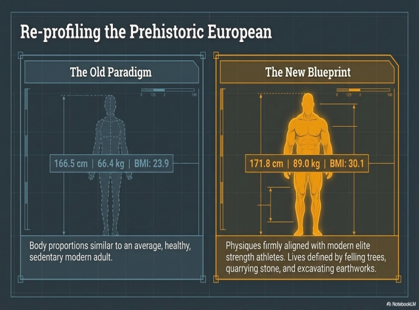
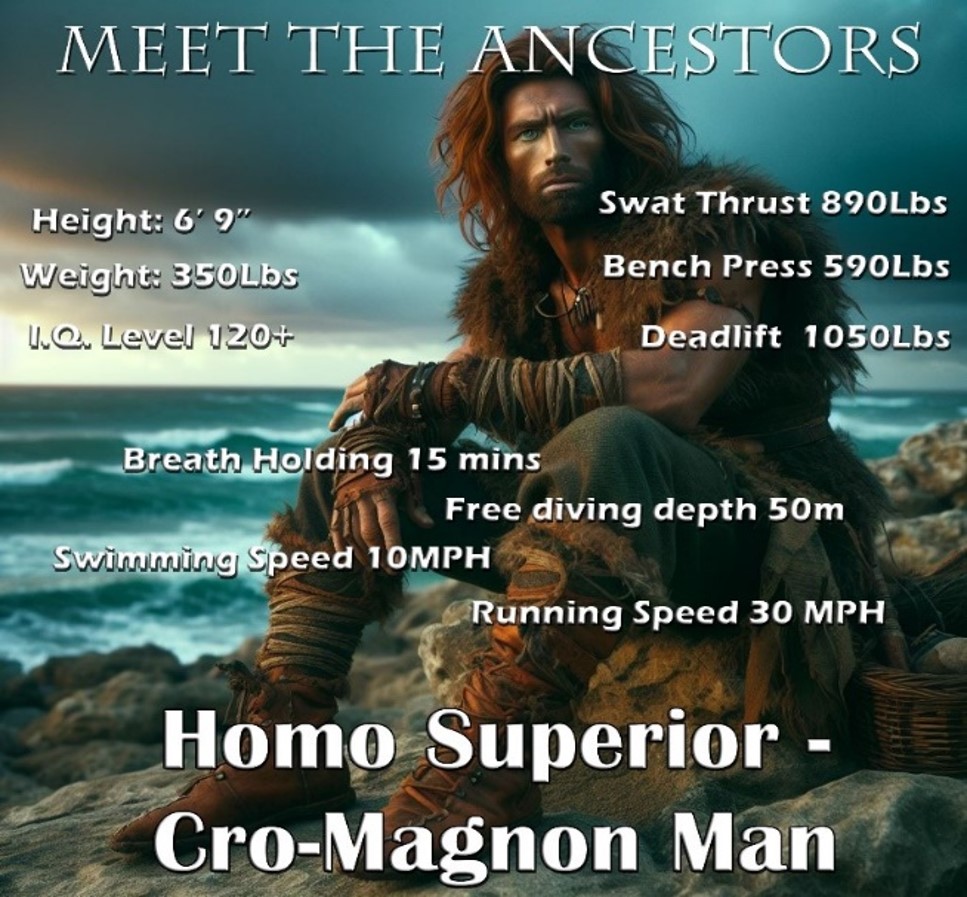
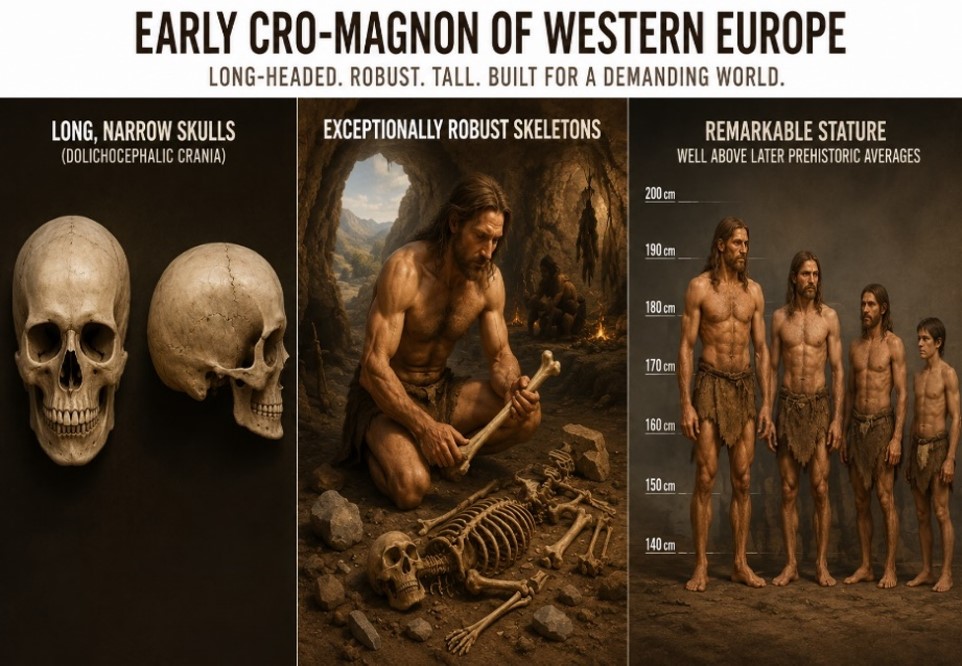
The revised database also allows body mass to be reconsidered. Using reconstructed stature together with skeletal robustness, Upper Palaeolithic males emerge as substantially larger individuals than are generally portrayed in the archaeological literature. Rather than resembling the average modern European male, many fall within the physical range occupied today by elite manual workers, heavyweight athletes, and strength competitors.
Perhaps the most striking result concerns the upper end of the population.
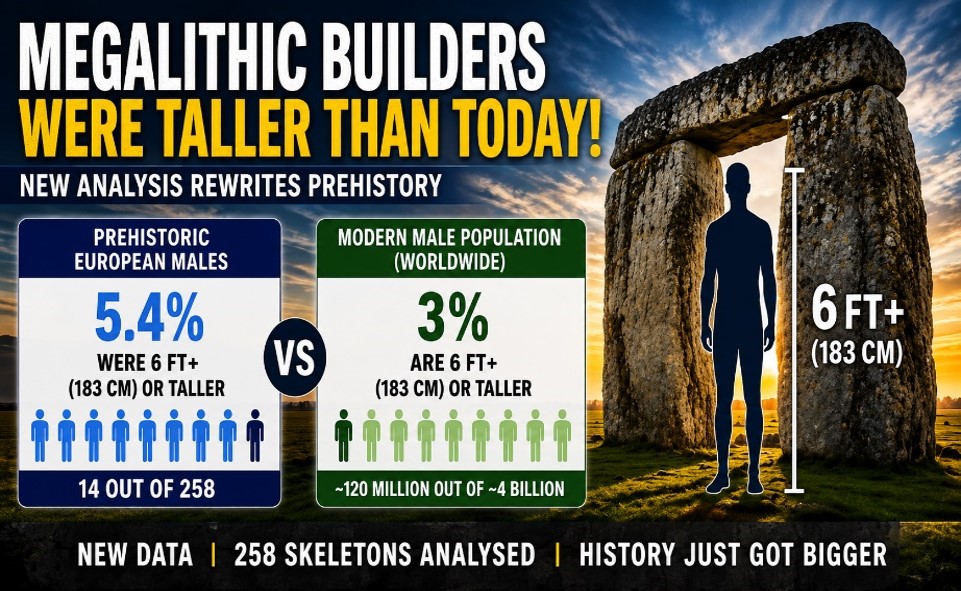
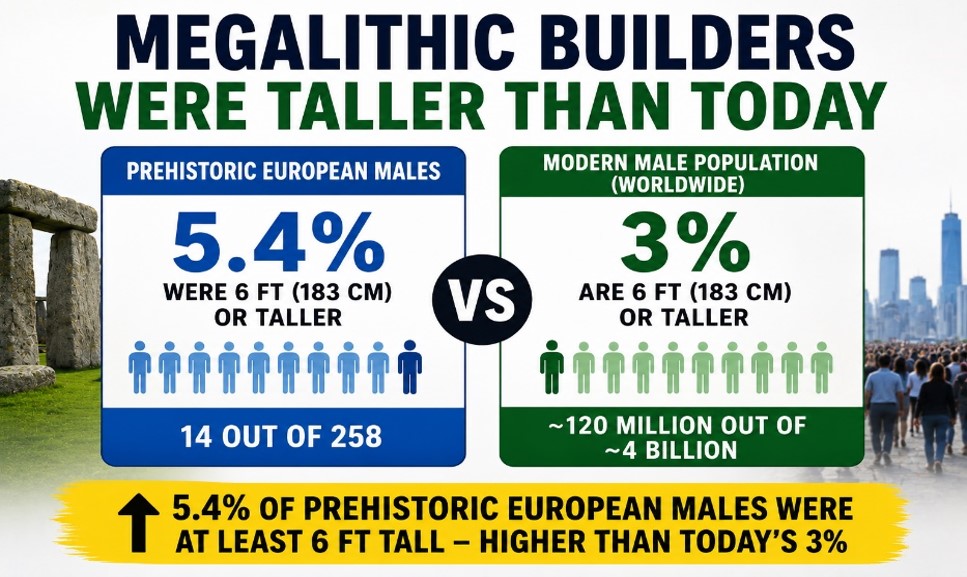
Within the revised database, 14 of the 258 reconstructed males exceed 183 centimetres (6 feet) in height, representing approximately 5.4% of the sample. By comparison, only around 3% of the modern global male population reaches the same height.
Independent Evidence for Exceptional Robusticity
Interestingly, the conclusion that Europe’s earliest hunter-gatherers possessed exceptionally robust physiques is not unique to this study. Christopher Ruff and colleagues have themselves shown that the adoption of agriculture was accompanied by a long-term decline in skeletal strength and mobility across Europe.
Their research concluded that pre-agricultural Europeans possessed substantially stronger limb bones than later farming populations, reflecting a physically demanding lifestyle involving greater mobility and repeated mechanical loading.
This independent evidence is important because it supports one of the central observations presented throughout this book. The disagreement is not over whether Europe’s earliest populations were unusually robust—the skeletal evidence clearly indicates that they were. Rather, it concerns how their living height and body mass should be reconstructed from those skeletons.
If prehistoric Europeans possessed stronger bones than later populations, routinely undertook heavy physical labour and constructed some of the largest prehistoric monuments ever built, then it is entirely reasonable to ask whether regression equations derived from modern reference populations still provide the most appropriate estimates of their living stature and body mass.
In other words, the skeletal evidence already tells us these people were physically exceptional. The remaining question is whether the mathematical models currently used to reconstruct them fully reflect that exceptional biology, or whether they have systematically normalised it through comparison with modern populations.
This indicates that exceptionally tall men were almost twice as common within these prehistoric European populations as they are within the modern world population.
The significance of this observation extends beyond simple height.
Height is strongly correlated with skeletal dimensions, muscle attachment areas, leverage, and ultimately the capacity to generate force.
When combined with the pronounced skeletal robustness already recognised in Upper Palaeolithic remains, the revised reconstructions suggest a population capable of sustained physical work on a scale that has frequently been underestimated.
It does, however, suggest that many engineering problems traditionally regarded as extraordinary—including the movement of heavy timbers, quarrying large stone blocks, transporting megaliths, and constructing extensive earthworks—should be reconsidered using a population whose physical characteristics differ measurably from those of modern Europeans.
See https://prehistoric-britain.co.uk/underestimating-the-physical-size-of-prehistoric-europeans for the complete original and our new analysis datasets.
Physical Characteristics
| This does not imply superhuman ability. |
The revised stature data are fully consistent with the broader anatomical evidence preserved in the skeletons themselves.
Upper Palaeolithic long bones frequently display pronounced muscle attachment sites, indicating powerful and regularly used musculature. Cortical bone thickness and overall skeletal robustness demonstrate repeated mechanical loading throughout life, reflecting sustained physical activity rather than occasional exertion.
Cranial morphology reinforces this picture. Upper Palaeolithic European skulls typically display high cranial vaults, reduced brow ridges, pronounced chins, and cranial capacities commonly ranging from 1,500 to 1,650 cubic centimetres, with some individuals exceeding 1,700 cc.
While cranial capacity alone cannot be used as a measure of intelligence, it remains an important anatomical characteristic for comparative analysis.
Taken together, the revised anthropometric database and the anatomical evidence describe a population that was not only behaviourally innovative but also physically exceptional. Upper Palaeolithic Europeans appear to have combined above-average stature, substantial skeletal robustness, considerable body mass, and the capacity for sustained physical labour.
These characteristics provide a far more realistic biological framework within which the technological and organisational achievements of later chapters can be understood.
A Population Built for Performance
Prehistoric Europeans were nearly twice as likely to exceed six feet in height as men living across the world today. This observation carries important implications.
Human stature is determined by both genetics and environment. While genetic potential establishes an upper limit, the ability to realise that potential depends heavily upon childhood nutrition, disease burden, workload and overall health during growth.
A population containing a significantly greater proportion of exceptionally tall individuals therefore suggests that many people were consistently reaching, or approaching, their biological growth potential.
Rather than representing an impoverished or nutritionally stressed population, the skeletal evidence is more consistent with communities enjoying abundant resources, sustained physical activity and generally favourable developmental conditions.
This conclusion sits comfortably alongside the archaeological evidence. Upper Palaeolithic Europeans occupied environments rich in large game, fish and wild resources before the nutritional decline that accompanied the widespread adoption of agriculture. Later prehistoric farming populations are well known to display reductions in average stature, a trend widely attributed to changes in diet, disease and living conditions.
Consequently, the revised anthropometric database suggests that Upper Palaeolithic Europeans may represent one of the physically most successful human populations known from the archaeological record.
If a population contains a larger upper tail than previously recognised, then exceptionally tall individuals become statistically more probable.
While the present database does not demonstrate the existence of the legendary giants described in historical sources, it does suggest that anthropologists may have underestimated the frequency of unusually tall individuals in prehistoric Europe.
Consequently, historical reports of exceptionally tall individuals should be assessed against revised anthropometric expectations rather than dismissed solely for exceeding modern averages.
“How Many Giants Walked Across Prehistoric Europe?”
Table 2.1. Estimated Frequency of Exceptionally Tall Individuals in Prehistoric Europe
Illustrative population model based on a European population of approximately 500,000 people. Modern height frequencies are derived from measured NHANES anthropometric data and scaled using the reconstructed prehistoric database, which indicates that males exceeding 6 feet in height were approximately 1.8 times as common as in the modern population.
| Height Threshold | Est. Number of Individuals |
| Over 6’0″ (183 cm) | 27,000 |
| Over 6’6″ (198 cm) | 135–270 |
| Over 6’9″ (206 cm) | 4–14 |
| Over 7’0″ (213 cm) | 0–2 |
Implications
The revised anthropometric database indicates that prehistoric European males were almost twice as likely to exceed six feet in height as men in modern populations. When this proportional increase is applied to an illustrative Mesolithic or Neolithic European population of approximately 500,000 individuals, the consequences become striking.
Rather than a handful of unusually tall individuals, Europe may have contained around 27,000 people taller than six feet, with perhaps 135 to 270 individuals exceeding 6 feet 6 inches. Men standing 6 feet 9 inches or taller would still have been genuinely exceptional but would nevertheless have existed within the wider population. Individuals reaching 7 feet would have remained extraordinarily rare, perhaps represented by only one or two people across the continent at any given time.
This model does not suggest that prehistoric Europe was inhabited by large numbers of mythical giants. Instead, it demonstrates that the upper end of the height distribution was substantially greater than previously recognised. Such a population would have contained significantly more exceptionally tall, heavily built and physically powerful individuals than are generally assumed within traditional archaeological reconstructions.
The implications extend beyond simple stature. Height is closely associated with body mass, muscle cross-sectional area, leverage and absolute strength.
A population producing almost twice as many exceptionally tall individuals is also likely to have possessed a correspondingly greater proportion of people capable of undertaking the physically demanding engineering, quarrying, timber construction and megalithic transport that characterise later prehistoric Europe.
Note: These figures are presented as an illustrative demographic model. They are derived by applying the proportional increase in tall stature observed within the reconstructed prehistoric database (5.4% of males exceeding 6 feet) to measured modern anthropometric frequencies. They are intended to demonstrate the likely scale of the prehistoric population’s upper-height distribution rather than to represent direct archaeological counts.
Strength, Tools, and Physical Capability
The revised anthropometric database presented in this chapter demonstrates that Upper Palaeolithic and early Neolithic Europeans were not only taller than traditionally reconstructed but also substantially more robust. Height alone, however, does not explain engineering capability. The tools these people used provide an equally important line of evidence.
One of the finest surviving examples is the complete Langdale axe recovered from Ehenside Tarn, one of the very few Neolithic axes to survive with both its original stone head and wooden haft preserved.
Unlike a modern steel felling axe, the Neolithic power axe was designed around an entirely different set of mechanical principles.
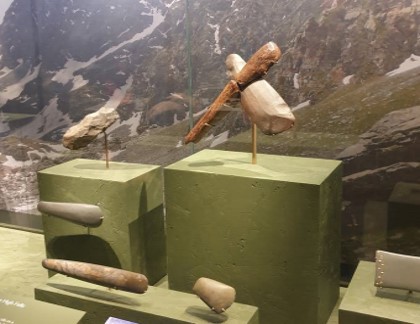
| This altered the mechanics of every swing |
The head was manufactured from exceptionally tough greenstone rather than forged steel. Because stone is less dense than steel, a considerably larger head was required to achieve equivalent striking energy. The haft itself was formed from fresh hardwood rather than kiln-dried timber, increasing the overall weight of the tool still further. The result was a substantially heavier implement with its centre of gravity positioned closer to the user’s hands than is typical of a modern axe.
Modern axes are designed to maximise efficiency. Their relatively light handles and concentrated steel heads reduce rotational inertia, minimise wrist fatigue and allow rapid repeated strikes over prolonged periods.
The Neolithic axe achieved exactly the opposite.
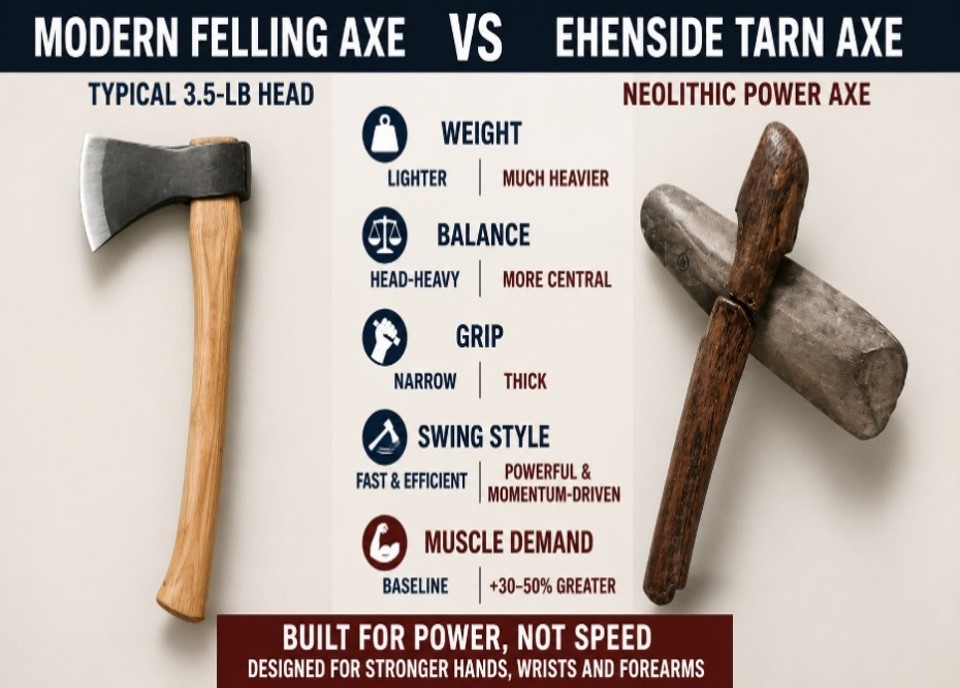
Its greater overall mass increased the rotational forces acting through the wrist, forearm and shoulder while the thicker haft required considerably greater grip strength. Rather than behaving like a lightweight forestry tool, the complete assembly functioned mechanically much more like a short-handled sledgehammer.
Comparative Mechanical Characteristics
| Characteristic | Modern Axe | Neolithic Power Axe |
| Head material | Forged steel | Langdale greenstone |
| Handle | Kiln-dried ash or hickory | Fresh hardwood |
| Overall balance | Head-weighted | More centrally balanced |
| Grip diameter | Narrow | Thick |
| Swing characteristics | Fast and efficient | Powerful and momentum-driven |
| Wrist loading | Moderate | Significantly greater |
| Forearm strength required | Baseline | Approximately 30–50% greater |
Biomechanically, this distinction is important.
Experimental engineering suggests that controlling a complete Neolithic power axe requires approximately 30–50% greater wrist and forearm strength than swinging a modern 3½-pound forestry axe with equivalent control.
This difference is produced not by the stone head alone but by the combined effects of increased tool mass, greater rotational inertia and a substantially thicker grip.
These characteristics closely match the anatomical evidence described earlier in this chapter. Upper Palaeolithic and early Neolithic skeletons display enlarged muscle attachment sites throughout the forearm, shoulder and upper arm, together with unusually robust wrists and hands. The revised anthropometric database further indicates that exceptionally tall and heavily built individuals occurred almost twice as frequently as in comparable modern populations.
The tools and the skeletons therefore tell the same story.
Rather than designing lightweight implements suited to relatively small agricultural populations, prehistoric Europeans produced heavy-duty tools optimised for repeated high-force work.
| This observation has important implications for later chapters |
Such implements would have been entirely appropriate for felling large timber, splitting trunks, constructing massive wooden frameworks, excavating waterlogged sediments and shaping the enormous quantities of timber required for prehistoric engineering projects.
Much archaeological reconstruction has focused upon antler picks as the primary excavation tool for monuments such as Avebury and Stonehenge. Antlers undoubtedly had specialised uses, but they represent only part of the prehistoric toolkit. Heavy stone axes, wooden spades, wedges, levers and water-assisted excavation techniques together provide a far more efficient engineering system than has traditionally been recognised.
Once the physical characteristics of both the workforce and their tools are reconsidered together, the scale of prehistoric construction begins to appear considerably less mysterious.
The Atlatl
The physical capabilities of Upper Palaeolithic European populations can be examined not only through skeletal remains, but through the tools and artefacts associated with them. These provide indirect but consistent evidence of the strength, dexterity, and endurance required for their production and use.
Upper Palaeolithic tool industries are characterised by a shift toward blade-based technologies, most notably within the Aurignacian, Gravettian, and Magdalenian traditions.
These industries demonstrate a high degree of standardisation in producing long, narrow blades struck from prepared cores. This process requires controlled force, precision, and repeatable technique. The consistency of these forms across multiple regions indicates that production was not solely dependent on individual skill, but followed shared methods.
In addition to flint tools, the use of bone, antler, and ivory becomes increasingly prominent. Artefacts such as spear points, awls, needles, and barbed implements require the shaping and finishing of dense organic materials. This involves sustained manual effort and controlled application of force, particularly when working antler and ivory.
The repeated production of such objects indicates both physical capability and the ability to maintain consistent manufacturing processes.
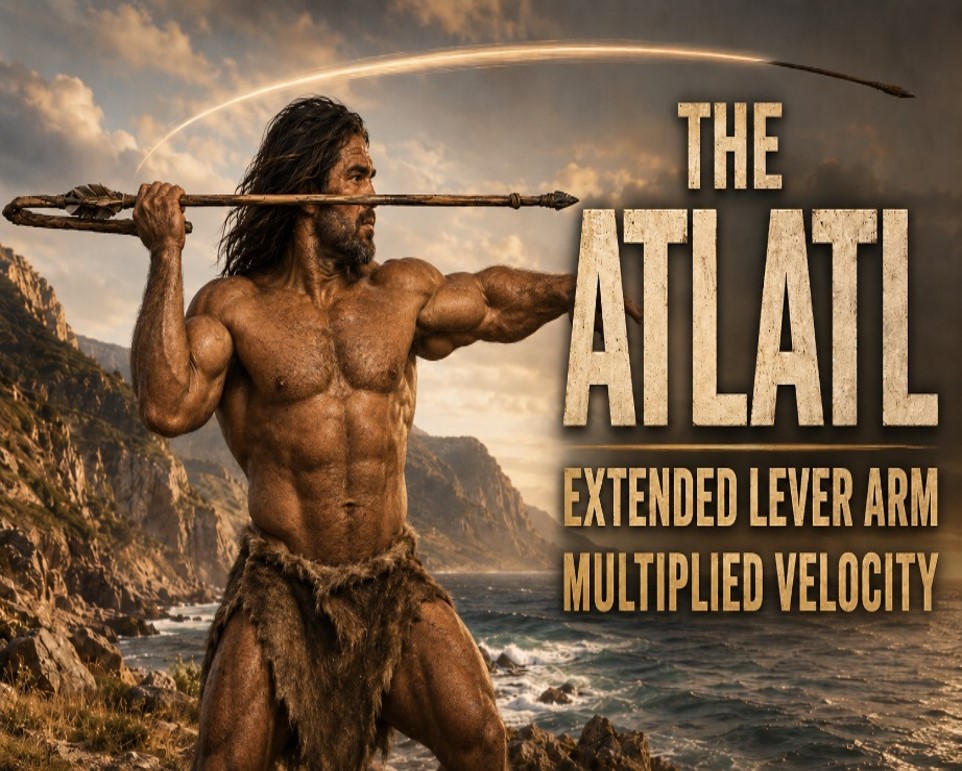
Projectile technology provides further evidence. The use of spear-throwing devices, or atlatls, extends the human body’s lever arm, increasing the velocity and force imparted to a projectile. While these devices improve efficiency, they do not eliminate physical demand. Their effective use requires strength, coordination, and repetition over time.
The transport and working of raw materials also reflect sustained physical effort. Flint, bone, and other resources were often obtained from specific locations and moved across the landscape before being worked.
This process, repeated across multiple sites, indicates consistent engagement with physically demanding tasks rather than isolated episodes of exertion.
Skeletal evidence supports this pattern. Upper Palaeolithic remains frequently display pronounced muscle attachment sites and bone density consistent with repeated mechanical loading, particularly in the upper limbs and shoulders. These features indicate adaptation to sustained physical activity rather than occasional use.
Comparison with later prehistoric populations reinforces this distinction. Following the transition to agriculture, skeletal evidence commonly shows reduced robustness and changes in activity patterns. In contrast, Upper Palaeolithic populations display characteristics consistent with higher, more sustained levels of physical exertion as a regular part of daily life.
The tools themselves do not indicate exceptional strength beyond human capability. Rather, they reflect a consistent requirement for controlled force, coordination, and endurance applied repeatedly over time. Their significance lies not in isolated effort, but in the regularity and consistency with which such effort was applied.
Taken together, the evidence indicates that Upper Palaeolithic European populations were adapted to sustained, force-intensive activity, supported by both skeletal structure and material culture. The repeated production of standardised tools across wide regions further indicates that this capability operated within shared and repeatable systems rather than individual practice alone.
Archaeological Behaviour and Capability
The archaeological record associated with Upper Palaeolithic European populations provides clear evidence of repeated and structured activity across a wide geographical area. This evidence, derived from artefacts, site organisation, and material remains, allows patterns of behaviour to be observed directly.
A defining feature of this period is the development of standardised tool industries.
The Aurignacian, Gravettian, and Magdalenian traditions display consistent technological characteristics, including the production of long, narrow blades, specialised implements, and the use of materials such as flint, bone, antler, and ivory. These industries are distributed across multiple sites and regions, indicating that production followed shared methods rather than isolated or localised practice.
The significance lies in the consistency of form and technique. Similar tools are produced across large distances using comparable methods, indicating that the processes involved were not dependent on individual improvisation.
Instead, they reflect established approaches that were maintained and repeated over time.
This pattern extends beyond utilitarian tools. The Upper Palaeolithic record includes carved figurines, engraved objects, and decorated implements that appear across multiple sites, often displaying recurring forms and motifs. While their specific purpose is not always clear, their consistent appearance indicates the repetition of defined practices rather than isolated acts.
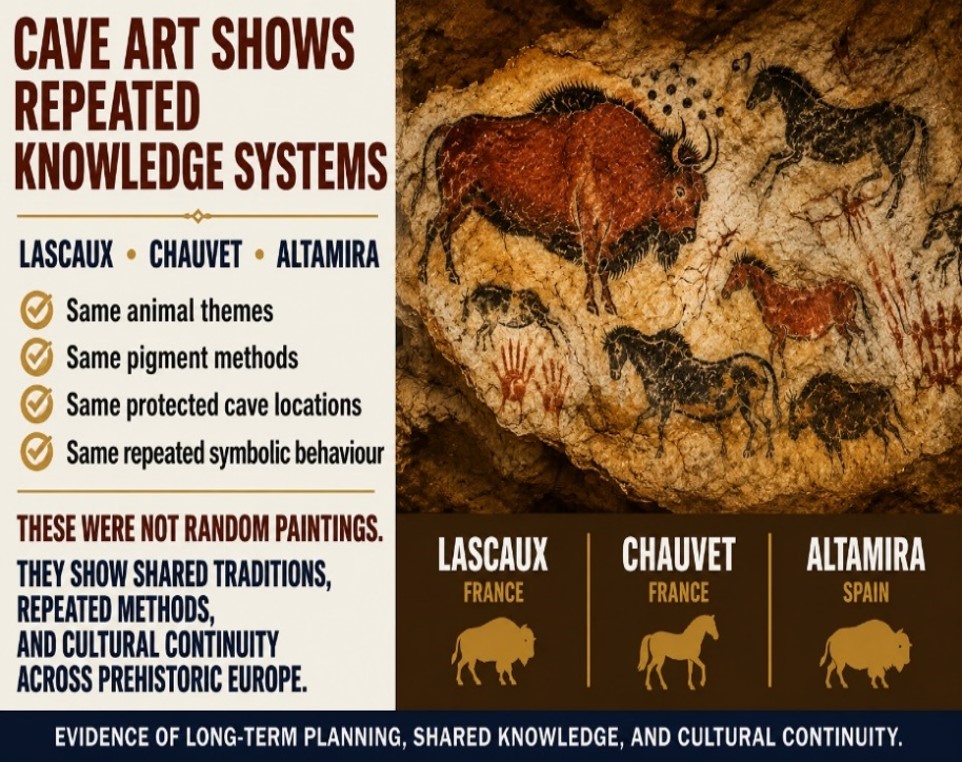
Cave art provides further evidence. Sites such as Lascaux and Chauvet in France and Altamira in Spain contain large numbers of painted and engraved images within specific, often restricted areas.
These sites were revisited over time, and the techniques used in pigment preparation and application were consistent across regions.
This indicates that both the location and the method were selected and repeated rather than being incidental.
Burial practices show similar patterns. Upper Palaeolithic burials occur across multiple sites and display recurring features, including the use of red ochre, the placement of objects with the body, and consistent positioning of the deceased. Examples such as Sungir in Russia and Paviland in Britain demonstrate that these practices were not random but followed recognisable and repeated forms.
Site organisation reinforces this interpretation. Excavated locations frequently show defined areas associated with specific activities, including tool production, processing, and occupation.
These spatial arrangements indicate that activity within sites was structured rather than opportunistic.
The repeated use of particular locations is also evident. Many sites show multiple phases of occupation, indicating that they were revisited and reused over time. This persistence suggests that locations were selected and maintained within a broader pattern of activity.
Material distribution provides further evidence of structure. Raw materials such as flint are often sourced from specific locations and transported over distance before being worked. The identification of these sources demonstrates that acquisition followed consistent patterns rather than isolated events.
| This distinction is critical |
Taken together, this evidence indicates that Upper Palaeolithic activity was not defined by isolated acts or local variation alone. Instead, it reflects behaviour that is repeatable, consistent, and extended across regions.
The pattern observed is not simply one of increased activity or isolated innovation, but of organisation. Production follows shared methods, practices are repeated across sites, and activity is structured in ways that extend beyond individual locations.
The archaeological record therefore reflects a mode of operation in which behaviour is not only sustained, but systematised.
Geographic Distribution in Europe and Britain
The distribution of Upper Palaeolithic human populations, commonly referred to as Cro-Magnon, is well established across Europe through a combination of fossil remains, artefact assemblages, and dated occupation sites. These populations are widely dispersed, occupying environments ranging from western Europe through central and eastern regions to parts of western Asia.
In western Europe, significant concentrations of evidence are found in France and the Iberian Peninsula. Sites in the Dordogne region, including the Cro-Magnon rock shelter at Les Eyzies, have yielded both skeletal remains and extensive archaeological material associated with Upper Palaeolithic industries. Cave systems such as Lascaux and Chauvet in France and Altamira in Spain provide further evidence of sustained activity in these regions.
Central and eastern Europe also contain a substantial record. Sites such as Dolní Věstonice and Pavlov in the Czech Republic, Kostenki on the Don River in Russia, and Sungir near Vladimir demonstrate occupation across a broad geographical range, supported by both skeletal remains and extensive artefact assemblages.
This distribution is not limited to a single environmental zone. Upper Palaeolithic populations occupied open plains, river valleys, and areas associated with major water systems. The repeated presence of sites within similar environmental contexts indicates that these locations were consistently selected and reused.
In Britain, the archaeological record is more limited, but it confirms inclusion within this wider pattern. Paviland Cave on the Gower Peninsula provides one of the earliest well-documented examples, dated to approximately 33,000 years before present. Additional sites, including Kent’s Cavern in Devon and Creswell Crags in Derbyshire, contain artefacts consistent with Upper Palaeolithic industries found across mainland Europe. Creswell Crags also preserves cave art attributed to this period.
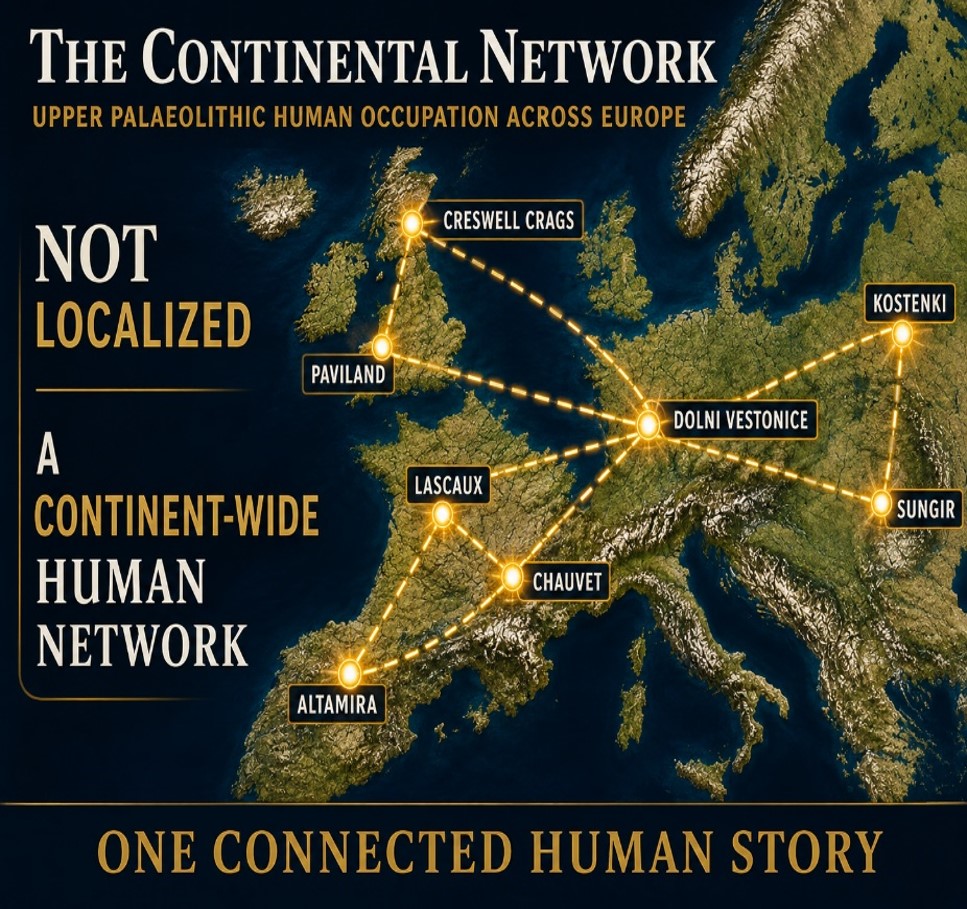
These sites demonstrate that Britain was not isolated from broader European patterns of occupation. During periods of lower sea level, Britain formed part of a continuous landmass with mainland Europe, commonly referred to as Doggerland.
This connection enabled movement without crossing the sea and facilitated the transmission of material culture across regions.
| The overall pattern is one of scale and connectivity |
As sea levels rose toward the end of the last Ice Age, this land connection was lost, leading to the geographic separation of Britain from the continent. However, Upper Palaeolithic occupation predates this separation and forms part of the same wider distribution.
Cro-Magnon populations are not confined to isolated locations but are distributed across a continental range, with consistent material culture and recurring activity patterns. Their presence is confirmed through multiple independent lines of evidence, including skeletal remains, artefacts, and dated occupation sites.
This distribution reinforces a key point: the patterns observed in the archaeological record are not localised phenomena but occur across a wide and connected landscape.
The Problem
The preceding sections establish the current framework for describing Upper Palaeolithic populations in Europe, commonly referred to as the Cro-Magnon. Within that framework, these populations are classified as early Homo sapiens, forming part of a continuous human presence extending from their arrival in Europe approximately 45,000 years before present through to later prehistoric populations.
Genetic evidence supports this continuity. These populations do not represent a separate species, nor do they disappear from the record. They contribute to the ancestry of later groups through processes of mixture and adaptation over time.
At the same time, the archaeological and skeletal evidence presents a pattern that this framework does not fully resolve.
For much of the Pleistocene, human activity is characterised by long periods of technological continuity. Tool traditions persist with limited variation, and production reflects local and individual execution. Change occurs, but it is gradual and constrained.
| In contrast the Upper Palaeolithic record displays a different structure |
Tool industries become standardised across wide geographical areas. Forms are repeated, methods are consistent, and production follows shared principles rather than isolated practice.
Artefacts are no longer simply variable outputs, but components of recognisable and repeatable systems.
This pattern extends beyond tools. Burial practices follow consistent forms, cave art displays repeated techniques across regions, sites are revisited and reused, and materials are transported over distance according to identifiable patterns.
Taken together, these features indicate organised behaviour.
| This distinction is critical |
The change observed in the Upper Palaeolithic is not simply one of incremental improvement or isolated innovation. It is a shift in how human activity is structured. Production becomes repeatable, behaviour becomes consistent, and patterns extend beyond individual locations into wider geographical systems.
The population associated with this transition is that traditionally described as Cro-Magnon.
Within the current model, this population is treated as part of a broader spectrum of Homo sapiens, and the classification that once distinguished it is no longer maintained.
However, the underlying evidence remains.
| This creates a point of tension |
Physical characteristics, behavioural patterns, and geographic distribution are consistent across multiple sites and regions. The data has not changed; only the framework used to describe it
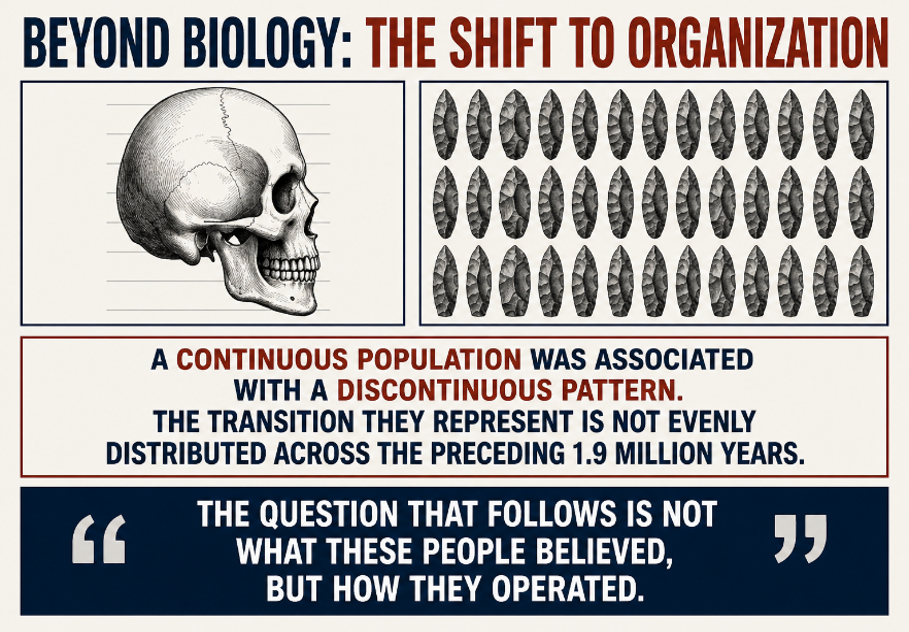
A continuous population is associated with a discontinuous pattern. The current model accounts for continuity of presence but does not fully capture the shift in organisation that becomes visible within the same record.
The issue is therefore not one of identification, but of explanation.
A population appears within the archaeological record associated with a measurable change in how human activity is organised. That population is not separate, and it does not disappear. Yet the transition it represents is not evenly distributed across the preceding timeline.
For over two million years, human activity remains broadly constrained within localised, non-systematic patterns. Within a comparatively short period, this changes. Behaviour becomes structured, repeatable, and extended across regions. The difference is not marginal, but fundamental.
| The scale of this transition must be acknowledged |
If this transition reflects a form of development within Homo sapiens, then it represents a level of change that is disproportionate to what precedes it. It marks a point at which human activity shifts from individual and localised behaviour to coordinated and system-based operation.
In that sense, the population associated with this change forms the foundation of all that follows.
The systems that emerge in this period—standardisation, repetition, coordination, and the extension of activity across landscapes—are the same principles that underpin later technological and societal development. Without this transition, the trajectory from early tool use to complex civilisation cannot be understood.
The question that follows is not whether this change occurred, but how it was achieved.
For millions of years, humans lived simple lives. They made tools, hunted, gathered food, and survived. Nothing changed quickly, and nothing operated beyond small groups. There were no systems, no coordination across distances, and no shared way of doing things.
Then, suddenly in just twenty thousand years, everything changes.
Tools become standard. Methods are repeated. Activity spreads across large areas and follows the same patterns. People are no longer just surviving—they are operating within organised systems.
| This is the turning point for humanity |
Without it, humans remain small groups making simple tools. There is no progression to large-scale organisation, no structured landscapes, and no foundation for later civilisation. Everything that comes after depends on this Cro-Magnon species and its associated civilisation.
The question is simple:
How did humans go from that… to this?
The Missing Biological Link: Reuniting Skull, Stature and DNA
For more than a century, the biological evidence for Europe’s prehistoric populations has been divided between separate academic disciplines. Physical anthropologists studied skull shape, osteologists reconstructed stature and skeletal proportions, and geneticists later analysed ancient DNA. Each field produced valuable evidence, but the results were rarely reunited into a single account of the people themselves. Skull form, body size and paternal ancestry were consequently discussed as separate subjects, even when they belonged to the same broad population history.
Upper Palaeolithic Europeans were frequently long-headed, powerfully built and, in some cases, exceptionally tall. Skeletons from Cro-Magnon, Barma Grande, Grotte des Enfants and other sites include males estimated at more than 185 centimetres, with some approaching or exceeding 190 centimetres. Their long bones, heavy skeletal construction and strong muscular attachments reveal people adapted to physically demanding lives.
These characteristics did not disappear when the Ice Age ended. Our reassessment of more than two hundred Mesolithic skeletons shows that tall and robust individuals continued across northern, western and south-eastern Europe. Numerous Mesolithic males exceeded 180 centimetres, while elongated cranial forms remained present among post-glacial hunter-gatherer populations. The supposed biological break between the Upper Palaeolithic and Mesolithic was therefore less complete than changes in tools, food production and burial customs have sometimes suggested.
Ancient DNA now allows these physical characteristics to be compared with paternal lineage.
Villabruna 1, discovered at Riparo Villabruna in northern Italy, lived approximately fourteen thousand years ago and carried the early paternal lineage R1b1, or R-L754. His skull measured 181 millimetres in maximum length and 137.5 millimetres in maximum breadth, producing a cranial index of 75.97. He was therefore not round-headed, and his cranial form stood close to the conventional boundary between mesocephalic and dolichocephalic skulls.
Villabruna’s published stature estimates range from approximately 167 to 169 centimetres, so he was not exceptionally tall. His importance lies in the secure connection between early R1b and a measured, non-round-headed cranium within the same individual. He also places R1b in western Europe around nine thousand years before the conventional Bell Beaker horizon.
The later expansion of particular R1b branches cannot therefore be treated as the first appearance of the wider lineage in Europe.
The stature connection is supplied by M50 from Schela Cladovei on the Romanian bank of the Danube. Genetic sample I4655 was identified as skeleton SCCL_50, also recorded as burial M50. This adult male dates to approximately 7059 to 6571 calibrated BCE and carried R-L754, an early branch of R1b. His right tibia measured 412 millimetres, while the published osteological estimate placed his stature at 181.63 centimetres.
M50 therefore provides a secure connection between early R1b and exceptional Mesolithic stature. He lived more than four thousand years before the conventional Bell Beaker expansion into western Europe and demonstrates that tall R1b males were already present among European hunter-gatherers long before the third millennium BC. His individual cranial measurements have not yet been recovered, so his skeleton cannot be used to determine whether he was also long-headed. Villabruna supplies the cranial connection; M50 supplies the stature connection.
Aveline’s Hole in Somerset provides the British link. It is Britain’s largest known Early Mesolithic cemetery and contained the male genetic sample I3004, also recorded as SB 337B3. The sample came from a human tibia directly dated to approximately 8600 to 8300 BCE and is currently assigned to an R1b-derived paternal lineage.
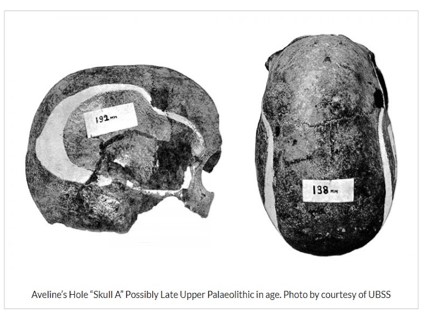
The cemetery also contained securely long-headed crania. One reconstructed skull, M1.11.301, measured 186 millimetres in maximum length and 134 millimetres in maximum breadth. Its cranial index was 72.0, placing it firmly within the dolichocephalic category.
The sampled tibia and measured skull have not been shown to belong to the same person, so Aveline’s Hole does not yet provide a complete individual crossover. It does, however, place an R1b-derived male and securely long-headed individuals within the same British Mesolithic burial population, more than five thousand years before the conventional Bell Beaker horizon.
The three discoveries form a connected biological sequence. Villabruna demonstrates that early R1b was present in a non-round-headed Upper Palaeolithic European. M50 demonstrates that basal R1b was carried by an exceptionally tall Mesolithic man. Aveline’s Hole places R1b and long-headed morphology within the same British Mesolithic cemetery.
Together, these cases reunite evidence that has previously been studied in isolation. Tall stature continued into the Mesolithic. Robust skeletal construction continued into the Mesolithic. Elongated cranial morphology continued into the Mesolithic. Early R1b paternal lineages also continued among European hunter-gatherers.
This does not require every early R1b male to have been tall or long-headed. Human populations naturally contain considerable physical variation. The evidence establishes that R1b, exceptional stature, and elongated cranial morphology all existed within the same broad Upper Palaeolithic and Mesolithic population history.
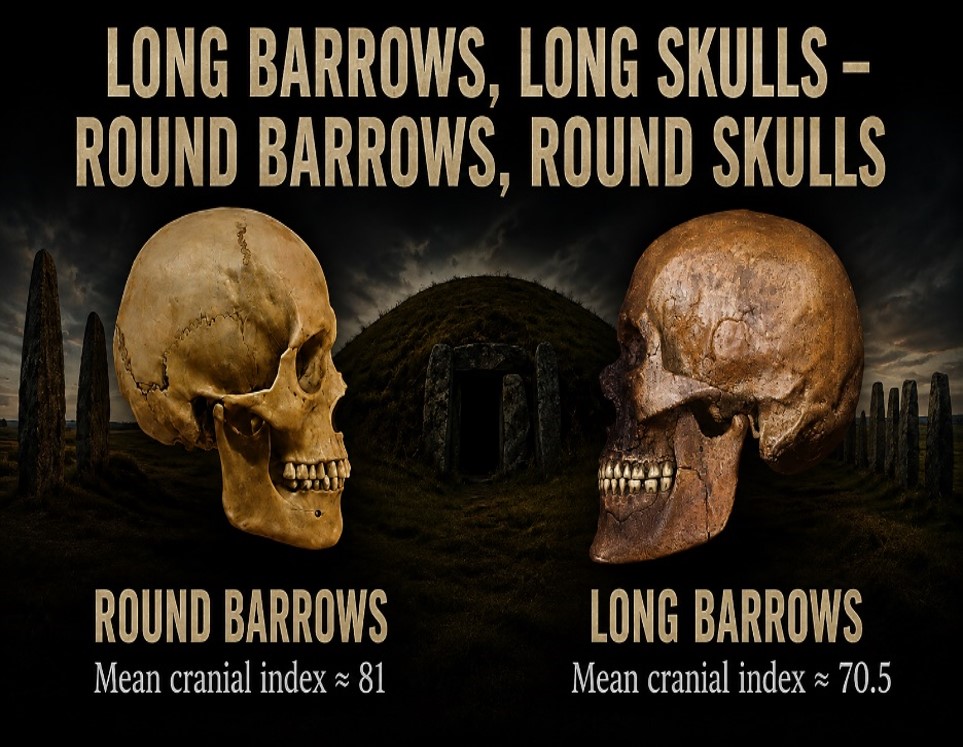
That creates a credible biological foundation for the long-headed population later buried in Britain’s long barrows. Thurnam’s measurements showed that the primary long-barrow burials were predominantly long-headed, while the later round-barrow population was markedly broader-headed.
The remaining question is whether the long-headed people selected for Britain’s earliest monumental burials carried paternal lineages inherited from older European hunter-gatherers. The answer lies in the surviving remains. The long-barrow crania must be relocated, directly dated, remeasured, and genetically tested so that cranial form, stature, DNA, and burial context can finally be reunited in the same individuals.
The missing biological link was largely created by separating connected evidence across different academic disciplines. Villabruna, M50, and Aveline’s Hole begin to restore that connection, revealing a biological sequence extending from Upper Palaeolithic Europe through Mesolithic hunter-gatherers towards the long-headed population buried within Britain’s earliest monumental landscape.

For more information on this topic and a video explainer, follow these links: https://prehistoric-britain.co.uk/the-ascent-of-man-from-survival-to-systems
PODCAST

Author’s Biography
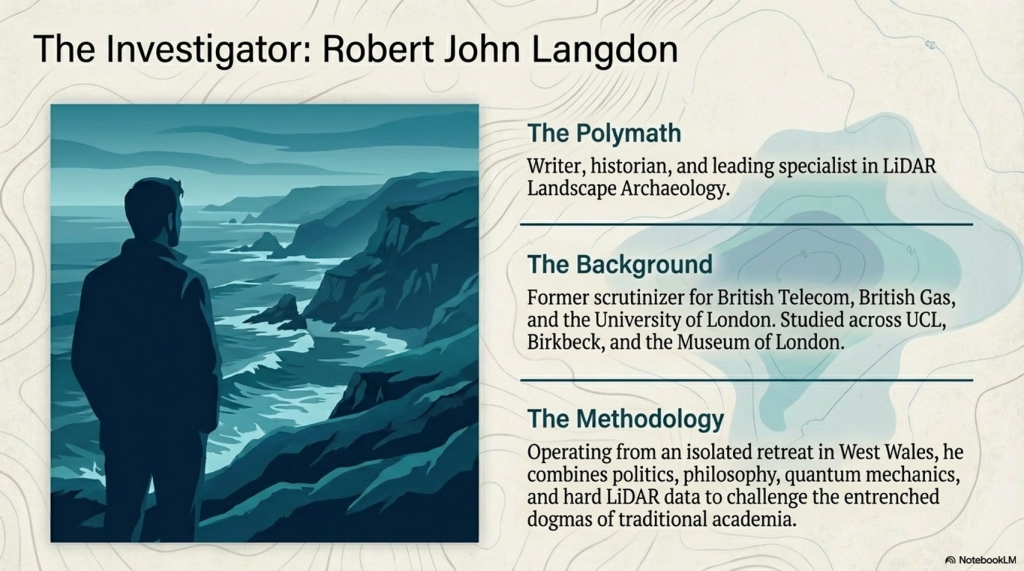
Robert John Langdon, a polymathic luminary, emerges as a writer, historian, and eminent specialist in LiDAR Landscape Archaeology.
His intellectual voyage has been interwoven with stints as an astute scrutineer in government and grand corporate bastions, a tapestry spanning British Telecommunications, Cable and Wireless, British Gas, and the esteemed University of London.
A decade hence, Robert’s transition into retirement unfurled a chapter of insatiable curiosity. This phase saw him immerse himself in Politics, Archaeology, Philosophy, and the enigmatic realm of Quantum Mechanics. His academic odyssey traversed the venerable corridors of knowledge hubs such as the Museum of London, University College London, Birkbeck College, The City Literature Institute, and Chichester University.
In the symphony of his life, Robert is a custodian of three progeny and a pair of cherished grandchildren. His sanctuary lies ensconced in the embrace of West Wales, where he inhabits an isolated cottage, its windows framing a vista of the boundless sea – a retreat from the scrutinising gaze of Her Majesty’s Revenue and Customs, an amiable clandestinity in the lap of nature.
Exploring Prehistoric Britain: A Journey Through Time
My blog delves into the fascinating mysteries of prehistoric Britain, challenging conventional narratives and offering fresh perspectives grounded in cutting-edge research, particularly LiDAR technology. I invite you to explore some key areas of my research. For example, the Wansdyke, often cited as a defensive structure, is re-examined in light of new evidence. I’ve presented my findings in my blog post Wansdyke: A British Frontier Wall – ‘Debunked’, and a Wansdyke LiDAR Flyover video further visualises my conclusions.
My work also often challenges established archaeological dogma. I argue that many sites, such as Hambledon Hill, commonly identified as Iron Age hillforts, are not what they seem. My posts Lidar Investigation Hambledon Hill – NOT an ‘Iron Age Fort’ and Unmasking the “Iron Age Hillfort” Myth explore these ideas in detail and offer an alternative view. Similarly, sites like Cissbury Ring and White Sheet Camp receive re-evaluations based on LiDAR analysis in my posts “Lidar Investigation Cissbury Ring through time” and “Lidar Investigation White Sheet Camp,“ revealing fascinating insights into their true purpose. I have also examined South Cadbury Castle, often linked to the mythical Camelot56.
My research also extends to ancient water management, including the role of canals and other linear earthworks. I have discussed the true origins of Car Dyke in multiple posts, including Car Dyke – ABC News Podcast and Lidar Investigation Car Dyke – North Section, which suggest a Mesolithic origin 2357. I also explore the misidentification of Roman aqueducts, as seen in my posts on the Great Chesters (Roman) Aqueduct. My research has also been greatly informed by my post-glacial flooding hypothesis, which has helped explain landscape transformations over time. I have discussed this hypothesis in several posts, including AI now supports my Post-Glacial Flooding Hypothesis and Exploring Britain’s Flooded Past: A Personal Journey
Finally, my blog also investigates prehistoric burial practices, as seen in Prehistoric Burial Practices of Britain and explores the mystery of Pillow Mounds, often mistaken for medieval rabbit warrens, but with a potential link to Bronze Age cremation in my posts: Pillow Mounds: A Bronze Age Legacy of Cremation? and The Mystery of Pillow Mounds: Are They Really Medieval Rabbit Warrens?. My research also includes astronomical insights into ancient sites, for example, in Rediscovering the Winter Solstice: The Original Winter Festival. I also review new information about the construction of Stonehenge in The Stonehenge Enigma.
Further Reading
For those interested in British Prehistory, visit www.prehistoric-britain.co.uk, a comprehensive resource featuring an extensive collection of archaeology articles, modern LiDAR investigations, and groundbreaking research. The site also includes insights and excerpts from the acclaimed Robert John Langdon Trilogy, a series of books that explore Britain during the Prehistoric period. Titles in the trilogy include The Stonehenge Enigma, Dawn of the Lost Civilisation, and The Post-Glacial Flooding Hypothesis, which offer compelling evidence of ancient landscapes shaped by post-glacial flooding.
To further explore these topics, Robert John Langdon has developed a dedicated YouTube channel featuring over 100 video documentaries and investigations that complement the trilogy. Notable discoveries and studies showcased on the channel include 13 Things that Don’t Make Sense in History and the revelation of Silbury Avenue – The Lost Stone Avenue, a rediscovered prehistoric feature at Avebury, Wiltshire.
In addition to his main works, Langdon has released a series of shorter, accessible publications, ideal for readers delving into specific topics. These include:
- The Ancient Mariners
- Stonehenge Built 8300 BCE
- Old Sarum
- Prehistoric Rivers
- Dykes, Ditches, and Earthworks
- Echoes of Atlantis
- Homo Superior
- 13 Things that Don’t Make Sense in History
- Silbury Avenue – The Lost Stone Avenue
- Offa’s Dyke
- The Stonehenge Enigma
- The Post-Glacial Flooding Hypothesis
- The Stonehenge Hoax
- Dawn of the Lost Civilisation
- Darwin’s Children
- Great Chester’s Roman Aqueduct
- Wansdyke
For active discussions and updates on the trilogy’s findings and recent LiDAR investigations, join our vibrant community on Facebook. Engage with like-minded enthusiasts by leaving a message or contributing to debates in our Facebook Group.
Whether through the books, the website, or interactive videos, we aim to provide a deeper understanding of Britain’s fascinating prehistoric past. We encourage you to explore these resources and uncover the mysteries of ancient landscapes through the lens of modern archaeology.
For more information, including chapter extracts and related publications, visit the Robert John Langdon Author Page. Dive into works such as The Stonehenge Enigma or Dawn of the Lost Civilisation, and explore cutting-edge theories that challenge traditional historical narratives.
Other Blogs
1
a
- AI now Supports – Homo Superior
- AI now supports my Post-Glacial Flooding Hypothesis
- Alexander the Great sailed into India – where no rivers exist today
- Ancient Secrets of Althorp – debunked
- Antler Picks built Ancient Monuments – yet there is no real evidence
- Antonine Wall – Prehistoric Canals (Dykes)
- Archaeological ‘pulp fiction’ – has archaeology turned from science?
- Archaeological Pseudoscience
- Archaeology in the Post-Truth Era
- Archaeology: A Bad Science?
- Archaeology: A Harbour for Fantasists?
- Archaeology: Fact or Fiction?
- Archaeology: The Flaws of Peer Review
- Archaeology’s Bayesian Mistake: Stop Averaging the Past
- Are Raised Beaches Archaeological Pseudoscience?
- Atlantis Found: The Mathematical Proof That Plato’s Lost City Was Doggerland
- ATLANTIS: Discovery with Dan Snow Debunked
- Avebury Ditch – Avebury Phase 2
- Avebury through time
- Avebury’s great mystery revealed
- Avebury’s Lost Stone Avenue – Flipbook
b
- Battlesbury Hill – Wiltshire
- Beyond Stone and Bone: Rethinking the Megalithic Architects of Northern Europe
- BGS Prehistoric River Map
- Blackhenge: Debunking the Media misinterpretation of the Stonehenge Builders
- Brain capacity (Cro-Magnon Man)
- Britain’s First Road – Stonehenge Avenue
- Britain’s Giant Prehistoric Waterways
- British Roman Ports miles away from the coast
c
- Caerfai Promontory Fort – Archaeological Nonsense
- Car Dyke – ABC News PodCast
- Car Dyke – North Section
- CASE STUDY – An Inconvenient TRUTH (Craig Rhos Y Felin)
- Case Study – River Avon
- Case Study – Woodhenge Reconstruction
- Chapter 2 – Craig Rhos-Y-Felin Debunked
- Chapter 2 – Stonehenge Phase I
- Chapter 2 – Variation of the Species
- Chapter 3 – Post Glacial Sea Levels
- Chapter 3 – Stonehenge Phase II
- Chapter 7 – Britain’s Post-Glacial Flooding
- Cissbury Ring through time
- Clement Reid, Doggerland, and the Archaeological Establishment
- Cro-Magnon Brain Capacity
- Cro-Magnon Megalithic Builders: Measurement, Biology, and the DNA
- Cro-Magnons – An Explainer
d
- Darwin’s Children – Flipbook
- Darwin’s Children – The Cro-Magnons
- Dawn of The Lost Civilisation – 1/10
- Dawn of the Lost Civilisation – Flipbook
- Dawn of the Lost Civilisation – Introduction
- Digging for Britain – Cerne Abbas
- Digging for Britain Debunked – Cerne Abbas 2
- Digging Up Britain’s Past – Debunked
- DLC Chapter 1 – The Ascent of Man
- Durrington Walls – Woodhenge through time
- Durrington Walls Revisited: Platforms, Fish Traps, and a Managed Mesolithic Landscape
- Dyke Construction – Hydrology 101
- Dykes Ditches and Earthworks
- DYKES of Britain
e
f
g
h
- Hadrian’s Wall – Military Way Hoax
- Hadrian’s Wall – the Stanegate Hoax
- Hadrian’s Wall LiDAR investigation
- Hambledon Hill – NOT an ‘Iron Age Fort’
- Hayling Island Lidar Maps
- Hidden Sources of Ancient Dykes: Tracing Underground Groundwater Fractals
- Historic River Avon
- Hollingsbury Camp Brighton – A Hillfort… or a Forgotten Harbour?
- Hollows, Sunken Lanes and Palaeochannels
- Homo Superior – Flipbook
- Homo Superior – History’s Giants
- How Lidar will change Archaeology
- Hydrology 101 Simplified: Why Britain’s Dykes Worked Without Rivers
i
l
m
- Maiden Castle through time
- Mathematics Meets Archaeology: Discovering the Mesolithic Origins of Car Dyke
- Mesolithic River Avon
- Mesolithic Stonehenge
- Minerals found in Prehistoric and Roman Quarries
- Mining in the Prehistoric to Roman Period
- Mount Caburn through time
- Mysteries of the Oldest Boatyard Uncovered
- Mythological Dragons – a non-existent animal that is shared by the World.
o
- Offa’s Dyke Flipbook
- Old Sarum Lidar Map
- Old Sarum Through Time…………….
- On Sunken Lands of the North Sea – Lived the World’s Greatest Civilisation.
- OSL Chronicles: Questioning Time in the Geological Tale of the Avon Valley
- Oswestry LiDAR Survey
- Oswestry through time
- Oysters in Archaeology: Nature’s Ancient Water Filters?
p
- Pillow Mounds: A Bronze Age Legacy of Cremation?
- Pinkery Canal
- Plato Was Right: The Archaeological Evidence the Academics Never Expected
- Post Glacial Flooding – Flipbook
- Prehistoric Burial Practices of Britain
- Prehistoric Canals – Wansdyke
- Prehistoric Canals – Wansdyke
- Prehistoric Canals (Dykes) – Great Chesters Aqueduct (The Vallum Pt. 4)
- Prehistoric Canals (Dykes) – Hadrian’s Wall Vallum (pt 1)
- Prehistoric Canals (Dykes) – Offa’s Dyke (Chepstow)
- Prehistoric Canals (Dykes) – Offa’s Dyke (LiDAR Survey)
- Prehistoric Canals (Dykes) – Offa’s Dyke Survey (End of Section A)
- Prehistoric Canals (Dykes) – Wansdyke (4)
- Prehistoric Canals Wansdyke 2
- Professor Bonkers and the mad, mad World of Archaeology
r
- Real-World Confirmation of Post-Glacial Flooding
- Rebirth in Stone: Decrypting the Winter Solstice Legacy of Stonehenge
- Rediscovering the Winter Solstice: The Original Winter Festival
- Rethinking Ancient Boundaries: The Vallum and Offa’s Dyke”
- Rethinking Ogham: Could Ireland’s Oldest Script Have Begun as a Tally System?
- Rethinking The Past: Mathematical Proof of Langdon’s Post-Glacial Flooding Hypothesis
- Revolutionising History: Car Dyke Unveiled as Prehistoric & the Launch of FusionBook 360
- Rising Evidence, Falling Rivers: The Real Story of Europe’s First Farmers
- Rivers of the Past Were Higher: A Fresh Perspective on Prehistoric Hydrology
s
- Sea Level Changes
- Section A – NY26SW
- Section B – NY25NE & NY26SE
- Section C – NY35NW
- Section D – NY35NE
- Section E – NY46SW & NY45NW
- Section F – NY46SE & NY45NE
- Section G – NY56SW
- Section H – NY56NE & NY56SE
- Section I – NY66NW
- Section J – NY66NE
- Section K – NY76NW
- Section L – NY76NE
- Section M – NY87SW & NY86NW
- Section N – NY87SE
- Section O – NY97SW & NY96NW
- Section P – NY96NE
- Section Q – NZ06NW
- Section R – NZ06NE
- Section S – NZ16NW
- Section T – NZ16NE
- Section U – NZ26NW & NZ26SW
- Section V – NZ26NE & NZ26SE
- Silbury Avenue – Avebury’s First Stone Avenue
- Silbury Hill
- Silbury Hill / Sanctuary – Avebury Phase 3
- Sky Maps of Prehistoric Britain
- Somerset Plain – Signs of Post-Glacial Flooding
- South Cadbury Castle – Camelot
- Statonbury Camp near Bath – an example of West Wansdyke
- Stone me – the druids are looking the wrong way on Solstice day
- Stone Transportation and Dumb Censorship
- Stonehenge – Monument to the Dead
- Stonehenge Hoax – Dating the Monument
- Stonehenge Hoax – Round Monument?
- Stonehenge Hoax – Summer Solstice
- Stonehenge LiDAR tour
- Stonehenge Phase 1 — Britain’s First Monument
- Stonehenge Phase I (The Stonehenge Landscape)
- Stonehenge Solved – Pythagorean maths put to use 4,000 years before he was born
- Stonehenge Through Time
- Stonehenge, Doggerland and Atlantis connection
- Stonehenge: Borehole Evidence of Post-Glacial Flooding
- Stonehenge: Discovery with Dan Snow Debunked
- Stonehenge: The Worlds First Computer
- Stonehenge’s The Lost Circle Revealed – DEBUNKED
t
- Ten Reasons Why Car Dyke Blows Britain’s Earthwork Myths Out of the Water
- Ten Things You Didn’t Know About Britain’s Prehistoric Flooded Past
- Ten thousand year old boats found on Northern Europe’s Hillsides
- Ten thousand-year-old boats found on Northern Europe’s Hillsides
- Testing Plato’s Atlantis Against Reality
- The “Hunter-Gatherer” Myth: Why It’s Time to Bury This Outdated Term
- The Ancient Mariners – Flipbook
- The Ancient Mariners – Prehistoric seafarers of the Mesolithic
- The Ascent of Man — From Survival to Systems
- The Beringian Migration Myth: Why the Peopling of the Americas by Foot is Mathematically and Logistically Impossible
- The Bluestone Enigma
- The Bulford Hoax: The “Simpler, Older Stonehenge” That Wasn’t
- The Cheddar Man Hoax
- The Cro-Magnon Cover-Up: How DNA and PR Labels Erased Our Real Ancestry
- The Dolmen and Long Barrow Connection
- The Durrington Mega-Monument Hoax: What Lies Beneath? – Debunked
- The Durrington Walls Hoax – it’s not a henge?
- The Dyke Myth Collapses: Excavation and Dating Prove Britain’s Great Dykes Are Prehistoric Canals
- The First European Smelted Bronzes
- The Fury of the Past: Natural Disasters in Historical and Prehistoric Britain
- The Giant’s Graves of Cumbria
- The Giants of Prehistory: Cro-Magnon and the Ancient Monuments
- The Great Ancient DNA Illusion: How Statistical Models Became Archaeological “Facts”
- The Great Antler Pick Hoax
- The Great Bell Beaker Migration Myth
- The Great Chichester Hoax – A Bridge too far?
- The Great Dorchester Aqueduct Hoax
- The Great Farming Hoax – (Einkorn Wheat)
- The Great Farming Migration Hoax
- The Great Hadrian’s Wall Hoax
- The Great Iron Age Hill Fort Hoax
- The Great Offa’s Dyke Hoax
- The Great Prehistoric Migration Hoax
- The Great Stone Transportation Hoax
- The Great Stonehenge Hoax
- The Great Wansdyke Hoax
- The Henge and River Relationship
- The Logistical Impossibility of Defending Maiden Castle
- The Long Barrow and Dolmen Enigma
- The Long Barrow Mystery
- The Long Barrow Mystery: Unravelling Ancient Connections
- The Lost Island of Avalon – revealed
- The Maiden Way Hoax – A Closer Look at an Ancient Road’s Hidden History
- The Maths – LGM total ice volume
- The Mystery of Pillow Mounds: Are They Really Medieval Rabbit Warrens?
- THE ODYSSEY PROBLEM: WHY DID A WEEK-LONG VOYAGE BECOME A TEN-YEAR EPIC?
- The Old Sarum Hoax
- The Oldest Boat Yard in the World found in Wales
- The Perils of Paradigm Shifts: Why Unconventional Hypotheses Get Branded as Pseudoscience
- The Post-Glacial Flooding Hypothesis – 1/11
- The Post-Glacial Flooding Hypothesis – Flipbook
- The Post-Glacial Flooding Theory
- The Problem with Hadrian’s Vallum
- The Rise of the Cro-Magnon (Homo Superior)
- The Roman Military Way Hoax
- The Silbury Hill Lighthouse?
- The Stone Money – Credit System
- The Stonehenge Avenue
- The Stonehenge Avenue
- The Stonehenge Code: Unveiling its 10,000-Year-Old Secret
- The Stonehenge Crescent: A Monument to a Lost World
- The Stonehenge Enigma – Flipbook
- The Stonehenge Enigma: Part 1/6
- The Stonehenge Hoax – Bluestone Quarry Site
- The Stonehenge Hoax – Flipbook
- The Stonehenge Hoax – Moving the Bluestones
- The Stonehenge Hoax – Periglacial Stripes
- The Stonehenge Hoax – Station Stones
- The Stonehenge Hoax – Stonehenge’s Location
- The Stonehenge Hoax – The Ditch
- The Stonehenge Hoax – The Slaughter Stone
- The Stonehenge Hoax – The Stonehenge Layer
- The Stonehenge Hoax – Totem Poles
- The Stonehenge Hoax – Woodhenge
- The Stonehenge Hospital
- The Stonehenge Transportation Mystery
- The Subtropical Britain Hoax
- The Troy, Hyperborea and Atlantis Connection
- The Vallum @ Hadrian’s Wall – it’s Prehistoric!
- The Vallum at Hadrian’s Wall (Summary)
- The Woodhenge Hoax
- Three Dykes – Kidland Forest
- Thurnam’s 137 Skulls: The Forgotten People Behind Britain’s Megaliths.
- Top Ten Misidentified Fire Beacons in British History
- Troy Debunked – Troy did not exist in Asia Minor, but in fact, the North Sea island of Doggerland
- TSE – DVD Barrows
- TSE DVD – An Inconvenient Truth
- TSE DVD – Antler Picks
- TSE DVD – Avebury
- TSE DVD – Durrington Walls & Woodhenge
- TSE DVD – Dykes
- TSE DVD – Epilogue
- TSE DVD – Stonehenge Phase I
- TSE DVD – Stonehenge Phase II
- TSE DVD – The Post-Glacial Hypothesis
- TSE DVD Introduction
- TSE DVD Old Sarum
- Twigs, Charcoal, and the Death of the Saxon Dyke Myth
w
- Wansdyke – Short Film
- Wansdyke East – Prehistoric Canals
- Wansdyke Flipbook
- Wansdyke LiDAR Flyover
- Wansdyke: A British Frontier Wall – ‘Debunked’
- Was Columbus the first European to reach America?
- What Archaeology Missed Beneath Stonehenge
- White Sheet Camp
- Why a Simple Fence Beats a Massive Dyke (and What That Means for History)
- Windmill Hill – Avebury Phase 1
- Winter Solstice – Science, Propaganda and Indoctrination
- Woodhenge – the World’s First Lighthouse?