Britain’s Changing Funeral Traditions
Introduction
This investigation examines a proposed development of prehistoric funeral customs: from the exposure of bodies and collection of ancestral bones, through oval burial monuments and inhumation, to the increasing use of organised cremation cemeteries.
The investigation begins with a question that conventional monument classifications may have obscured.
Were the structures archaeologists call long barrows all examples of the same funerary tradition?
If architectural differences correspond with different construction periods and burial practices, some monuments traditionally grouped together may represent successive cultural developments.
Wor Barrow in Dorset provides an opportunity to investigate that possibility.
Section One — Excarnation: Dolmens and the Origins of the Long-Barrow Tradition
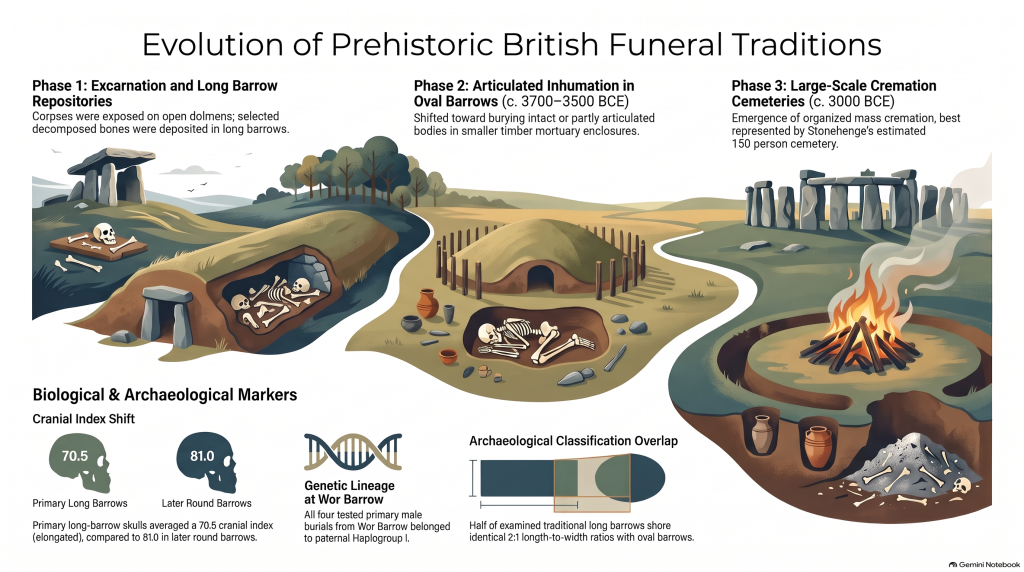
The first stage of Britain’s proposed prehistoric funerary transition was excarnation: exposing a corpse until decomposition was complete, collecting the surviving bones, and depositing them in a permanent monument.
My earlier investigations, The Long Barrow and Dolmen Enigma and The Dolmen and Long Barrow Connection, propose that two structures served different parts of this process:
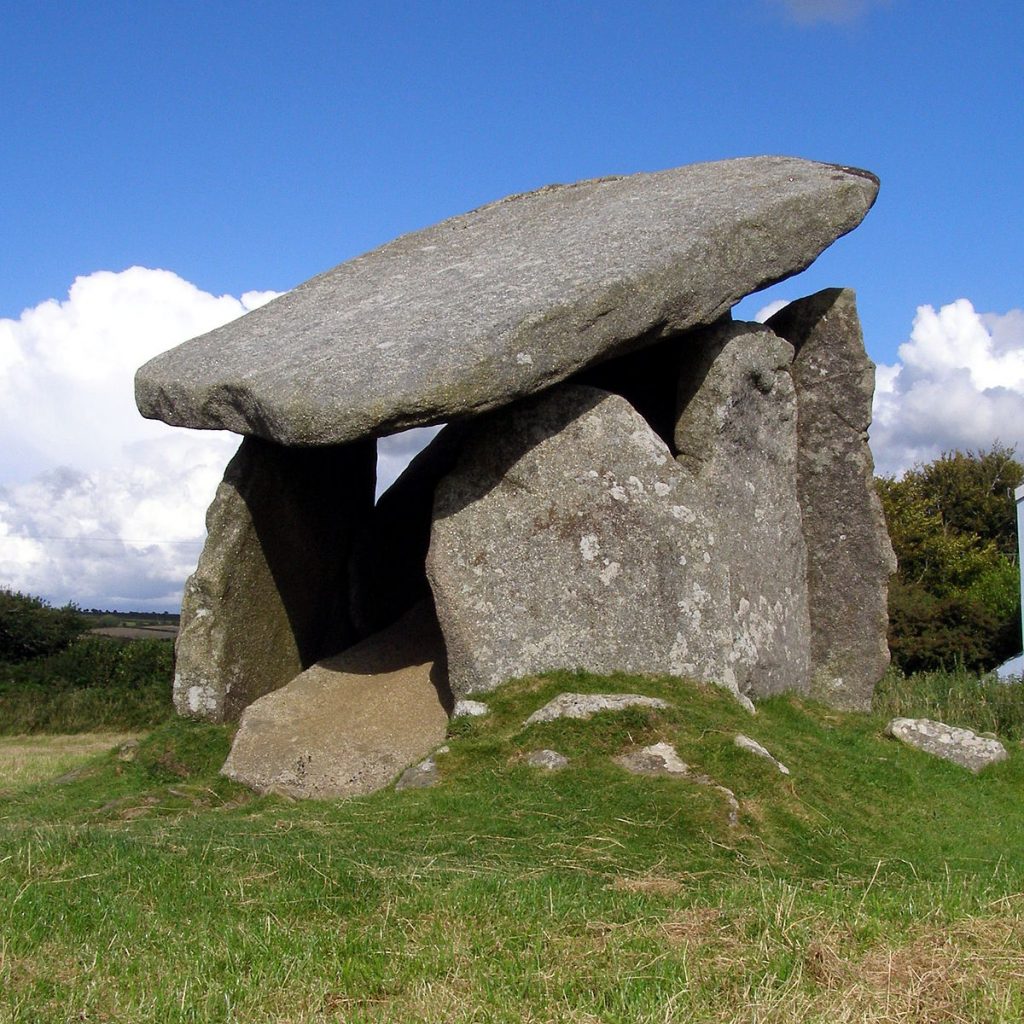
Dolmens were exposure platforms; long barrows were repositories for collected skeletal remains.
This interpretation rests on three sets of evidence: monument engineering, skeletal deposition and the physical characteristics of the people buried in long barrows.
1. Dolmens: The Engineering Evidence
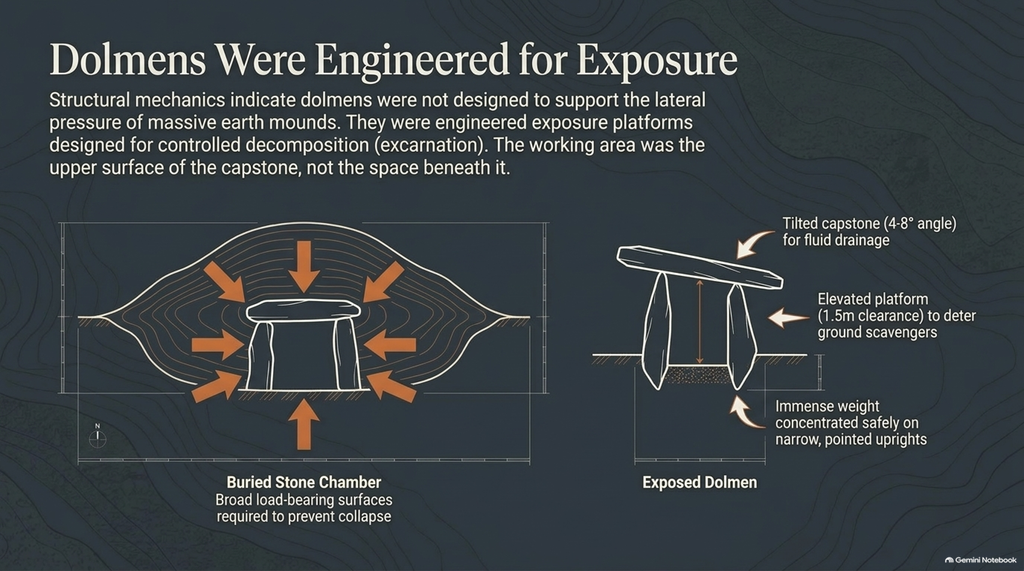
The crucial distinction is between a structure designed to stand exposed and a chamber designed to support the weight of an enclosing mound.
| Structural feature | Exposed dolmen | Buried stone chamber |
|---|---|---|
| Capstone support | Often concentrated on pointed uprights | Broader bearing surfaces |
| Capstone position | Frequently tilted or irregular | Arranged to support the chamber roof |
| Weight distribution | Concentrated at limited contact points | Distributed through supporting stones |
| Lateral earth pressure | Potentially vulnerable without additional support | Must resist surrounding fill |
| Proposed function | Exposure of the body above the capstone | Protection and storage of skeletal remains |
These distinctions emerged in my February 2026 investigation.
They lead to a testable engineering question: could a particular dolmen have supported the weight and lateral pressure of the mound archaeologists propose once it was surrounded?
A proper assessment requires the actual stone dimensions, contact geometry and evidence of former mound material. It cannot be settled merely by calling the structure a tomb.
The dimensions of a possible exposure platform
My investigation also identifies characteristics associated with controlled decomposition.
| Feature | Figure or characteristic identified | Proposed purpose |
|---|---|---|
| Capstone inclination | Approximately 4–8° | Drainage of fluids and rainwater |
| Platform elevation | Around 1.5 m or greater | Reduced access by ground scavengers |
| Supporting stones | Narrow or pointed contact areas | Reduced climbing access |
| Surroundings | Open airflow | Natural decomposition |
| Upper surface | Accessible to birds | Removal of soft tissue |
The angular and height figures come from my earlier article; they are not yet a verified measurement series for every dolmen. Individual monuments must be assessed separately.
The important proposition is that the upper surface of the capstone, rather than the space beneath it, was the working surface.
This also explains why some surviving dolmens appear to provide very little protected space beneath their capstones.
2. Where Did the Bones Go?
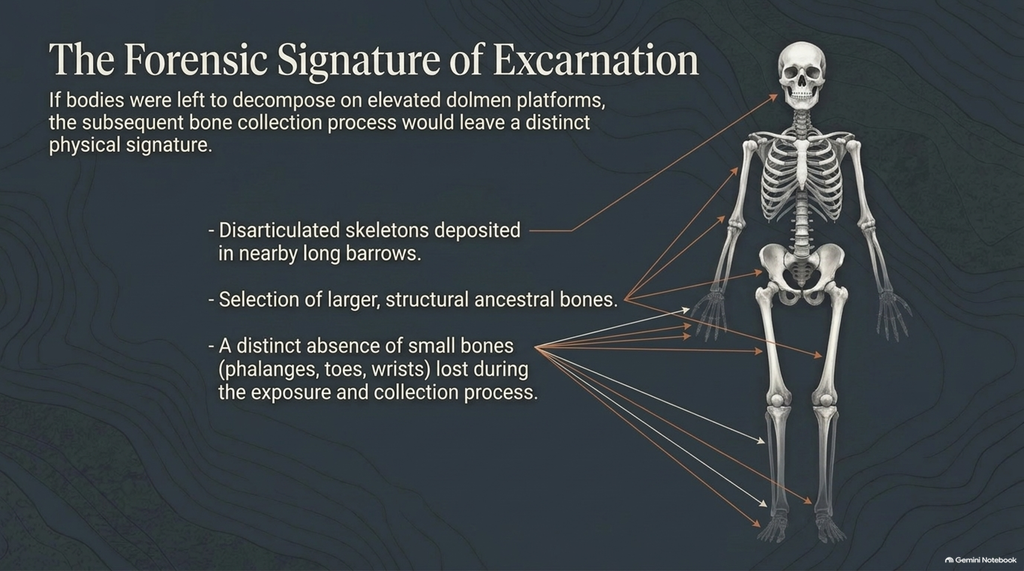
If bodies decomposed on exposed platforms, the next stage would involve collecting the bones.
My proposed reconstruction identifies long barrows as the permanent repositories.
Their excavated skeletal assemblages frequently include disarticulated remains, collections of bones from several individuals and evidence that remains were moved or rearranged.
This pattern matters because it can be compared with what different funerary processes would be expected to produce.
| Archaeological observation | Explanation under the excarnation model |
|---|---|
| Disarticulated skeletons | Bodies decomposed before final deposition |
| Missing finger and toe bones | Small elements lost during exposure or collection |
| Selected larger bones | Deliberate collection after decomposition |
| Bones from several individuals together | Repeated deposition of ancestral remains |
| Reordered skeletal material | Secondary handling rather than undisturbed burial |
The missing small bones are particularly important.
Phalanges, small wrist bones and foot bones are more easily overlooked or dispersed when a decomposed skeleton is collected.
But this needs quantification. Neither my earlier general account nor the nineteenth-century measurements provide a complete, site-by-site count of expected versus recovered small bones.
That inventory would be necessary to demonstrate how consistently the proposed pattern occurs.
Disarticulation alone cannot distinguish excarnation from decomposition and rearrangement inside a tomb. The argument depends on the combined evidence.
3. Dolmens and Controlled Exposure Sites
The hypothesis extends beyond individual dolmens.
My earlier articles identify possible architectural arrangements intended to control access to decomposing bodies.
| Monument | Archaeological feature discussed | Proposed interpretation |
|---|---|---|
| Dolmens | Elevated capstones on uprights | Exposure platforms |
| Arthur’s Stone, Herefordshire | Posthole evidence around an earlier monument | Controlled mortuary enclosure |
| Stonehenge Phase I | Q and R stoneholes and proposed surrounding palisades | Managed exposure area |
| Chambered long barrows | Collected and rearranged skeletal remains | Final deposition after excarnation |
At Arthur’s Stone, the archaeological evidence for earlier structures and surrounding features must be separated from the interpretation that they protected exposed corpses.
Similarly, my proposed reconstruction of Stonehenge Phase I identifies an excarnation complex, but the stoneholes and postholes do not independently prove that function.
These comparisons establish a hypothesis that can be tested against excavated plans, structural relationships and human remains.
4. Thurnam’s 137 Skulls: Who Was Being Buried?
The next important evidence concerns the individuals whose remains were deposited within these monuments.
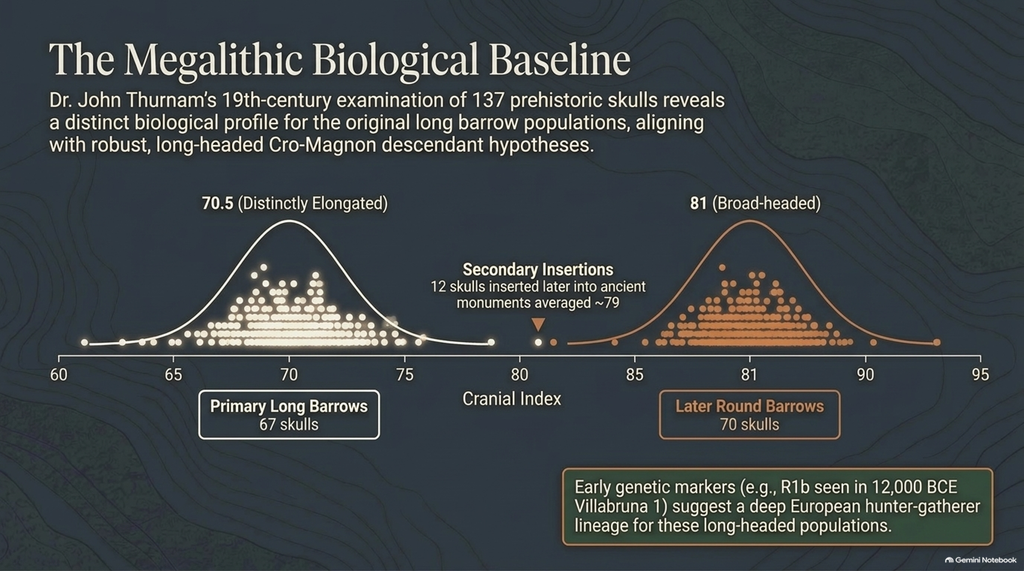
Dr John Thurnam examined 137 prehistoric skulls recovered from long and round barrows. My July 2026 investigation reconstructed his published measurements.
| Burial category | Skulls | Average cranial index |
|---|---|---|
| Unchambered long barrows | 27 | 69 |
| Chambered long barrows | 40 | 71.5 |
| All long barrows | 67 | 70.5 |
| Later round barrows | 70 | 81 |
| Later secondary burials within long barrows | 12 | Approximately 79 |
<small>The additional 12 secondary burials are a separate comparison, not part of the original 137-skull total.</small>
The cranial index is calculated as:
Maximum skull breadth ÷ maximum skull length × 100
The 67 long-barrow skulls came from 17 monuments. The unchambered examples included 27 skulls with indices ranging from 63 to 75.
Among the 70 later round-barrow skulls, Thurnam recorded 44 with indices between 80 and 89.
The difference was therefore not confined to a single unusual skeleton.
More importantly, the 12 later skulls inserted into older long barrows averaged about 79, suggesting that different burial populations could occupy the same monument over time.
These measurements do not establish excarnation or identify a particular genetic lineage. They do, however, provide a measurable biological comparison relevant to the later changes in funerary practice.
5. The Original Purpose of Long Barrows
My wider Post-Glacial Flooding Hypothesis proposes that Britain’s elongated long barrows also had a maritime significance.
Their tapered plans, frequently prominent landscape positions and potential visibility from ancient waterways raise the possibility that some were designed to resemble vessels carrying ancestral remains towards an afterlife.
This remains a proposed interpretation rather than an established archaeological function.
Conventional chronology places Britain’s securely dated chambered long barrows principally in the early Neolithic. My alternative reconstruction investigates whether the underlying tradition extended into the Mesolithic.
The dates of deposited bones cannot automatically establish the original construction dates of their monuments.
Conclusion — The First Funerary Tradition
The proposed sequence is therefore straightforward:
Body exposed on a dolmen → decomposition → collection of selected bones → deposition within a long barrow.
The engineering features, skeletal patterns and recorded cranial measurements provide different kinds of evidence for investigating this reconstruction. They should not be mistaken for independent proof that every dolmen served the same function.
This establishes the starting hypothesis for our wider investigation.
The next stage is the appearance of oval barrows, where the burial of complete or partly articulated bodies within timber mortuary structures becomes central to the discussion.
Section Two — The Oval Barrow: A Different Monument or a Misidentified Long Barrow?
1. How Many Long Barrows Are There?
Historic England’s published records provide the starting point.
| Recorded monument category | Number in England |
|---|---|
| Long barrows | Approximately 500–540 |
| Oval barrows | Fewer than 50 |
| Long barrows in Hampshire, Wiltshire and Dorset | Approximately 180 |
| Chambered long barrows surviving in the Cotswold–Severn region | More than 150 |
The figures come from Historic England’s monument descriptions and English Heritage’s survey of chambered long barrows.
The totals are not necessarily mutually exclusive, and they do not count independently dated monuments.
Nevertheless, they raise a question: could the comparatively small number of officially recognised oval barrows reflect the way prehistoric monuments have been classified?
To investigate that possibility, we need measurable criteria rather than antiquarian names.
2. Is a Monument Under 50 Metres Really a Long Barrow?
Buckinghamshire’s archaeological guidance describes conventional long barrows as generally 25–120 metres long, while oval barrows are generally shorter than 45 metres.
A wider survey from the Damerham Archaeology Project states that most long barrows measure between 25 and 60 metres, with some below 20 metres.
Therefore, length alone cannot establish a separate type. But the measurements are worth comparing.
| Monument | Length | Width | Length/width ratio | Recorded classification |
|---|---|---|---|---|
| West Kennet, Wiltshire | 100 m | 25 m | 4.0 | Chambered long barrow |
| Wayland’s Smithy II, Oxfordshire | 55 m | — | — | Chambered long barrow |
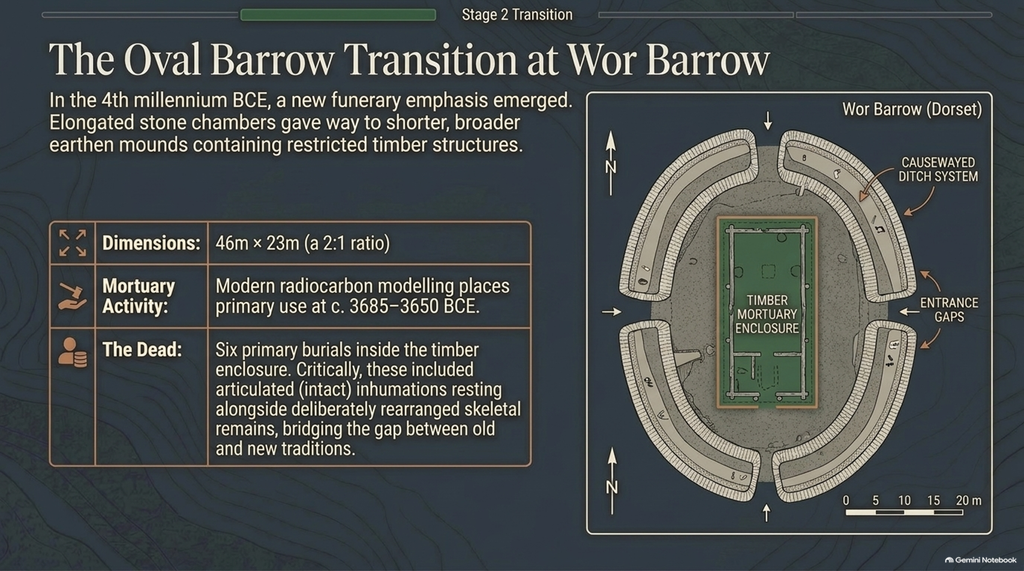
| Wor Barrow, Dorset | 46 m | 23 m | 2.0 | Oval barrow |
| Shrub’s Wood, Kent | 38 m | 19 m | 2.0 | Oval barrow |
| Coberley, Gloucestershire | 38 m | 12 m | 3.2 | Long barrow |
| Whiteleaf Hill, Buckinghamshire | 22 m | 18 m | 1.2 | Oval barrow |
Dimensions are published measurements, rounded where appropriate. Ratios are calculated from those figures; Whiteleaf’s surviving shape has been affected by excavation.
This comparison reveals the problem.
Coberley and Shrub’s Wood are both 38 metres long, yet one is classified as a long barrow and the other as an oval barrow.
The reason is not their length. Coberley is substantially narrower relative to its length.
Wor Barrow is slightly longer than the general 45-metre limit given for oval barrows but retains an approximately 2:1 plan.
A proposed 50-metre threshold would therefore identify useful candidates for re-examination, but it would also incorrectly group some recognised elongated long barrows with oval monuments.
The stronger test is to compare length, width, plan, ditch configuration and construction sequence.
3. What Makes an Oval Barrow Different?
| Architectural feature | Conventional long barrow | Oval barrow |
|---|---|---|
| Overall plan | Elongated, often trapezoidal | Rounded or elliptical |
| Length/width | Commonly more than 2:1 | Frequently around 2:1 or less |
| Ditches | Usually flanking the sides | May curve around the ends |
| Mortuary arrangements | Stone chambers, timber structures or other deposits | Often smaller burial arrangements; considerable variation |
| Construction | Sometimes developed through several phases | Also frequently enlarged or remodelled |
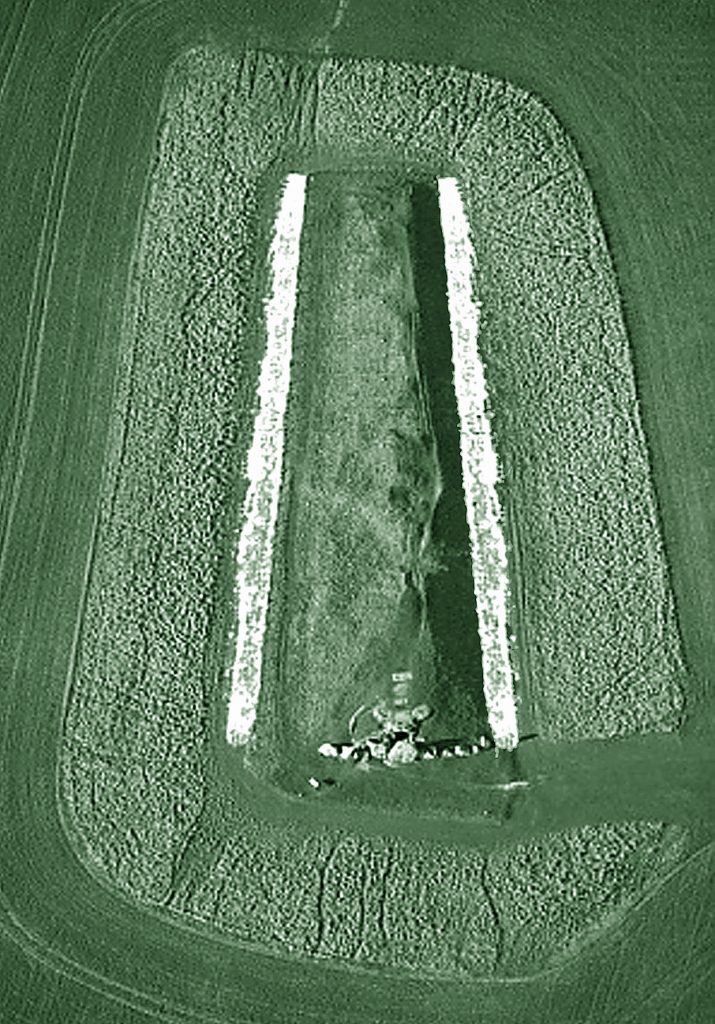
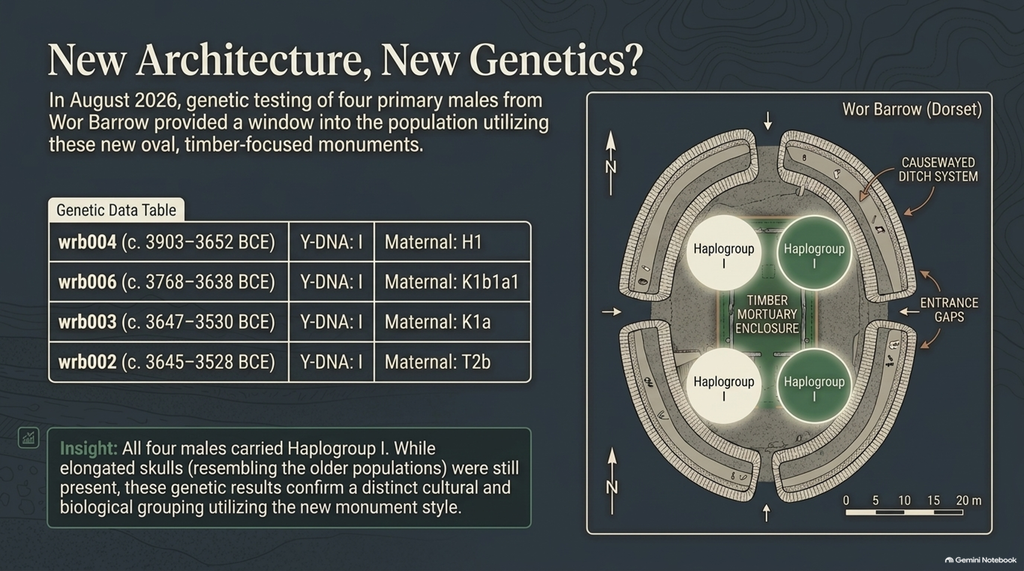
Wor Barrow illustrates the significance of the ditch arrangement.
Pitt-Rivers recorded substantial segmented ditches surrounding the mound, with causeways separating the excavated sections.
The monument also contained a timber mortuary enclosure and six primary burials.
Its architecture therefore differs from the familiar elongated, stone-chambered monument represented by West Kennet.
But the distinction cannot be reduced to stone versus timber: both types could incorporate wooden structures.
The question is whether the architectural differences also reflect a chronological shift.
4. Do the Radiocarbon Dates Identify a Later Tradition?
Published investigations provide several useful comparisons.
| Monument | Published date, cal BCE | What was dated or estimated |
|---|---|---|
| West Kennet | c. 3650 | Modelled monument construction from mortuary evidence |
| Wor Barrow | c. 3685–3650 | Modelled beginning of mortuary activity; original timber construction not directly dated |
| Whiteleaf Hill | 3760–3640 | Human burial |
| Whiteleaf Hill | 3660–3520 | Initial mound construction |
| Wayland’s Smithy I | 3590–3555 | Earliest burials in timber-and-stone mortuary structure |
| Wayland’s Smithy II | c. 3460–3400 | Later monumental chambered barrow |
These dates come from published studies that used earlier calibration and modelling procedures. They have not been independently recalculated with IntCal20.
The most revealing example is Whiteleaf Hill.
Its human remains date to 3760–3640 BCE, but the original oval mound was constructed around 3660–3520 BCE.
The person buried there may therefore have died before the mound was constructed.
This shows that dating skeletal remains and dating monument construction are not necessarily the same.
Wor Barrow presents a related problem. Its mortuary activity is comparatively well dated, but Historic England acknowledges that no surviving material directly dates the construction of its original timber enclosure.
The dates nevertheless place both sites within the period when oval barrows became archaeologically prominent.
5. What Does the Wider Chronological Study Show?
A 2018 investigation published in Internet Archaeology compared monument traditions across south-central England.
Its statistical modelling produced the following results:
| Chronological comparison | Modelled probability |
|---|---|
| Chambered long barrows appeared before oval barrows | 85.5% |
| Earthen long barrows appeared before oval barrows | 76.6% |
| Oval barrows first appeared during the 36th–35th centuries BCE | Most probable interval, not a fixed date |
The full model gives a wider 95% probability range of 3850–3375 BCE for the beginning of oval-barrow construction.
Importantly, the same study cautions that the smaller monuments around Stonehenge do not independently establish a simple relationship between oval shape and later construction.
Thus, the dates support a broad chronological tendency, but not an absolute rule.
6. What Does This Mean for the Funerary Transition?
The preceding section proposed that an earlier megalithic tradition involved excarnation followed by collecting and depositing selected bones.
The oval barrow introduces a potentially different emphasis.
At Wor Barrow, two primary skeletons were largely articulated, another retained substantial articulation, and three were partly or wholly disarticulated.
The burial group was placed within a restricted mortuary structure, subsequently covered and monumentalised.
This is not evidence that secondary treatment suddenly disappeared.
Rather, it demonstrates that articulated inhumation and rearranged skeletal deposition could occur within the same monument.
That combination is precisely why Wor Barrow deserves attention as a possible transitional example.
The next stage of the investigation must therefore examine whether the people buried in these monuments differed from those associated with the earlier long-barrow tradition — and whether the growing use of inhumation coincided with changes in population, culture or belief.
The central proposition is not that every monument under 50 metres has been misidentified. It is that the existing long-barrow category may conceal different architectural and funerary traditions whose relationships can be tested through measurements, construction sequences and radiocarbon chronology.
Section Three — The Oval Barrow: Has Archaeological Misclassification Obscured a Prehistoric Cultural Transition?
Our proposed sequence of prehistoric funerary traditions identifies the emergence of oval barrows during the fourth millennium BCE as an important development between earlier megalithic practices and the growth of organised cremation.
But there is a fundamental problem.
How can archaeologists establish when oval barrows first appeared if monuments with virtually identical characteristics have been classified differently?
Historic England records approximately 500 long barrows in England, compared with fewer than 50 officially recognised oval barrows.
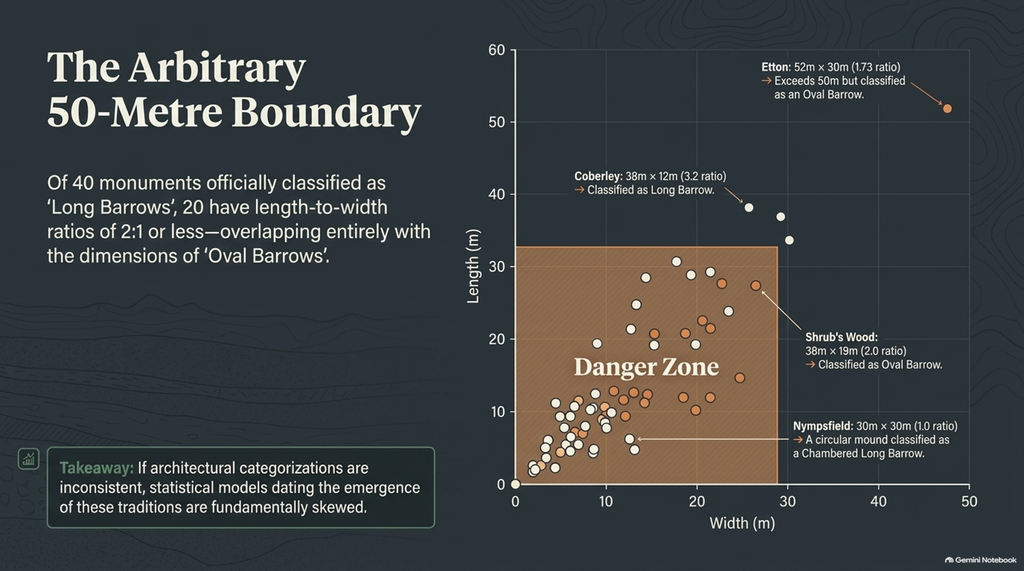
Yet an examination of 51 recorded monuments reveals considerable overlap between these categories.
1. The Classification Problem — What Is a Long Barrow?
Traditionally, long barrows are described as elongated funerary monuments, commonly trapezoidal, with quarry ditches along their sides.
Oval barrows are usually shorter, broader and more elliptical, sometimes with ditches extending around their ends.
However, these distinctions are not applied consistently.
Our initial inventory contains:
| Official classification | Monuments examined |
|---|---|
| Long barrows | 35 |
| Chambered long barrows | 5 |
| Oval barrows | 11 |
| Total | 51 |
Of the 40 monuments classified as long or chambered long barrows, 20 have recorded length-to-width ratios of 2:1 or less.
This is remarkable because such proportions overlap substantially with monuments officially classified as oval barrows.
The inventory deliberately includes shorter and broader examples; it is not a representative national sample. Nevertheless, the inconsistencies are measurable.
2. Different Names for Almost Identical Monuments
Consider the following examples taken directly from Historic England’s records.
| Monument | Official classification | Length | Width | Ratio |
|---|---|---|---|---|
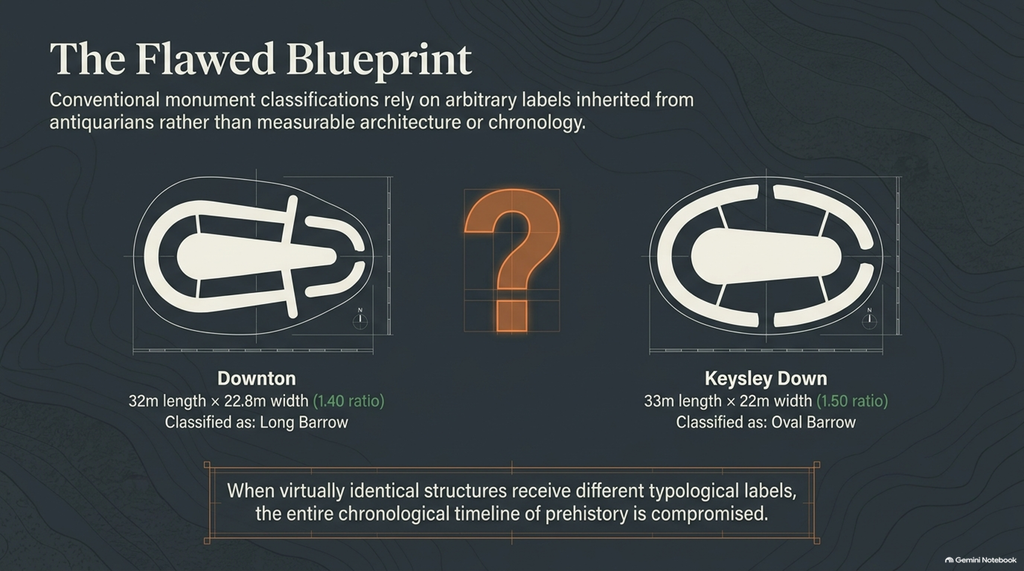
| Downton, Wiltshire | Long barrow | 32 m | 22.8 m | 1.40 |
| Keysley Down, Wiltshire | Oval barrow | 33 m | 22 m | 1.50 |
| Barrow Copse, Wiltshire | Long barrow | 40 m | 27 m | 1.48 |
| Wor Barrow, Dorset | Oval barrow | 46 m | 23 m | 2.00 |
| Etton, Yorkshire | Oval barrow | 52 m | 30 m | 1.73 |
| Nympsfield, Gloucestershire | Chambered long barrow | 30 m | 30 m | 1.00 |
The most revealing comparison is Downton and Keysley Down.
Both monuments are approximately 33 metres long and 22 metres wide.
Both have flanking quarry ditches.
Both are situated in Wiltshire.
Yet one is officially classified as a long barrow and the other as an oval barrow.
Barrow Copse presents another example. Its official description identifies the mound as ovate, measuring 40 by 27 metres, but still classifies it as a long barrow.
Meanwhile, Etton is classified as an oval barrow despite measuring 52 metres long.
There is clearly no consistently applied 50-metre boundary between the two monument categories.
Indeed, Nympsfield demonstrates the opposite problem: a virtually circular mound containing genuine stone chambers remains classified as a chambered long barrow.
Its classification reflects internal architecture and regional tradition rather than overall mound shape.
This suggests that archaeological terminology combines several different criteria without consistently separating them.
3. Archaeologists Have Already Acknowledged the Problem
This criticism is not based solely on our inventory.
In 2018, researchers publishing in Internet Archaeology examined the classification of long and oval barrows around Stonehenge.
They acknowledged that shorter long barrows were sometimes called oval barrows and that the basis for treating oval barrows as a separate monument type was not clearly defined.
That admission is important.
The same study subsequently used archaeological classifications to model the chronological appearance of different monument categories.
Its results suggested that oval barrows emerged later than chambered and earthen long barrows.
| Chronological comparison | Published probability |
|---|---|
| Chambered long barrows appeared before oval barrows | 85.5% |
| Earthen long barrows appeared before oval barrows | 76.6% |
| Oval barrows were the last of the compared types to appear | 54.4% |
Oval barrows were estimated to have emerged most probably during the 36th or 35th centuries BCE.
But these results depend partly on which monuments were assigned to each category.
If short, broad monuments have been classified inconsistently, the chronological comparison may be affected.
Radiocarbon measurements can be perfectly accurate, while the archaeological categories used to interpret them remain questionable.
This distinction is at the centre of this investigation.
4. The Dating Problem Is Even Greater
Our 51-monument inventory presents another difficulty.
Only three entries currently contain explicit chronological information in the inventory’s dating field.
The other 48 require further investigation to establish whether direct construction dates, burial dates or only typological estimates are available.
This does not mean those monuments have never been dated. It means we have not yet independently established their construction chronology within our dataset.
The difference between a burial date and the construction date of its monument is particularly important.
At Wor Barrow, modern radiocarbon modelling places the principal mortuary activity around 3700–3600 BCE.
But Historic England acknowledges that the original timber mortuary enclosure was not directly dated.
The excavators therefore inferred its relationship to the earliest burials.
In other words, the chronology of the burials is better established than the date when the original structure was built.
Any attempt to date the emergence of oval barrows must distinguish these events.
Otherwise, we risk dating monument use rather than its construction.
5. Was a Cultural Transition Hidden Inside the Wrong Category?
The implications extend beyond terminology.
If some shorter, broader monuments currently recorded as long barrows belong to a distinctive architectural tradition, their classification could obscure that tradition’s chronology.
This matters particularly when investigating changing funeral customs.
The earlier megalithic model proposed in Section One involves collecting and depositing selected ancestral bones.
Wor Barrow, by contrast, contained six individuals within a small timber mortuary structure, including substantially articulated bodies and deliberately rearranged skeletal remains.
At Etton, another officially classified oval barrow, excavators discovered cremated remains beneath the mound.
Thus, oval barrows themselves could accommodate different funerary practices.
The architecture may reflect a changing tradition, but it cannot automatically be equated with a single burial form.
The possibility worth investigating is whether the shorter, broader monuments form a previously under-recognised chronological or cultural grouping.
To establish that, we need a systematic comparison of original monument plans, ditch arrangements, construction phases and directly associated radiocarbon dates.
Simply renaming every monument shorter than 50 metres would reproduce the very classification problem we are criticising.
Conclusion — If the Categories Are Wrong, the History May Be Wrong
The initial evidence establishes three important findings.
First, long and oval barrows overlap considerably in their recorded dimensions.
Second, official archaeological classifications do not follow one consistent rule based on shape or size.
Third, the proposed chronology of oval-barrow emergence depends upon the selection and classification of monuments included in archaeological dating models.
These observations do not prove that every questionable monument has been misidentified.
They do show that the existing classification system requires further testing before it can serve as a reliable foundation for reconstructing cultural development.
The consequences could be considerable.
If a later architectural tradition has been grouped indiscriminately with earlier monuments, archaeologists may have underestimated its frequency, misunderstood its distribution or distorted the apparent timing of its emergence.
The problem is not necessarily the scientific dating. It is the interpretation of that evidence through archaeological categories that may be inconsistent or historically inherited.
This brings us directly to Wor Barrow.
Rather than assuming it is simply another long barrow, we should investigate whether its oval architecture, unusual mortuary enclosure and burial arrangements represent a distinct stage in prehistoric funeral customs.
Only then can we establish whether the apparent transition from earlier ancestral burial practices to later inhumation and cremation reflects a real cultural development—or whether that transition has remained obscured by how the monuments were originally classified.
Section Four — Ancient DNA: Did a New Population Bring Different Funeral Customs to Britain?
The preceding sections identified two potentially distinct funerary traditions: an earlier megalithic system associated, in our hypothesis, with Mesolithic excarnation and the collection of ancestral bones, followed by the appearance of oval barrows containing articulated inhumations during the Early Neolithic.
Could this architectural and cultural transition also represent a change in the people occupying Britain?
Our 2026 book, Dawn of the Lost Civilisation, investigated this question precisely by combining skeletal stature, cranial measurements and ancient DNA to explore the origins of Britain’s megalithic builders.
The proposed connection links the physically robust, long-headed populations traditionally described as Cro-Magnon with early European paternal lineages belonging to R1b.
1. Identifying the Earlier Population
The first evidence comes from individuals whose genetic ancestry and physical measurements can be compared.
| Individual | Period and location | Genetic evidence | Physical evidence |
|---|---|---|---|
| Villabruna 1 | c. 12,000 BCE, Italy | R1b1 / R-L754 | Skull 181 × 137.5 mm; cranial index 75.97 |
| M50 / I4655 | 7059–6571 BCE, Romania | R-L754 | Tibia 412 mm; reconstructed stature 181.63 cm |
| I3004, Aveline’s Hole | 8606–8300 BCE, Somerset | Reported R1b-derived; provisional assignment | Dated human tibia |
| Skull M1.11.301, Aveline’s Hole | British Mesolithic | Not genetically identified | Skull 186 × 134 mm; cranial index 72.0 |
These findings, examined in Chapter One of Dawn of the Lost Civilisation, establish important connections.
Villabruna shows an early R1b lineage in a non-round-headed European individual.
M50 establishes that a tall Mesolithic European male carried an early R1b lineage.
At Aveline’s Hole, the proposed R1b connection occurs within the same burial population as elongated skulls, although the genetically sampled tibia and measured cranium have not been identified as belonging to the same individual. The I3004 genetic assignment also requires confirmation.
The combined findings support investigating a biological relationship between older European hunter-gatherers and the people subsequently buried in Britain’s megalithic monuments.
They do not yet establish that the original megalith builders predominantly carried R1b.
2. Thurnam’s Evidence — The Long-Headed Population
The next evidence comes from John Thurnam’s nineteenth-century investigation of prehistoric British skulls.
| Burial context | Individuals | Average cranial index |
|---|---|---|
| Primary long-barrow deposits | 67 | 70.5 |
| Later secondary deposits within long barrows | 12 | Approximately 79 |
| Round-barrow comparative sample | 70 | 81 |
The 67 primary long-barrow skulls came from 17 monuments.
Their average cranial index demonstrates a predominantly elongated cranial form.
The additional 12 skulls recovered from later deposits within existing long barrows averaged approximately 79.
This is particularly interesting because cranial form differed between burial phases even within the same monuments.
Thurnam’s round-barrow comparison belongs to a later funerary horizon and must not be mistaken for direct evidence of a Mesolithic-to-Early-Neolithic population change.
Nevertheless, his measurements establish a biological pattern worth investigating.
Our hypothesis proposes that the original long-barrow population preserved elements of the earlier Cro-Magnon physical tradition, as identified through skeletal robustness, stature, and cranial dimensions.
The question is whether that physical continuity also corresponds to inherited R1b lineages.
3. Wor Barrow — Four Males Carrying Haplogroup I
A genetic investigation published in August 2026 provides important new evidence from Wor Barrow.
Four individuals from the original six primary burials yielded the following results:
| Genetic sample | Date, cal BCE (95.4%) | Y-DNA | Maternal lineage |
|---|---|---|---|
| wrb004 | 3903–3652 | I | H1 |
| wrb006 | 3768–3638 | I | K1b1a1 |
| wrb003 | 3647–3530 | I | K1a |
| wrb002 | 3645–3528 | I | T2b |
All four tested males belonged to paternal haplogroup I.
The genetic study assigned them only to the broad haplogroup I category, rather than identifying a more specific I2 branch.
This distinction matters.
Other males recovered from contemporary Neolithic long barrows, including Sale’s Lot and Sisters Long Barrow, carried I2a2 lineages.
Therefore, haplogroup I was not exclusive to Wor Barrow or to oval burial monuments.
Nevertheless, the Wor Barrow results provide a useful opportunity to investigate whether changes in funerary architecture corresponded with differences in the populations using those monuments.
4. Did the Physical Characteristics Change?
Pitt-Rivers identified elongated skulls among the Wor Barrow individuals.
This produces an important comparison with the earlier long-barrow population.
| Characteristic | Proposed earlier population | Wor Barrow |
|---|---|---|
| Funerary architecture | Megalithic chambers and long barrows | Timber mortuary structure beneath an oval mound |
| Proposed funeral practice | Excarnation followed by secondary bone deposition | Articulated inhumations alongside rearranged bones |
| Cranial morphology | Predominantly elongated | Elongated skulls also recorded |
| Paternal DNA | Early R1b connection proposed | Four tested males assigned to I |
| Original builders genetically established? | No | Original timber construction not directly dated |
The difficulty is immediately apparent.
A change in funerary architecture and burial practice does not necessarily correspond to an equally clear change in skull shape.
If the Wor Barrow males carried haplogroup I while displaying elongated crania, cranial morphology alone cannot reliably identify an R1b paternal lineage.
Nor does the skull evidence invalidate their genetic assignments.
What requires investigation is whether the earlier and later populations differed in combinations of traits — stature, body proportions, cranial dimensions and genome-wide ancestry — rather than in one characteristic alone.
The original Wor Barrow measurements are particularly valuable because they can potentially be compared directly with Thurnam’s wider dataset.
5. Was the Transition Cultural or Biological?
The evidence can now be separated into two questions.
First, did the funerary practices change?
The archaeological record establishes differences in monument architecture and the treatment of human remains, although practices also overlapped.
Second, did the population change?
Our earlier research identifies a possible connection between robust, long-headed hunter-gatherers and early R1b ancestry. The Wor Barrow investigation confirms haplogroup I among four individuals using a different type of funerary monument.
However, these findings do not yet provide a direct genetic comparison between securely identified original Mesolithic megalith builders and Wor Barrow.
Indeed, haplogroup I was already present among Mesolithic populations in Britain and Europe. It cannot automatically be treated as evidence of a newly arrived people.
The next stage of research requires direct genetic analysis of the original long-barrow remains, matched with their cranial measurements, stature estimates and archaeological contexts.
Conclusion — DNA as Secondary Evidence for Cultural Transition
Our working hypothesis proposes that the earlier megalithic funerary tradition was associated with an indigenous population descended from Europe’s robust, long-headed Cro-Magnon populations, with early R1b providing a possible paternal genetic connection.
Wor Barrow offers a comparison: a fourth-millennium BCE oval monument containing different mortuary arrangements and four genetically tested males belonging to haplogroup I.
The evidence therefore contrasts a proposed earlier population history with the directly measured ancestry of later burials.
It does not yet show that the two groups were genetically separate, or that one replaced the other.
The central argument remains the transformation of funeral customs. Ancient DNA provides an independent opportunity to test whether that transformation also involved changing communities.
If matched skeletal measurements and ancient DNA can eventually demonstrate the proposed biological distinctions, they may help explain whether the transition from megalithic mortuary practices to oval-barrow inhumation reflected changing beliefs within one population or the emergence of different cultural groups.
Principal references
- Langdon, R. J. (2026). Dawn of the Lost Civilisation, Version 5.0, Chapter One, pp. 81–86, and Chapter Six, pp. 275–278.
- Langdon, R. J. (2026). Thurnam’s 137 Skulls: The Forgotten People Behind Britain’s Megaliths.
- Vuković, N. et al. (2026). Diachronic Reuse of Neolithic Burial Monuments by Bronze Age Newcomers in Southwestern Britain. Scientific Reports, 16, 26819.
- Pitt-Rivers, A. H. L. F. (1898). Excavations in Cranborne Chase, Volume IV.
Section Five — The Cremation Revolution: Immigration and the Division of Britain’s Funeral Traditions
The final stage of our investigation concerns a major change in prehistoric funeral customs: the emergence of large-scale, organised cremation at Stonehenge around 3000 BCE.
Our earlier sections proposed that Britain’s original megalithic tradition involved excarnation and the collection of ancestral bones, followed by the introduction of articulated burials within oval monuments such as Wor Barrow.
Stonehenge presents a third development.
Instead of preserving complete bodies or collecting skeletal remains, its cemetery contained the cremated remains of numerous individuals.
Was this another cultural tradition introduced from continental Europe?
Did subsequent immigration create a division between communities practising cremation and those favouring inhumation?
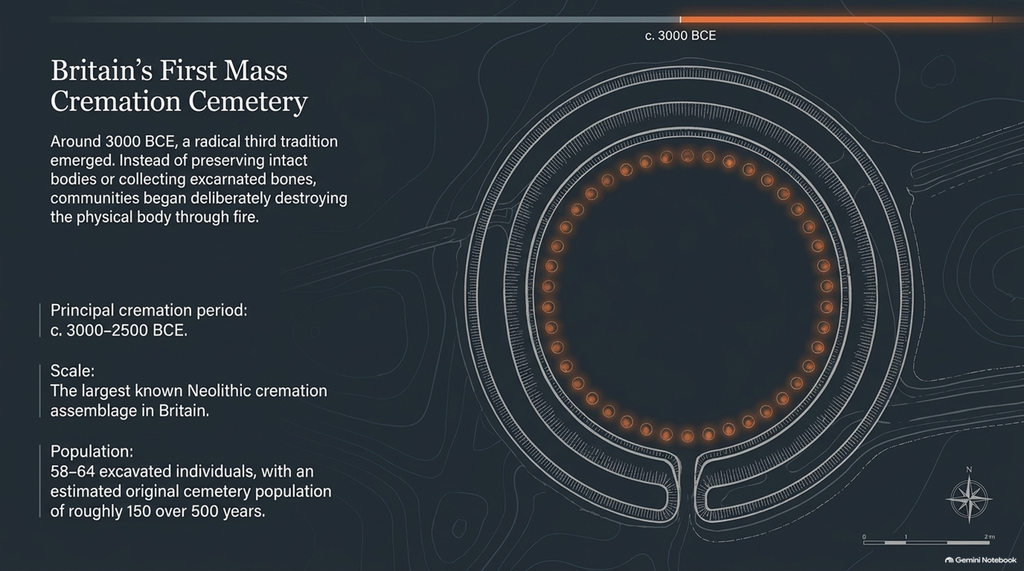
1. Stonehenge — Britain’s First Great Cremation Cemetery
The most significant evidence comes from Stonehenge itself.
Research published by Willis and colleagues in 2016 established that Stonehenge contains the largest known Neolithic cremation assemblage in Britain.
Unlike isolated earlier cremations, this was a substantial cemetery used repeatedly over several centuries.
| Archaeological evidence | Stonehenge findings |
|---|---|
| Principal cremation period | c. 3000–2500 BCE |
| Excavated individuals | Approximately 58–64 |
| Estimated original cemetery population | Approximately 150, although uncertain |
| Main burial locations | Aubrey Holes and surrounding ditch |
| Duration | Approximately 500 years |
| Significance | Largest known Neolithic cremation cemetery in Britain |
The original cemetery population may have been considerably greater than the number recovered because early excavations did not retain all the cremated material.
Stonehenge therefore provides our first substantial, demonstrable example of mass cremation within this proposed funerary sequence. It is not necessarily the earliest place where cremation occurred, but its scale distinguishes it from isolated earlier examples.
The chronology of the cremations must also be separated from the monument’s original construction. My Stonehenge Phase II investigation proposes an earlier architectural history, with a major phase around 4300–4200 BCE.
Within that reconstruction, the cremation cemetery represents the adoption of a different funerary practice at an existing monumental location.
2. Three Different Ways of Treating the Dead
We can now compare the changes identified throughout this investigation.
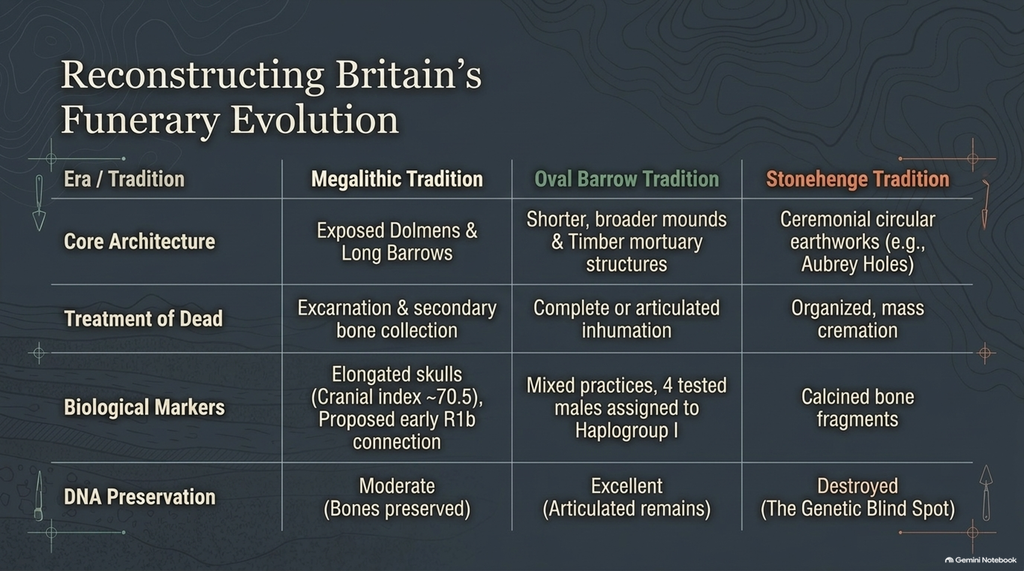
| Proposed cultural phase | Principal treatment of the dead | Monumental expression |
|---|---|---|
| Earlier megalithic tradition | Excarnation followed by collection of bones | Dolmens and long barrows |
| c. 3700–3500 BCE | Articulated inhumation alongside rearranged bones | Timber mortuary structures and oval barrows |
| From c. 3000 BCE | Organised cremation of numerous individuals | Stonehenge and associated cemetery monuments |
The archaeological differences are substantial.
Excarnation removes the flesh while preserving selected bones.
Inhumation places a substantially complete body within a grave or mortuary structure.
Cremation deliberately burns the body before the surviving remains are collected or deposited.
These are different physical treatments, potentially reflecting different ideas concerning death, ancestors and the relationship between the living and the deceased.
Could their changing prominence represent successive cultural influences introduced by different communities?
Ancient DNA provides an opportunity to investigate that possibility.
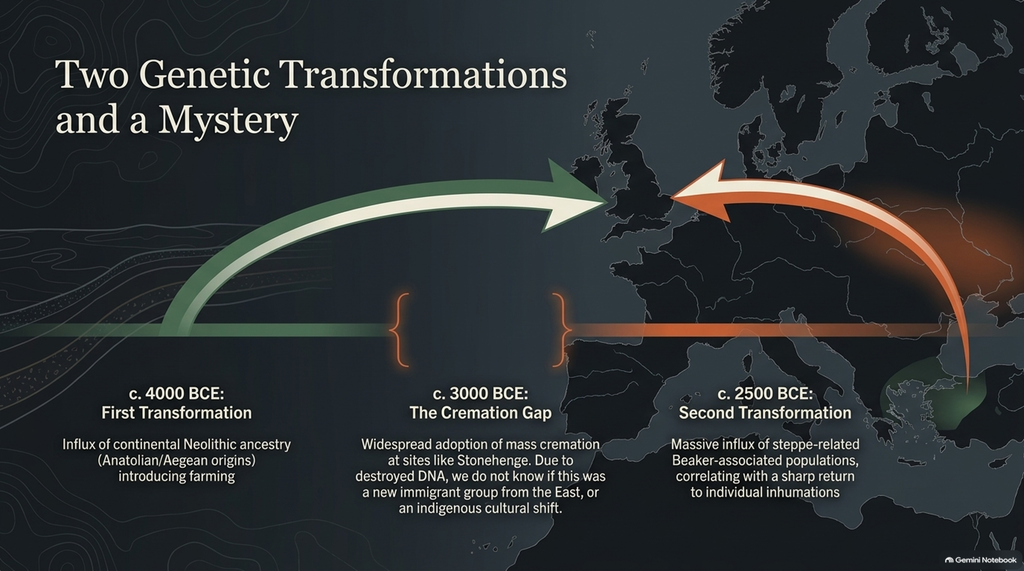
3. Immigration from Continental Europe — Two Genetic Transformations
Genetic studies identify two major periods of continental immigration affecting Britain’s prehistoric population.
| Event | Approximate date | Genetic evidence | Cultural development |
|---|---|---|---|
| Earlier indigenous population | Mesolithic | European hunter-gatherer ancestry; both I and early R1b lineages occur in relevant European populations | Proposed earlier megalithic tradition |
| First major farming-associated influx | c. 4000 BCE | Continental Neolithic ancestry with ultimate origins in Anatolia and the Aegean | Farming and Early Neolithic cultural developments |
| Stonehenge cremation cemetery | c. 3000 BCE | Genetic identity of cremated population largely unknown | Large-scale organised cremation |
| Second major continental genetic influx | c. 2500 BCE | Substantial steppe-related ancestry among sampled Beaker-associated individuals | Increasing prominence of individual inhumation |
The first recognised influx is conventionally associated with the introduction of farming around 4000 BCE.
This is contemporary with, or earlier than, the oval-barrow developments examined at Wor Barrow.
The second major genetic transformation occurred much later, around 2500 BCE, during the transition from the Late Neolithic to the Early Bronze Age.
Importantly, these later immigrants did not introduce farming into Britain for the first time.
Stonehenge’s cremation cemetery emerges between these two major genetic developments.
That raises the possibility of an additional cultural influence, perhaps spreading westwards through continental European networks.
An eastern introduction of the organised cremation tradition is therefore a hypothesis worth testing. However, the available evidence does not establish that a genetically identifiable group of eastern immigrants founded Stonehenge’s cemetery.
4. The Later Division — Cremation Versus Inhumation
By the end of the Neolithic, Britain’s funerary record presents an important contrast.
Cremation was prominent during the period represented by Stonehenge’s cemetery.
Following the arrival of Beaker-associated populations, individual inhumation became increasingly visible.
| Characteristic | Late Neolithic cremation | Beaker-associated inhumation |
|---|---|---|
| Treatment | Body burned | Body generally buried intact |
| Remains | Calcined, fragmented bones | Often articulated skeleton |
| Archaeological setting | Cremation pits, cemeteries and monuments | Individual graves and later round barrows |
| Ancient DNA recovery | Generally poor | Often substantially better |
| Population ancestry | Frequently unknown | Increased steppe-related ancestry among sampled individuals |
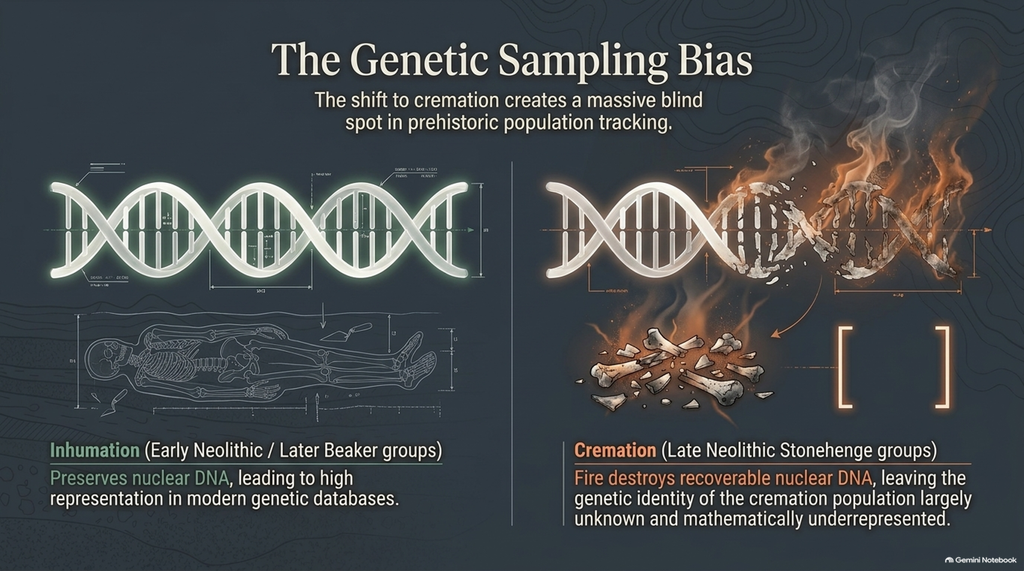
This division matters because different funeral customs directly influence what survives for scientific investigation.
Cremation usually destroys the recoverable nuclear DNA needed for conventional ancient-genome analysis.
Inhumation often preserves it.
Consequently, a population practising cremation may be substantially underrepresented in ancient-DNA databases compared with another population practising inhumation.
Researchers investigating the Beaker-associated genetic transformation have explicitly considered this potential sampling bias.
It cannot automatically explain away observed genetic change, but it must be considered when comparing populations whose dead were treated differently.
5. Was Cremation the Funeral Practice of an Earlier Population?
This brings us to the central question.
If an established Late Neolithic population was practising cremation when another continental population arrived favouring individual inhumation, the archaeological record might contain two different cultural traditions operating at approximately the same time.
Widespread DNA recovery from the inhumation population would not necessarily capture the cremation population.
That possibility is particularly relevant to our investigation of Britain’s earlier indigenous inhabitants.
Our proposed Cro-Magnon and R1b connection identifies one potential strand of earlier population history. The Wor Barrow haplogroup I results offer another point of comparison.
But without recoverable DNA from the Stonehenge cremation population, we cannot establish whether those individuals descended predominantly from earlier British communities, later continental immigrants or a mixture of both.
The funerary evidence demonstrates a cultural distinction; the genetic identity of the cremation population remains an open question.
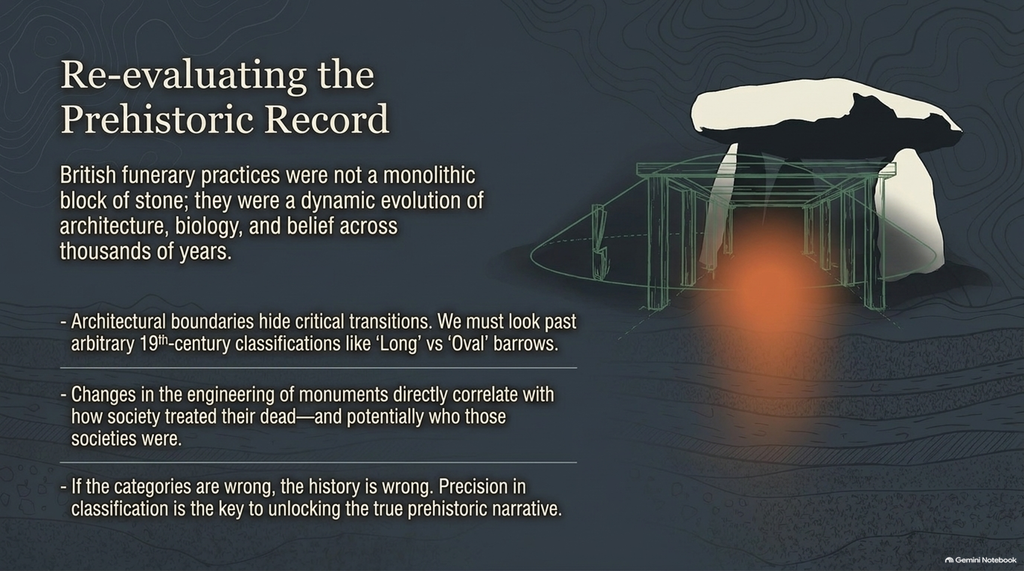
Conclusion — A Cultural Transition Hidden Within the Archaeological Record
Our investigation has followed three proposed stages in the development of prehistoric British funeral customs:
Excarnation and megalithic long barrows; articulated burial and oval barrows; and finally, large-scale cremation at Stonehenge.
The investigation focuses on changes in architecture and the treatment of the dead.
Ancient DNA provides another way to determine whether those changes corresponded to different communities.
The evidence already demonstrates major genetic changes associated with continental immigration during the Early Neolithic and again around the end of the Neolithic.
But Britain’s principal Late Neolithic cremation population remains poorly represented in the genetic record.
This creates a fundamental difficulty when reconstructing prehistoric population history.
If one community cremated its dead while another buried them intact, the surviving DNA record would inevitably favour the population practising inhumation.
Our proposed cultural transition therefore raises a question extending beyond archaeology’s conventional monument classifications.
Were Britain’s changing funerary practices the result of new beliefs spreading among established populations, successive immigration from continental Europe, or the coexistence of communities preserving different traditions?
Stonehenge provides the strongest evidence for the cremation stage.
Wor Barrow provides an earlier example of changing burial architecture and mortuary treatment.
And the proposed megalithic exhumation tradition offers a starting point for examining the possible continuity of Britain’s earlier inhabitants.
Together, they provide a framework for investigating not simply how prehistoric people buried their dead, but how British society itself may have changed over thousands of years.
Principal references
- Willis, C. et al. (2016). The Dead of Stonehenge. Antiquity, 90, 337–356.
- Brace, S. et al. (2019). Ancient Genomes Indicate Population Replacement in Early Neolithic Britain. Nature Ecology & Evolution.
- Olalde, I. et al. (2018). The Beaker Phenomenon and the Genomic Transformation of Northwest Europe. Nature.
- Langdon, R. J. (2026). Dawn of the Lost Civilisation, Version 5.0.
- Langdon, R. J. (2026). Stonehenge Phase II. Prehistoric Britain.
Podcast

Author’s Biography
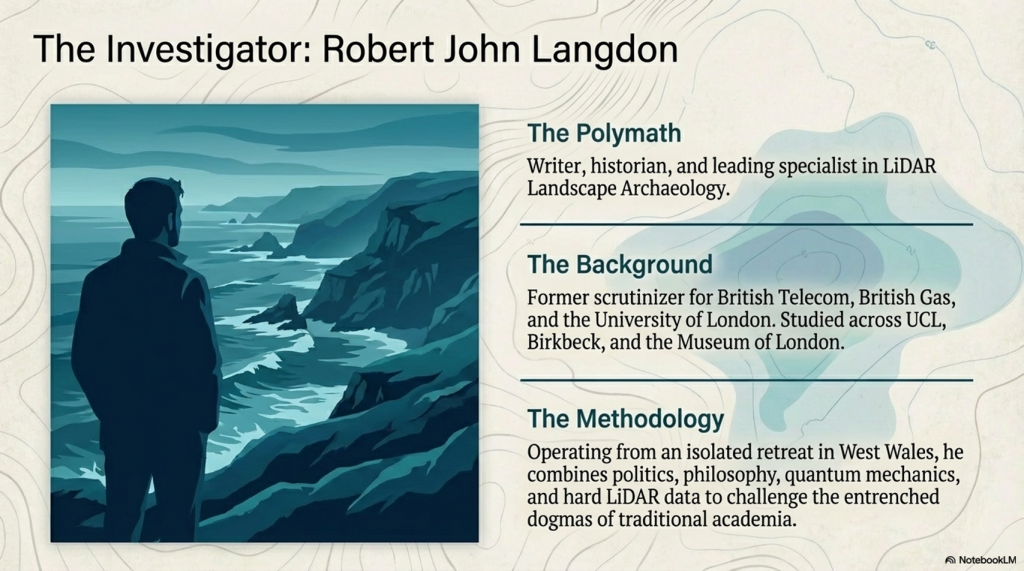
Robert John Langdon, a polymathic luminary, emerges as a writer, historian, and eminent specialist in LiDAR Landscape Archaeology.
His intellectual journey has included stints as an astute scrutineer in government and major corporate bastions, spanning British Telecommunications, Cable and Wireless, British Gas, and the esteemed University of London.
A decade hence, Robert’s transition into retirement unfurled a chapter of insatiable curiosity. He immersed himself in Politics, Archaeology, Philosophy, and the enigmatic realm of Quantum Mechanics. His academic odyssey took him through the venerable corridors of knowledge hubs such as the Museum of London, University College London, Birkbeck College, The City Literature Institute, and Chichester University.
In the symphony of his life, Robert is a custodian of three progeny and a pair of cherished grandchildren. His sanctuary lies ensconced in the embrace of West Wales, where he inhabits an isolated cottage, its windows framing a vista of the boundless sea – a retreat from the scrutinising gaze of Her Majesty’s Revenue and Customs, an amiable clandestinity in the lap of nature.
Exploring Prehistoric Britain: A Journey Through Time
My blog delves into the fascinating mysteries of prehistoric Britain, challenging conventional narratives and offering fresh perspectives grounded in cutting-edge research, particularly LiDAR technology. I invite you to explore some key areas of my research. For example, I re-examine the Wansdyke, often cited as a defensive structure, in light of new evidence. I’ve presented my findings in my blog post Wansdyke: A British Frontier Wall – ‘Debunked’, and a Wansdyke LiDAR Flyover video further visualises my conclusions.
My work also often challenges established archaeological dogma. I argue that many sites, such as Hambledon Hill, commonly identified as Iron Age hillforts, are not what they seem. My posts Lidar Investigation Hambledon Hill – NOT an ‘Iron Age Fort’ and Unmasking the “Iron Age Hillfort” Myth explore these ideas in detail and offer an alternative view. Similarly, I re-evaluated sites like Cissbury Ring and White Sheet Camp through LiDAR analysis in my posts “Lidar Investigation Cissbury Ring through time” and “Lidar Investigation White Sheet Camp,“ revealing fascinating insights into their true purpose. I have also examined South Cadbury Castle, often linked to the mythical Camelot56.
My research also extends to ancient water management, including the role of canals and other linear earthworks. I have discussed the true origins of Car Dyke in multiple posts, including Car Dyke – ABC News Podcast and Lidar Investigation Car Dyke – North Section, which suggest a Mesolithic origin 2357. I also explore the misidentification of Roman aqueducts, as seen in my posts on the Great Chesters (Roman) Aqueduct. My research has also been greatly informed by my post-glacial flooding hypothesis, which has helped explain landscape transformations over time. I have discussed this hypothesis in several posts, including AI now supports my Post-Glacial Flooding Hypothesis and Exploring Britain’s Flooded Past: A Personal Journey
Finally, my blog also investigates prehistoric burial practices, as seen in Prehistoric Burial Practices of Britain and explores the mystery of Pillow Mounds, often mistaken for medieval rabbit warrens, but with a potential link to Bronze Age cremation in my posts: Pillow Mounds: A Bronze Age Legacy of Cremation? and The Mystery of Pillow Mounds: Are They Really Medieval Rabbit Warrens?. My research also includes astronomical insights into ancient sites, for example, in Rediscovering the Winter Solstice: The Original Winter Festival. I also review new information about the construction of Stonehenge in The Stonehenge Enigma.
Yes. I’d make this far tighter, more inviting and more obviously a gateway into the rest of your work. The present version repeats the website several times and reads more like an author biography than a “what next?” section.
I’d also make the three routes immediately obvious: Explore the Research → Watch the Videos → Read the Books, with Facebook as the discussion/community route.
Further Reading — Explore the Evidence
The investigation doesn’t end with this article.
Prehistoric Britain brings together hundreds of articles, LiDAR investigations, field discoveries, archaeological studies and original research exploring Britain’s prehistoric landscape from a different perspective.
Follow the evidence across ancient waterways, lost landscapes, Stonehenge and Avebury, prehistoric engineering, submerged Britain, ancient DNA and the effects of post-glacial flooding — comparing established archaeological interpretations with alternative explanations suggested by the physical evidence.
🎬 Watch the Investigations
Prefer to watch rather than read?
The Robert John Langdon YouTube channel has more than 200 documentaries, investigations, and video presentations that bring the research to life through maps, LiDAR, archaeological evidence, and landscape reconstruction.
Discover investigations including 13 Things That Don’t Make Sense in History, Silbury Avenue – The Lost Stone Avenue, Stonehenge, prehistoric waterways, submerged landscapes and many more.
📚 Explore the Book Library
Go deeper into the evidence through Robert John Langdon’s growing collection of books and specialist studies, including:
- The Stonehenge Hoax – 13 Things That Don’t Make Sense in History
- Car Dyke – Prehistoric Dyke
- Wansdyke – Prehistoric Dyke
- Offa’s Dyke – Prehistoric Dyke
- Silbury Avenue – The Lost Stone Avenue
- The Vallum – At Hadrian’s Wall
- Stonehenge: The World’s First Computer
- Avebury’s Lost Stone Avenue
Many of these investigations connect directly with the evidence discussed throughout the website, allowing individual discoveries to be examined as part of the much wider prehistoric landscape.
🔎 Read the Main Trilogy
Three major works bring together the central strands of the research:
The Post-Glacial Flooding Hypothesis — investigates the evidence for radically different water levels, waterways and landscapes in prehistoric Britain.
The Stonehenge Enigma — re-examines the chronology, landscape and purpose of one of the world’s most famous prehistoric monuments.
Dawn of the Lost Civilisation — explores the evidence for sophisticated communities, technology and maritime connections far earlier than traditionally assumed.
💬 Join the Investigation
New discoveries, LiDAR surveys and research are discussed as they happen in the Prehistoric Britain Facebook Group.
Join the discussion, challenge the evidence, offer alternative interpretations and follow new investigations as they develop.
Don’t just read the accepted story. Explore the evidence, compare the interpretations, and decide for yourself.
Other Blogs
1
a
- Ackling Dyke – Facts and the Archaeological Fiction
- Ackling Dyke – Part II – Puddletown Forest: When a Roman Road Becomes an Assumption
- Ackling Dyke – Part III – The Roman Road Mystery Finally Makes Sense
- AI now Supports – Homo Superior
- AI now supports my Post-Glacial Flooding Hypothesis
- Alexander the Great sailed into India – where no rivers exist today
- Ancient Secrets of Althorp – debunked
- Antler Picks built Ancient Monuments – yet there is no real evidence
- Antonine Wall – Prehistoric Canals (Dykes)
- Archaeological ‘pulp fiction’ – has archaeology turned from science?
- Archaeological Pseudoscience
- Archaeology in the Post-Truth Era
- Archaeology: A Bad Science?
- Archaeology: A Harbour for Fantasists?
- Archaeology: Fact or Fiction?
- Archaeology: The Flaws of Peer Review
- Archaeology’s Bayesian Mistake: Stop Averaging the Past
- Are Raised Beaches Archaeological Pseudoscience?
- Atlantis Found: The Mathematical Proof That Plato’s Lost City Was Doggerland
- ATLANTIS: Discovery with Dan Snow Debunked
- Avebury Ditch – Avebury Phase 2
- Avebury through time
- Avebury’s great mystery revealed
- Avebury’s Lost Stone Avenue – Flipbook
b
- Battlesbury Hill – Wiltshire
- Beyond Stone and Bone: Rethinking the Megalithic Architects of Northern Europe
- BGS Prehistoric River Map
- Blackhenge: Debunking the Media misinterpretation of the Stonehenge Builders
- Brain capacity (Cro-Magnon Man)
- Britain’s Changing Funeral Traditions
- Britain’s First Road – Stonehenge Avenue
- Britain’s Giant Prehistoric Waterways
- British Roman Ports miles away from the coast
c
- Caerfai Promontory Fort – Archaeological Nonsense
- Car Dyke – ABC News PodCast
- Car Dyke – North Section
- Cardigan Bay: The Holocene Evidence the Old Geological Story Has Missed
- CASE STUDY – An Inconvenient TRUTH (Craig Rhos Y Felin)
- Case Study – River Avon
- Case Study – Woodhenge Reconstruction
- Chapter 2 – Craig Rhos-Y-Felin Debunked
- Chapter 2 – Stonehenge Phase I
- Chapter 2 – Variation of the Species
- Chapter 3 – Post Glacial Sea Levels
- Chapter 3 – Stonehenge Phase II
- Chapter 7 – Britain’s Post-Glacial Flooding
- Cissbury Ring through time
- Clement Reid, Doggerland, and the Archaeological Establishment
- Cro-Magnon Brain Capacity
- Cro-Magnon Megalithic Builders: Measurement, Biology, and the DNA
- Cro-Magnons – An Explainer
d
- Darwin’s Children – Flipbook
- Darwin’s Children – The Cro-Magnons
- Dawn of The Lost Civilisation – 1/10
- Dawn of the Lost Civilisation – Flipbook
- Dawn of the Lost Civilisation – Introduction
- Digging for Britain – Cerne Abbas
- Digging for Britain Debunked – Cerne Abbas 2
- Digging Up Britain’s Past – Debunked
- DLC Chapter 1 – The Ascent of Man
- Durrington Walls – Woodhenge through time
- Durrington Walls Revisited: Platforms, Fish Traps, and a Managed Mesolithic Landscape
- Dyke Construction – Hydrology 101
- Dykes Ditches and Earthworks
- DYKES of Britain
e
f
g
h
- Hadrian’s Wall – Military Way Hoax
- Hadrian’s Wall – the Stanegate Hoax
- Hadrian’s Wall Vallum – Prehistoric Canals – FREE Online Book
- Hadrian’s Wall LiDAR investigation
- Hambledon Hill – NOT an ‘Iron Age Fort’
- Hayling Island Lidar Maps
- Hidden Sources of Ancient Dykes: Tracing Underground Groundwater Fractals
- Historic River Avon
- Hollingsbury Camp Brighton – A Hillfort… or a Forgotten Harbour?
- Hollows, Sunken Lanes and Palaeochannels
- Homo Superior – Flipbook
- Homo Superior – History’s Giants
- How Lidar will change Archaeology
- Hydrology 101 Simplified: Why Britain’s Dykes Worked Without Rivers
i
l
m
- Maiden Castle through time
- Mathematics Meets Archaeology: Discovering the Mesolithic Origins of Car Dyke
- Mesolithic River Avon
- Mesolithic Stonehenge
- Minerals found in Prehistoric and Roman Quarries
- Mining in the Prehistoric to Roman Period
- Mount Caburn through time
- Mysteries of the Oldest Boatyard Uncovered
- Mythological Dragons – a non-existent animal that is shared by the World.
o
- Offa’s Dyke Flipbook
- Old Sarum Lidar Map
- Old Sarum Through Time…………….
- On Sunken Lands of the North Sea – Lived the World’s Greatest Civilisation.
- OSL Chronicles: Questioning Time in the Geological Tale of the Avon Valley
- Oswestry LiDAR Survey
- Oswestry through time
- Oysters in Archaeology: Nature’s Ancient Water Filters?
p
- Pillow Mounds: A Bronze Age Legacy of Cremation?
- Pinkery Canal
- Plato Was Right: The Archaeological Evidence the Academics Never Expected
- Post Glacial Flooding – Flipbook
- Prehistoric Burial Practices of Britain
- Prehistoric Canals – Wansdyke
- Prehistoric Canals – Wansdyke
- Prehistoric Canals (Dykes) – Great Chesters Aqueduct (The Vallum Pt. 4)
- Prehistoric Canals (Dykes) – Offa’s Dyke (Chepstow)
- Prehistoric Canals (Dykes) – Offa’s Dyke (LiDAR Survey)
- Prehistoric Canals (Dykes) – Offa’s Dyke Survey (End of Section A)
- Prehistoric Canals (Dykes) – Wansdyke (4)
- Prehistoric Canals Wansdyke 2
- Professor Bonkers and the mad, mad World of Archaeology
r
- Real-World Confirmation of Post-Glacial Flooding
- Rebirth in Stone: Decrypting the Winter Solstice Legacy of Stonehenge
- Rediscovering the Winter Solstice: The Original Winter Festival
- Rethinking Ancient Boundaries: The Vallum and Offa’s Dyke”
- Rethinking Ogham: Could Ireland’s Oldest Script Have Begun as a Tally System?
- Rethinking The Past: Mathematical Proof of Langdon’s Post-Glacial Flooding Hypothesis
- Revolutionising History: Car Dyke Unveiled as Prehistoric & the Launch of FusionBook 360
- Rising Evidence, Falling Rivers: The Real Story of Europe’s First Farmers
- Rivers of the Past Were Higher: A Fresh Perspective on Prehistoric Hydrology
s
- Sea Level Changes
- Section A – NY26SW
- Section B – NY25NE & NY26SE
- Section C – NY35NW
- Section D – NY35NE
- Section E – NY46SW & NY45NW
- Section F – NY46SE & NY45NE
- Section G – NY56SW
- Section H – NY56NE & NY56SE
- Section I – NY66NW
- Section J – NY66NE
- Section K – NY76NW
- Section L – NY76NE
- Section M – NY87SW & NY86NW
- Section N – NY87SE
- Section O – NY97SW & NY96NW
- Section P – NY96NE
- Section Q – NZ06NW
- Section R – NZ06NE
- Section S – NZ16NW
- Section T – NZ16NE
- Section U – NZ26NW & NZ26SW
- Section V – NZ26NE & NZ26SE
- Silbury Avenue – Avebury’s First Stone Avenue
- Silbury Hill
- Silbury Hill / Sanctuary – Avebury Phase 3
- Sky Maps of Prehistoric Britain
- Somerset Plain – Signs of Post-Glacial Flooding
- South Cadbury Castle – Camelot
- Statonbury Camp near Bath – an example of West Wansdyke
- Stone me – the druids are looking the wrong way on Solstice day
- Stone Transportation and Dumb Censorship
- Stonehenge – Monument to the Dead
- Stonehenge Hoax – Dating the Monument
- Stonehenge Hoax – Round Monument?
- Stonehenge Hoax – Summer Solstice
- Stonehenge LiDAR tour
- Stonehenge Phase 1 — Britain’s First Monument
- Stonehenge Phase I (The Stonehenge Landscape)
- Stonehenge Solved – Pythagorean maths put to use 4,000 years before he was born
- Stonehenge Through Time
- Stonehenge, Doggerland and Atlantis connection
- Stonehenge: Borehole Evidence of Post-Glacial Flooding
- Stonehenge: Discovery with Dan Snow Debunked
- Stonehenge: The World’s First Computer – FREE Book
- Stonehenge: The Worlds First Computer
- Stonehenge’s The Lost Circle Revealed – DEBUNKED
- Stonehenge’s Chronological Mirage
t
- Ten Reasons Why Car Dyke Blows Britain’s Earthwork Myths Out of the Water
- Ten Things You Didn’t Know About Britain’s Prehistoric Flooded Past
- Ten thousand year old boats found on Northern Europe’s Hillsides
- Ten thousand-year-old boats found on Northern Europe’s Hillsides
- Testing Plato’s Atlantis Against Reality
- The “Hunter-Gatherer” Myth: Why It’s Time to Bury This Outdated Term
- The Ackling Dyke Smoking Gun
- The Ancient Mariners – Flipbook
- The Ancient Mariners – Prehistoric seafarers of the Mesolithic
- The Ascent of Man — From Survival to Systems
- The Beringian Migration Myth: Why the Peopling of the Americas by Foot is Mathematically and Logistically Impossible
- The Bluestone Enigma
- The Bulford Hoax: The “Simpler, Older Stonehenge” That Wasn’t
- The Cheddar Man Hoax
- The Cro-Magnon Cover-Up: How DNA and PR Labels Erased Our Real Ancestry
- The Dolmen and Long Barrow Connection
- The Durrington Mega-Monument Hoax: What Lies Beneath? – Debunked
- The Durrington Walls Hoax – it’s not a henge?
- The Dyke Myth Collapses: Excavation and Dating Prove Britain’s Great Dykes Are Prehistoric Canals
- The First European Smelted Bronzes
- The Fury of the Past: Natural Disasters in Historical and Prehistoric Britain
- The Giant’s Graves of Cumbria
- The Giants of Prehistory: Cro-Magnon and the Ancient Monuments
- The Great Ancient DNA Illusion: How Statistical Models Became Archaeological “Facts”
- The Great Antler Pick Hoax
- The Great Bell Beaker Migration Myth
- The Great Chichester Hoax – A Bridge too far?
- The Great Dorchester Aqueduct Hoax
- The Great Farming Hoax – (Einkorn Wheat)
- The Great Farming Migration Hoax
- The Great Hadrian’s Wall Hoax
- The Great Iron Age Hill Fort Hoax
- The Great Offa’s Dyke Hoax
- The Great Prehistoric Migration Hoax
- The Great Stone Transportation Hoax
- The Great Stonehenge Hoax
- The Great Wansdyke Hoax
- THE GREAT WEST WOODS HOAX — WHEN ONE STONE BECOMES FIFTY
- The Henge and River Relationship
- The Logistical Impossibility of Defending Maiden Castle
- The Long Barrow and Dolmen Enigma
- The Long Barrow Mystery
- The Long Barrow Mystery: Unravelling Ancient Connections
- The Lost Island of Avalon – revealed
- The Maiden Way Hoax – A Closer Look at an Ancient Road’s Hidden History
- The Maths – LGM total ice volume
- The Mystery of Pillow Mounds: Are They Really Medieval Rabbit Warrens?
- THE ODYSSEY PROBLEM: WHY DID A WEEK-LONG VOYAGE BECOME A TEN-YEAR EPIC?
- The Old Sarum Hoax
- The Oldest Boat Yard in the World found in Wales
- The Perils of Paradigm Shifts: Why Unconventional Hypotheses Get Branded as Pseudoscience
- The Post-Glacial Flooding Hypothesis – 1/11
- The Post-Glacial Flooding Hypothesis – Flipbook
- The Post-Glacial Flooding Theory
- The Problem with Hadrian’s Vallum
- The Rise of the Cro-Magnon (Homo Superior)
- The Roman Military Way Hoax
- The Silbury Hill Lighthouse?
- The Stone Money – Credit System
- The Stonehenge Avenue
- The Stonehenge Avenue
- The Stonehenge Code: Unveiling its 10,000-Year-Old Secret
- The Stonehenge Crescent: A Monument to a Lost World
- The Stonehenge Enigma – Flipbook
- The Stonehenge Enigma: Part 1/6
- The Stonehenge Hoax – Bluestone Quarry Site
- The Stonehenge Hoax – Flipbook
- The Stonehenge Hoax – Moving the Bluestones
- The Stonehenge Hoax – Periglacial Stripes
- The Stonehenge Hoax – Station Stones
- The Stonehenge Hoax – Stonehenge’s Location
- The Stonehenge Hoax – The Ditch
- The Stonehenge Hoax – The Slaughter Stone
- The Stonehenge Hoax – The Stonehenge Layer
- The Stonehenge Hoax – Totem Poles
- The Stonehenge Hoax – Woodhenge
- The Stonehenge Hospital
- The Stonehenge Transportation Mystery
- The Subtropical Britain Hoax
- The Troy, Hyperborea and Atlantis Connection
- The Vallum @ Hadrian’s Wall – it’s Prehistoric!
- The Vallum at Hadrian’s Wall (Summary)
- The Woodhenge Hoax
- Thirty Years of CAU Archaeology Going Nowhere?
- Three Dykes – Kidland Forest
- Thurnam’s 137 Skulls: The Forgotten People Behind Britain’s Megaliths.
- Top Ten Misidentified Fire Beacons in British History
- Troy Debunked – Troy did not exist in Asia Minor, but in fact, the North Sea island of Doggerland
- TSE – DVD Barrows
- TSE DVD – An Inconvenient Truth
- TSE DVD – Antler Picks
- TSE DVD – Avebury
- TSE DVD – Durrington Walls & Woodhenge
- TSE DVD – Dykes
- TSE DVD – Epilogue
- TSE DVD – Stonehenge Phase I
- TSE DVD – Stonehenge Phase II
- TSE DVD – The Post-Glacial Hypothesis
- TSE DVD Introduction
- TSE DVD Old Sarum
- Twigs, Charcoal, and the Death of the Saxon Dyke Myth
w
- Wansdyke – Short Film
- Wansdyke East – Prehistoric Canals
- Wansdyke Flipbook
- Wansdyke LiDAR Flyover
- Wansdyke: A British Frontier Wall – ‘Debunked’
- Was Columbus the first European to reach America?
- What Archaeology Missed Beneath Stonehenge
- White Sheet Camp
- Why a Simple Fence Beats a Massive Dyke (and What That Means for History)
- Windmill Hill – Avebury Phase 1
- Winter Solstice – Science, Propaganda and Indoctrination
- Woodhenge – the World’s First Lighthouse?