
The Academic Illusion: Why Archaeologists Cannot Explain the Past, and Economists Cannot Predict the Future
Two different disciplines. One institutional failure. Has our outdated academic system become one of the greatest obstacles to scientific progress?
When the Theory Becomes More Important Than the Evidence
What could archaeology possibly have in common with economics?
At first glance, very little. Archaeologists investigate the past, while economists attempt to explain the present and predict the future. One excavates ancient monuments, while the other examines financial markets, government policies and human economic behaviour.
Yet both disciplines face a remarkably similar problem — an academic system that can reward preserving established theories rather than discovering new knowledge.
It is not necessarily a failure of intelligence, technology or the availability of information. It may be a failure of the institutional processes that interpret, assess, publish, and reward information.
To understand why our interpretation of prehistoric Britain has changed so little, despite extraordinary advances in scientific technology, we must look beyond archaeology itself and examine the academic machinery that produces it.

The University System: A Model from the Past
Universities were originally established to preserve and transmit knowledge. They subsequently developed into centres of scientific research and intellectual discovery.
But the modern academic system has increasingly become an industry of qualifications, publications, research grants, institutional rankings and professional advancement.
An academic’s career can depend upon several factors:
- The number of papers they publish.
- The prestige of the journals in which they publish.
- The number of citations their research receives.
- Their ability to obtain research funding.
- The recognition of their academic peers.
- Their standing within established institutions.
Notice what is not explicitly measured by any of these indicators.
Whether their conclusions are ultimately correct.
A paper can be extensively cited because it is controversial, convenient or influential. A researcher can become internationally recognised for developing a theoretical model that subsequently proves inadequate. An entire academic department can build its reputation around an interpretation that has never undergone sufficiently rigorous independent testing.
Academic success and scientific accuracy are not necessarily the same thing.
And that distinction lies at the heart of the problem.

Economics: The Science That Struggles to Predict
Economics offers a particularly interesting illustration of this institutional weakness because, unlike archaeology, some of its conclusions can be tested against subsequent events.
Economic institutions employ highly educated individuals, equipped with enormous quantities of data, sophisticated mathematical models and extraordinary computing power.
Yet economic forecasts regularly require substantial revisions, and major financial crises have repeatedly exposed weaknesses in prevailing economic assumptions.
The global financial crisis of 2008 demonstrated how influential economic and financial models could underestimate systemic risks. Although some economists and analysts identified the emerging dangers, many established institutions failed to appreciate their significance.
The question is not why every economist failed to predict the crisis — clearly, they did not.
The more interesting question is why warnings that challenged prevailing assumptions were not given sufficient institutional weight.
When an economic model fails to explain what happens next, the scientific response should be to investigate the assumptions on which it was built.
However, institutions are tempted to explain the discrepancy as an exceptional event, an external shock, or an unforeseen circumstance, rather than reconsider the model’s theoretical foundations.
The theory survives, even when its predictive performance is disappointing.
Does this sound familiar to anyone who has studied archaeology?

Archaeology: A Discipline Without a Forecasting Deadline
Archaeology enjoys an advantage that economics does not.
Its principal conclusions concern events that happened long ago, often thousands of years ago, making independent verification much harder.
An economist who predicts a particular economic outcome may eventually be confronted by the actual result.
An archaeologist who claims a prehistoric monument was built for religious ceremonies, territorial defence, or social prestige may never face an equally decisive test.
This creates an environment in which interpretations can survive for generations without conclusive demonstration.
A ditch becomes a defensive structure.
A bank becomes a territorial boundary.
A circular monument becomes a ceremonial enclosure.
An unexplained deposit becomes a ritual offering.
A straight route becomes a Roman road.
Each of these interpretations might be correct in particular circumstances. But none becomes a scientifically established fact simply because archaeological literature has repeatedly described it that way.
The problem arises when the original interpretation becomes the starting assumption for subsequent research.
Eventually, the academic literature contains hundreds of references to a conclusion that may have started as little more than an educated guess.
Repetition is not replication, and academic consensus is not experimental proof.

The Same Problem in Two Different Disciplines
The institutional similarities between archaeology and economics become increasingly apparent when we compare their working processes.
| Economics | Archaeology |
|---|---|
| Established economic models | Established historical chronologies |
| Assumptions about human behaviour | Assumptions about prehistoric behaviour |
| Forecasts derived from theoretical models | Interpretations derived from historical models |
| Unexpected economic outcomes | Archaeological anomalies |
| Adjustments to preserve existing models | Revised interpretations to accommodate anomalies |
| Academic citations and research funding | Academic citations and research funding |
| Difficulty challenging influential theories | Difficulty challenging established chronologies |
Neither discipline is inherently incapable of scientific investigation. Both contain excellent researchers and valuable empirical work.
The problem is that their institutional structures do not necessarily distinguish adequately between a successful academic interpretation and a successfully tested scientific hypothesis.
The more established a theory becomes, the more academic careers, publications, research projects and institutional reputations may become associated with it.
Replacing such a theory is consequently no longer just an intellectual exercise.
It becomes an institutional problem.

The Roman Roads That Nobody Built?
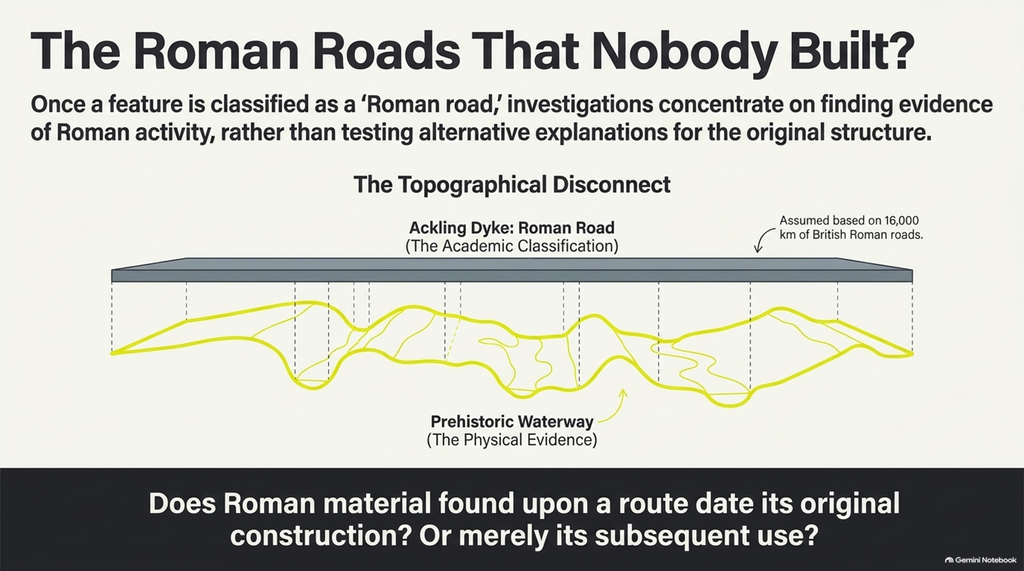
My recent investigations into Ackling Dyke offer a clear example of how inherited academic interpretations can shape the examination of physical evidence.
We are repeatedly informed that the Romans constructed approximately 16,000 kilometres of roads in Britain.
But how much of this infrastructure has been shown to have been originally constructed during the Roman occupation, rather than simply used, adapted, or resurfaced during that period?
These are fundamentally different historical propositions.
Roman occupation does not demonstrate Roman invention.
Roman material found upon a route does not necessarily date its original construction.
Yet once a feature has been classified as a Roman road, subsequent investigations may concentrate upon identifying evidence of Roman activity rather than testing competing explanations for the original structure.
My investigations between Old Sarum and Dorchester examine the surviving landscape, substantial cuttings, raised banks, gradients, river systems and the relationship between the route and prehistoric monuments.
They propose an alternative interpretation: that elements of this infrastructure may have originated as prehistoric waterways.
Whether this hypothesis is ultimately accepted should depend upon the physical and chronological evidence, not upon whether it conforms to the established archaeological classification.
The scientific question is straightforward.
Which interpretation best explains the surviving evidence?
The institutional question is rather different.
Which interpretation is most likely to be accepted by the existing academic community?
Those two questions should produce the same answer in a properly functioning scientific system.
But do they?
The Problem of Prehistoric Water Levels
My research into post-glacial flooding began with observations that appeared inconsistent with conventional interpretations of the prehistoric landscape.
Why were ancient monuments distributed at particular elevations?
Why did prehistoric earthworks frequently relate to river valleys and former watercourses?
Why were apparently water-related sediments encountered within geological boreholes at elevations that warranted further hydrological investigation?
Rather than assume the prehistoric landscape resembled the modern landscape, I developed a hypothesis to test whether inland water levels and groundwater conditions differed substantially after the last glaciation.
This hypothesis has subsequently been explored through archaeological distributions, geological boreholes, topographical analysis, LiDAR imagery and the investigation of prehistoric earthworks.
It is an alternative model that generates questions and potentially testable predictions.
Yet its implications extend beyond identifying ancient waterways.
If prehistoric hydrological conditions differed substantially from those generally reconstructed, then many of our assumptions about prehistoric settlement, transportation, agriculture, and monumental construction would require reconsideration.
This illustrates why seemingly separate academic conclusions can depend on one another.
Challenge the underlying environmental assumption, and numerous interpretations built upon it may also require examination.
Economics suffers from precisely this vulnerability. A questionable foundational assumption can propagate through an entire theoretical system, producing increasingly sophisticated conclusions without necessarily improving their relationship with reality.

Mathematical Sophistication Is Not Scientific Accuracy
Another common problem is the increasing tendency to confuse mathematical sophistication with scientific reliability.
Economics has developed extraordinarily complex mathematical models. Archaeology has similarly embraced statistical modelling, Bayesian chronology, radiocarbon calibration, computer-generated environmental reconstructions and other sophisticated analytical techniques.
These are potentially excellent scientific tools.
However, the reliability of their conclusions still depends on the quality of the data and the validity of the assumptions used in the calculations.
A computer cannot establish that an assumption is historically correct merely by calculating its consequences.
Bayesian modelling, for example, can provide a powerful method of investigating archaeological chronology. But where an archaeological sequence or other prior assumption is inadequately justified, the resulting chronology must be examined for its sensitivity to that assumption.
The mathematics might be impeccable while the historical interpretation remains questionable.
Similarly, an economic forecast can be mathematically consistent with its theoretical assumptions and still fail to describe the behaviour of the real economy.
The danger is that mathematical complexity can give an interpretation an appearance of scientific certainty that its underlying evidence does not necessarily warrant.
A more sophisticated calculation of an incorrect assumption does not make the assumption correct.

Peer Review or Peer Approval?
The modern academic system relies heavily upon peer review.
In principle, this is an entirely sensible process. Research should be examined by knowledgeable individuals who can identify methodological weaknesses, statistical errors and unsupported conclusions.
But peer review is not independent experimental verification.
It is an assessment conducted by other individuals, frequently working within the same academic discipline, educated through similar institutional processes and familiar with the same established theoretical frameworks.
This creates a potential structural weakness when research challenges those frameworks.
How readily will a discipline recognise evidence that questions the foundations upon which its existing literature has been constructed?
This does not require a conspiracy.
There need not be a secret meeting of economists or archaeologists deciding which discoveries should be permitted.
The reward system itself can encourage intellectual conservatism.
A young academic seeking employment, research funding and professional recognition must consider the consequences of producing work that challenges influential individuals or established interpretations.
Research that extends an existing theory may represent a more predictable career path than research that attempts to overturn it.
What begins as a rational professional decision for an individual can become a collective obstacle to intellectual progress.

The Citation Industry
Imagine we assessed engineers the same way universities frequently assess academics.
An engineer designs a bridge, publishes numerous papers about it, receives hundreds of citations and obtains further funding to investigate related bridge designs.
Unfortunately, the bridge collapses.
Would we regard the citations as evidence that the engineering had been successful?
Of course not.
We would investigate why the structure failed, examine the original calculations and reconsider the assumptions upon which the design was based.
The bridge’s physical performance would take precedence over the designer’s professional reputation.
Yet in disciplines where outcomes are harder to measure, academic influence can substitute for demonstrated accuracy.
A researcher may receive considerable recognition for developing a widely adopted model, even when its empirical performance remains uncertain.
This is a fundamental problem with using citations and publications to measure scientific achievement.
They primarily tell us how research circulates within the academic community.
They do not, by themselves, tell us whether it accurately describes reality.

The Independent Researcher
One advantage of independent research is the absence of some of these institutional pressures.
An independent researcher does not necessarily need approval from a university department, continued research funding, or the endorsement of senior academics to pursue an alternative hypothesis.
This freedom is particularly important when investigating subjects that cross traditional academic boundaries.
My own research into prehistoric Britain involves archaeology, geology, hydrology, engineering, mathematics, genetics, cartography and historical documentation.
The prehistoric landscape did not develop according to the departmental structures of a modern university.
Waterways do not recognise the boundary between archaeology and geology. Ancient construction does not distinguish between engineering and anthropology. Human migration cannot be adequately investigated without considering environmental conditions, chronology and genetics.
Yet academic specialisation can encourage these subjects to be investigated separately.
Independent research offers the opportunity to examine their relationships without being confined to a particular departmental interpretation.
Of course, independence does not automatically ensure accuracy. Independent researchers are equally capable of confirmation bias and methodological mistakes.
The solution is not to replace academic authority with independent authority.
It is to replace authority with demonstrable evidence.

What Should Academia Actually Reward?
If universities are genuinely intended to advance human knowledge, their reward systems should place far greater emphasis on research that can withstand independent investigation.
Academic achievement should increasingly be assessed through:
- The accuracy of testable predictions.
- The independent replication of findings.
- The transparency and accessibility of original data.
- Identifying and correcting existing errors.
- The comparison of competing hypotheses.
- Publishing negative and contradictory results.
- The willingness to revise conclusions when new evidence emerges.
In economics, this might include maintaining transparent records of forecasts and evaluating their subsequent accuracy against alternative models.
In archaeology, it could involve requiring interpretations to generate physical predictions that distinguish them from competing hypotheses.
If an earthwork is identified as a defensive structure, what specific physical evidence distinguishes it from a water-management structure?
If a route is identified as an original Roman construction, what evidence dates its initial excavation rather than its subsequent use?
If a monument is described as ceremonial, what observations would demonstrate that this interpretation was mistaken?
The ability to identify evidence that could invalidate a hypothesis is essential to scientific investigation.
Without it, interpretations risk becoming intellectually protected beliefs.

We Have Twenty-First-Century Technology and an Outdated Academic Culture
Today, independent researchers have access to scientific resources unimaginable to previous generations.
Satellite imagery, LiDAR surveys, digital geological archives, ancient DNA databases, radiocarbon datasets, geographical information systems and advanced computational tools have transformed our ability to investigate the past.
Economists similarly have access to enormous quantities of financial and behavioural data, alongside increasingly powerful analytical technologies.
The shortage is no longer necessarily information or computational power.
It is the willingness to reconsider established assumptions when that information demands it.
There is little point in applying twenty-first-century technology to an investigation if the conclusions must remain compatible with interpretations inherited from previous centuries.
New technology should provide an opportunity to test old ideas, not merely illustrate them more impressively.

Conclusion: Is Academia Becoming an Obstacle to Knowledge?
Archaeology and economics investigate very different aspects of human existence, but they face a common institutional challenge.
Both operate within an academic environment where professional recognition, publications, citations, and research funding can become disconnected from the ultimate accuracy of their conclusions.
Both can develop theoretical frameworks that become increasingly difficult to challenge as more academic work accumulates around them.
Both also show the danger of confusing the acceptance of an interpretation with its scientific verification.
The purpose of scientific investigation should not be to demonstrate that previous researchers were correct.
It should be to establish whether they were correct.
That distinction is fundamental.
We should not judge an archaeological interpretation by the number of professors who endorse it, any more than we should judge an economic theory by the number of economists who teach it.
We should judge both by their ability to explain observable evidence, survive independent examination and outperform competing explanations.
Perhaps the greatest intellectual revolution of the twenty-first century will not come from a new scientific discovery, a more powerful computer or an extraordinary technological invention.
Perhaps it will come from changing the institutional system that decides which discoveries are worthy of recognition in the first place.
Science should reward those who discover we were wrong just as much as those who show we were right.
Until academia learns to make that distinction, we may keep misunderstanding our past while repeatedly failing to anticipate our future.
Podcast

Author’s Biography
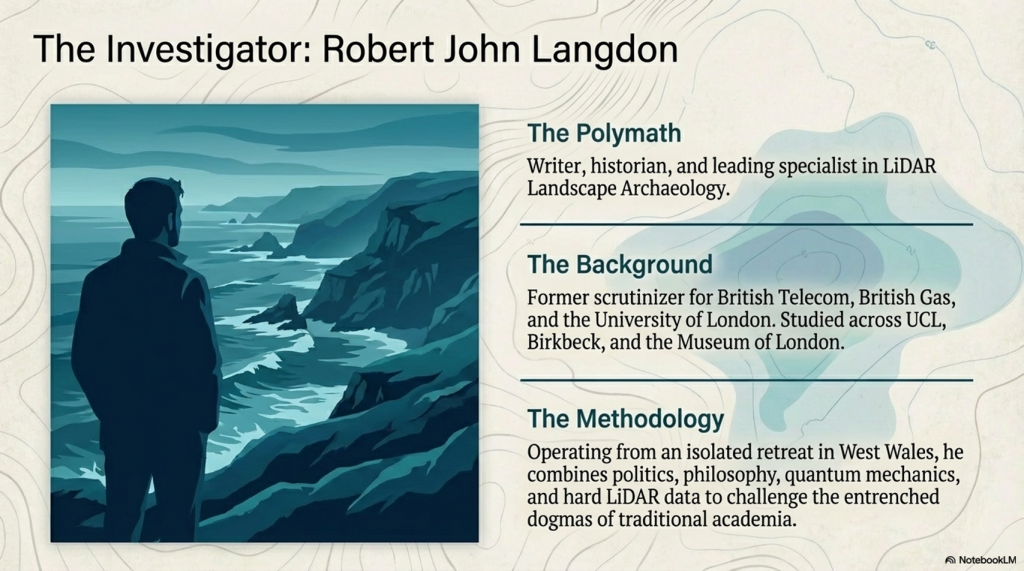
Robert John Langdon, a polymathic luminary, emerges as a writer, historian, and eminent specialist in LiDAR Landscape Archaeology.
His intellectual journey has included stints as an astute scrutineer in government and major corporate bastions, spanning British Telecommunications, Cable and Wireless, British Gas, and the esteemed University of London.
A decade hence, Robert’s transition into retirement unfurled a chapter of insatiable curiosity. He immersed himself in Politics, Archaeology, Philosophy, and the enigmatic realm of Quantum Mechanics. His academic odyssey took him through the venerable corridors of knowledge hubs such as the Museum of London, University College London, Birkbeck College, The City Literature Institute, and Chichester University.
In the symphony of his life, Robert is a custodian of three progeny and a pair of cherished grandchildren. His sanctuary lies ensconced in the embrace of West Wales, where he inhabits an isolated cottage, its windows framing a vista of the boundless sea – a retreat from the scrutinising gaze of Her Majesty’s Revenue and Customs, an amiable clandestinity in the lap of nature.
Exploring Prehistoric Britain: A Journey Through Time
My blog delves into the fascinating mysteries of prehistoric Britain, challenging conventional narratives and offering fresh perspectives grounded in cutting-edge research, particularly LiDAR technology. I invite you to explore some key areas of my research. For example, I re-examine the Wansdyke, often cited as a defensive structure, in light of new evidence. I’ve presented my findings in my blog post Wansdyke: A British Frontier Wall – ‘Debunked’, and a Wansdyke LiDAR Flyover video further visualises my conclusions.
My work also often challenges established archaeological dogma. I argue that many sites, such as Hambledon Hill, commonly identified as Iron Age hillforts, are not what they seem. My posts Lidar Investigation Hambledon Hill – NOT an ‘Iron Age Fort’ and Unmasking the “Iron Age Hillfort” Myth explore these ideas in detail and offer an alternative view. Similarly, I re-evaluated sites like Cissbury Ring and White Sheet Camp through LiDAR analysis in my posts “Lidar Investigation Cissbury Ring through time” and “Lidar Investigation White Sheet Camp,“ revealing fascinating insights into their true purpose. I have also examined South Cadbury Castle, often linked to the mythical Camelot56.
My research also extends to ancient water management, including the role of canals and other linear earthworks. I have discussed the true origins of Car Dyke in multiple posts, including Car Dyke – ABC News Podcast and Lidar Investigation Car Dyke – North Section, which suggest a Mesolithic origin 2357. I also explore the misidentification of Roman aqueducts, as seen in my posts on the Great Chesters (Roman) Aqueduct. My research has also been shaped by my post-glacial flooding hypothesis, which helps explain landscape transformations over time. I have discussed this hypothesis in several posts, including AI now supports my Post-Glacial Flooding Hypothesis and Exploring Britain’s Flooded Past: A Personal Journey
Finally, my blog also investigates prehistoric burial practices, as seen in Prehistoric Burial Practices of Britain and explores the mystery of Pillow Mounds, often mistaken for medieval rabbit warrens, but with a potential link to Bronze Age cremation in my posts: Pillow Mounds: A Bronze Age Legacy of Cremation? and The Mystery of Pillow Mounds: Are They Really Medieval Rabbit Warrens?. My research also includes astronomical insights into ancient sites, for example, in Rediscovering the Winter Solstice: The Original Winter Festival. I also review new information about Stonehenge’s construction in The Stonehenge Enigma.
Yes. I’d make this far tighter, more inviting and more obviously a gateway into the rest of your work. The present version repeats the website several times and reads more like an author biography than a “what next?” section.
I’d also make the three routes immediately obvious: Explore the Research → Watch the Videos → Read the Books, with Facebook as the discussion/community route.
Further Reading — Explore the Evidence
The investigation doesn’t end with this article.
Prehistoric Britain brings together hundreds of articles, LiDAR investigations, field discoveries, archaeological studies, and original research that explore Britain’s prehistoric landscape from a different perspective.
Follow the evidence across ancient waterways, lost landscapes, Stonehenge and Avebury, prehistoric engineering, submerged Britain, ancient DNA and the effects of post-glacial flooding — comparing established archaeological interpretations with alternative explanations suggested by the physical evidence.
🎬 Watch the Investigations
Prefer to watch rather than read?
The Robert John Langdon YouTube channel has more than 200 documentaries, investigations, and video presentations that bring the research to life through maps, LiDAR, archaeological evidence, and landscape reconstruction.
Discover investigations including 13 Things That Don’t Make Sense in History, Silbury Avenue – The Lost Stone Avenue, Stonehenge, prehistoric waterways, submerged landscapes and many more.
📚 Explore the Book Library
Go deeper into the evidence through Robert John Langdon’s growing collection of books and specialist studies, including:
- The Stonehenge Hoax – 13 Things That Don’t Make Sense in History
- Car Dyke – Prehistoric Dyke
- Wansdyke – Prehistoric Dyke
- Offa’s Dyke – Prehistoric Dyke
- Silbury Avenue – The Lost Stone Avenue
- The Vallum – At Hadrian’s Wall
- Stonehenge: The World’s First Computer
- Avebury’s Lost Stone Avenue
Many of these investigations connect directly with the evidence discussed throughout the website, allowing individual discoveries to be examined as part of the much wider prehistoric landscape.
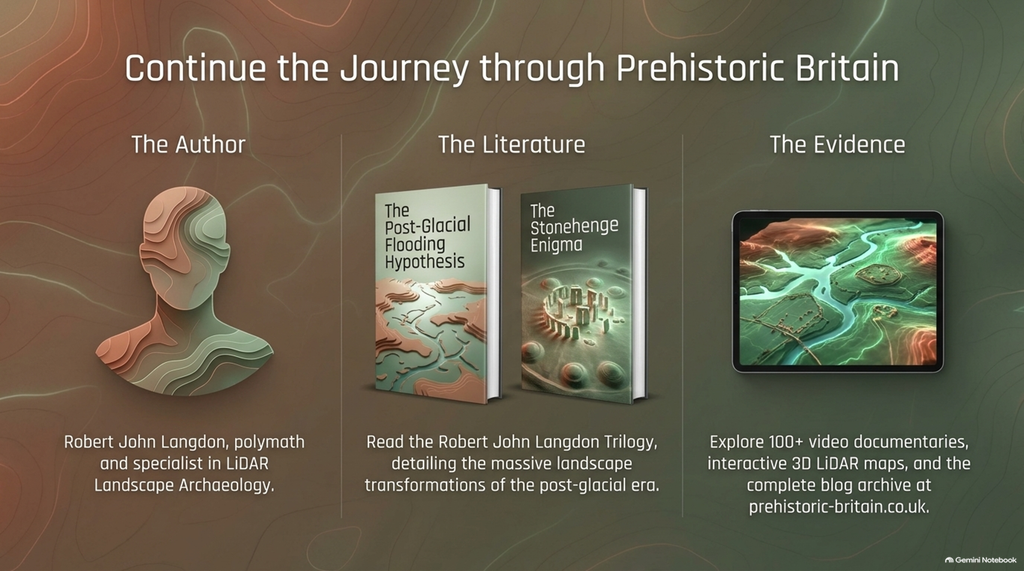
🔎 Read the Main Trilogy
Three major works bring together the central strands of the research:
The Post-Glacial Flooding Hypothesis — investigates the evidence for radically different water levels, waterways and landscapes in prehistoric Britain.
The Stonehenge Enigma — re-examines the chronology, landscape and purpose of one of the world’s most famous prehistoric monuments.
Dawn of the Lost Civilisation — explores the evidence for sophisticated communities, technology and maritime connections far earlier than traditionally assumed.
💬 Join the Investigation
New discoveries, LiDAR surveys and research are discussed as they happen in the Prehistoric Britain Facebook Group.
Join the discussion, challenge the evidence, offer alternative interpretations and follow new investigations as they develop.
Don’t just read the accepted story. Explore the evidence, compare the interpretations, and decide for yourself.
Other Blogs
1
a
- Ackling Dyke – Facts and the Archaeological Fiction
- Ackling Dyke – A Prehistoric Canal? – FREE Flipbook
- Ackling Dyke – Part II – Puddletown Forest: When a Roman Road Becomes an Assumption
- Ackling Dyke – Part III – The Roman Road Mystery Finally Makes Sense
- AI now Supports – Homo Superior
- AI now supports my Post-Glacial Flooding Hypothesis
- Alexander the Great sailed into India – where no rivers exist today
- Ancient Secrets of Althorp – debunked
- Antler Picks built Ancient Monuments – yet there is no real evidence
- Antonine Wall – Prehistoric Canals (Dykes)
- Archaeological ‘pulp fiction’ – has archaeology turned from science?
- Archaeological Pseudoscience
- Archaeology in the Post-Truth Era
- Archaeology: A Bad Science?
- Archaeology: A Harbour for Fantasists?
- Archaeology: Fact or Fiction?
- Archaeology: The Flaws of Peer Review
- Archaeology’s Bayesian Mistake: Stop Averaging the Past
- Are Raised Beaches Archaeological Pseudoscience?
- Atlantis Found: The Mathematical Proof That Plato’s Lost City Was Doggerland
- ATLANTIS: Discovery with Dan Snow Debunked
- Avebury Ditch – Avebury Phase 2
- Avebury through time
- Avebury’s great mystery revealed
- Avebury’s Lost Stone Avenue – Flipbook
b
- Battlesbury Hill – Wiltshire
- Beyond Stone and Bone: Rethinking the Megalithic Architects of Northern Europe
- BGS Prehistoric River Map
- Blackhenge: Debunking the Media misinterpretation of the Stonehenge Builders
- Brain capacity (Cro-Magnon Man)
- Britain’s Changing Funeral Traditions
- Britain’s First Road – Stonehenge Avenue
- Britain’s Giant Prehistoric Waterways
- British Roman Ports miles away from the coast
c
- Caerfai Promontory Fort – Archaeological Nonsense
- Car Dyke – ABC News PodCast
- Car Dyke – North Section
- Cardigan Bay: The Holocene Evidence the Old Geological Story Has Missed
- CASE STUDY – An Inconvenient TRUTH (Craig Rhos Y Felin)
- Case Study – River Avon
- Case Study – Woodhenge Reconstruction
- Chapter 2 – Craig Rhos-Y-Felin Debunked
- Chapter 2 – Stonehenge Phase I
- Chapter 2 – Variation of the Species
- Chapter 3 – Post Glacial Sea Levels
- Chapter 3 – Stonehenge Phase II
- Chapter 7 – Britain’s Post-Glacial Flooding
- Cissbury Ring through time
- Clement Reid, Doggerland, and the Archaeological Establishment
- Cro-Magnon Brain Capacity
- Cro-Magnon Megalithic Builders: Measurement, Biology, and the DNA
- Cro-Magnons – An Explainer
d
- Darwin’s Children – Flipbook
- Darwin’s Children – The Cro-Magnons
- Dawn of The Lost Civilisation – 1/10
- Dawn of the Lost Civilisation – Flipbook
- Dawn of the Lost Civilisation – Introduction
- Digging for Britain – Cerne Abbas
- Digging for Britain Debunked – Cerne Abbas 2
- Digging Up Britain’s Past – Debunked
- DLC Chapter 1 – The Ascent of Man
- Durrington Walls – Woodhenge through time
- Durrington Walls Revisited: Platforms, Fish Traps, and a Managed Mesolithic Landscape
- Dyke Construction – Hydrology 101
- Dykes Ditches and Earthworks
- DYKES of Britain
e
f
g
h
- Hadrian’s Wall – Military Way Hoax
- Hadrian’s Wall – the Stanegate Hoax
- Hadrian’s Wall Vallum – Prehistoric Canals – FREE Online Book
- Hadrian’s Wall LiDAR investigation
- Hambledon Hill – NOT an ‘Iron Age Fort’
- Hayling Island Lidar Maps
- Hidden Sources of Ancient Dykes: Tracing Underground Groundwater Fractals
- Historic River Avon
- Hollingsbury Camp Brighton – A Hillfort… or a Forgotten Harbour?
- Hollows, Sunken Lanes and Palaeochannels
- Homo Superior – Flipbook
- Homo Superior – History’s Giants
- How Lidar will change Archaeology
- Hydrology 101 Simplified: Why Britain’s Dykes Worked Without Rivers
i
l
m
- Maiden Castle through time
- Mathematics Meets Archaeology: Discovering the Mesolithic Origins of Car Dyke
- Mesolithic River Avon
- Mesolithic Stonehenge
- Minerals found in Prehistoric and Roman Quarries
- Mining in the Prehistoric to Roman Period
- Mount Caburn through time
- Mysteries of the Oldest Boatyard Uncovered
- Mythological Dragons – a non-existent animal that is shared by the World.
o
- Offa’s Dyke Flipbook
- Old Sarum Lidar Map
- Old Sarum Through Time…………….
- On Sunken Lands of the North Sea – Lived the World’s Greatest Civilisation.
- OSL Chronicles: Questioning Time in the Geological Tale of the Avon Valley
- Oswestry LiDAR Survey
- Oswestry through time
- Oysters in Archaeology: Nature’s Ancient Water Filters?
p
- Pillow Mounds: A Bronze Age Legacy of Cremation?
- Pinkery Canal
- Plato Was Right: The Archaeological Evidence the Academics Never Expected
- Post Glacial Flooding – Flipbook
- Prehistoric Burial Practices of Britain
- Prehistoric Canals – Wansdyke
- Prehistoric Canals – Wansdyke
- Prehistoric Canals (Dykes) – Great Chesters Aqueduct (The Vallum Pt. 4)
- Prehistoric Canals (Dykes) – Offa’s Dyke (Chepstow)
- Prehistoric Canals (Dykes) – Offa’s Dyke (LiDAR Survey)
- Prehistoric Canals (Dykes) – Offa’s Dyke Survey (End of Section A)
- Prehistoric Canals (Dykes) – Wansdyke (4)
- Prehistoric Canals Wansdyke 2
- Professor Bonkers and the mad, mad World of Archaeology
r
- Real-World Confirmation of Post-Glacial Flooding
- Rebirth in Stone: Decrypting the Winter Solstice Legacy of Stonehenge
- Rediscovering the Winter Solstice: The Original Winter Festival
- Rethinking Ancient Boundaries: The Vallum and Offa’s Dyke”
- Rethinking Ogham: Could Ireland’s Oldest Script Have Begun as a Tally System?
- Rethinking The Past: Mathematical Proof of Langdon’s Post-Glacial Flooding Hypothesis
- Revolutionising History: Car Dyke Unveiled as Prehistoric & the Launch of FusionBook 360
- Rising Evidence, Falling Rivers: The Real Story of Europe’s First Farmers
- Rivers of the Past Were Higher: A Fresh Perspective on Prehistoric Hydrology
s
- Sea Level Changes
- Section A – NY26SW
- Section B – NY25NE & NY26SE
- Section C – NY35NW
- Section D – NY35NE
- Section E – NY46SW & NY45NW
- Section F – NY46SE & NY45NE
- Section G – NY56SW
- Section H – NY56NE & NY56SE
- Section I – NY66NW
- Section J – NY66NE
- Section K – NY76NW
- Section L – NY76NE
- Section M – NY87SW & NY86NW
- Section N – NY87SE
- Section O – NY97SW & NY96NW
- Section P – NY96NE
- Section Q – NZ06NW
- Section R – NZ06NE
- Section S – NZ16NW
- Section T – NZ16NE
- Section U – NZ26NW & NZ26SW
- Section V – NZ26NE & NZ26SE
- Silbury Avenue – Avebury’s First Stone Avenue
- Silbury Hill
- Silbury Hill / Sanctuary – Avebury Phase 3
- Sky Maps of Prehistoric Britain
- Somerset Plain – Signs of Post-Glacial Flooding
- South Cadbury Castle – Camelot
- Statonbury Camp near Bath – an example of West Wansdyke
- Stone me – the druids are looking the wrong way on Solstice day
- Stone Transportation and Dumb Censorship
- Stonehenge – Monument to the Dead
- Stonehenge Hoax – Dating the Monument
- Stonehenge Hoax – Round Monument?
- Stonehenge Hoax – Summer Solstice
- Stonehenge LiDAR tour
- Stonehenge Phase 1 — Britain’s First Monument
- Stonehenge Phase I (The Stonehenge Landscape)
- Stonehenge Solved – Pythagorean maths put to use 4,000 years before he was born
- Stonehenge Through Time
- Stonehenge, Doggerland and Atlantis connection
- Stonehenge: Borehole Evidence of Post-Glacial Flooding
- Stonehenge: Discovery with Dan Snow Debunked
- Stonehenge: The World’s First Computer – FREE Book
- Stonehenge: The Worlds First Computer
- Stonehenge’s The Lost Circle Revealed – DEBUNKED
- Stonehenge’s Chronological Mirage
t
- Ten Reasons Why Car Dyke Blows Britain’s Earthwork Myths Out of the Water
- Ten Things You Didn’t Know About Britain’s Prehistoric Flooded Past
- Ten thousand year old boats found on Northern Europe’s Hillsides
- Ten thousand-year-old boats found on Northern Europe’s Hillsides
- Testing Plato’s Atlantis Against Reality
- The “Hunter-Gatherer” Myth: Why It’s Time to Bury This Outdated Term
- The Academic Illusion: Why Archaeologists Cannot Explain the Past, and Economists Cannot Predict the Future
- The Ackling Dyke Smoking Gun
- The Ancient Mariners – Flipbook
- The Ancient Mariners – Prehistoric seafarers of the Mesolithic
- The Ascent of Man — From Survival to Systems
- The Beringian Migration Myth: Why the Peopling of the Americas by Foot is Mathematically and Logistically Impossible
- The Bluestone Enigma
- The Bulford Hoax: The “Simpler, Older Stonehenge” That Wasn’t
- The Cheddar Man Hoax
- The Cro-Magnon Cover-Up: How DNA and PR Labels Erased Our Real Ancestry
- The Dolmen and Long Barrow Connection
- The Durrington Mega-Monument Hoax: What Lies Beneath? – Debunked
- The Durrington Walls Hoax – it’s not a henge?
- The Dyke Myth Collapses: Excavation and Dating Prove Britain’s Great Dykes Are Prehistoric Canals
- The First European Smelted Bronzes
- The Fury of the Past: Natural Disasters in Historical and Prehistoric Britain
- The Giant’s Graves of Cumbria
- The Giants of Prehistory: Cro-Magnon and the Ancient Monuments
- The Great Ancient DNA Illusion: How Statistical Models Became Archaeological “Facts”
- The Great Antler Pick Hoax
- The Great Bell Beaker Migration Myth
- The Great Chichester Hoax – A Bridge too far?
- The Great Dorchester Aqueduct Hoax
- The Great Farming Hoax – (Einkorn Wheat)
- The Great Farming Migration Hoax
- The Great Hadrian’s Wall Hoax
- The Great Iron Age Hill Fort Hoax
- The Great Offa’s Dyke Hoax
- The Great Prehistoric Migration Hoax
- THE GREAT ROMAN ROAD HOAX
- THE GREAT ROMAN ROAD MAP MYTH
- The Great Stone Transportation Hoax
- The Great Stonehenge Hoax
- The Great Wansdyke Hoax
- THE GREAT WEST WOODS HOAX — WHEN ONE STONE BECOMES FIFTY
- The Henge and River Relationship
- The Logistical Impossibility of Defending Maiden Castle
- The Long Barrow and Dolmen Enigma
- The Long Barrow Mystery
- The Long Barrow Mystery: Unravelling Ancient Connections
- The Lost Island of Avalon – revealed
- The Maiden Way Hoax – A Closer Look at an Ancient Road’s Hidden History
- The Maths – LGM total ice volume
- The Mystery of Pillow Mounds: Are They Really Medieval Rabbit Warrens?
- THE ODYSSEY PROBLEM: WHY DID A WEEK-LONG VOYAGE BECOME A TEN-YEAR EPIC?
- The Old Sarum Hoax
- The Oldest Boat Yard in the World found in Wales
- The Perils of Paradigm Shifts: Why Unconventional Hypotheses Get Branded as Pseudoscience
- The Post-Glacial Flooding Hypothesis – 1/11
- The Post-Glacial Flooding Hypothesis – Flipbook
- The Post-Glacial Flooding Theory
- The Problem with Hadrian’s Vallum
- The Rise of the Cro-Magnon (Homo Superior)
- The Roman Military Way Hoax
- The Silbury Hill Lighthouse?
- The Stone Money – Credit System
- The Stonehenge Avenue
- The Stonehenge Avenue
- The Stonehenge Code: Unveiling its 10,000-Year-Old Secret
- The Stonehenge Crescent: A Monument to a Lost World
- The Stonehenge Enigma – Flipbook
- The Stonehenge Enigma: Part 1/6
- The Stonehenge Hoax – Bluestone Quarry Site
- The Stonehenge Hoax – Flipbook
- The Stonehenge Hoax – Moving the Bluestones
- The Stonehenge Hoax – Periglacial Stripes
- The Stonehenge Hoax – Station Stones
- The Stonehenge Hoax – Stonehenge’s Location
- The Stonehenge Hoax – The Ditch
- The Stonehenge Hoax – The Slaughter Stone
- The Stonehenge Hoax – The Stonehenge Layer
- The Stonehenge Hoax – Totem Poles
- The Stonehenge Hoax – Woodhenge
- The Stonehenge Hospital
- The Stonehenge Transportation Mystery
- The Storegga Tsunami: How a Real Geological Event Became a Myth of Britain’s Destruction
- The Subtropical Britain Hoax
- The Troy, Hyperborea and Atlantis Connection
- The Vallum @ Hadrian’s Wall – it’s Prehistoric!
- The Vallum at Hadrian’s Wall (Summary)
- The Woodhenge Hoax
- Thirty Years of CAU Archaeology Going Nowhere?
- Three Dykes – Kidland Forest
- Thurnam’s 137 Skulls: The Forgotten People Behind Britain’s Megaliths.
- Top Ten Misidentified Fire Beacons in British History
- Troy Debunked – Troy did not exist in Asia Minor, but in fact, the North Sea island of Doggerland
- TSE – DVD Barrows
- TSE DVD – An Inconvenient Truth
- TSE DVD – Antler Picks
- TSE DVD – Avebury
- TSE DVD – Durrington Walls & Woodhenge
- TSE DVD – Dykes
- TSE DVD – Epilogue
- TSE DVD – Stonehenge Phase I
- TSE DVD – Stonehenge Phase II
- TSE DVD – The Post-Glacial Hypothesis
- TSE DVD Introduction
- TSE DVD Old Sarum
- Twigs, Charcoal, and the Death of the Saxon Dyke Myth
w
- Wansdyke – Short Film
- Wansdyke East – Prehistoric Canals
- Wansdyke Flipbook
- Wansdyke LiDAR Flyover
- Wansdyke: A British Frontier Wall – ‘Debunked’
- Was Columbus the first European to reach America?
- What Archaeology Missed Beneath Stonehenge
- White Sheet Camp
- Why a Simple Fence Beats a Massive Dyke (and What That Means for History)
- Windmill Hill – Avebury Phase 1
- Winter Solstice – Science, Propaganda and Indoctrination
- Woodhenge – the World’s First Lighthouse?